Friday Focal Mechanisms: South Australian shaking keeps Chris guessing

A post by Chris RowanRather annoyingly, I’ve actually been unable to find a focal mechanism for the magnitude 5.2 earthquake that shook the state of Victoria in southeast Australia on Tuesday. Although there were no reports of major damage, the relatively shallow depth of the rupture meant that people over a wide area felt the shaking, including a friend of mine who lives in Melbourne.
[blackbirdpie url=”http://twitter.com/syntype/status/215434334683926528″]
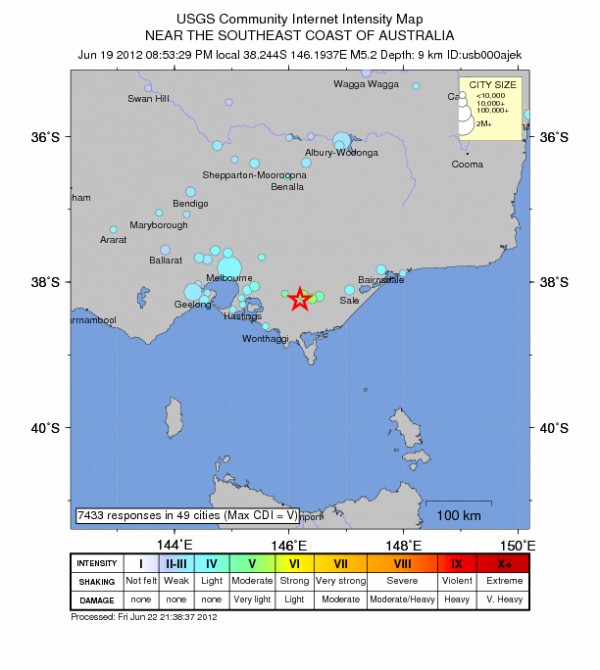
Source: USGS

What makes things even more tricky is the fact that this was an interplate earthquake, occurring far from any active plate boundary. Rather than being caused by deformation between two tectonic plates that are moving around the planet at different speeds and in different directions to each other, it was the result of deformation within the Australian plate itself. When an earthquake occurs at or near a plate boundary, since we know how the two plates are moving relative to each other, we can at least make a reasonable guess as to whether it is caused by compression or extension, and even what direction that compression or extension is occurring in. In contrast, interplate earthquakes are driven by forces that are more distant, and more subtle, and happen on old, reactivated faults that were formed in a tectonic episode that is now long finished. All this makes it hard to make even a marginally educated guess as to what sort of focal mechanism we might expect.

Fortunately, earthquakes also rarely occur in complete isolation, and I managed to dig up this report from Geoscience Australia that lists all known Australian earthquakes for which focal mechanisms have been determined (the fact that you can actually do this without producing a telephone directory tells you something about how seismically active Australia…isn’t). This list contained three moderately large (body wave magnitudes of 4.7-5.0) earthquakes in the same area as Tuesday’s event, which I’ve plotted together with their listed focal mechanisms in the figure below:
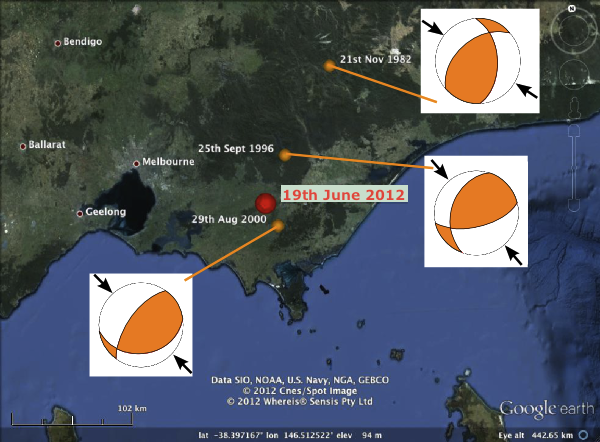
Locations and focal mechanisms of significant earthquakes in Victoria in the past 20 years (orange dots), compared to location of the M 5.2 earthquake on 19th June 2012 (red dot)

As you can see, these focal mechanisms (as well as two smaller aftershocks of the August 2000 event, which I didn’t plot) rather consistently show northwest-southeast compression on northeast-southwest oriented faults. This consistency suggests there might be a uniform regional stress field acting on the crust in this region – and that there are a number of old faults with similar (NE-SW) trends being reactivated in response to this stress. Based on this, suggesting that Tuesday’s earthquake was similar to these other three seems like a reasonable hypothesis. And whilst we’re guessing, I’d guess the dominance of northeast-southwest trending faults in this area may be due to it being at the southern end of the Great Dividing Range, a series of mountain belts that runs along the entire east coast of Australia; their formation would have produced lots of thrust faults in this orientation.

Of course, I could easily be wrong; if and when someone produces a focal mechanism, I’ll let you know.
Categories: earthquakes, focal mechanisms, tectonics

Drawing sharp boundaries in a fuzzy world

A post by Chris RowanHumans are natural splitters. We have an innate tendency to look at the world and mentally sort everything into different categories, and grades, and entities: this is one thing, that is another; it was this, now it’s that. Our perception of colour is a good example of how our brains automatically split a continuum into discrete boxes.

We’ve incorporated our love of classification deep into science, trying to formalise and quantify the dividing lines we want to draw on everything: it’s this when conditions A and B are met, it’s that when we see Y and Z. But nature doesn’t often make it easy for us to draw our sharp dividing lines. We can exactly define state A and state B, but when something is gradually changing from one state to the other, when does it stop being A and start being B? We end up drawing our dividing line in the middle of the transition, even though there are signs of change before this line, and change continues on after it. In other words, the boundaries that we draw are almost always a little arbitrary, leading to uncertainty – and often disagreement – about where they should fall. The eternal debate over the best way to define a species is a prominent example of the problems that can arise when we try to draw sharp boundaries across fuzzy transitions that have depth, or width, or duration. In geology, the geological timescale is an entirely human contrivance, with the boundaries of periods and epochs delineating shifts in the state of the planet that might have taken hundreds of thousands or even millions of years.

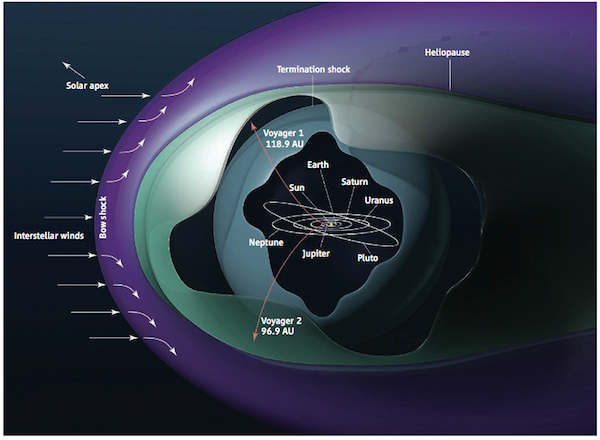
A more topical boundary problem is provided by Voyager 1’s imminent entry into true interstellar space – the first manmade object to do so. I love that scientists are excitedly poring over data sent by a 35 year-old space probe, working far beyond its imagined operating lifetime. But it’s also clear from those data that the heliopause – the boundary between the sphere of the sun’s influence and the stuff outside – is one of those fuzzy boundaries writ large. One indicator being tracked by Voyager’s detectors, low energy cosmic ray particles that are generally unable to penetrate the heliopause, is spiking, possibly indicating the boundary is near. But two other important parameters – the level of lower energy particles produced by the sun (which can’t escape the other way across the heliopause), and magnetic field strength – are not yet changing as we’d expect. It seems that as we speak, Voyager 1 is now located somewhere between ‘definitely in the solar system’ and ‘definitely in interstellar space’.

Voyager at the heliopause

Voyager's location at the boundary between solar and interstellar space. Source: NASA/JPL

One of the issues is that because this is the first time we’ve crossed this particular boundary, we don’t know exactly what a transition looks like (we don’t know exactly what it looks like on the other side, either, which is why this is so exciting). It is often the case that until a boundary is crossed at least once, you can only tell when you actually crossed it in hindsight; then you can see the whole sequence of events and measurements that accompanied the transition, and define a boundary amidst them.

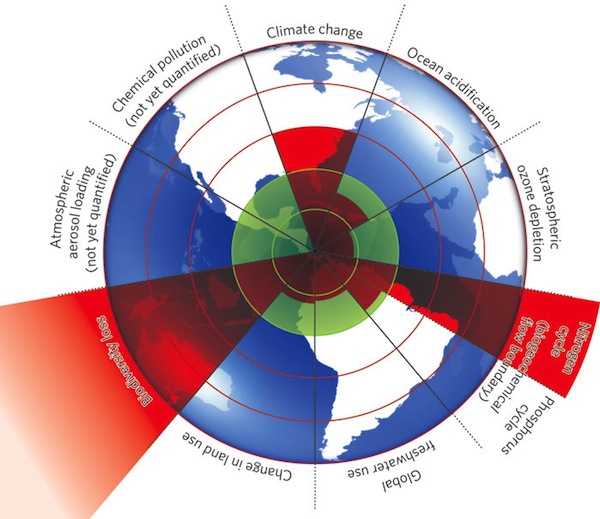
But what if you’re trying to define a boundary that you dont want to cross? Such is the case for the ‘Planetary Boundaries’ that attempt to attempt to define exactly how far we can push the planet’s ecosystems, atmosphere and hydrosphere without triggering irreversible changes.

Planetary Boundaries

The 'planetary boundary' concept attempts to quantify the resilience of the Earth's natural systems to human-driven change. Source: Rockstrom et al., 2009.

It seems that some people think the planetary boundary lines above have been drawn in the wrong place, or can’t be drawn at all. Nonetheless, given that our civilisation is rather finely tuned to the fairly narrow climatic range that we have enjoyed for the past 10,000 years or so, identifying any such critical thresholds is important – especially since we seem as hell bent on pushing beyond these boundaries as Voyager is on crossing the heliopause. Unfortunately, in the case of our complex, feedback-infested planet, not only are we unsure what exactly lies on the other side of any approaching boundaries, but monitoring our passage is also a much more difficult venture.

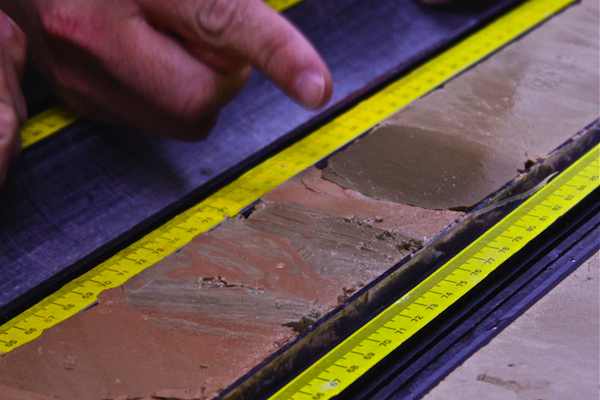
In theory, we geologists can provide a lot of help with identifying planetary thresholds: studying the progression of past, naturally driven climatic changes can give us valuable clues as to where the point of no return might be for the present, human driven one. An event of particular interest is the Paleocene-Eocene Thermal Maximum (PETM), an abrupt 5-6° C warming of the planet around 55 million years ago, which appears to have been caused by a massive fluctuation in the planetary carbon cycle. Last week we got treated to core drilled right through the PETM, pulled up from beneath the seafloor off of Newfoundland by the research drilling ship the Joides Resolution.

PETM core photo

An oceanic sediment core containing the PETM boundary (the transition from red and grey to brown sediments, as pointed out by a helpful IOPD finger). Source: Joides Resolution Blog.

Here, at least, is a boundary that is easy to point at – an abrupt darkening in the colour of the sediment that marks where the warming killed off phytoplankton in the surface oceans, and shut off the steady rain of biologically produced carbonate onto the ocean floor. But ironically, in this case we might be faced with a boundary that is too sharp for its own good. The warming at the PETM took of the order of 10 to 20 thousand years, but Deep Time has taken this originally fuzzy boundary and squashed it into a few centimetres of core. Whilst this has made it easy to locate, it also means that information about how the transition actually occurred has been highly compressed, or even lost entirely. This is a recurring problem when you mix (relatively) rapid events with the geological record: in my own field of paleomagnetism, we have a similar problem when trying to find good records of magnetic field reversals.

So that’s the problem with drawing boundaries in science: more often than not, they’re either informative, and tricky to define; or easy to spot, and difficult to understand.

Categories: general science, geology

What do you mean, the Gulf Stream doesn’t keep Europe warmer than North America? How even scientists are afflicted by urban myths

A post by Chris RowanIn science, you discover that you’re wrong at least as often as you’re proven right – and the things that you end up being wrong about can be quite surprising. Prior to last week, if asked I would have confidently confirmed that the reason the UK does not have a polar bear problem, despite being located at the same latitude as Hudson Bay, is the heat supplied by warm water transported into the northwest Atlantic from the Gulf of Mexico by the Gulf Stream. But then, courtesy of Kevin Anchukaitis, known on Twitter as thirstygecko (and someone you really should follow if you’re interested in things paleoclimatic), I found out that this is not the case at all.
Continue reading

Categories: academic life, climate science

A mountain (meta)geologist

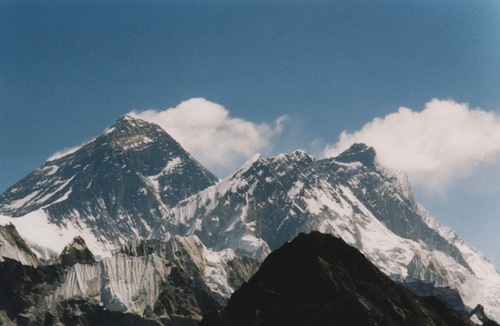
A post by Chris RowanAs you might have noticed, my blogging has been a little thin on the ground recently, which means I have been remiss in pointing you to some sterling posts from fellow All-geo blogger Simon Wellings, who is writing a whole series exploring the geology of mountains, with a focus on the Himalayas and the Tibetan plateau. As he explains, plate tectonics is often not a good model for deformation on continents, and of the many models that have been suggested and processes that have been proposed to explain how it all works, perhaps the most mind-bending is “channel flow“, where the middle regions of the crust are warmed and weakened as a plate thickens during an orogeny, then squeezed out sideways into neighbouring regions like toothpaste. As Simon’s most recent post explains, this process appears to have occurred beneath the Tibetan Plateau: driven by rapid erosion at the surface, channel flow has transported deeply buried rocks 200 km sideways and 20 km upwards to be exposed in the Himalayas. The peak of Everest may be stupendously uplifted marine carbonates, but the rocks that make up the slopes beneath have been on an even more extreme tectonic adventure. The Geology of Mount Everest comes complete with many fabulous photos taken by the author himself; the fact that Simon was in a position to do so makes me swoon with jealousy. Check it out.

Ooh. Click image for more pretty mountains, courtesy of Simon Wellings.

Categories: geology, links, structures, tectonics

Scenic Saturday: a pilgrimage back to the grand granitic tors of Dartmoor

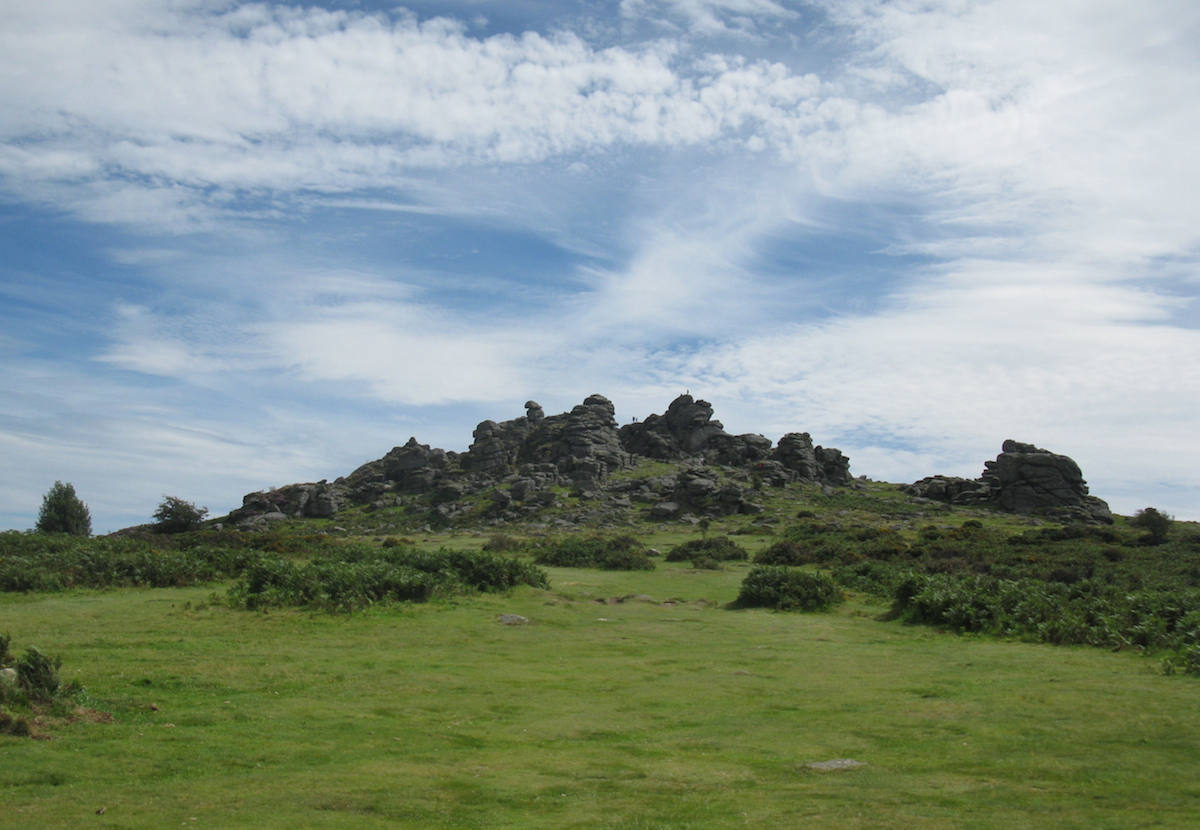
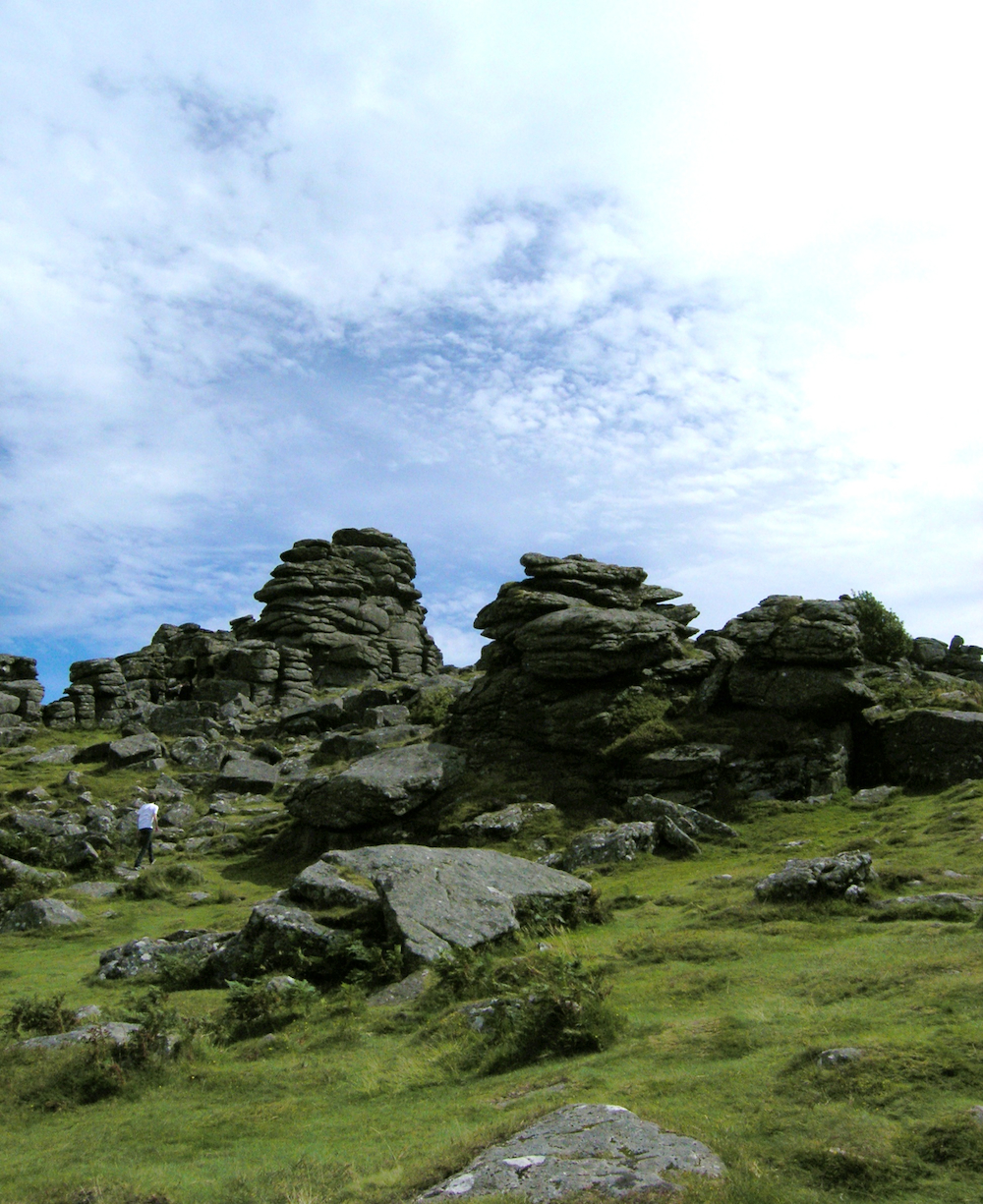
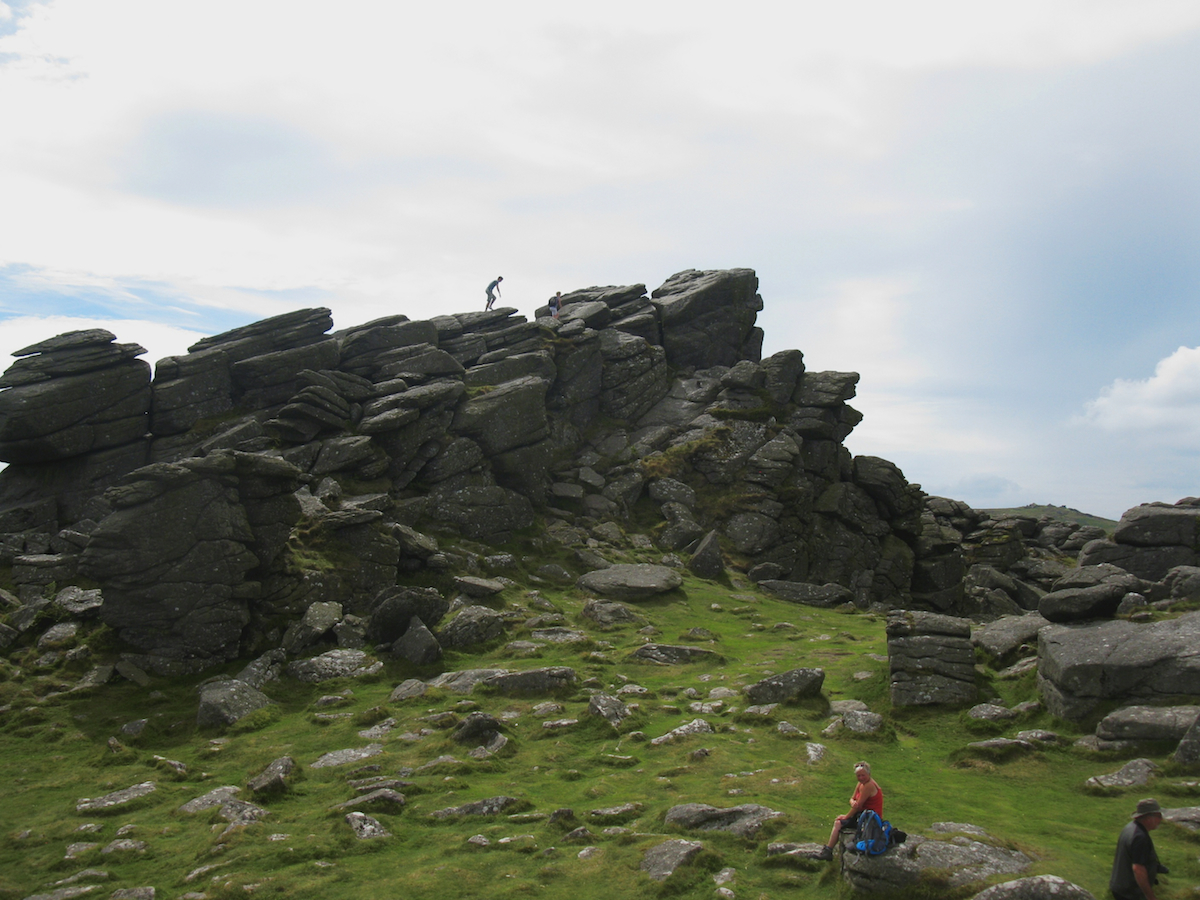
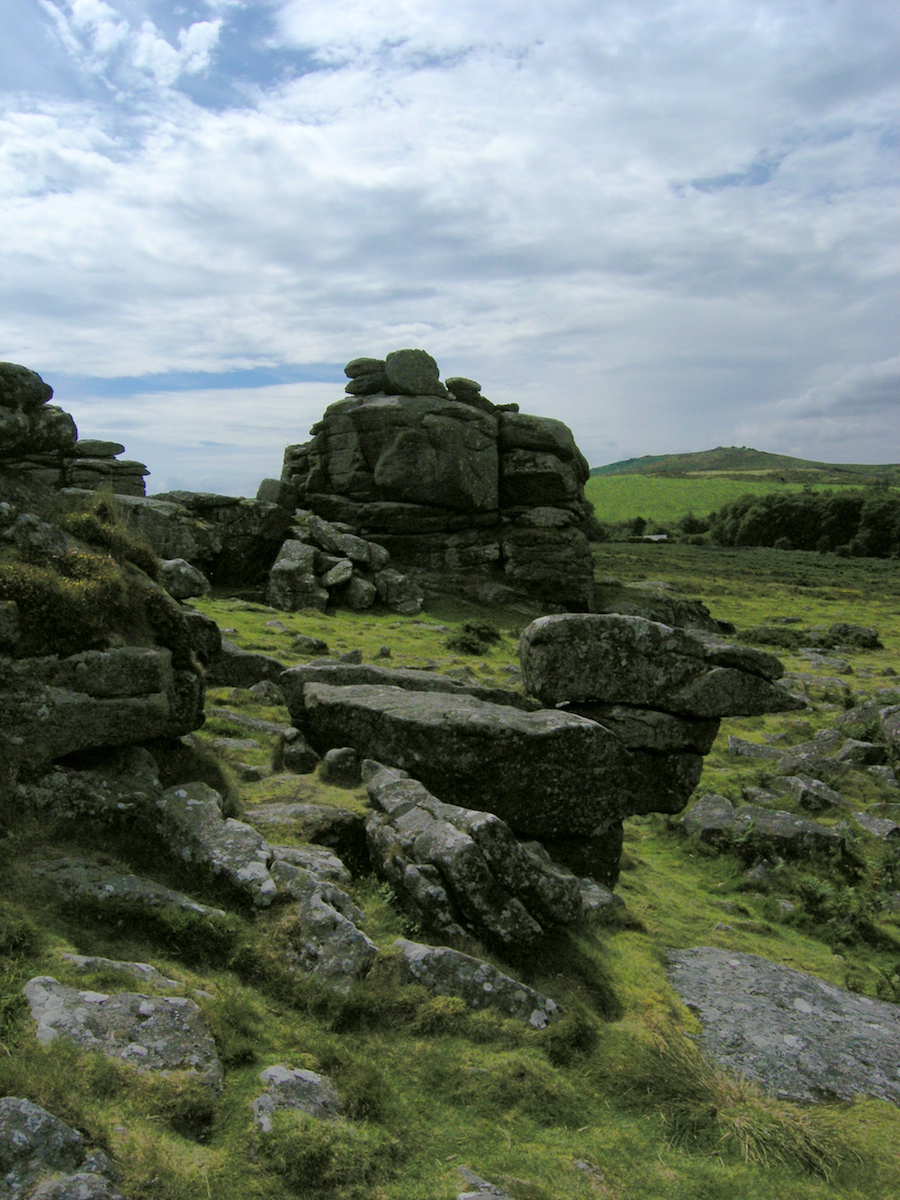
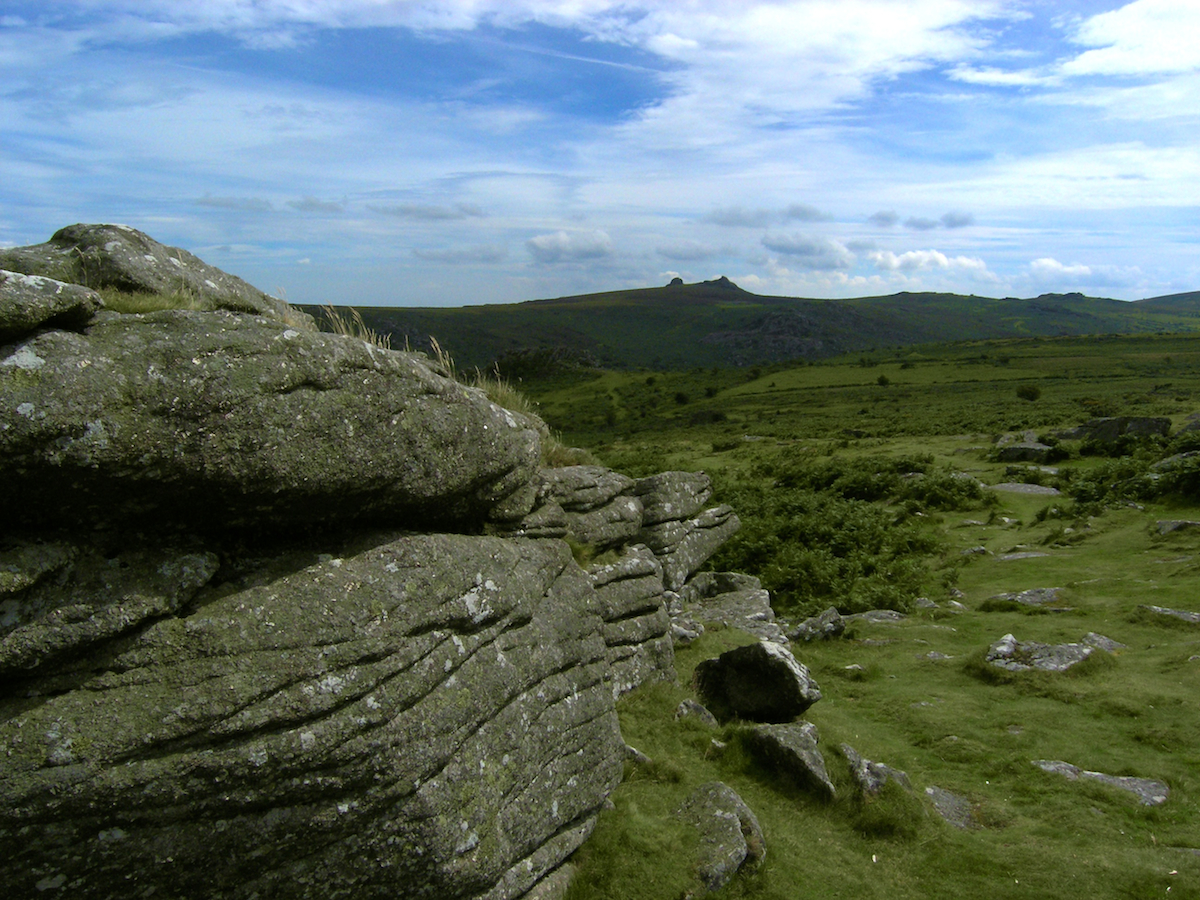
A post by Chris RowanThe high and rugged scenery of Dartmoor is as wild and untamed a landscape as you’re likely to find in the United Kingdom, and would seem to have more in common with the Scottish Highlands than the prim and proper south of England. Yet not an hour’s drive from the crowded beaches of the ‘English Riviera’*, you can find yourself in a stark, windswept landscape dominated by the tors: granite-topped hills that could easily be mistaken for ruined castles, but are instead the product of millions of years of weathering.

Hound Tor, Dartmoor. Click to enlarge. Photo: Chris Rowan, 2011.

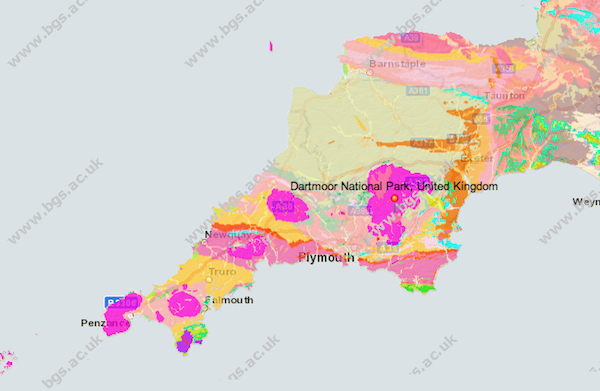
Around 300 million years ago, the Variscan orogeny, the collision between Gondwana (Africa and South America) and Laurussia (North America, Northwest Europe and the UK) that marked the final assembly of the supercontinent Pangea, produced the wickedly folded and metamorphosed rocks that can be found on the coasts of Cornwall, Devon, and South Wales, and thickened the crust enough to cause the lower reaches to melt. This produced a large granite intrusion – a batholith – that runs down the buried spine of Devon and Cornwall all the way down to Lands End. In various places, it pokes above the surface, the largest of these outcrops being Dartmoor.

Geological Map of SW England

Geological Map of SW England. Granites are garish pink. Source: BGS (click image to go to their online map viewer).

I first visited Dartmoor when I was around 6 or 7, and I remember being fascinated by the tors, which were looming and mysterious and great for causing my mother minor heart attacks as I clambered around them in a death-defying manner. As someone who grew up on the flat coastal plains of East Anglia, this was probably one of the first times that I realised that landscapes could be interesting. Thus was born a life-long love affair with pointy places and the interesting rocks you find there. Last summer, 25 years or so later, it was great fun to revisit the tors and look at them as the geologist that they helped inspire me to eventually become. And find some rather impressively large feldspars whilst I was at it.

Larger versions of all these images can be seen by clicking on them.

Hound Tor, Dartmoor

Photo: Chris Rowan, 2011.

Hound Tor, Dartmoor

Photo: Chris Rowan, 2011.

Hound Tor, Dartmoor

Photo: Chris Rowan, 2011.

Hound Tor, Dartmoor

Photo: Chris Rowan, 2011.

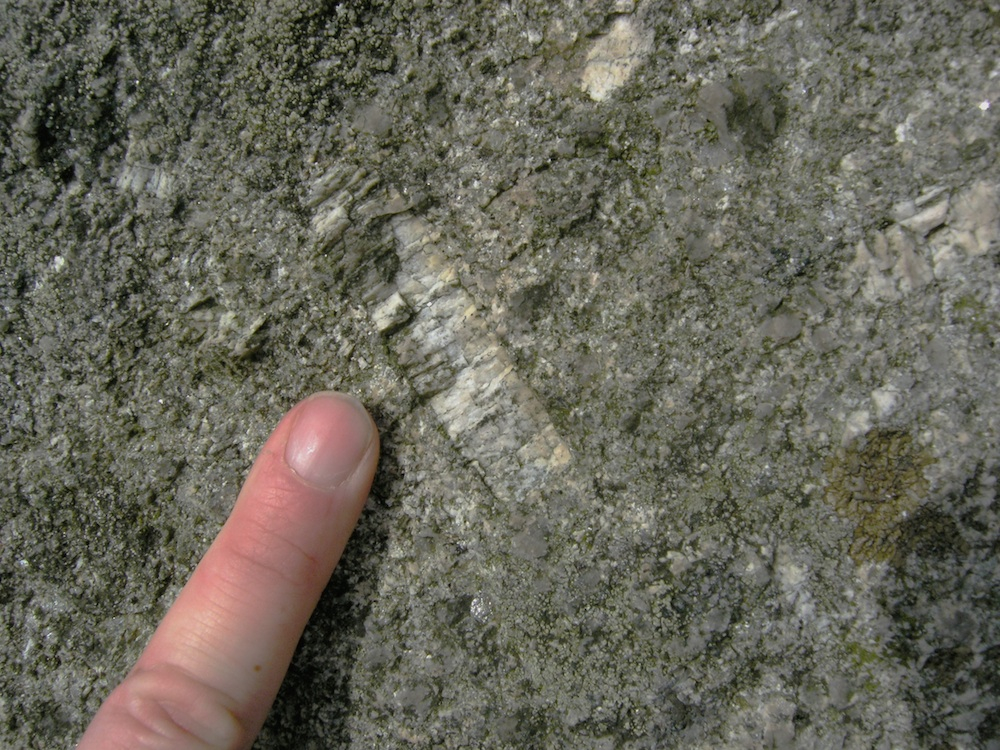
Plagioclase in granite, Dartmoor

A large plagioclase phenocryst visible in the weathered and lichen encrusted granite of Dartmoor. Photo: Chris Rowan, 2011.

*Not an ironic designation, as far as I can tell. Because hey, it doesn’t rain all the time…

Categories: geomorphology, outcrops, Palaeozoic, photos, rocks & minerals