One Venus transit – but many kinds of scientific outreach

A post by Chris RowanOn Tuesday afternoon, I took the bus to downtown Chicago and walked out to the prime piece of lakeshore real estate that is occupied by the Adler Planetarium. This was hardly the epic journey that some of my British forebears undertook to see Venus transit across the Sun, but I was still keen to personally observe the event through a telescope. As it turned out, I wasn’t the only one to have this idea:
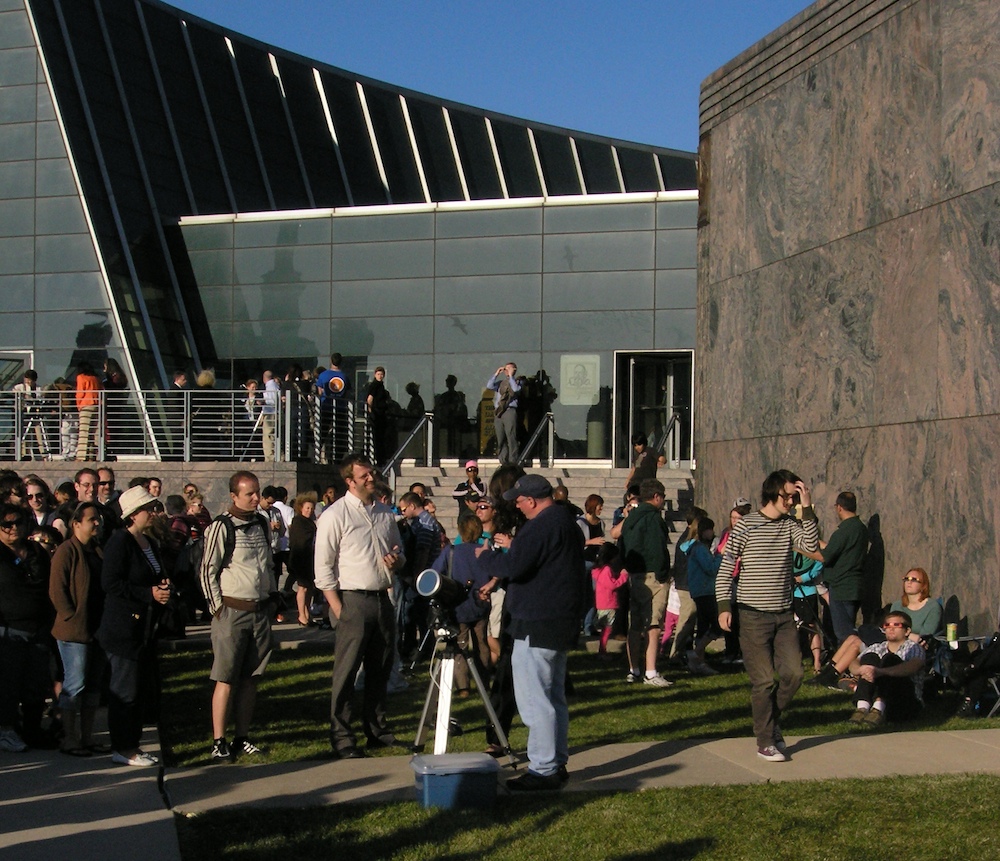
Queuing to observe the Venus Transit at the Adler Planetarium, 5 June 2012. Photo: Chris Rowan 2012.
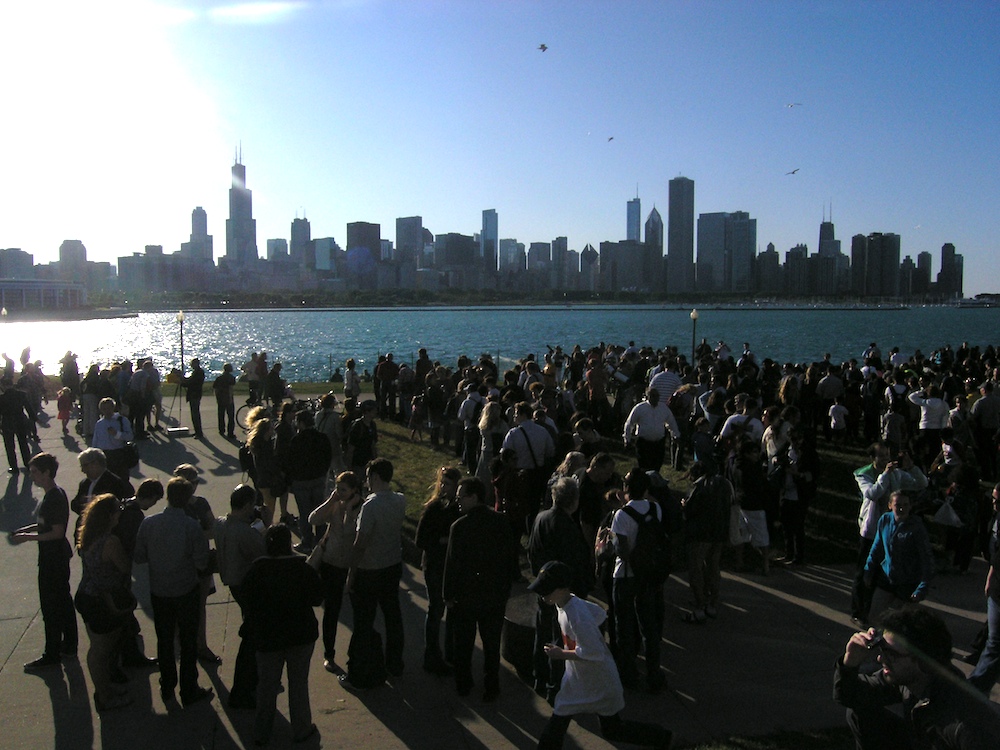
Venus transit party, with Chicago as a backdrop. Photo: Chris Rowan 2012.

After a wander through the planetarium itself, I joined the queues outside and eventually got my 20 seconds of peering through an eyepiece at the sun, seeing both the black dot of Venus itself and an impressive constellation of sunspots. Mission accomplished, and not just for me: the Adler itself had done more than stick a few telescopes on its lawn, with lots of other scientific and historical information on display, and incorporated into their planetarium shows. One of the coolest things that I learnt was that observations being taken during this transit will help us to characterise the atmospheres of exoplanets as they transit their parent stars (which is how the likes of Kepler actually spot them in the first place); because we know the composition of Venus’ atmosphere very well, it provides a useful calibration point (as this article explains). All this was clearly a pretty successful exercise in scientific outreach: lots of people turned up to see the transit, and the atmosphere was one of excitement and fascination.

The sun set behind the skyscrapers of downtown Chicago long before the transit was over, so I headed back home, fired up my web browser and pointed it to NASA’s livestream from the Keck Observatory on Hawaii. As the screen capture below shows, I joined more than 86,000 people in doing so – possibly many more before the transit was over – and whilst it may have lacked the more visceral experience I got from actually peering through a telescope lens, it more than made up for this by there being no queue of people behind me waiting to take their turn and pressuring me to cut short my ogling. Clearly, with lots of viewers and lots of interaction the astronomers providing commentary on the livestream, who were having a great time answering a never-ending stream of questions, NASA’s online streaming was another outreach success.
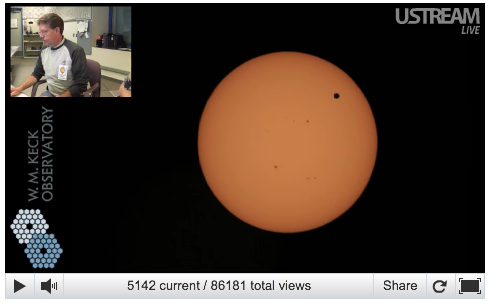
The NASA livestream of the Venus transit from the Keck Observatory

But the transit experience didn’t end there: in the last couple of days, I’ve continued to be supplied with stunning imagery via blogs and Twitter. I think my favorite was this video of the first moments of the transit, where Venus’ atmosphere is clearly lit up by the sun’s glow before it fully entered the suns disc.

The penumbra of tweets, blogs and videos around this event clearly augmented the experience for many people. Before the transit, it told people it was happening and why it was important and rare, and told them where they could go to observe it; during and after the transit it was the means of sharing a constant stream of gorgeous pictures and videos (particularly from NASA’s various outlets). Not only was all this activity successful scientific outreach in itself, but by widely promoting the other events I’ve been talking about, it undoubtedly boosted their own success.

In a week when the question of why scientists in academia don’t do more outreach, and how hard it is to get professional credit if we try (see some excellent posts from SciCurious, Kate Clancy, and Cedar Riener), has once more reared its head, I think this last point is worth pondering. Of course, outreach is a much more prominent part of the remit of organisations like NASA and the Adler planetarium, which means that some of the pressures that inhibit scientists who work at research universities are less stifling. But this use of blogs and social media to augment more approved forms of outreach might help to convince our still-skeptical peers and superiors that all this internet stuff is not a complete waste of our time. This doesn’t always have to be the case, of course, but the prospect of adding value to forms of outreach that are more accepted – things like open days and public lectures – might be a helpful lever.

Categories: planets, public science

Bringing the stream to the people

With the help of four students and my daughter, we brought out the Emriver stream table and a groundwater model to teach hundreds of folks about urban hydrology, stormwater management, fluvial geomorphology, and groundwater pollution. Our booth was one of dozens on the UNCC campus for 3 hours on Sunday afternoon April 29. I’d guess that well over 1000 people visited the expo. This event was part of the NC Science Festival and was a huge success. I hope this becomes an annual event for UNCC.

If you click through to the Flickr set, you can read slightly more informative captions about each picture.

Categories: by Anne, geomorphology, public science

Hope Jahren, isotope detective

A post by Anne Jefferson The waning days of the academic year seem like an apt time to recognize the mentors who have had an important influences on my careers. I could wax lyrical about my Ph.D. advisor, but he reads the blog and I’ll save him the embarrassment (for now). And I’ve already written about some of my memories of Reds Wolman, who was a huge influence on my and the whole field of geomorphology. Today, I’d like to introduce another key figure in my education. Even better, you’ll get to meet her in her own words.

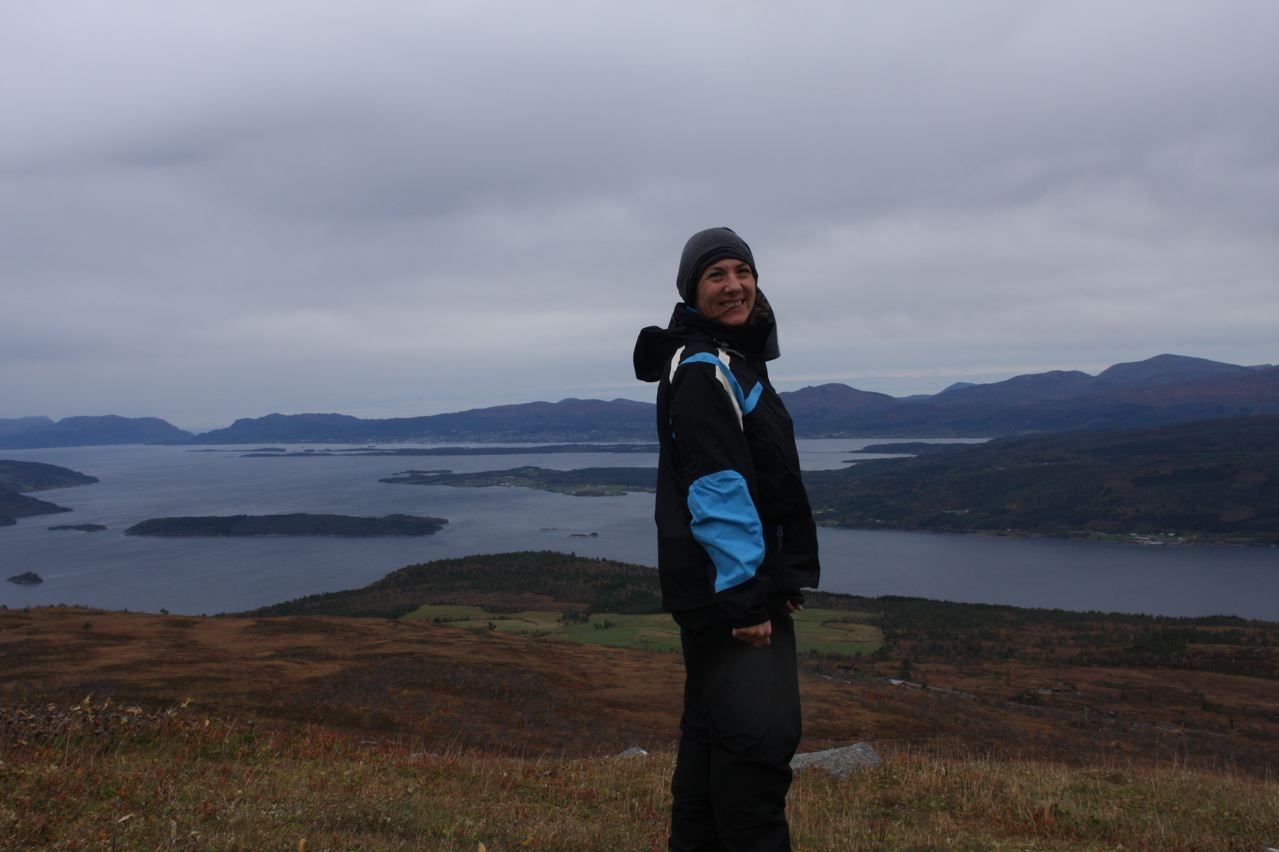
Photo of Hope Jahren near Andalsnes, Norway. Photo provided by Jahren and used with permission.

Hope Jahren near Andalsnes, Norway, one of her favorite places.

Hope Jahren is a Professor in the School of Ocean and Earth Science and Technology at the University of Hawaii at Manoa. She uses stable isotopes to understand how organisms are linked to their environment, both in modern times and in the fossil record. Her work has taken her all over the world, from the fossil forests of the High Arctic to the fast food restaurants of the American midwest. Like me, Hope is a native Minnesotan. She earned a PhD in Soil Science at Berkeley, and then held positions at Georgia Tech and Johns Hopkins (where I met her), before moving to Hawaii in 2008. Along the way she has held several Fulbrights, earned both the GSA and AGU young scientist medals and been named one of Popular Science’s “Brilliant 10.” She’s also currently the editor of GSA Bulletin, a recent Leopold fellow, and a fun voice on Twitter. I had the privilege to work with hope on my undergraduate thesis on soil water isotopes and again as an MS student, when she sent me to the fossil forests of Ellesmere Island. Recently, I emailed her to pick her brain on research, teaching, and how she got to be the fantastic scientist I know and love. Here’s our exchange:

Anne: You were the person who introduced me to the amazing world of stable isotopes, when I worked on my senior thesis with you. That thesis was on soil water isotopes in the western US. I went on use stable isotopes of water in my MS and PhD research, and now they are a core analytical technique for me. Thanks for that! So I’m wondering, what got you into isotopes?

Hope: My Ph.D. thesis explored the use of terrestrial plant carbonate — a biomineralized seed — to reconstruct paleoclimate. Some of the fundamental studies on past climate (e.g., reconstruction of the ice ages) had relied upon stable isotope measurements of marine fossil carbonates — we were hoping to do something similar with terrestrial fossils. However, as I got deeper into the project, we realized that plant physiology was exerting a great deal of control over the system … in this way, I got interested in studying how plants work, and how photosynthesis may have worked in the past.

I’ve got a new-fangled cavity ringdown spectrometer (CRDS) for analyzing water isotopes, and it is so much cheaper and easier to use than a traditional mass spectrometer. But I’m also limited to a just hydrogen and oxygen in water, unlike the versatility of a mass spec, so that’s a big downside. Do you care to say what you think the future of stable isotope spectrometry will be? Will the CRDS systems displace the old-school mass spec or am I buying into a passing fad?

I’ve never been much of a hipster instrumentalist, I’m much more interested in talking about data. I think that any method that yields quality measurements is a bonus to the field. Since I started in isotopes, many measurements that we used to do one by one “offline” are now run using automated online accessory instrumentation. This has resulted in many more data points being produced each year, but still fundamentally relies on smart people to generate and test hypotheses.

I also owe you a huge heap of thanks for sending me to Ellesmere Island for my MS research on spectacularly preserved Paleocene-Eocene fossilized forests. You went to the High Arctic for several field seasons, and I know you’ve also done field work in China. Has your science taken you to other exotic locales? Any particular favorites?

I have had the fortune to visit many places in the course of my research, including Japan, Colombia, Brazil and Ireland … as well as many places in the US. My favorite place to work is in Norway, where I spent 2010-2011. There I had the fortune to work with foresters, who are doing fascinating experiments looking at the effects of climate change on the ways in which spruce trees integrate developmental stimuli.

Your “geobiology” class also introduced me to nutrient cycles, soils, and the unforgettable concept of soil forming factors and sequences. I still have my copy of Jenny’s 1944 “Factors of Soil Formation” and I use the concept of chrono- and climo-sequences to understand the evolution of volcanic landscapes. Do you have a favorite soil somewhere in the world?

There’s an ultisol in Coweta county, south of Atlanta that is just stunning. I saw it from the car window in 1996 and have exposed it several times since then. I used to take my courses there several times a year when I was a professor at Georgia Tech.

You said on Twitter that you don’t really consider yourself a teacher, but you definitely had a lasting influence on me, both through your classroom teaching and your research mentorship. I’m sure I’m not the only student you’ve reached. What do you think makes someone a good teacher or mentor?

I don’t think of myself as a teacher in the traditional sense, because I am suspicious of the idea that research (my main interest) can be taught. What I try to do is provide an opportunity, and try to pull a student towards success. However, the student has to decide how much they push themselves in order to make something of that opportunity. I have provided a huge number of opportunities to do research over the years, to undergraduates, to grad students and to post-docs. Occasionally someone really special makes great use of the possibilities offered and succeeds, and I feel lucky to be able to facilitate that success.

When I was an undergraduate, you were early in your career. Now you’re mid-career, are spectacularly successful at research, and have been on the faculty at three universities. Now I’m an early career professor, but I’m starting to move into that mid-career phase too. Yet there’s still so much I feel like I need to learn! Any advice on successfully navigating the real and psychological transition from early career to mid-career faculty?

I think that tenure comes with new obligations, namely to push yourself harder and into riskier areas. I often want to say to newly-tenured faculty, ok, now you’ve got tenure, what are you going to use it *for*? As in, you’ve got 30-odd years of guaranteed job security and very few concrete tasks will be required of you. The concept of tenure doesn’t really exist outside of academia, and it was intended to protect academics from the standard societal pressures toward conformity. So, how will you take advantage of that protection, by putting yourself out there, and what risks will you take? The sabbatical that often follows tenure is the perfect time to reflect, switch gears, and begin taking risks.

I love seeing you pop-up on Twitter, running across your name in various journals, and having a strong female role model in my professional life. Thanks very much for your help with this interview and for being such an influential figure in my career.

Categories: academic life, by Anne

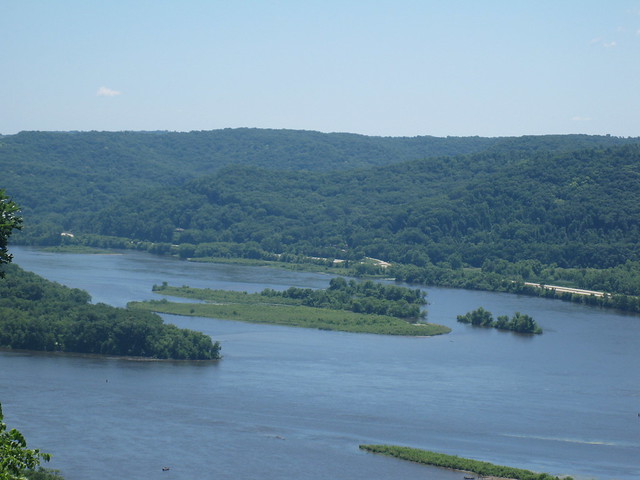
Scenic Saturday: Upper Mississippi Islands

A post by Anne JeffersonThe last few weeks have seen me overwhelmingly busy with #sciwrite, #gradingjail, #proposalpurgatory, and #deathbydataanalysis, and it doesn’t look like I’ll come up for air for a little while longer. But to give the blog a little freshening, and help me avoid grading early on a Saturday morning, I thought I’d show a picture of my homeland, the Driftless area of southeastern Minnesota and western Wisconsin.

Mobile Islands near Trempealeau, Wisconsin. Photo by A. Jefferson, June 2011

Mobile Islands near Trempealeau, Wisconsin. Photo by A. Jefferson, June 2011

This is a view from the top of Brady’s Bluff in Perrot State Park near Trempealeau, Wisconsin. I am looking south towards Minnesota, across the Upper Mississippi River. The river here is not the classic, loopy meanders of the lower Mississippi. Instead, it is termed “island braided.” The channel is wide and subdivided by multiple, somewhat stable islands. Some of these islands have been around since the first mapping of the river in the 1870s. Other islands appear after each large flood, but then seem to persist. Still others have their whole existence occur within a few decades.

Looking from the left of the picture, the first treed island is mapped as Island 81 by the Mississippi River Commission in the 1890s. Parts of the island have upland oak forest vegetation with huge old trees, and lots of poison ivy. The next low island with shorter trees is one my family calls Gull Island, because it first appeared as the waters receded after the flood of 1993. At first, it was an emergent sandbar that had accumulated around a piece of large wood on which gulls liked to rest. Now it is completely covered by 4 m or higher willows. Behind Gull Island is Lower Mobile Island. This island first appeared in the aftermath of the 1965 flood, and was the subject of study by Winona State University biology professors for several decades. Upstream of Lower Mobile Island is Upper Mobile Island. This island was created when water levels in the river were raised in 1935 by the construction of the Lock and Dam System. It has mostly been eroding ever since. Behind Lower Mobile Island, you might be able to identify another discrete line of trees before your eye reaches the Minnesota shore. That line of trees is all that remains of Lower LaMoille Island, another created by raised water levels in 1936. Upper LaMoille Island disappeared from the surface in the 1990s. Finally, there’s the river bank on the Minnesota side and the classic bluffland topography for which the Driftless Area is famous.

These islands are special to me because their dynamism is really what got me hooked on the field of fluvial geomorphology. I did a science fair project on the geomorphology and history of the islands when I was 16, and I have an MS student who worked on them before being lured to the wilds of Alaska. I’m not sure he’ll ever finish his thesis or that I’ll ever get a paper out of it, but if you want to learn more about the dynamic Upper Mississippi, you should learn from Cal Fremling, the man who wrote the book: “Immortal River: The Upper Mississippi in Ancient and Modern Times.” He’s the biology professor that started studying the Mobile Islands back in 1965.

Categories: by Anne, geomorphology, photos

Stuff we linked to on Twitter last week

A post by Chris RowanA post by Anne JeffersonWelcome to the weekly links fest from your friendly Highly Allochthonous bloggers. If you’re thinking the format looks a bit different this week, it’s because Chris has been tinkering a bit with the script that generates the links in an attempt to improve readability. Let us know what you think.

Other posts on All-geo

Earthquakes

Volcanoes

Planets

Fossils

(Paleo)climate

Water

Environmental

General Geology

Interesting Miscellaney

Categories: links