My picks of the November literature

A post by Anne JeffersonI love seeing the tables of contents of new journal issues arrive in my email box. I just get so excited about all of the cool new things that people are discovering about groundwater, rivers, climate and rocks. Below are some of my favorite articles from the past month. They reflect an amalgamation of my research, teaching, and personal interests and are only a sampling of the neat hydrogeology, geomorphology, and climate science research that has been recently published.
Fussel, H-M. 2009. An updated assessment of the risks from climate change based on research published since the IPCC Fourth Assessment Report. Climatic Change (2009) 97:469-482. doi:10.1007/s10584-009-9648-5
The takeaway message is this: While some topics are still under debate (e.g., changes to tropical cyclones), most recent research indicates that things are looking even worse now than we thought a few years ago. Greenhouse gas emissions are rising faster than we anticipated, and we have already committed to substantial warming, which is currently somewhat masked by high aerosol concentrations. It is increasingly urgent to find mitigation and adaptation strategies. Not good.
Gardner, LR. 2009. Assessing the effect of climate change on mean annual runoff. Journal of Hydrology. 379 (3-4): 351-359. doi:10.1016/j.jhydrol.2009.10.021
This fascinating article starts by showing a strong correlation (r2 = 0.94) between mean annual runoff and a function of potential evapotranspiration and precipitation. The author then goes on to derive an equation that shows how temperature increases can be used to calculate the change in evapotranspiration, therefore solving the water budget and allowing the calculation of the change in mean annual runoff. Conversely, the same equation can be used to solve for the necessary increase in precipitation to sustain current runoff under different warming scenarios.
Schuler, T. V., and U. H. Fischer. 2009.Modeling the diurnal variation of tracer transit velocity through a subglacial channel, J. Geophys. Res., 114, F04017, doi:10.1029/2008JF001238.
The authors made multiple dye tracer injections into a glacial moulin and then measured discharge and tracer breakthrough at the proglacial channel. They found strong hysteresis in the relationship between tracer velocity and proglacial discharge and attributed this hysteresis to the adjustment of the size of a subglacial R??thlisberger channel to hydraulic conditions that change over the course of the day. Cool!
Bense, V. F., G. Ferguson, and H. Kooi (2009), Evolution of shallow groundwater flow systems in areas of degrading permafrost, Geophys. Res. Lett., 36, L22401, doi:10.1029/2009GL039225.
Warming temperatures in the Arctic and sub-arctic are lowering the permafrost table and activating shallow groundwater systems, causing increasing baseflow discharge of Arctic rivers. This paper shows how the groundwater flow conditions adjust to lowering permafrost over decades to centuries and suggests that even if air temperatures are stabilized, baseflow discharge will continue to increase for a long time.
Soulsby, Tetzlaff, and Hrachowitz. Tracers and transit times: Windows for viewing catchment scale storage. Hydrological Processes. 23(24): 3503 – 3507. doi: 10.1002/hyp.7501
In this installment of Hydrological Processes series of excellent invited commentaries, Soulsby and colleagues remind readers that although flux measurements have been the major focus of hydrologic science for decades, it is storage that is most relevant for applied water resources problems. They show that tracer-derived estimates of mean transit time combined with streamflow measurements can be used to calculate the amount of water stored in the watershed. They use their long-term study watersheds in the Scottish Highlands to illustrate how transit time and storage scale together and correlate with climate, physiography, and soils in the watersheds. Finally, they argue that while such tracer-derived storage estimates have uncertainties and are not a panacea, they do show promise across a range of scales and geographies.
Chatanantavet, P., and G. Parker (2009), Physically based modeling of bedrock incision by abrasion, plucking, and macroabrasion, J. Geophys. Res., 114, F04018, doi:10.1029/2008JF001044.
Over the past 2 decades, geomorphologists have developed much better insight into the landscape evolution of mountainous areas by developing computerized landscape evolution models. A key component of such models is the stream power rule for bedrock incision, but some have complained that is not physically based enough to describe. In this paper, the authors lay out a new model for bedrock incision based on the mechanisms of abrasion, plucking, and macroabrasion (fracturing and removal of rock by the impact of moving sediment) and incorporating the hydrology and hydraulics of mountain rivers. This could be an influential paper.

Payn, R. A., M. N. Gooseff, B. L. McGlynn, K. E. Bencala, and S. M. Wondzell (2009), Channel water balance and exchange with subsurface flow along a mountain headwater stream in Montana, United States, Water Resour. Res., 45, W11427, doi:10.1029/2008WR007644.

Tracer tests were conducted along 13 continuous reaches of a mountain stream to quantify gross change in discharge versus net loss and net gain. Interestingly, the change in discharge over some reaches did not correspond to calculations of net loss or net gain based on tracer recovery. These results suggests that commonly used methods for estimating exchange with subsurface flow may not be representing all fluxes. Bidirectional exchange with the subsurface, like that found in this paper, is likely to be very important for nutrient processing and benthic ecology.
Please note that I can’t read the full article of AGU publications (including WRR, JGR, and GRL) until July 2010 or the print issue arrives in my institution’s library. Summaries of those articles are based on the abstract only.
Categories: by Anne, paper reviews

Thanks for giving kids the Earth (Science)

A post by Anne JeffersonIn October, we happily took part in the DonorsChoose Social Media Challenge, teaming up with All of My Faults are Stress-Related and Eruptions to create a geoblog generosity trifecta. We got amazing results, with geoblogs readers giving $8660 to our challenge.
Part of that money was contributed by a generous match from HP, and they have distributed giving codes to all challenge donors. If you gave to a DonorsChoose challenge in October, check your email for a link to put that HP match into action. All you have to do is follow the link, select the project(s) of your choice, and spend HP’s money.
Chris, Kim, and I also promised you that we would write 5 posts of you choice, but so far we’ve only gotten suggestions from three people. Suggest away and give us some inspiration to post here.
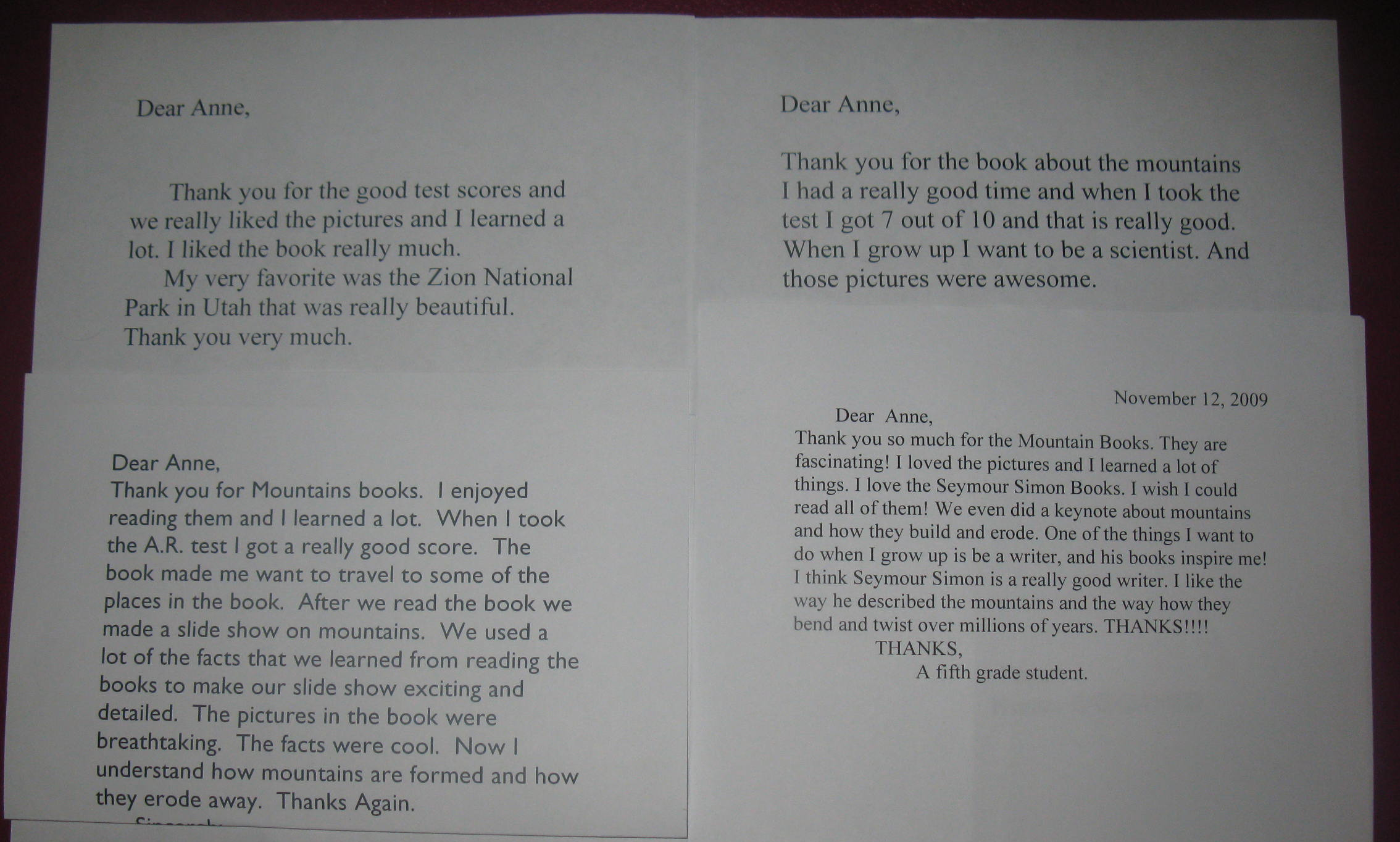
Finally, I wanted to share with you the most wonderful thanks I’ve gotten for contributing to the challenge. Donors who give $100 to a single project, or contribute the amount needed to fully fund the project, get a packet of thank you letters from the students. I helped complete a project that gave copies of Seymour Simon’s book Mountains to a classroom in Utah. Here are a sampling of the thank you letters I received:
dc-thanks.jpg
(Click to enlarge.)

Categories: science education

Casting a Wider Net: Opportunities for Enhancing Diversity in the Geosciences

A post by Anne JeffersonAlong with D.N. Lee, I’ll be convening a session on Casting a wider net: Promoting gender and ethnic diversity in STEM at Science Online 2010. To start discussion going in preparation for the session, DNL is hosting the next edition of the Diversity in Science carnival, with a theme of “STEM Diversity and Broad Impacts I: Highlights of successful, ambitious STEM diversity programs such as REUs, mentoring programs and scholarships for college under-graduates, graduate students, post-doctoral associates and early career scientists and engineers.” The deadline for submissions is today, and the carnival will go up on Friday.
In the United States, we have a diversity problem in the geosciences. Less than 5% of BS degrees in geosciences go to minorities, contrasting with ~15% in science and engineering as a whole (NSF data from 2000). As we move into graduate school the problem remains: 3.3% at the M.S. level and 5% at the PhD level. For the sciences and engineering combined, it’s 10.6% for the MS and 8.2% for the PhD. Contrast this with the demographics of the American population, and you see that the sciences in general, and geosciences in particular, are not doing a good job of attracting students that reflect the diversity of our country and are losing out on the discoveries a more diverse scientific community might be able to produce.
NSF has recognized this near-monoculture in geosciences as a problem, and specifically solicits ideas and programs that might improve the situation through its Opportunities for Enhancing Diversity in the Geosciences (OEDG) program. Here’s the gist of the program synopsis:

“The primary goal of the OEDG Program is to increase participation in the geosciences by African Americans, Hispanic Americans, Native Americans (American Indians and Alaskan Natives), Native Pacific Islanders (Polynesians or Micronesians), and persons with disabilities. A secondary goal of the program is to increase the perceived relevance of the geosciences among broad and diverse segments of the population. The OEDG Program supports activities that will increase the number of members of underrepresented groups who:
* Are involved in formal pre-college geoscience education programs;
* Pursue bachelor, master, and doctoral degrees in the geosciences;
* Enter geoscience careers; and
* Participate in informal geoscience education programs.”

The program offers three tracks for funding: planning grants (getting our act together to roll out a new program); proof-of-concept projects (one-time and short-term activities); and full-scale projects (5 years of funding and designed to be self-sustained after the end of the grant period).
The array of projects that have been funded by the OEDG program is inspiring.

  • Morgan State University in Baltimore, Maryland is helping high school students and their teachers connect to the geosciences by giving them hands-on field experiences in Chesapeake Bay in a proof-of-concept OEDG grant.
  • Faculty at North Carolina A&T State University, Penn State University, Fort Valley State University, University of Texas El Paso, and California State University Northridge are developing AfricaArray, an alliance that will run summer workshops for high school teachers, create scholarships and high school outreach activities, conduct a summer field course in Africa to recruit and mentor undergraduate students, and provide opportunities for students to participate in research in Africa, in a full-scale project through OEDG.
  • The Hawaii Institute of Marine Biology is creating Ocean FEST (families exploring science together) to reach out to elementary-school Native Hawaiians and Pacific Islanders and their families by creating an evening program to engage them with ocean-environment issues and demonstrate the value of geoscience careers to the local community, in a proof-of-concept grant.
  • Lake Superior State University in northern Michigan is creating a two-week summer geoscience field experience targeting Native-American high school students, by engaging them in solving geological problems with faculty, taking them to sites of both geological and Native American significance, and linking ways of scientific thinking and ways of knowing from within their own cultures.

The projects listed above are just a sampling of the sort of programs that OEDG funds. My university serves ~25% minority students, but our upper-level geoscience classrooms are significantly whiter. In my third year at Charlotte, I am still trying to develop my sense of how to get my classrooms to be more reflective of the university’s student body and the wider community. How can I cast a wider net?
I am starting to think down the line toward an OEDG proposal aimed at giving urban, minority university students a field geoscience experience and then maybe having them partner with high school students to do geoscience research projects in the local area. I’d be curious to know if any of our readers have experience doing this sort of project or if any of you might be interested in partnering on some future OEDG proposal.

Categories: academic life, by Anne, science education

The amazing disappearing asymmetric magnetic reversals

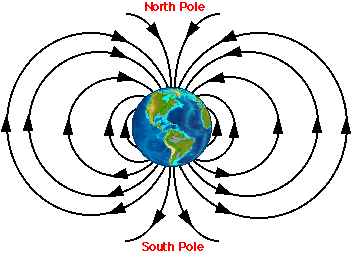
ResearchBlogging.orgA post by Chris RowanInterpreting the record of the Earth’s magnetic field preserved in rocks – palaeomagnetism – is a complicated business, but at the heart of it is one very simple assumption: except when it is reversing, if you average over a few thousand years or so, the geomagnetic field resembles a dipole aligned with the Earth’s geographic poles.

geomag.gif

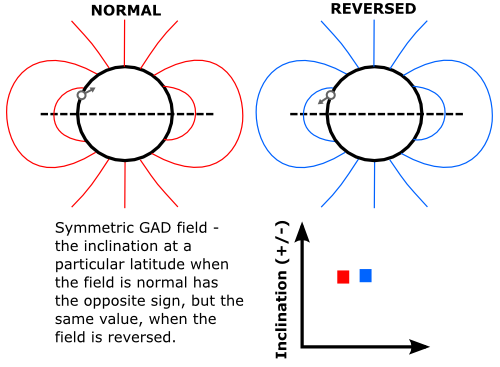
This relatively uncomplicated shape means that there is a very simple relationship between latitude and the magnetic inclination (the angle magnetic field lines make with the horizontal); it is zero at the equator, and gradually increases to 90 degrees at the poles. If you measure the direction of the fossil field direction carried by rocks at a particular site, a simple formula converts the inclination of this ancient magnetisation into the palaeolatitude of that particular chunk of crust at the time the rocks formed. Because the field is symmetric, a reversal changes the polarity, but not the shape, of the field; for example, an inclination value of 50 and -50 degrees both always correspond to a latitude of 30 degrees.
Symmetric Geomagnetic Field - simple relationship between inclination and latitude
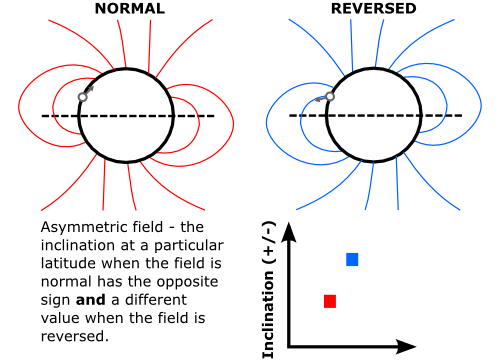
But what if our simple assumption is wrong, and the Earth’s magnetic field has not always been a dipole? There are more complicated quadropole and octopole components in the present geomagnetic field, but they are fairly minor and, except during a magnetic reversal, seem to average out to zero over a few thousand years. But what if at some point in the geological past these components were not only a more significant part of the geomagnetic field, but also did not average to zero over geological time? This would produce an asymmetric long-term field geometry, as in the figure below, where 15% of the earth’s magnetic field energy is in the quadropole component. For a point at mid-to low northern latitudes, rocks forming in a normal polarity field would have a shallow magnetic inclination, whilst rocks forming in a reversed polarity field would have a much steeper inclination. The warped field geometry means that there is no longer a one-to-one relationship between inclination and latitude, which makes working out the plate motions recorded by all of those ancient magnetic directions much more difficult.
Asymmetric field - no simple relationship between inclination and latitude

Continue reading

Categories: geology, geophysics, palaeomagic, past worlds, Proterozoic

Stuff I linked to on Twitter last week

A post by Chris RowanMore interesting links that I’ve shared via Twitter over the past seven days. If I had to highlight just one you should really click on, take some time to be wowed by the HiRISE imagery of Mars over at the Big Picture – they are jaw-droppingly beautiful. And seismogenic – also known as Julian from Harmonic Tremors – earned all the geonerd cred, and everyone’s insane jealously, by filming his encounters with Hawaiian lava.
Bill Bryson’s Notes from a Large Hadron Collider Manages to convey excitement without any destroy the Earth!! nonsense.
http://www.timesonline.co.uk/tol/news/science/eureka/article6899505.ece
Zuska explores cultural parallels between scientific and religious institutions.
http://scienceblogs.com/thusspakezuska/2009/11/can_we_talk_about_science_i_me.php
(via @ScienceBlogs )
35 beautiful landscapes selected from HiRISE imagery at The Big Picture. Coffee table book out when?
http://www.boston.com/bigpicture/2009/11/martian_landscapes.html
(via @HiRISE)
Philippines: Mayon ‘may explode anytime’, heavy rains mean lahar risk remains.
http://www.manilatimes.net/index.php/component/content/article/42-rokstories/5412-mount-mayon-may-explode-anytime–phivolcs-official
(via @volcanismblog)
Dr. Albert Bartlett’s "Laws of Sustainability".
http://www.theoildrum.com/node/5925
(via @TheOilDrum)
Geoengineering in the House. Of Congress, that is. Seems testimony was sensible, at least.
http://blogs.nature.com/news/thegreatbeyond/2009/11/geoengineering_in_the_house.html
(via @NatureNews)
Some beautiful images of islands from space. No. 10 us the coolest.
http://www.wired.com/wiredscience/2009/11/islands-space/
(via @geographile)
MESSENGER Rewrites Mercury Textbooks Even Before Entering Orbit: Lots of iron, but not in silicates…
http://www.planetary.org/news/2009/1105_MESSENGER_Rewrites_Mercury_Textbooks.html
(via @elakdawalla)
The World’s Costly Nitrogen Addiction: 80 megatons of fertiliser used/year; only 17 gets into food.
http://www.e360.yale.edu/content/feature.msp?id=2207
(via @YaleE360)
Unsettled Youth: Spitzer Observes a Chaotic Planetary System Dust cloud formed by lots of proto-planetary collisions?
http://www.physorg.com/news176576185.html
Another example of synthetic aperture radar data being used to track volcanism in the African Rift Valley.
http://www.sciencedaily.com/releases/2009/11/091104123027.htm
Solar power generation around the clock . Heat stored in molten salt -> electricity as needed.
http://www.physorg.com/news176632405.html
(via @physorg_com)
Haunting outlines of bones and plastic highlight impact of plastic on albatrosses.
http://www.guardian.co.uk/environment/gallery/2009/nov/03/albatross-plastic-poison-pacific
(via @BobOHara, @edyong209)
Blog post from @brianshiro about his work at Pacific Tsunami Warning Centre.
http://www.astronautforhire.com/2009/11/tsunami-kind-of-month.html
Not pretty at all: Athabasca Oil Sands: open-pit mines and tailings ponds line the Athabasca River.
http://earthobservatory.nasa.gov/IOTD/view.php?id=40997&src=iotdrss
(via @EarthObser)
Fibre optic solar cells.
http://news.bbc.co.uk/1/hi/sci/tech/8341186.stm
(via @suehutton)
Even if all other CO2 emissions stopped, fully exploiting Canada oil sands -> 2C global warming.
http://business.timesonline.co.uk/tol/business/industry_sectors/natural_resources/article6902006.ece
(via @twitoil)
CO2 from forest destruction overestimated.
http://www.guardian.co.uk/environment/2009/nov/03/forest-destruction-co2-overestimated
(via @guardianscience)
Video of lava flows on Kilauea from @seismogenic. Not jealous not jealous not jealous…
http://www.youtube.com/watch?v=Aqj_VGQUC8g ,http://www.youtube.com/watch?v=wnbcYtgDwCw
Run don’t walk to Cassini raw images site for new pics from Enceladus flyby e.g.
http://saturn.jpl.nasa.gov/photos/raw/?start=1 ,http://saturn.jpl.nasa.gov/multimedia/images/raw/casJPGFullS54/N00145397.jpg
(via @elakdawalla)
Nice discussion of the Shiva Crater palava by Suvrat.
http://suvratk.blogspot.com/2009/11/end-cretaceous-how-many-impacts-how.html
‘Ultra-primitive’ particles found in comet dust Including lots of ‘pre-solar’ grains.
http://www.physorg.com/news176400764.html
(via @physorg_com)
New PNAS study lists 17 easy household changes that would reduce US ems by 7%
http://www.pnas.org/content/early/2009/10/23/0908738106.abstract
(via @KHayhoe)
Atacama mudflows may be equivalent of controversial recent flow deposits on Mars.
http://www.abc.net.au/news/stories/2009/11/02/2730988.htm
(via @geologynews)
Geological Society of London on fossil webs found in amber: wow!
http://www.geolsoc.org.uk/gsl/geoscientist/geonews/fossilwebs
(via @geosociety)
Coping With Climate Change: Which Societies Will Do Best?
http://www.e360.yale.edu/content/feature.msp?id=2205
(via @YaleE360)
Solar power from Sahara a step closer CSP network aims to provide 15% of Euro power by 2050. Ambitious…
http://www.guardian.co.uk/business/2009/nov/01/solar-power-sahara-europe-desertec#
Planet hunt delayed by noise problems with Kepler. Fixable though.
http://www.nature.com/news/2009/091030/full/news.2009.1051.html
(via @NatureNews)

Categories: links