
Earthquakes within plates: we don’t know when, and we may not know where

ResearchBlogging.orgA post by Chris RowanEd has already given the lowdown on a new study in Nature which might lead to a rethink on earthquake hazards in the continental interior. Plate tectonics treats plates as entirely rigid entities, but continental crust is too weak, and too riddled with faults left over from when it was close to a plate boundary, for it to entirely hold up when subjected to the stresses of plate motion. So although a very large proportion of the Earth’s earthquakes occur at plate boundaries, there is also some seismicity – including some very large shocks – within plate interiors. The problem is working out where this intraplate deformation is going to occur, and to do so seismologists rely on data which serve them well at plate boundaries – the historical record of large earthquakes, and the location of low-level seismic activity which indicates the build up of tectonic strain.

What Stein and Liu argue in their paper is that away from the plate boundaries, these tools provide a very misleading picture. In apparently active parts of the continental interior like the New Madrid area, all the abnormal seismicity can be regarded as a long-lived aftershock sequence; rather than indicating any new elastic strain being built up by external forces, which could eventually produce another large earthquake in the future, the seismicity is just a local tectonic response to a historically recent large earthquake (in New Madrid’s case, it was a series of magnitude 7-8 earthquakes in late 1811 and early 1812), and will eventually die off with time.

This conclusion is a little worrying, since it implies that the next big intra-continental quake might well occur in what presently seems to be a seismically inactive region, which, given the density of old faults cutting through your typical chunk of continental crust, could be almost anywhere. We already know the difficulties of predicting when big earthquakes are going to occur, but it seems that in the middle of plates, predicting where they are going to happen might also be a bit more tricky than we thought. However, a caveat remains: the proposed length of a typical intra-continental aftershock sequence is hundreds of years, which is much longer than our instrumental records, and even historical records in many places. The authors do point out that earthquake patterns in China, which has the best historical record, is of single large quakes in different areas (with last year’s Sichuan quake being the most recent) rather than a series of large earthquakes associated with a particular fault; perhaps palaeoseimology can show whether a similar pattern holds further back in time and on other continents.

Stein, S., & Liu, M. (2009). Long aftershock sequences within continents and implications for earthquake hazard assessment Nature, 462 (7269), 87-89 DOI: 10.1038/nature08502
Categories: earthquakes, geohazards, geology

Earthquake hazard mitigation the Iranian way

A post by Chris RowanThe Guardian reports that the Iranian government has approved plans for a new capital city. It seems this decision was at least partially driven by fears that the present capital, Tehran, is facing some serious earthquake hazard in the future:

Plans for a new capital were first drawn up 20 years ago, but officials only gave them serious consideration after the 2003 earthquake that devastated the south-eastern city of Bam and killed an estimated 40,000 people. Experts warn that Tehran sits on at least 100 faultlines – including one nearly 60 miles long – and that many of its buildings would not survive a major quake.

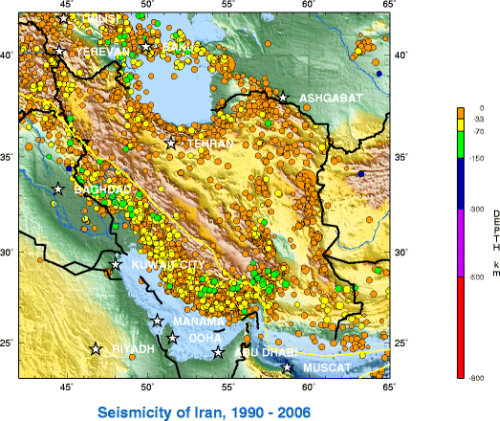
Iran is part of the Alpine-Himalyan Belt, formed as the African, Arabian and Indo-Australian plates all push northwards into Eurasia. In Iran, seismicity is concentrated in the Zagros mountains in the south and the Alborz mountains in the North, with both of these mountain belts apparently being actively uplifted as they accommodate plate convergence.

iran_sesimicity.png

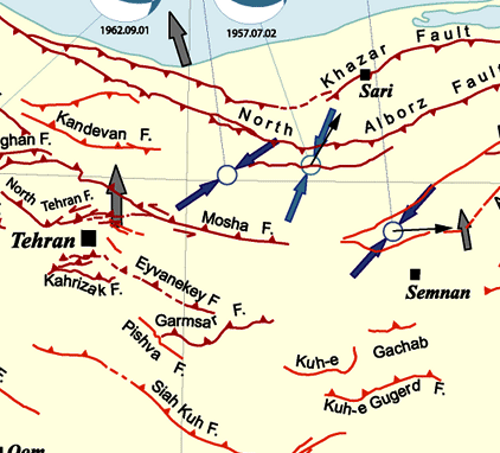
Tehran, with a population of about 12 million people, is located just on the southern edge of the Alborz mountains, and a map of the major faults in the area shows that it is surrounded on all sides by sizeable thrust faults.

Tehran_Faults.png

So, at first glance a relocation seems like a fairly foresighted strategy, even if a cynic (who, me?) might wonder if the move encompasses more than the political elite and their associated minions. But population centres do not generally spring up at random; there are usually strategic and/or economic reasons that people have settled in a particular location, and once established they tend to suck in ever more people and investment as time goes on. Add to that our general inertia in the face of abstract future risk (just look at the response to climate change) and you have to wonder if people will be all that willing to move. There’s also the question of how the cost of abandoning all the infrastructure incorporated into a large city like Tehran, and building a whole new infrastructure in your new city, compares to the cost of increasing peoples’ safety by enforcing robust building codes: after all, earthquakes don’t kill people, collapsing buildings do*.
In the long term, of course, it makes sense to move as much of your population as possible from areas of high seismic risk to low risk areas, by encouraging investment in geologically safer areas and letting economic migration rebalance the population over a generation or three. Sadly, I suspect urban planning is generally driven by somewhat narrower, short-term factors; if building houses on flood plains is waved through without blinking, I can’t see nearby faults giving people much pause.
*and tsunamis. But not in Tehran.

Categories: earthquakes, geohazards, tectonics

Advice and Advocacy

A post by Chris RowanGetting involved in science policy is a tricky business. For the most part, a statement made by a scientific expert is taken as more authoritative than a statement by a government minister, even when the expert strays away from talking about data and evidence and probabilities – the input into a policy decision – and starts talking about translating those data into action – the decision itself. I don’t think scientists shouldn’t suggest courses of action, but they shouldn’t do it in a unilateral way. It’s the difference between ‘studies show x, and y appears to be a promising approach to dealing with this’ (ok) and ‘studies show x, so we must do y’ (not so ok). A fine distinction, perhaps, but one worth trying to make as hard as possible.
Of course, in the case of David Nutt’s forced resignation from the Advisory Council on the Misuse of Drugs (ACMD – see also here and here), it appears to be more a case of ‘studies show x, it would be sensible to do y, but government has not only done z, which is silly/unworkable, but claims its policy is evidence-based.’ Untangle that, if you dare.
It’s obvious that scientific evidence is just one of the things that ministers take into account when making policy decisions. When it comes to drug regulation, for example, beyond issues of harm there are questions of social impact on particularly at-risk groups, and (when it comes to alcohol and tobacco) long-standing societal mores, which also have to be considered when formulating policy, and perhaps might justify going against the recommendations of a body like the ACMD. As a scientist, I have no problem with that – as long as the decision to go against such advice is justified in those terms. Where it does become a problem is when, for whatever reason, a recommendation based on the best available science is ignored, yet the government continues to assert that it is following an ‘evidence-based’ policy, rather than acknowledging that its decisions are clearly being driven by other concerns.
It is this lack of transparency that worries me; and a scientist who actually faces the paradox of being consulted by the government to provide a veneer of scientific authority, whilst having their actual opinion on the issue at hand ignored, is perhaps justified in getting a little annoyed .
I once described Tony Blair’s attitude to science thusly:

…he does not seem to want a electorate that is truly scientifically literate, but one that will accept scientific authorities as expert witnesses in support of government policy.

It seems that this attitude is still prevalent amongst politicians here in the UK; and if David Nutt did sail over (or very close to) the line between advice and outright advocacy, I think it’s at least partly because we have a government which refuses to discuss complex and controversial issues in a grown-up manner.

Categories: public science

To our amazing readers, we are humbled. Post requests are now open.

A post by Anne JeffersonGeoblog readers are truly amazing. Between you, you gave $8660, making earth science a hands-on reality for 1270 students. Forty-three of you, with a little help from HP, gave more than readers of any other ScienceBlog. Thank you. Your generosity humbles me.
A few weeks ago, during Earth Science Week, I offered up posts by Chris and I on topics of our readers’ choice. Then Kim willingly jumped in to help. We promised to write one post for each project completely funded during the week with help from geoblogs readers. By the end of the week, you all had funded five amazing projects:

Check out the links above to see thank you notes from the teachers and photos of the projects in action. Seeing the students excitedly looking at rocks is the biggest reward I can imagine. But, if you want us to reward you by producing posts on topics that get you excited, here’s your chance to nominate the topic.

In the comment thread below, make your requests, and Chris, Kim, and I will look through them and select five topics that we feel most able to answer. Then we’ll get to work fulfilling them as we can manage in our busy schedules. Maybe we’ll get inspired and pick up even more of your ideas for future posts.

Categories: bloggery, science education

ScienceOnline 2010: geobloggers required

A post by Chris RowanRegistration is now open for ScienceOnline2010, the fourth annual science communicators conference, being held January 14-17 next year in the Research Triangle Park area of North Carolina.

Please join us for this free (but donations are accepted) three-day event to explore science on the Web. Our goal is to bring together scientists, physicians, patients, educators, students, publishers, editors, bloggers, journalists, writers, web developers, programmers and others to discuss, demonstrate and debate online strategies and tools for doing science, publishing science, teaching science, and promoting the public understanding of science.

I’ll be there, but that’s probably a rather dubious temptation; however, if you check out the numerous interesting discussion topics enshrined in the semi-finalised programme you’ll see that there is a session entitled ‘Earth Science, Web 2.0+, and Geospatial Applications’, being run by Jacqueline Floyd with back-up from yours truly. That’s right, a specialised session which doesn’t involve biology.
Hopefully this might tempt some of the rest of the geoblog/tweetosphere to attend as well. Even if you can’t attend, Jacqueline and I are keen to get as much participation from all of you as possible. Feel free to get in touch with any ideas you might have, but in a perfect world we’d have you all there participating – and if you’re physically there, I can buy you a beer. Places are vanishing fast, so don’t ponder too much: Register today!

Categories: bloggery, public science