More large aftershocks rattle Christchurch: will it ever end?

A post by Chris RowanPoor Christchurch just can’t seem to catch a seismic break this year: two more powerful aftershocks shook the city early Monday afternoon local time: the first a magnitude 5.3 (Geonet, USGS), the second a magnitude 6 (Geonet, USGS). The focal mechanisms of both shocks indicate mostly pure strike-slip motion, probably dextral strike-slip along a northeast-southwest oriented fault plane; the M6 quake also has a component of roughly east-west compression. These focal mechanisms are very similar to the magnitude 7 Darfield earthquake last September and the magnitude 6.3 rupture that badly damaged the city in February. These latest tremors occurred a few kilometres to the east of February’s quake, and from their location and the manner in which they ruptured, it looks like these earthquakes were on another, more easterly segment of the same fault.
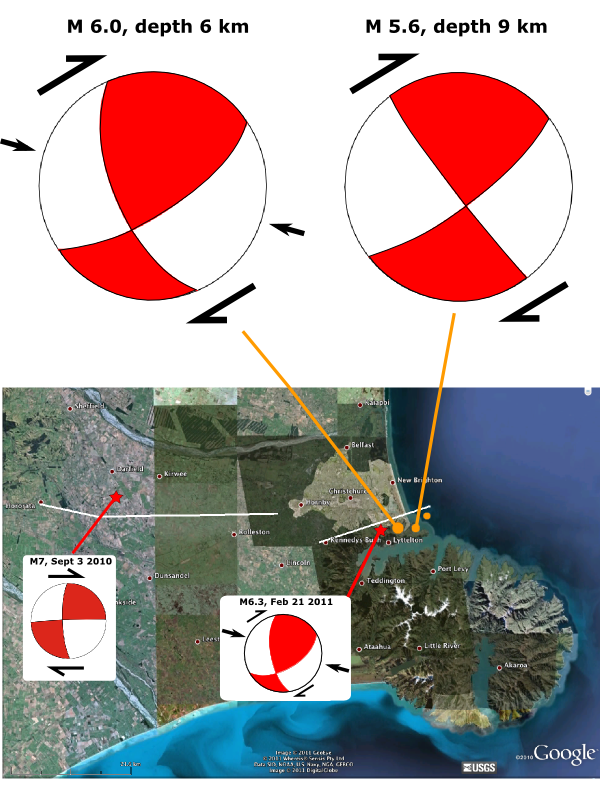
Focal mechanisms and locations for the two large June 13 aftershocks, compared to the September 2010 and February 2011 ruptures. White lines are rough fault traces.

Fortunately, there appear have been few casualties this time around, but a new violent tremor is not good news for the many already damaged buildings in Christchurch. Peak ground accelerations from the M6 shock were quite high in the southern parts of the city (0.7-0.8g mostly, although one instrument recorded a 2.1g acceleration). The BBC reports that several buildings have collapsed, and there have also been further rockfalls, perhaps from cliffs already weakened by the previous earthquakes. Once again, the shaking has also caused extensive liquefaction in Christchurch and its suburbs, exacerbating the damage and destruction.

An SUV engulfed in mud caused by seismic liquefaction. Source: The Australian.

A clear thread running through many of the reports and interviews that I’ve been reading today is that the residents of Christchurch are fearful and fed-up with what is turning into a year of misery – and you can hardly blame them for wondering if they shouldn’t just give up and move. The risk of further large aftershocks is still present, of course, but one clear trend since the Darfield earthquake last September is that seismic activity is migrating east over time. The mainshock and aftershocks of February’s earthquake (the red circles in the figure below) are to the east of the Darfield mainshock and aftershocks (blue circles), and yesterday’s earthquakes (orange circles) are further east still. The whole fault system seems to be progressively unzipping from west to east, and the locus of seismic activity has now moved past Christchurch and is heading out to sea. The earthquakes may not stop right away, but at least they’ll probably be further away – and will therefore cause less damage.
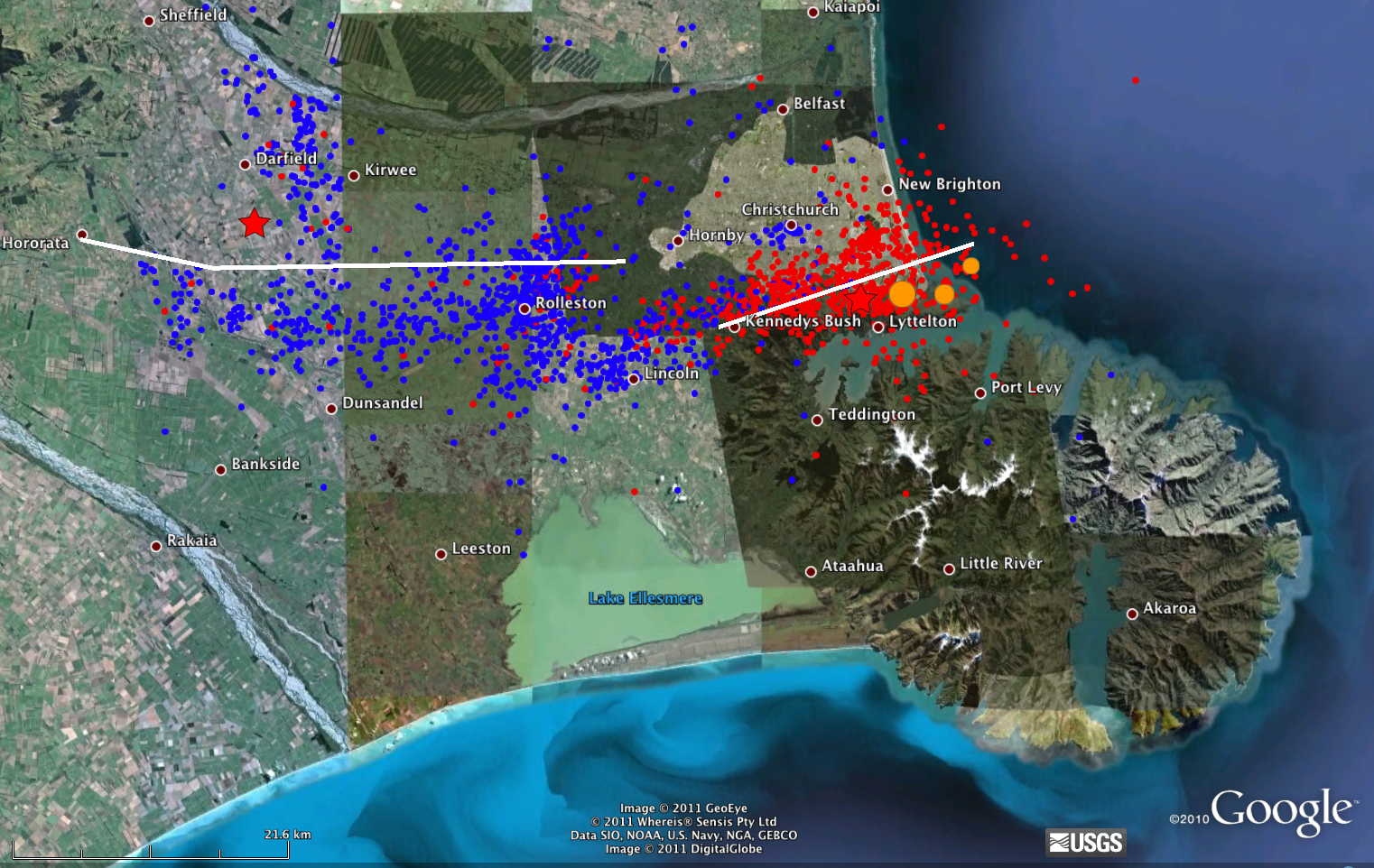
Aftershocks of the September 2010 Darfield earthquake (blue), the February 2011 earthquake closer to Christchurch (red), and the biggest earthquakes on June 13 (orange). Click for a larger version. Data from Geonet.

Also, whilst it may be happening far slower than everyone would like, the seismic activity is slowly dying down. In the top figure below I’ve plotted the magnitudes of all of the earthquakes with a moment magnitude larger than 3 that have been detected around Christchurch since the Darfield earthquake last September; in the bottom figure I’ve plotted the number of earthquakes per day. There is a clear sawtooth pattern: the magnitude and frequency of the aftershocks decayed as expected following the Darfield quake, until February’s magnitude 6.3 tremor. This triggered a whole new flurry of activity, but note that the peak magnitudes are lower in this cycle, and the aftershock frequency decays more quickly. Yesterday’s events have temporarily boosted seismic activity again, but (as far as you can tell from limited data so far) to a still lesser degree.
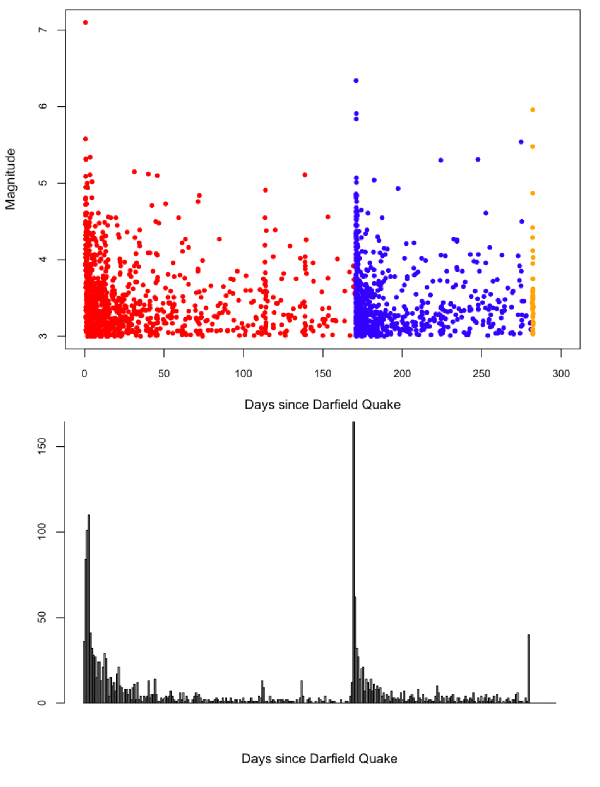
Magnitude and Frequency of earthquakes near Christchurch since September 2010 Darfield Earthquake. Data from Geonet.

So, whilst the immediate seismic risk has by no means abated for the citizens of Christchurch, hopefully the worst is behind them.

Categories: earthquakes, focal mechanisms, geohazards, tectonics

Stuff we linked to on Twitter last week

A post by Chris RowanA post by Anne JeffersonThanks for voting for Anne in the Three Quarks Daily contest. She’s been voted into the semi-finals round, and now it is up to the editors of 3QD and the judges. Do check out the list of other semi-finalists; they are all excellent reads and the geo- and enviro-sciences are well-represented.

Earthquakes and Tsunami

Volcanoes

Landslides

Fossils

(Paleo)climate

Categories: links

Portolan Maps: the medieval GPS?

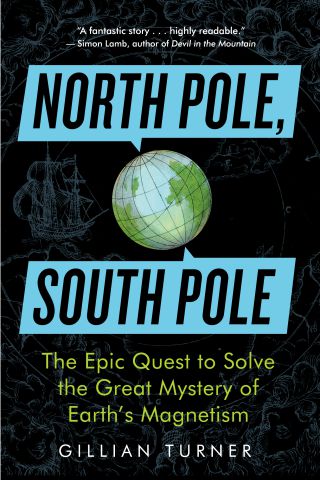
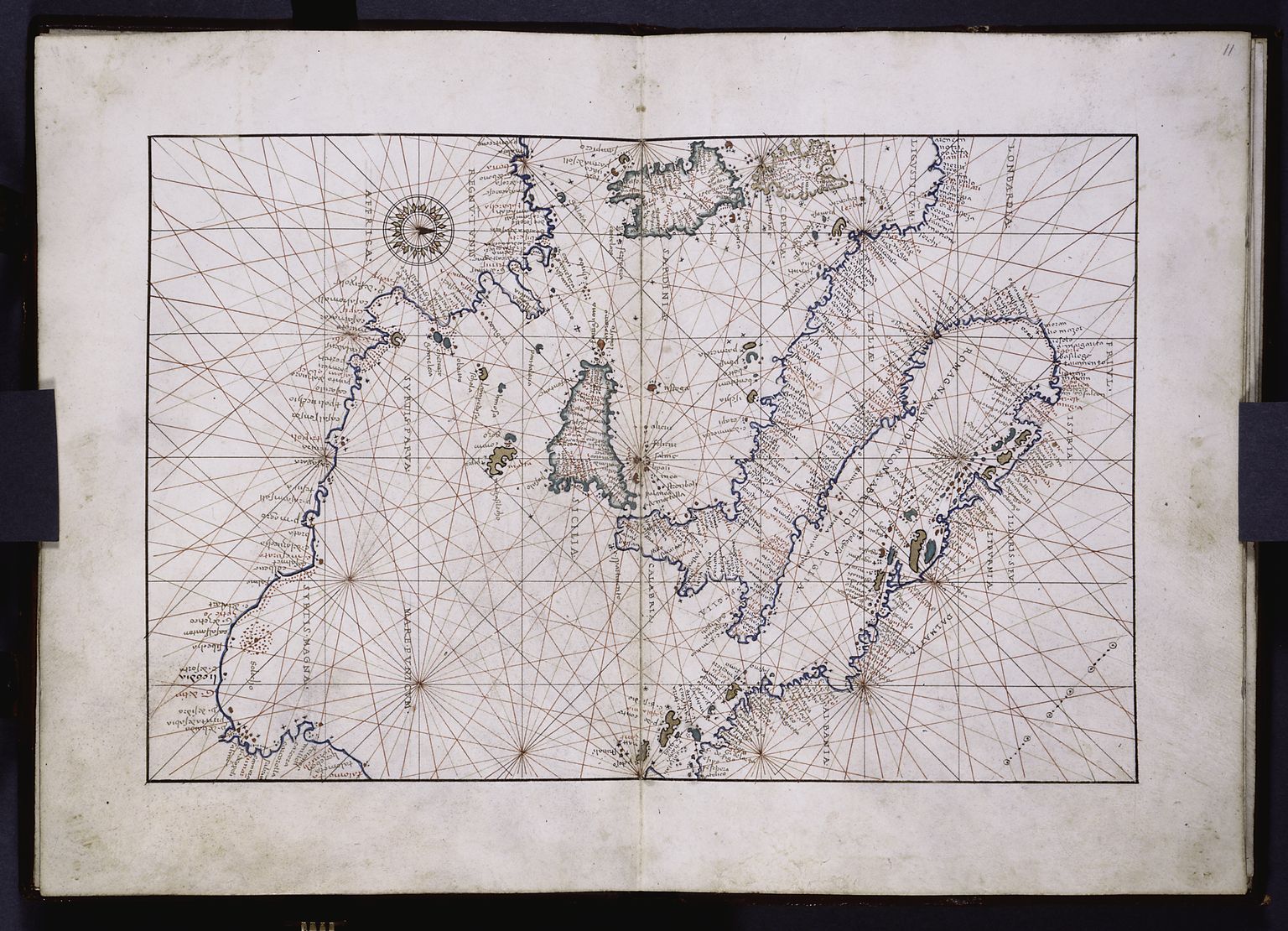
A post by Chris RowanThere was a fascinating tidbit in one of the opening chapters of North Pole, South Pole that appealed to my inner map junkie. Many nautical charts from medieval times are criss-crossed with a network of lines which radiate outwards from selected points on the map.

Portolan map of the Central Mediterranean, dated to about 1550. Click to enlarge. Source: Digitial Scriptorium

It turns out the the sources of the radiating lines correspond to major seaports, and the lines themselves record the magnetic compass bearing to other ports in the region. Thus, to get from one port to another, all a navigator had to do was get the bearing off one of these ‘portolan’ (or ‘harbour finding’) maps and set a course along it. Pretty clever.

The disadvantage of this method, of course, is that you’re following a route without really knowing where you’re going, just as many people nowadays blindly follow the instructions of their GPS navigation software – sometimes into a teensy bit of trouble. However, given that this was centuries before a reliable and accurate method of estimating longitude was developed, the coastlines traced out by charts in this time may well have been of questionable accuracy. Perhaps it was a better bet to trust in the magnetic gods, and ‘sail along bearing 124 until you reach… coast’

Categories: palaeomagic

Why does a compass point north? A mystery at the heart of the story of science (book review)

A post by Chris RowanStrange as it might seem, I’m finding North Pole, South Pole, paleomagnetist Gillian Turner’s newly published account of “the epic quest to solve the great mystery of Earth’s magnetism”, a difficult book to review. It’s not that I didn’t enjoy reading it; I did. I found it both interesting and well written (Gillian has a talent for making scientific papers almost enjoyable to read, so I hardly expected otherwise). The problem is that I’m not your average reader: I’ve spent a large chunk of my geological career so far studying ancient rock magnetisations, so it’s hardly a surprise that I’d be interested in the scientific history of my field.

North Pole, South Pole, by Gillian Turner

Even so, I believe that the story than Gillian tells is not just of interest to me and my paleomagnetic brethren, because it turns out that even before scientists were calling themselves scientists, they were asking: why does a compass needle point north? The ancient Greeks knew of the magnetic properties of lodestone, and compasses have been around for almost two millennia. These devices were utterly useful for navigation, and hence a vital cog in trade and the maintenance of empires (compasses are still used to guide our ships and our airliners, and it is only in the past decade or two, with the advent of GPS, that you could potentially navigate safely without one). And yet, at the same time, they were utterly mysterious: a fact that must have been of some concern to those engaged in trade and empire building: it’s never a good idea to be totally reliant on something you neither control, nor even understand.

Early scientists tended to be somewhat promiscuous in their interests, but the mystery of magnetism was certainly something that cropped up with some regularity as the modern scientific enterprise grew and took shape over the last millennium. The first known work of experimental science in Europe? An exploration of the magnetic properties of lodestone, written by Petrus Peregrinus in 1269, that also presciently argued that the Earth was magnetised in the same way that a compass needle was. The first known research cruise? A voyage to measure variations in magnetic declination – the difference between true north (as determined from the stars) and magnetic north organised by Edmond Halley in 1698. One of the earliest international scientific collaborations? A network of geomagnetic observatories, set up in the early 19th century by Carl Gauss, Alexander von Humboldt and Edward Sabine, to collect enough measurements to accurately model the Earth’s magnetic field. Explorations of the connections between magnetism and electricity by the likes of Ørsted, Ampère, Faraday and Maxwell led to dynamos, radio and the modern world as we know it, as well as offering the first glimpses into how the Earth’s magnetic field was actually generated. Paleomagnetism itself, born from attempts to understand the wandering of magnetic north around the Arctic Ocean, was a key part of the discovery of plate tectonics, both by confirming the slow drift of continents over geological time, and providing the killer bit of evidence for seafloor spreading in the form of the seafloor stripes formed by magnetic field reversals.

All of this and more is explained with great clarity in Gillian’s book, all framed in terms of the slow progress towards the understanding that the Earth is a big magnet, and the even longer quest to explain why. The story continues right up until the present day: it is still less than 20 years since a decent model of a geodynamo produced by convection in the outer core was finally produced. At the heart of the book is a coherent narrative that manages to lucidly cover a large amount of territory in the history of science, and the science of magnetism. It’s not a narrative driven by a single personality, in the vein of Longitude or The Map That Changed the World, which may put some people off, but if you’re interested in finding out how we know what we know about the Earth’s magnetic field, or would like a gentle introduction to the forces that orient your compass needle, North Pole, South Pole is well worth reading.

North Pole, South Pole is published by The Experiment Publishing and is available on Amazon (USA, UK)

Categories: geophysics, palaeomagic, public science, reviews

Flooding Around the World

A post by Anne Jefferson Got flood fatigue yet? Too bad, because the wet weather and the high water keeps coming. Here is a quick round up of the notable flood-related news of the week.

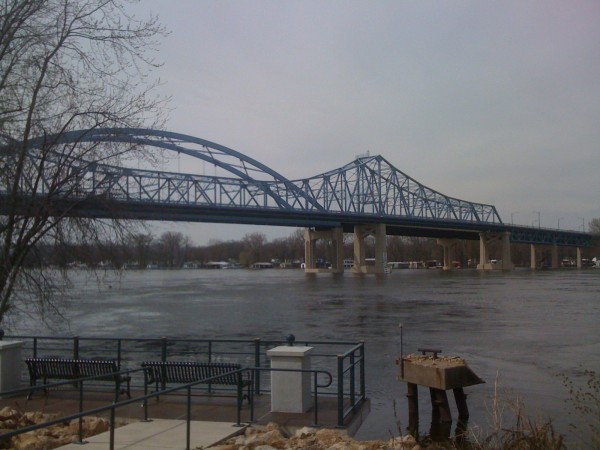
High water on the Mississippi River, La Crosse, Wisconsin, 21 April 2011

Front row seats for water levels above flood stage on the Mississippi River, La Crosse, Wisconsin, 21 April 2011

Mississippi River

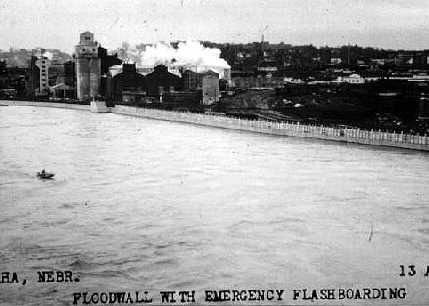
Floodwall (with emergency height added) in Omaha, Nebraska during the record 1952 floods.

Floodwall (with emergency height added) in Omaha, Nebraska during the record 1952 floods. Will that record be broken this year? (Image from Nebraska DNR.)

Missouri River

Heavy snowpacks in the Missouri River watershed (an areally large, but volumetrically smaller contributor to the Mississippi) have led to near-record flooding that is on-going along its whole length from Montana to Missouri. It’s not getting as much media attention as the Mississippi River, but water levels may stay above flood stage for months. Right now there are heavy rains occurring in parts of the basin, with more rain in the forecast, which will only add to flood problems.

Like the Mississippi, the Missouri is heavily managed by the Corps of Engineers, which is taking some criticism for residents in affected cities. There have also been evacuations because of seepage under levees and concerns about the possibility of failure. Like all big river/developed world flood stories, this one is a complicated mix of huge volumes of water, complicated multi-purpose river management plans, and unwise historical floodplain development.

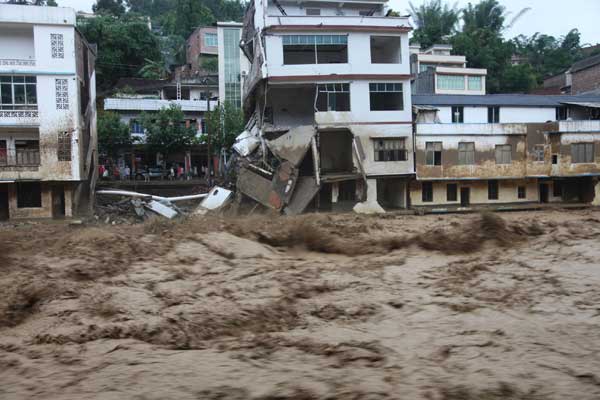
Flooding from heavy rain in Guizhou province, southwestern China on 6 June 2011 (photo: Xinhua)

Flooding from heavy rain in Guizhou province, southwestern China on 6 June 2011 (photo: Xinhua)

China

For months, China has been stricken by its most intense drought in 60 years, but right now it’s too much, not too little, water that is the problem. Flooding since the 1st of the month has affected East China’s Jiangxi Province and 12 provinces in central and southern China, and more rain is in the forecast for many areas. Intense rains over the last few days have caused the evacuation of more than 100,000 people and killed at least 54.

Elsewhere

The Flood Observatory is also reporting on-going flooding in Colombia, the Philippines, Algeria, Haiti and the Dominican Republic, Canada, India, and Upstate New York/Vermont’s Lake Champlain area. In every one of these places, people are losing their homes and lives. While volcanoes and earthquakes shake things up spectacularly now and again, every single day, somewhere in the world, there’s a devastating flood going on.

Categories: by Anne, geohazards, hydrology