Seismo-volcanism in Eritrea

A post by Chris RowanThe Great Rift Valley marks where East Africa is slowly attempting to break away from the rest of the African continent, at a rate of less than a centimetre a year. At the north-eastern end of the rift, where it links to the oceanic spreading centres in the Red Sea and the Gulf of Aden, it has come very close to succeeding, producing the Afar triangle. Low, hot and arid, and home to numerous volcanoes and ultra-saline lakes, it’s the closest thing we have to an onland oceanic spreading centre – a structure that is normally found beneath 4 kilometres of water.
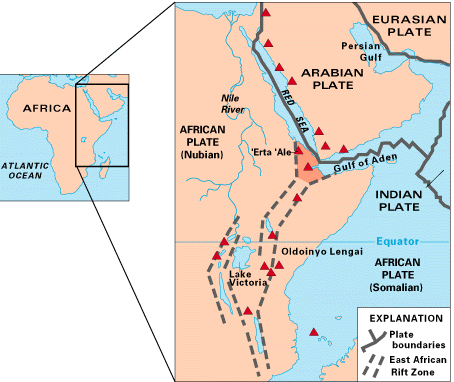
The Afar triangle is located at the junction between the East African continental rift, the Red Sea and Gulf of Aden oceanic rifts. Source: USGS

At the beginning of last week, Nabro, a volcano that has not been previously active in historical times, began to erupt, with ash clouds and a new lava flow spotted in satellite imagery. The Volcanism Blog and Eruptions are doing their usual excellent job of covering the eruption, but this event was also accompanied by some interesting seismic activity, which I thought was worth looking at in a bit more detail.

The global seismometer network detected 13 magnitude 4 or greater earthquakes near the border between Ethiopia and Eritrea on Sunday 12th June, all within a 20 km radius of the main caldera. The two largest quakes in this sequence had a magnitude of 5.7, occurred within 30 minutes of each other, and both had extensional focal mechanisms that indicated that the crust was being stretched – or pushed apart – in a northeast-southwest direction (the USGS information pages for these earthquakes are here and here).
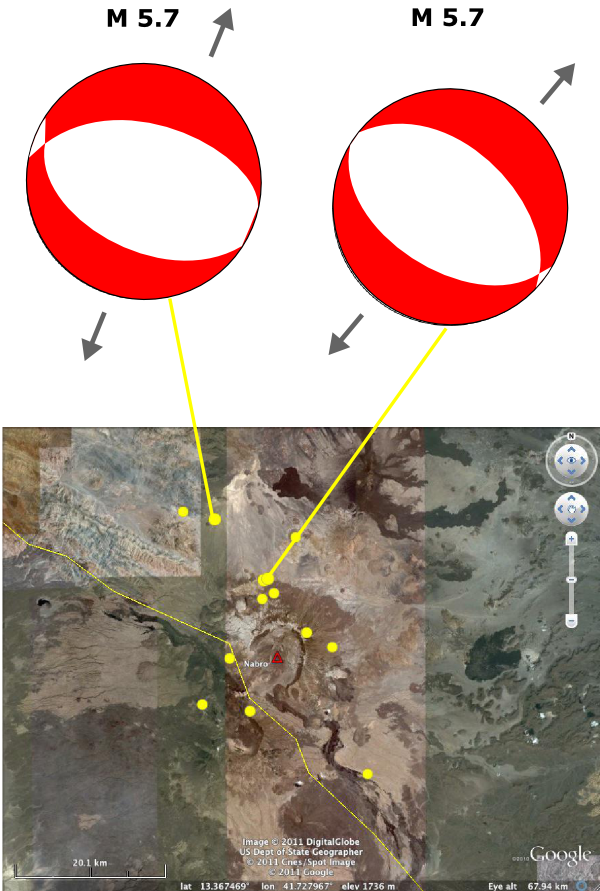
Earthquakes around Nabro on the 12th June, showing the extensional focal mechanisms for the two largest events in the sequence.

The reason I found this interesting was that it reminded me of a paper published a couple of years ago describing a massive dike injection event in the Afar triangle in 2005. Magma rising through the crust opened a 60 kilometre long, linear fracture beneath the surface and forced itself in, pushing the crust apart by up to eight metres; a process very reminiscent of what goes on at true oceanic spreading centres. One notable feature of the accompanying seismic activity was that most of the larger earthquakes had focal mechanisms showing northeast-southwest extension. There was also an associated volcanic eruption: at Da’Ure, a fissure vent of Dabbahu.
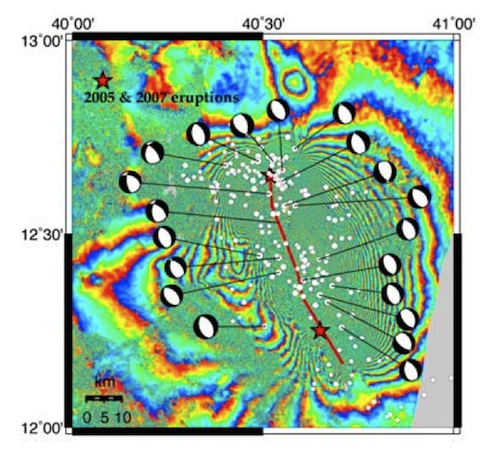
Focal mechanisms for the major earthquakes in the 2005 Dyke injection sequence. From Ayele et al., 2009 (see text for link).
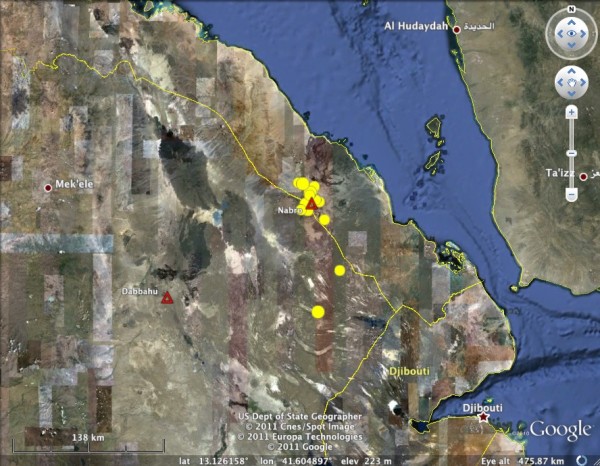
Location of the recent activity compared to the 2005 diking event centred on Dabbahu.

The 2005 diking event occured about 150 kilometres to the southwest of the current activity. Both are obviously linked to the regional extension associated with rifting. What is less clear is if the recent seisimicity – and the eruption of Nabro – can also be linked to dike injection at depth. In 2005, the seismic activity went on for a couple of weeks, and the migration of earthquake locations from northwest to southeast over time clearly showed the movement of injected magma along the dike away from the initial injection point. In contrast, the recent bout of seismic activity appears to have been much more short-lived, and although the earthquakes are (very roughly) distributed along a northwest-southeast trending line, there is no obvious migration of the epicentres over the course of the sequence. This may just be an issue of scale: last week may have seen a much smaller-scale injection of magma than in 2005, but in both cases the earthquake focal mechanisms were controlled by the regional extension, which will produce many more such events as Afar continues its slow transformation into a small ocean basin

Update: via the Earthquake Report, I’ve found a local seismometer network in Djibouti, the country south of Eritrea, which has the ability to pick up smaller earthquakes associated with the Nabro eruption. According to their page commenting on the eruption, although activity really kicked off on the 12th June, there was some seismic activity in the area in May – around half a dozen approximately magnitude 2.5 earthquakes, mainly to the northwest of the Nabro caldera. They also have a more detailed map of the seismicity for the 12th June (with almost 50 events) and also a map of the last 7 days of activity. Despite the addition of many more lower magnitude earthquakes to this sequence, there doesn’t seem to be any particular trend in the location of the seismic activity.
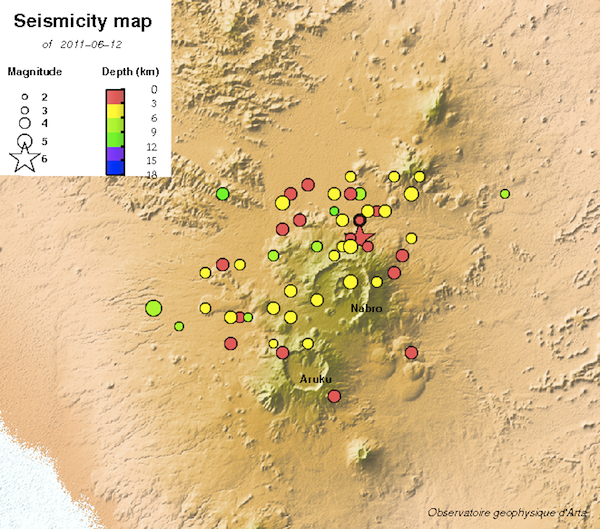
Magnitude 2+ Earthquakes around Nabro on the 12 June. Source: Observatoire Geophysique Arta
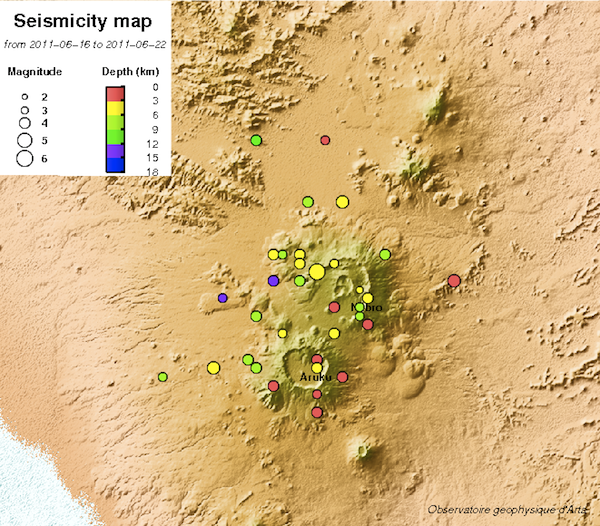
Magnitude 2+ earthquakes around Nabro, 16-22 June. Source: Observatoire Geophysique Arta

Also, if you’re interested in the tectonic forces driving the earthquakes and volcanism in the Afar triangle, and want to learn about the latest (pre Nabro) research on the activity in this area, check out this superb article by Alex Witze.

Categories: earthquakes, focal mechanisms, tectonics

Anne is a Strange Quark, AKA awesome science writer!

A post by Chris RowanWhen Anne first started blogging on Highly Allochthonous, I introduced her first post with the words:

I let her post this on the condition that she not show me up by being clearly smarter and a better writer than I am.

I was half joking, but It has been clear to me ever since that first post that Anne is a wonderful and intelligent writer, whose presence on this site has added immeasurably to its scope, relevance and credibility. I am therefore delighted to see the rest of the world properly recognising Anne’s talents: her post “Levees and the Illusion of Flood Control” has taken 2nd place in the Three Quarks Daily Science Prize, or the Strange Quark’ as it is known in those parts.

Anne’s own words in her “Acceptance Speech” at 3QD are typically modest:

The 1993 Mississippi River floods were the event that made me become the scientist I am today, so I really wanted to do a creditable job explaining the perspectives and nuances of flood management. Based on the response to the piece, I must have done OK! But now I’ve set myself the goal of bringing that same quality of writing to more blog posts and my scientific papers, so I may be in trouble if they don’t live up to the high praise that this post has gotten.

but I have no qualms in being smug on her behalf. Well done, Anne! Feel free to use the comments to tell her how awesome she is.

I’d also like to thank all of you who voted Anne’s post through in the initial round of the contest, and particularly Evelyn for nominating it in the first place.

Categories: bloggery

Stuff we linked to on Twitter last week

A post by Chris RowanA post by Anne Jefferson

Earthquakes and Tectonics

Volcanoes

Planets

(Paleo)climate

Water

Environmental

General Geology

Interesting Miscellaney

Categories: links

The slowly building threat of Cascadia – and the slow realisation it was there (book review)

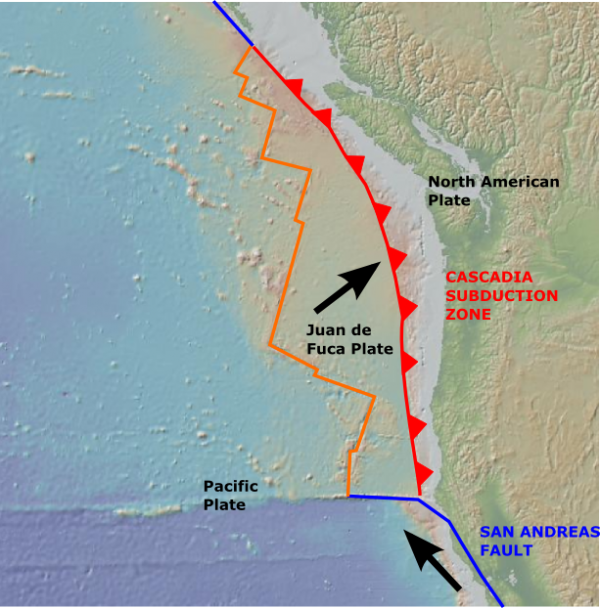
A post by Chris RowanIf you asked the average person on the street which part of the USA was most threatened by earthquakes, most of them would probably say California. The San Andreas Fault is so embedded into the popular consciousness that it is the only fault in the world to have its own Twitter account (we should probably be glad it is so inactive…). The San Andreas is certainly capable of generating large and damaging earthquakes; it has done so a number of times in the last couple of hundred years, and will do so again in the future. However, the Tohuku earthquake 3 months ago was merely the latest reminder that the biggest seismic threats do not come from onshore strike-slip faults, even ones located on plate boundaries. The tectonic structures that generate the biggest earthquakes, and cause the most devastation, are the shallowly dipping, tsunami-generating megathrusts at offshore subduction zones. And north of the San Andreas Fault, past the Mendecino Triple Junction, the west coast of North America has a subduction zone of its very own: the Cascadia subduction zone, where the Juan de Fuca Plate is being thrust northeast beneath the Pacific Northwest.

Tectonic map of the Pacific Northwest, showing the Cascadia subduction zone. Base map created using GeoMapApp.

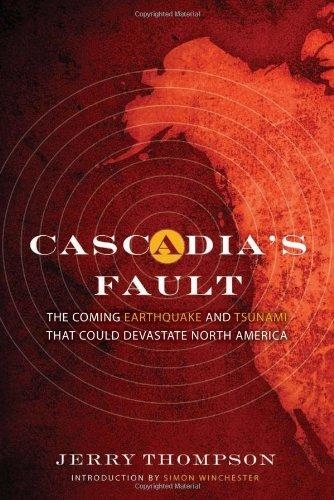
If you don’t know much about the risk posed by Cascadia, then you are not alone; indeed, for a long time even geologists were in the dark. The story of how they slowly uncovered the danger signs is the focus of journalist Jerry Thompson’s excellent new book, Cascadia’s Fault, a creditable attempt to raise awareness beyond geoscientists and emergency planners who have, as he puts it in his introduction, been “having a devil of a time getting anyone to pay attention.”

Cascadia's Fault, by Jerry Thompson

Although Cascadia is the focus of his book, Thompson’s story is actually much broader in scope. He takes us back to the early 1960s, when what are still the two largest earthquakes ever recorded shook Chile in 1960 and Alaska in 1964. Both of these events occurred on subduction zones, but back then, in a time before plate tectonics had been fully figured out, no-one knew that. Things that geologists now take for granted, such as thousand-mile long, shallow dipping thrust faults off many continental shorelines, were totally new and surprising – as were the tsunamis, capable of causing significant damage half an ocean basin away, that they generated.

Over the next decade, geologists gradually uncovered the workings of plate tectonics, and the nature of subduction zones. The deep trenches that advertised their presence could be seen all around the Pacific Rim. However, although people began to appreciate the risks these structures posed, that appreciation was not distributed equally. In Japan, Chile, and Alaska people started to worry about – and prepare for – the massive earthquakes and tsunamis that the subduction zones off their shores would one day generate. But Cascadia seemed to fly under the radar. In comparison to most of the world’s subduction zones, it seemed to be seismically quite quiet, and this led scientists to hypothesise, perhaps a little too hastily in hindsight, that Cascadia was different, and posed no real risk. Subduction had stalled, or the plates moved so easily past each other that no strain was being built up that would be released in large earthquakes.

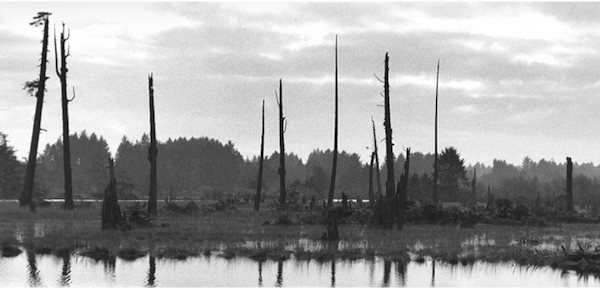
Cascadia’s Fault tells the fascinating story of how this view was gradually overturned. It started with geodetic measurements of deformation on the coast behind the subduction zone, which suggested that the the subduction zone was, in fact, locked and accumulating strain. Then there was Brian Atwater’s discovery of drowned forests and salt marshes, lowered beneath the waterline in the subsidence that follows a large subduction zone earthquake and then engulfed by the tsunami it generated. Then, finally, a sublime bit of detective work allowed the event that killed the trees to be accurately dated. An ‘orphan tsunami’ – a large wave without any accompanying earthquake, indicating that it was generated somewhere else around the Pacific Rim – was found in Japanese records. With macabre precision, we now know that the last major rupture of the Cascadia subduction zone occurred at around 9pm on Janaury 26th, 1700 – and it was a Very Big One.

One of Cascadia's 'ghost forests', drowned following the 1700 earthquake: Source: 'The Orphan Tsunami of 1700' by Atwater et al.

Now, thanks to the work of marine scientists such as Chris Goldfinger, we know not only when the last big Cascadia earthquake happened, but also the approximate timing of the forty before that. A big earthquake can trigger submarine landslides along the whole length of the ruptured margin, and the record of those simultaneous landslides in oceanic sediment cores provides an unmatched record of Cascadia’s last 10,000 years: 41 large earthquakes, 19 of which appear to have been magnitude 9 tremors that ruptured the whole length of the margin. All of this has happened before, and all of it will happen again.

This story is excellently told, providing a good amount of detail without ever straying into jargon. It is also an excellent account of how science truly progresses. There is no one moment where the paradigm shifts, in a dramatic showdown between a young mavericks and the musty old guard: the community works on a problem together, with many scientists working on different aspects of the problem, and people gradually changing their minds as the evidence becames more convincing.

Also, despite the gravity of the threat that Cascadia poses, Thompson avoids lapsing into fearmongering. In the closing chapters, he attempts to describe how a magnitude 9+ rupture on the Cascadia subduction zone might play out for the cities, towns and residents of the Pacific Northwest – an exercise in imagination that has been made rather redundant by the real life imagery from Japan 3 months ago – but he ends with the proposition that although Cascadia’s next rupture will be a severe blow, most people can survive to rebuild – if we are adequately prepared.

After all this deserved praise it seems a little churlish to mention the only real gripe I have with this book, but you might have spotted from the picture of the cover that the foreward is written by Simon Winchester, he of the notorious (and scientifically questionable) Newsweek article. To the dismay of my now rather ground teeth, his contribution is basically that very article (literally – some sections are almost word for word) bookended with some paragraphs about Cascadia. But let’s not let a few silly pages obscure the fact that this is a truly excellent book. According to his bio, Jerry Thompson has been following the Cascadia story, on and off, for the past 25 years. It shows.

Cascadia’s Fault is published by Counterpoint Press and can be ordered online from Amazon and Barnes and Noble. Check out the book’s website for more information.

Categories: earthquakes, geohazards, reviews

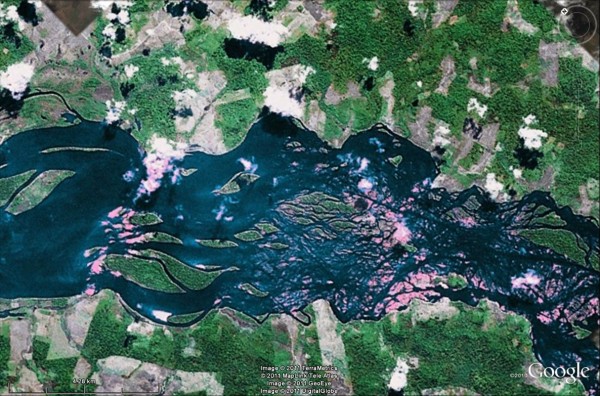
Where on Google Earth #291

A post by Anne JeffersonHaving identified the location of the previous WoGE as the world’s tallest landslide dam, I have the honor of hosting the next go-around of this digital scavenger hunt.

For those that haven’t played before, here’s a quick overview of the rules. First one to correctly identify the latitude and longitude of the center of the image AND say something about what makes this area geologically interesting…wins. The prize is getting to pick the next WoGE location and hosting it on your blog or picking a geoblogger to host it for you. If you’ve won WoGE in the past, you have to wait one hour before submitting your answer for each of your previous wins (the Schott Rule). If you don’t remember how many times you’ve won, you can look at Ron Schott’s kmz file.

I don’t know much about the geologic history of the place pictured below, but I picked it for a certain relevance to Anthropocene events.

WoGE 291 (image from Google Earth)

Where on (Google) Earth #291? (Click for a larger image)

Posting time is 12:25 pm US Central Time (17:25 GMT) on 16 June.

Note: I’ll be offline this weekend, so if you solve the WoGE, you can go ahead and post the next one if you wish. If the WoGE is still unsolved when I return, I’ll consider a hint.

Categories: by Anne, geopuzzling