Dear Nature, You got a sexist story, but when you published it, you gave it your stamp of approval and became sexist too.

A post by Anne JeffersonDear Nature,

“Womanspace” by Ed Rybicki is the most appalling thing I have ever read in a scientific journal. When I read the Futures (science fiction) piece you published on 29 September 2011, about how the hero and a man friend were unable to cope with a simple errand and how that led them to discover the existence of parallel universe inhabited by women that naturally endowed women with their domestic prowess, but which women were too dumb to observe until the great men of science made their discovery, I checked to make make sure I was still on nature.com. To my dismay, I was.

The story hearkens back to the “good old” sexist days when men did important things (like write books about virology) and women did unimportant things (like keep their families fed and clothed); when men couldn’t be bothered to be useful around the house and even when women did manage to get science degrees they were better employed as cooks and errand runners. The writer makes the explicit assumption that all of his (and, thus Nature’s) readers are male and have a “significant female other” who helps with their shopping. The story uses a cliched trope that women have an alternate reality, but then adds the extra punch that we aren’t even smart or observant enough to know it. As a woman scientist reading this article, it seems in every way designed to make me feel othered and excluded from the scientific academy.

It’s one thing to write a not-very-funny witty story full of sexism and gender stereotypes, but it’s a completely different thing to publish it with the stamp of approval of one of the world’s leading scientific publications. Maybe the writer is really privileged and clueless enough not to have intended this as an effort to put women in their place, but it’s not plausible that the Nature editorial staff were blind to the way this piece would be perceived. Besides, the evidence suggests that both the writer and Nature’s Futures editor were fully aware that they were courting controversy and perhaps were even doing so intentionally. When the piece was published, the author tweeted “I WILL catch flak for this” and four days later Henry Gee (who claims to be the editor of this section) commented: “I’m amazed we haven’t had any outraged comments about this story.” The outrage did come, and the majority of comments posted on Nature’s website have been highly critical. This week, Nature published two of the comments as correspondence in their current issue, which is how this story caught my attention. I don’t want to read fiction in my scientific journals, but I do pay attention to letters with titles of “Women: Sexist fiction is alienating” and “Women: Latent bias harms careers.

So far I have seen no other response from Nature Publishing Group, on what in my opinion is an atrocious decision to give a broader platform to the author’s sexist views. The Careers section of Nature routinely has articles about the challenges faced by women scientists, maybe now they can write an expose on their own organization? Better yet, Nature should print an apology for the piece and seriously review their practice of approving Futures articles for publication.

Sincerely,

Anne Jefferson
University of North Carolina at Charlotte

Categories: academic life, by Anne, publication, ranting, society

Writing Challenge, Week 2: Define progress.

A post by Anne JeffersonSciwrite by Chris RowanIt’s been two weeks since I issued the initial challenge to join me in a month-ish of intense writing activity. Last week, I told you what I was doing and how it was going, and 13 brave commenters shared (and even graded) their own early progress. There’s also been sporadic use of the #sciwrite hashtag on Twitter, though I’ve noticed that there seems to be some association with declarations of suboptimal progress on writing committments.
I’ve been making some of those declarations myself. I proclaimed that I’d have one part of the results section done last Monday, complete methods and results by Friday, and introduction, discussion, and figures in progress too. Well, uh, … my week of writing didn’t quite go according to plan. Instead, I spent Monday’s writing time puzzling over that same results section. I just couldn’t wrap my head around the data for one of the field sites. Nothing I read helped me explain it. I finally decided I needed to dive back into the GIS data for the site, and on Thursday I found my smoking gun. A minor georeferencing problem essentially caused a portion of my dataset to be gibberish. ARGH!!! Friday, I redid the GIS work and began the process of rewriting the section. I had 600 words in that section this time last week. Now I’m up to 772, but every single one of those words has been changed multiple times in the past seven days. They are hard fought words and simple counting does not provide an adequate measure of progress. Instead, I’m viewing it as having done my due diligence on the dataset and saved myself from going way out on a limb to try to explain something that wasn’t actually there. So much better to have discovered this now than during peer review.

Thus, tonight’s subheading is “Define progress.” By any numeric metric, my week has mostly been a wash, but in terms of the quality of my science, it’s been a big gain. Not only because the data are now right, but also because all the reading, thinking, and head-scratching that I did in trying to figure this out has advanced my thinking not only about the paper, but about the way landscapes behave. Maybe this was just the “boink” I needed.

How about you? Did your week go smoothly and according to plan? Or do you need to define progress in a new way?

Categories: academic life, by Anne

Stuff we linked to on Twitter last week

A post by Chris RowanA post by Anne Jefferson

Other posts on All-geo

Blogs in motion

Volcanoes

Earthquakes

Fossils

(Paleo)climate

Water

Environmental

Planets

General Geology

Interesting Miscellaney

Categories: links

Scenic Saturday: Wood in Streams

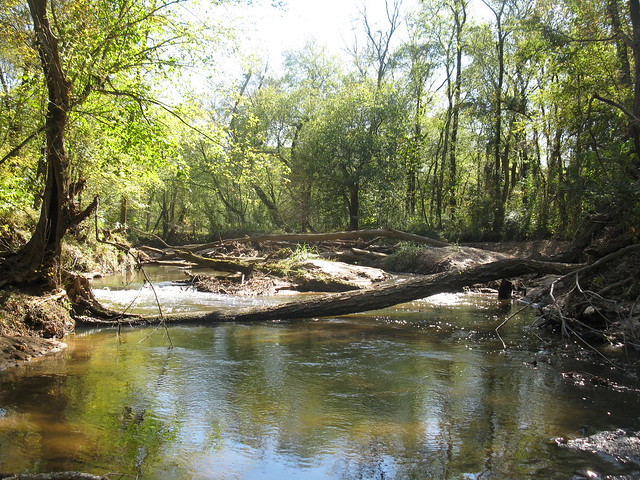
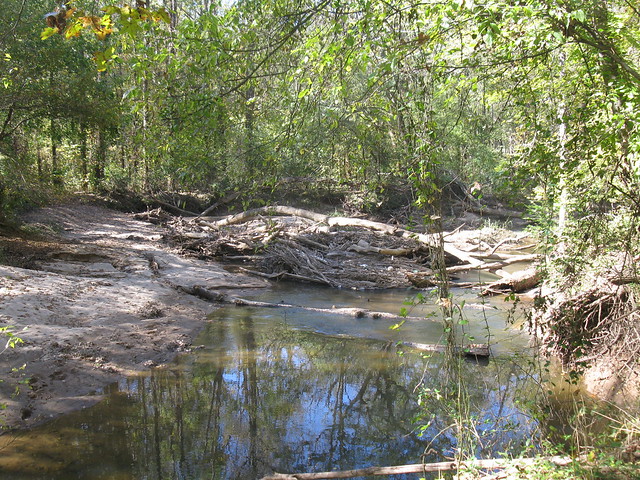
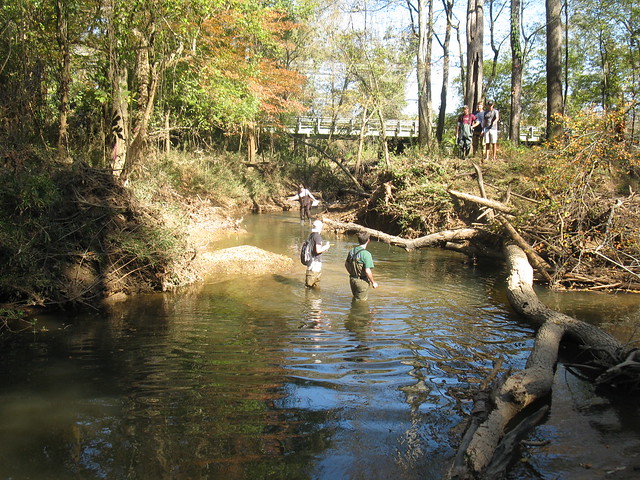
A post by Anne JeffersonOne of our field trips in my Fluvial Processes class takes the students to the lower reaches of Mallard Creek, the urban stream that drains the northern portion of Charlotte, including our campus. For most of its length, Mallard Creek is highly incised, so it’s quite a surprise to see the stream near its mouth, where it is more free to meander through a floodplain forest. For their field exercise, the students measure meander geometry and plot it against the classic Leopold, Wolman and Miller relationships, they attempt to identify bankfull channel geometry, and they contemplate the effects of wood on channel morphology.

Looking upstream at the big wood jam (photo by A. Jefferson, 2011)

Looking upstream at one of the big wood jams in Mallard Creek, near Harrisburg, North Carolina

Looking downstream at the same wood jam (Photo by A. Jefferson, 2011)

Looking downstream at the same wood jam as above. Notice how much smaller wood (and trash) has piled up against the big keystone logs.

Wood is perhaps the most striking feature of this reach of Mallard Creek, because it is everywhere, and because it is profoundly shaping the channel geometry and meandering behavior. So it is appropriate that Mallard Creek had an important role in the scientific recognition of the importance of wood in shaping fluvial systems. A 1979 article by Ed Keller and Fred Swanson, “Effects of large organic material on channel form and fluvial processes“, is the fifth most cited paper in geomorphology, according to an analysis done by Martin Doyle and Jason Julian in 2005. As part of their analysis, they asked the authors of the highly cited papers to speak to what inspired the work. Here’s what Keller said:

I first recognized the importance of large woody
debris while doing PhD work on pools and riffles in
Wildcat Creek near Lafayette, Indiana in 1971. I observed
that the debris formed a jam that backed up
water at high flow. The backwater caused a chute to
form across a bend, facilitating a meander cutoff. I
nearly forgot this until starting as a new Assistant
Professor at the University of North Carolina at Charlotte.
I was looking at Mallard Creek near the university
for a site to study pools and riffles. The floodplain
was forested, and I was complaining to myself that I
couldn’t find a “natural” site without large woody
debris interfering with the morphology I was looking
for. Then it happened—I heard a large groan followed
by a loud cracking. I walked around a bend just in time
to see a large tree fall into the stream with a great
splash! I suddenly had the a-ha–this is “natural”–these
streams with forested floodplains and lots of trees on
the banks are greatly modified by large woody debris
that enters the active channel! Then in 1973, I moved
to the University of California, Santa Barbara, and
started work in the redwood forest of northwestern
California where the woody debris that ends up in
streams is truly gigantic. I contacted Fred Swanson,
who was working for a US Forest Service Research
Laboratory at Oregon State University, and suggested
we write a paper on the role of large woody debris on
stream channel form and process. Fred had been working
for several years on large woody debris in streams
of the Oregon Coast Ranges. We had a great collaboration
at just the right time for the emerging field of
forest geomorphology.

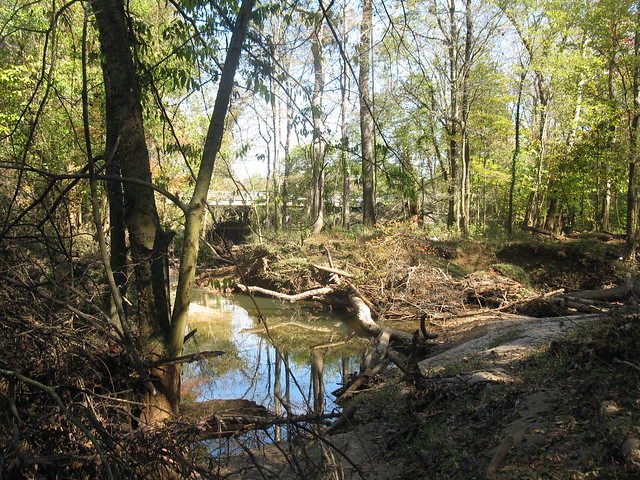
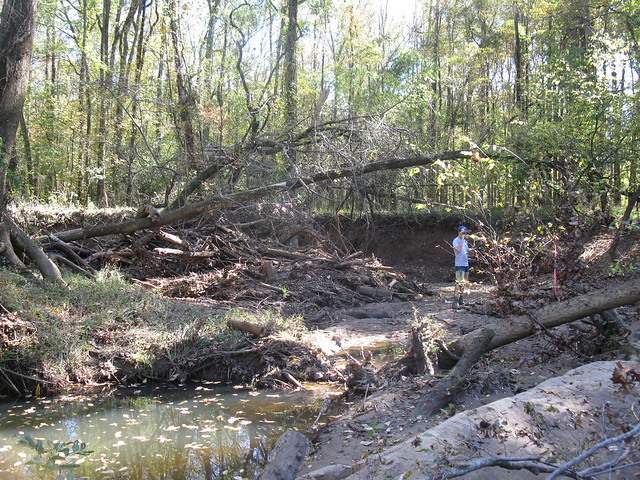
I haven’t seen a tree fall into Mallard Creek, but in the five years I’ve been bringing my class to this site, I’ve seen some pretty remarkable changes. The photos below show a meander that cut off sometime between May 2010 and October 2011. In May 2010, the “new” channel (on the left) existed but was very narrow and didn’t carry water at low flow. Now, the “old” channel (on the right) is largely sedimented (and wood-jammed) in and carries only a trickle of water at low flow. While the meander would likely have cut off at some point in the future, my interpretation is that a series of large wood jams in the old channel backed up water during high flows, increasing overbank flooding, and greatly accelerating the cut off process.

Old channel on the right, new channel on the left (photo by A. Jefferson, 2011)

A recently cutoff meander in Mallard Creek. The new channel is to the left, the old channel (active in May 2010) flowed to the right.

Looking down the old channel (photo by A. Jefferson)

Looking down the old channel, from atop the large wood at the cutoff point.

Looking down the new channel (photo by A. Jefferson, 2011)

Looking down the new channel, with students for scale. The students on land are on an island between the old and new channels.

Categories: by Anne, environment, geomorphology, photos, publication, science education

Friday focal mechanisms: aftershocks in eastern Turkey

A post by Chris RowanAlmost a fortnight after a magnitude 7.1 earthquake shook Eastern Turkey, the region continues to suffer from aftershocks, and there were two pretty big ones earlier this week: a magnitude 5.2 on Tuesday, and then a magnitude 5.6 on Wednesday. As this rather harrowing CCTV footage shows, the shaking from the latter quake was powerful enough to push more buildings past the point of collapse, killing at least 13 people.

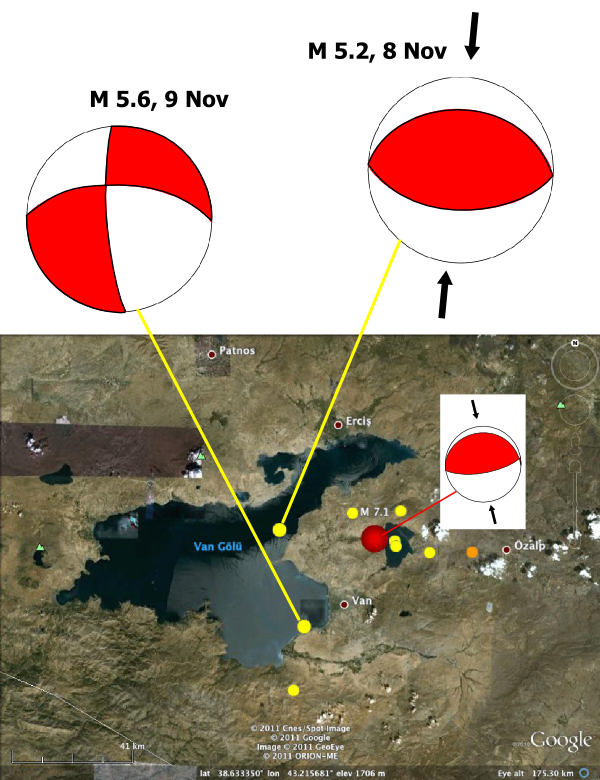
Like the original shock, the focal mechanism for the smaller M 5.2 tremor on Tuesday indicates north-south compression on an east-west oriented thrust fault (a primer on interpreting focal mechanisms). It is 20-30 km directly west of the main shock, so potentially occurred on the same fault that originally ruptured a couple of weeks ago. In contrast, the more damaging M 5.6 quake was 30-40 km to the southwest, and has a strike-slip focal mechanism.

Focal mechanisms for the two M 5+ aftershocks of the Van earthquake in Eastern Turkey this week. Red circle and inset focal mechanism are for the M7.1 main shock.

As I discussed in my original post, and talked about in a bit more detail on the Scientific American guest blog, tectonics in this region are complicated, due to the transition between continental collision further east in Iran, and the strike-slip ‘escape’ tectonics that drive activity on the Anatolian Faults further to the west in Turkey. So we might expect to be seeing thrust and strike-slip earthquakes mixed up with each other. However,the precise type of deformation that the focal mechanism represents is a little unclear in this instance. Every focal mechanism has two ‘focal planes’, which represent the two possible ways the ground could have moved in the initial rupture to produce the first-motion patterns seen on the global seismograph network. Without additional information, such as a surface rupture or knowledge of regional structure, it is sometimes difficult to know which of the focal planes actually corresponds to the fault.

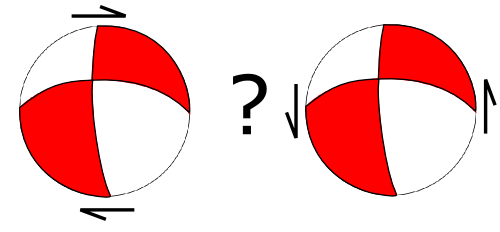
In the case of Wednesdays earthquake, the focal mechanism tells us that it was due to right lateral strike-slip on a fault that runs from east to west, or left-lateral strike-slip on a fault that runs from north to south.

Two possible interpretations of the M 5.6 aftershock on Wednesday, depending on which of the focal planes is the fault plane.

The first option, an east-west running strike-slip fault, is more consistent with the overall regional deformation (Turkey moving west). But the main shock last month tells us that this particular area is also experiencing north-south compression, which could be accommodated by strike-slip on a north-south oriented fault just as easily as thrusting on an east-west trending fault. This ambiguity is a useful reminder of the limits of studying tectonics from a distance: you can usually see the big picture, but without knowledge of local geology and structure you can’t always unravel the detail.

Categories: earthquakes, focal mechanisms, geohazards