

Wednesday at AGU

A post by Chris RowanChris: Wasn’t it the first of your two invited talks this morning? How did it go?


A post by Anne JeffersonAnne: It went well. Even though I hadn’t managed to run through the presentation out loud beforehand, I hit the final slide with 20 seconds before the light came on, and a couple of people stuck around until after the session to ask questions and give feedback. Plus, the other talks in my session were really cool. I learned about catastrophic ecosystem shifts, landscape controls on net ecosystem productivity, a sedge that behaves like a boulder, and all sorts of neat connections between water, landforms, and life that I hadn’t known much about before.

What did you do this morning?

Chris: Good question. I started off this morning going to a workshop on NSF funding.

Anne: That sounds useful. Any pro tips?

Chris:It was more a good introduction to the complexities of the US funding system, but they did start off by trying to dispel pessimistic rumors about funding levels. The program officers all seem to think it’s a great time to get good geoscience done.

Later in the morning, I sat in a session on the challenges of interpreting rock magnetic records from sediment cores. It’s quite fast and easy to measure things like magnetic mineral concentration and grain size, which can theoretically act as proxies for environmental changes that effect sediment source and supply. Unfortunately, magnetic minerals also tend to be highly sensitive to redox conditions, which means that any environmental signal is convolved with a strong diagenetic filter that can drastically alter the original record. Most of the talks emphasised how difficult it can be to see through the effects of diagnenesis. However, the session ended on a positive note by introducing a potentially cool new source of high resolution magnetic records – from stalagmites in cave systems.

What did you move onto after your talk session concluded?

Anne:In a way I had a nice transition into thinking about my talk for Thursday. I ended up in the poster hall vortex, unexpectedly looking at volcano geomorphology posters. I watched Gordon Grant get very excited about critical flow in molten lava, and I was pleased to see Brian Romans’ fantastic picture of standing waves on the poster. Then I learned what happens when a pyroclastic density current falls off a cliff. After a working lunch, my brain needed a rest and found solace in the geomorphology corner of the exhibit hall, where within the space of a few short meters I found the Emriver stream table, the National Center for Earth Surface Dynamics delta model, and the St. Anthony Falls Lab high-resolution terrain scanner. After that I was ready to head back to talks, and a funny thing happened.

Chris: Oh? What’s that?

Anne: I ran into you.

Chris: Ah, yes. We both decided to attend the Birch Lecture, given by Michael Manga. I believe I was grumbling a bit after sitting through the latest episode of ‘nobody ever believes the paleomagnetists’ in the companion session to my poster session yesterday. Lots of presentations trying to understand the tectonic forces that caused the bend in the Hawaii-Emperor hotspot chain 50 million years ago, when the paleomagnetic data show clearly it’s more to do with the hotspot moving – or ceasing to move – than any change in the motion of the Pacific plate. We’ll convince them eventually – if you can get both of us attending the same talk at AGU, anything can happen.

Fortunately, I soon got into Michael Manga’s very interesting discussion of the hydrological effects of distant earthquakes. It was actually rather impressive seeing how the transient stress produced by the passage of seismic waves could produce large and permanent changes in groundwater flow. It certainly provides some insight into how similar changes, deeper underground, could affect volcanic and earthquake activity.

Anne: [Evil laughter] I knew I’d corrupt you eventually. It’ll be groundwater flow modeling for you next! The earthquake hydrology stuff was quite interesting, but I know the big draw of that talk was Manga’s work on Lusi, the Indonesia mud volcano. Maybe there will be an update on his latest calculations, and what Lusi is doing lately, on this blog at some point?

Chris: I did find it a rather ironic counterpoint that his work on Lusi is all about disproving an earthquake connection – which he did, fairly convincingly. As for an update post, we’ll have to see; he did point to some newly published calculations on the potential longevity of Lusi’s eruption (there’s a 50% chance it will continue for another 50 years) which may be worth looking into.

But first, I have to survive the rest of the conference.

Anne: At least you don’t have to give another talk tomorrow morning.

Chris: True enough. Good luck!

[NB: This is a repost. A server failure at our hosts meant the original was lost.]
Categories: conferences

Tuesday at AGU

A post by Anne JeffersonAnne: So, Chris – how did your poster session go?


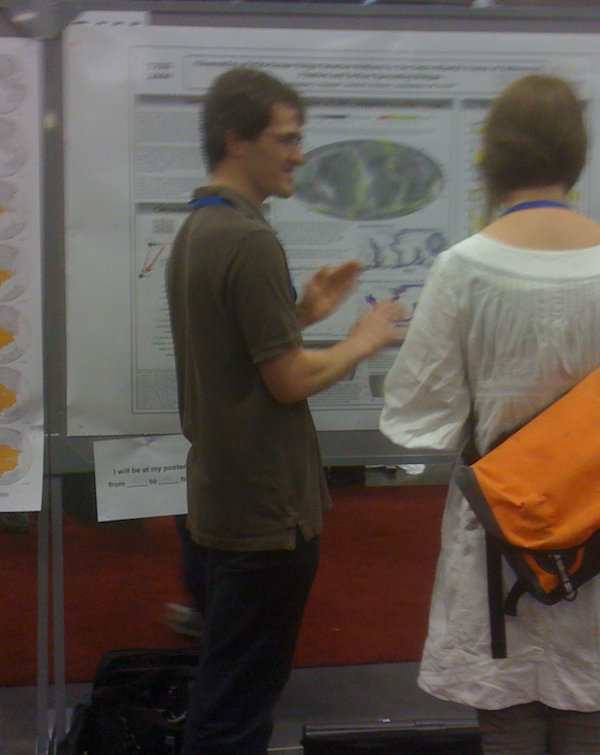
A post by Chris RowanChris: It went pretty well. The two key things that you want from a poster session are that you spend more time talking to people than you do standing and staring hopefully at everyone wandering past, and that the people you talk to don’t find glaring, basic flaws in the scientific story that you’re trying to present. Most people seemed to think that I had an interesting story about global ridge motions and how the EPR is fixed in the mantle, and I still had my voice at the end of it all. So I’m pretty satisfied.

Chris discusses his poster. Camera angle cunningly chosen to hide confused look on the face of his audience.

Anne: And did you get to those talks you wanted to see this afternoon during your poster session?

Chris: I got to the Gutenburg Lecture just after lunch. Thorne Lay gave a great overview of how seismic and geodetic data from continuous GPS receivers are being combined to great effect in studies of large subduction zone earthquakes, like the 2004 Sumatra earthquake and this years Tohuku earthquake off Japan (what he called ‘seismo-geodesy’). It was quite fun for me because a lot of the earthquakes he talked about were quite familiar to me through my blogging about them.

Sadly, a lengthy discussion at my poster prevented me from attending the rock magnetism talk I was planning to go to at the end of the day. By the time I’d finished talking, the lecture had already been going for 15 minutes.

Anne: Yeah, I know what you mean. I missed a whole hour of talks I meant to see, but had really good, useful conversations in that time instead. I’m starting to think that the poster hall has a serious gravity well associated with it. Every time I think I’m going to escape its orbit and go and listen to some talks in Moscone West, I get sucked back into the vortex by just one more interesting poster, or an encounter with a long-time acquaintance.

Chris: So any highlights from the poster hall vortex?

Anne: I had a couple of really good discussions about linking topographic form of watersheds to the geomorphic processes that shape them, which is directly related to the talk I’m giving tomorrow morning, so it was helpful to see what other people were thinking and doing in places ranging from endorheic basins in Chile to the mountains of Idaho.

But the definite highlight of my time in the poster vortex was running into a former undergraduate student of mine, who took my very first offering of hydrogeology. Now he’s completing a Masters degree in hydrogeology.

Chris: Very cool. My adventures in the vortex centered around the tectonics of subduction zones – particularly what happens when you try to subduct things like ridges and seamounts. I also had a good discussion of new data being collected along the Hikurangi subduction zone off New Zealand, which is a long-standing interest from my PhD research. But I did finally escape to Moscone West, where I sat in on an interesting series of talks about the role of tectonic inheritance in determining the structure of mountain belts. I’d never really appreciated this before, but if a continental collision is the end result of an ocean basin closing, then that ocean had to have first opened up by rifting; and it seems that the structures that formed during that rifting are very important when you get to the mountain building stage. So to truly understand mountain belts, you have to think quite long-term.

And you managed to escape to see some talks today, didn’t you?

Anne: Yes. I spent a good chunk of the afternoon in a hydrology session on ‘Landscape system response under change’, which had talks on the intersections between hydrology, geomorphology and biology. I especially liked Ellen Whol’s talk on the influence that headwater stream geomorphology plays on carbon storage in coarse wood in the floodplain and channel and in fine sediment. Beavers may play an important role in the carbon cycle!! It got me wondering about ways that urban stream hydrology and geomorphology may influence carbon dynamics.

Actually, Chris, it was all about allochthonous materials – at least as I understand them!

Chris: Well, there’s at least one word I understand! Once again, we both had very busy days which had very little in common with each other. It just goes to show just how much is going on at AGU. Bring on Wednesday!

[NB: This is a repost. A server failure at our hosts meant the original was lost.]

Categories: conferences

Monday at AGU

A post by Chris RowanChris: So how was your first day at AGU? You had a poster to present this morning, I think.

A post by Anne JeffersonAnne: It wasn’t really my first day, you know. Yesterday I was at the Berkeley Catchment Science Symposium which was filled with really great talks on topics ranging from floods to metal isotopes, and lots of great discussions. It was a great way to get my head into the intense science week of AGU.

Chris: Alright, I’m a slacker.

Anne: But, yes, the poster. I was standing in for my graduate student Alea Tuttle and colleague Sara McMillan, who were unable to make it to the meeting. The poster presents some cool data on how stream restoration affects nitrogen dynamics at the stream-reach and individual structure scale. Alea did a great job putting the poster together so that it was very clear what she’d done and found, but I did get a few questions I wasn’t fully able to answer, so I’ll be going back to Charlotte with a few queries for Alea. I’m sure they are all things she’s thought of, and I’ll get a chance to learn some more nitrogen stuff as she explains things to me.

Chris: Excellent. What did you get up to when you weren’t manning your poster?

Anne: I saw a few talks – also on nitrogen, as it relates to hydrologic dynamics. And I caught up with old friends and made some new ones. After going to AGU for about 6 years, it’s amazing how much of a community it becomes.

How about you? You weren’t still working on a presentation, were you?

Chris: I got my poster done before getting on the plane, thank you very much. I’m presenting it tomorrow afternoon.

Anne: So, plenty of time to learn about interesting new science, then.

Chris: Yep. I ended up spending a lot of time today listening to talks discussing the interactions between convection in the mantle, plate tectonics, and topography – an area that my current research semi-overlaps with. I found it quite interesting how, depending on the research objectives, some people were using plate motions to drive mantle convection models, whereas other people were using the history of subduction encoded in the mantle’s temperature structure to refine plate motions. Several talks also emphasised how important mantle flow in response to subduction is in determining things like slab dip and deformation on the overiding plate.

In between talks, I visited the poster hall to look at the paleomagnetism contributions – experimental dynamos, Pangea reconstructions, the timing of the India-Asian collision, oh my! There were also a few interesting ones on dynamic stress triggering following large earthquakes – including a study that proposed that surface waves from a large main shock could circle the globe and trigger its own aftershocks. This falls into the ‘too cool not to be true’ category, although statistically it’s not quite a slam dunk yet,

Anne: Wow, that is cool. But are you sure we’re attending the same conference?

Chris: Well, we both turned up at the same Social Media Soiree.

Anne: Purely coincidence, I’m sure…

Chris: Maybe the next few days will expose some topics of converging interest for the Highly Allochthonous bloggers.

[NB: This is a repost. A server failure at our hosts meant the original was lost.]

Categories: conferences

Highly Allochthonous at AGU 2011

A post by Chris RowanA post by Anne JeffersonIt’s that time of year again – the time when San Francisco gets invaded by a small town’s worth of geoscientists for the annual AGU conference. At least 20,000 people have registered this year at last count, although since that number includes geologists and geophysicists, atmospheric scientists and oceanographers, hydrogeologists and geobiologists, what this really means is that it’s more like 10 conferences all running in parallel.

Chris and Anne are both at the conference this year, although probably mostly not in the same place because of our rather different scientific interests. Given how easily a carefully worked-out schedule can be disrupted by a random meeting in the hallway, the best way to keep track of our progress is to follow @Allochthonous and @highlyanne on Twitter (there is also a hashtag, #AGU11, that will allow you to keep track of all the geotweeps attending the conference). However, there are a few places where we will definitely be:

  • Monday morning: Anne has a poster B11C-0497: “Geomorphic and chemical controls on sediment denitrification in restored urban streams” in Moscone South.
  • Monday, 6-8 pm. Anne and Chris, along with lots of your other favourite geology bloggers and tweeters, will be attending the AGU’s Social Media Soiree in InterContinental Ballroom C.
  • Tuesday, from 1:40 pm: Chris will be manning his poster T23D-2444: “Kinematics of Mid-Ocean Ridge Relative Motions in the Indo-Atlantic Frame of Reference: Passive and Active Spreading Ridges” in Moscone South.
  • Tuesday Evening: Anne will be attending the CUAHSI Reception in the Grand Hyatt Ballroom.
  • Wednesday, 9 am: Anne is presenting the talk “Understanding channel network extent in the North Carolina Piedmont in the context of legacy land use, flow generation processes, and landscape dissection” in Rooms 2022-2024 (Moscone West).
  • Wednesday, 10:50 am: Chris is a co-author on the talk “Magnetic properties of sedimentary greigite (Fe3S4): An update” in Room 304 (Moscone South).
  • Wednesday, 3:10 pm: Chris is a co-author on the talk “The East Pacific Rise: An Active Not Passive Spreading System” in Room 2012 (Moscone West). This is a companion talk to Tuesday’s poster.
  • Wednesday, 5-6 pm. In a rare confluence of our scientific interests, we’re both planning to attend the Birch Lecture by Michael Manga. “Hydrological responses to earthquakes (and, was the LUSI mud volcano eruption in Indonesia caused by an earthquake?)” is in Rooms 2022-2024 (Moscone West).
  • Thursday, 9.15 am. Anne is presenting the talk “Controls on the hydrologic evolution of Quaternary volcanic landscapes” in Room 307 (Moscone South).
  • Friday, 4:45 pm. Chris is a co-author on (and may be presenting) the talk “Widespread remagnetizations associated with sedimentary greigite (Fe3S4): Implications for Neogene tectonic rotations within the Australia-Pacific plate boundary zone, New Zealand” in Room 304 (Moscone South).

Are you attending? Let us know what and where you’re presenting in the comments so we can come and find you.

Categories: conferences

Writing Challenge, Week 3: Slow and steady

A post by Anne JeffersonSciwrite by Chris RowanIt’s been three weeks since I issued the initial challenge to join me in a month-ish of intense writing activity. Last week I needed to redefine what I meant by making satisfactory progress, and several of you shared your own stories or definitions of progress in comments or tweets.

This week I did not encounter any unexpected barriers to progress, but I was forced to remind myself of the children’s story about a sprinter and a plodder. I never had a breakthrough moment of rapidly advancement this week, but manuscript-related word documents, PDFs, excel files, and figures filled up my task bar almost all week. Image of taskbar showing all the paper-related files open

According to my rather optimistic timeline, I should have everything but the conclusions written by tonight. I don’t. Last Sunday, in a bout of free-writing I got a great introduction drafted, but going through it, double checking things, and adding appropriate references has taken substantial time this week. This time last week, I had about 600 words and no references in the introduction. Now I have ~550 words that are complete with citations and another ~500 to go. I’ve continued to tinker with methods and results, and I’ve delegated some tasks to my co-author. I don’t have a discussion written yet, but it is gestating.

The other place where some progress was made this week was in the figures. There will be four, but several will have multiple parts. They are slowly being drafted in ArcGIS, R, and a combination of JMP/Inkscape. I always make sure that my figures are publishable quality and file formats before the initial submission, just in case I don’t have to revisit them later in the review process. But this means monkeying around with seemingly small details now, and learning some more R tricks along the way. Again, I’m not where I wanted to be with figures, but I’m on my way.

This week is a short work-week, but my goal is to get an almost complete draft to my co-author mid-week. I then need to turn my attention to the increasingly scary, looming presence of my two talks for AGU. I’m hoping that I can get at least one whipped into shape late in the week, so that I can head into a very busy week-before-AGU still able to keep working on this paper. December 3rd is not getting any farther away!

Anne's progress this week is comparable in speed to a Galapagos tortoise, but just like them, I'll get there eventually. (photo by A. Jefferson)How about you? Have you been slow and steady? Or making progress in periodic bursts? Either way, I’m confident we’ll all get to the finish line together.

Categories: academic life, by Anne, publication
