Friday(ish) Focal Mechanism: a kinky slab beneath Mexico

A quick look this week at the magnitude 6.5 earthquake that shook southern Mexico last Sunday. It caused a fair amount of shaking in Mexico City, and a few deaths, but apparently no major structural damage. The depth of the rupture – around 65 kilometres (40 miles) – means that the seismic energy released had spread out over a wider area by the time it reached the surface, reducing the maximum shaking close to the epicentre.

A tectonic map of the region shows that there is a subduction zone running along the southwest coast of Mexico, where the oceanic Cocos plate is being subducted eastward beneath the North American plate. The rupture depth of 65 km puts it below the crust of the overriding plate, so it must be associated with the subducting slab. The focal mechanism indicates that the earthquake was due to northeast-southwest extension (see my primer on interpreting focal mechanisms).
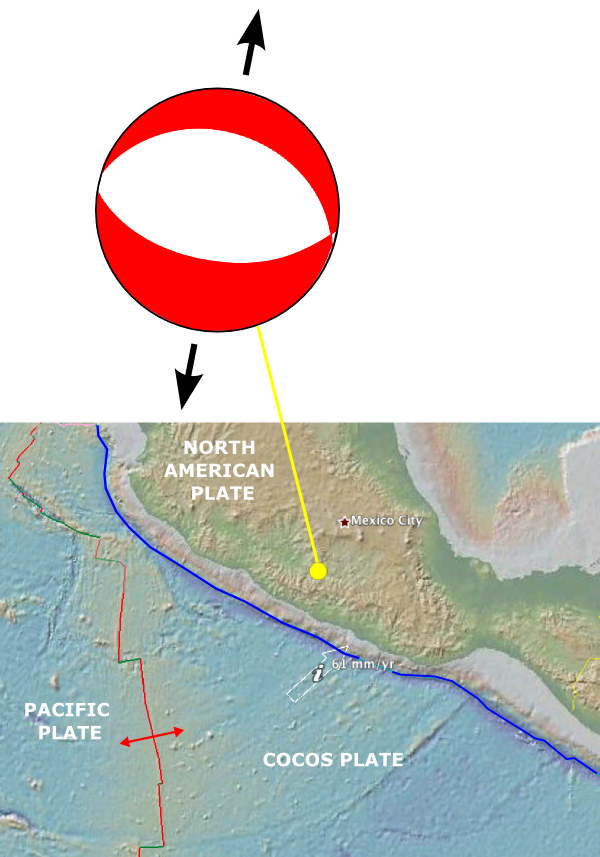
Map showing location of the M 6.5 earthquake that struck south of Mexico City on 11 December, its extensional focal mechanism and proximity to the subduction zone off the southwest Mexican coast.

This might seem a bit odd at first glance: subduction zones are all about accommodating plate convergence, so a compressional, thrust focal mechanism would seem more likely. However, while that would certainly be the case for an earthquake that occurred on the subduction megathrust itself, this is not the only place in a relatively cold, subducting plate where earthquakes can occur if stress is being applied to the interior somehow. One mechanism that causes extensional earthquakes within the downgoing slab is if it is being bent; for example, you often see earthquakes with normal focal mechanisms on the outer rise of a subducting plate, where the plate is just starting to bend as it is pushed beneath the overriding plate into the mantle. This earthquake was 180 kilometres behind the trench, so was obviously not associated with this initial bending. However, gravity, GPS and seismic studies of this subduction zone have found that there is probably further bending of the slab beneath Mexico. The width of the locked zone associated with the subduction thrust, where elastic strain is being built up that will mostly be released in future megaquakes, is about twice as wide (200 km or so) as it usually is, suggesting that the Cocos plate is being subducted at a very shallow angle beneath southwest Mexico, before it eventually steepens again about 275 km away from the trench. As the image below, taken from Manea et al. (2004) shows, an earlier kink, where there is a temporary steepening of the slab before it flattens out again, has also been postulated, mainly in order to explain the positions of all of the earthquakes that trace out the position of the main thrust.
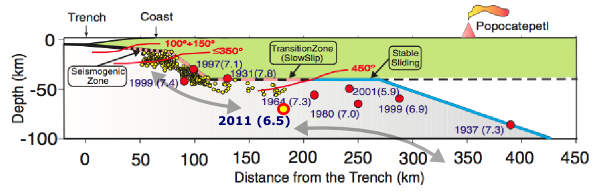
Cross section showing the inferred geometry of the subducted Cocos plate beneath southern Mexico, showing mostly shallow subduction with a steeper kink about 100 km behind the subduction zone, and slab steep deepening after 250-300 km. Red and yellow circle shows the approximate location of Sunday's earthquake. Grey arrows show inferred bending of the slab. Source: Manea et al., 2004.

Where does last Sunday’s earthquake fit into this geometry? It is located on the second shallowly dipping section of the subducted Cocos plate, about half way between the first steep section and the end of shallow subduction. This is a plausible location for an extensional earthquake; the slab will be starting to get stretched as the plate ahead of it is pulled down more steeply into the mantle. As the figure above shows, there were four other large earthquakes associated with the second bend in the plate; after a very brief search, I found the record of the 1999 6.9, which also has an extensional focal mechanism. So it seems reasonable to interpret last Sundays earthquake as a plate bending event, found where the Cocos plate is starting to transition from shallow to steeper subduction.

Of course, that still leaves us with a mystery: why is the dip of the subducting slab initially so shallow? If you look back to the map in the first figure, you’ll notice that whilst the crust being subducted beneath the west coast of Mexico belongs to the Cocos plate, you don’t have to travel much farther offshore before you cross another plate boundary – this time, a mid-ocean ridge – and find yourself on the Pacific plate. Although the ridge is still active and producing new crust, it is doing so at a slower pace than the Cocos plate is being subducted beneath Mexico. So over time, the ridge is getting closer and closer to the trench, and closer and closer to being subducted itself; a little further to the north the ridge and trench have already collided with each other.

One consequence of this is that the crust being subducted beneath Mexico is not very old; after cooling and solidifying from hot, molten magma at the ridge, it lingers on the surface for just a few million years after being created before it gets pushed back down into the mantle again. And if you’re subducting unsually young crust, that means you’re also subducting unusually warm crust: the way that oceanic crust is created means that it starts hot and gradually cools over tens of millions of years. Because hot, young crust is more buoyant – and therefore harder to subduct – than old, cold, dense crust, this might explain the shallow dip. The additional buoyancy of young Cocos crust makes it want to stay near the surface for a little bit longer, leading to shallow subduction. But eventually the slab is called back to a more proper angle for its return back to where it came from, even if it registers a seismic protest as it does so.

Categories: earthquakes, focal mechanisms, tectonics

Struggle and Serendipity (or: Yay! I’m in Open Lab!)

A post by Chris RowanFor some reason I wasn’t exactly keeping up with my e-mail last week – or much else that wasn’t Big Geology Conference related. So, although I did take note of the e-mail containing the glad tidings that my post ‘Ten Million Feet Upon the Stair’ had been chosen to be part of next year’s Open Lab anthology, once I had made a pleased noise or two (and a celebratory tweet), I didn’t have the time to dwell on it too much, as I had to get back to getting my brain overloaded by cool new geoscience.

But now I have the time to think about it (and get around to approving the edits for the book version before this year’s editor Jennifer Oullette breaks out her painful-sounding ‘Mallet of Loving Correction’*), I have to say that I’m rather pleased about this. Not just pleased in general, though of course I am; who wouldn’t be a bit chuffed that something they wrote is going to appear in a proper book? No, I’m pleased that it’s this particular post, of everything that I’ve written this year, that got the nod. Why? Because I put a lot of effort into writing it.

I’m actually not the most naturally fluent of writers: I can’t just sit down and let perfect prose flow easily from my head onto the screen or paper. Instead, my writing tends to coalesce from a starting collection of disjointed sentence fragments that represent the key ideas I want to express, or nice turns of phrase that express them. I arrange these into a semi-logical order, and then there is a messy sequence of filling in the gaps so it all flows together, swapping things around, and rewriting, sometimes several times.

For me, the most challenging writing is when I have an idea or concept that feels perfectly clear in my head, but is novel or unfamiliar enough that I struggle to actually articulate it. This happens all the time when I’m writing scientific papers: I can take ages endlessly writing and rewriting the same few paragraphs as I try to make my ideas and interpretations as clear and robust as I possibly can. It can be very frustrating, but despite the common stereotype, clear writing is just as important to doing good science as well-designed experiments, good data and clever ideas. After all, your revolutionary theories will get nowhere if you’re the only one who understands them.

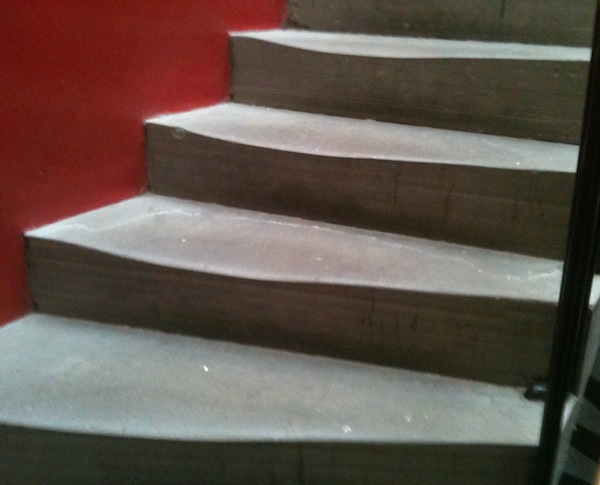
Sometimes, I hit a similar block when trying to write a blog post, and ‘Ten Million Feet Upon the Stair’ is a prime example. The basic concept – that a centuries’ worth of wear on a stone staircase is a striking visual representation of the large cumalative impact of many small actions, a key concept in geology – came to be not long after I first moved into my flat in Edinburgh. I liked the idea, and thought it would be good piece. But turning that passing thought into something more substantial turned out to be much more challenging, which is why a post about the staircase up to my flat in Edinburgh did not actually go up on the blog until two months after I’d moved to Chicago. By that point, it had already existed in some form for quite a few months, but I’d periodically work on it for half an hour or so, get frustrated with my inability to write something good, and put it away again for a few weeks. This continued until my annoyance with not finishing the darned thing finally inspired me enough to thrash out something I was happy with. That is why this post getting the nod from the Open Lab judges pleases me so much: I put quite a lot of effort into clearly articulating an idea, and writers who I respect got it. And they liked it! Validation!

On a less self-involved note, it wasn’t just due to the struggle to get it written that this post very nearly didn’t get written at all. To really make sense, the post needed a photo of the stairs in question. Given that I walked up and down them every day, and most of those times I was carrying a phone with a camera, you’d think that that wouldn’t have been a problem. But believe it or not, this shot:

The stairs up to my Edinburgh flat. Photo: Chris Rowan, 2010.

was taken on my last morning in Edinburgh, about ten minutes before I got a taxi to the train station. You’d think that when you’re about to move countries, taking photos for future blog posts would not exactly be at the top of one’s to-do list, but it turns out that you recall all sorts of things when you’re in an empty flat with nothing to do but wait. I’m certainly glad now that I remembered.

So that’s the story of my Open Lab entry, which is in some pretty illustrious company. I was extremely glad to see that the judges loved Dana Hunter’s wonderful account of how she got bitten by the geology bug, ‘Adorers of the Good Science of Rock-breaking’ (also a lovely testimonial to the power of public outreach through blogging), as much as I did. Further geoblogospheric representation comes via Dave Bressan’s fascinating piece on forensic geology. Not that these two posts, and mine, represent even a small fraction of the truly excellent geoblogging that took place in 2011, but hopefully we’ll do you all proud in the finished anthology.

*sic. And scary.

Categories: bloggery

All the blogging from AGU

A post by Chris RowanOne thing I’ve been doing in free moments since the end of the AGU Fall Meeting is catching up on what cool science other geobloggers who attended the meeting had unearthed whilst wandering the poster hall and lecture halls. Below are all the posts I’ve found in my feeds about the meeting. This is probably not a totally comprehensive list, so feel free to point me at anything I’ve missed in the comments.

Overview posts

Monday

Tuesday

Wednesday

Thursday

Friday

Lots of interesting stories there, even though it represents only a tiny fraction of all the new science that was presented during the course of the meeting. To their credit, this year AGU has also provided us with video of the keynote lectures and some sessions (one of which features my co-blogger about 40-45 minutes in), and gave people the option of putting their posters into an online repository (at least 2000 were uploaded, and mine is one of them).

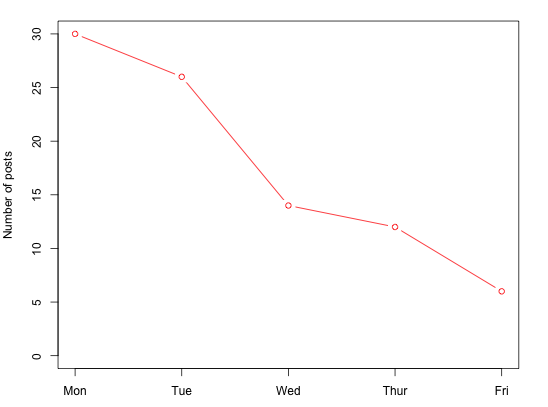
One thing that stands out when looking at the blogging activity listed above is the precipitous decline in posting as the week progressed:

This is hardly a surprise; a five day conference featuring 20,000 of your scientific peers is pretty overwhelming on the first day, let alone on day 5. There’s too much cool science to see, too many people to catch up with, too little time to write about it all and still get any sleep. Even the light-hearted blog chats between Anne and I were almost too much. Maybe audio would be a better option? Either way, I think I definitely need to give any future conference dispatches slightly more descriptive titles.

Categories: bloggery, conferences, links

Writing Challenge: The end, or is it?

A post by Anne JeffersonSciwrite by Chris Rowan“I love deadlines. I like the whooshing sound they make as they fly by.” – Douglas Adams

I’m a week overdue for my final sciwrite check in, and I didn’t make my goal of submitting the manuscript by the time I arrived in San Francisco for AGU. The week leading up to AGU was insane, as conference prep and the end of the semester collided with a bout of the stomach flu. This past week was an extremely busy conference week, and the word document hasn’t seen many changes in the past two weeks. But I’m actually glad I didn’t make my submission-by-AGU goal, because the process of writing my talk was another useful step in gathering my thoughts and honing my message; I got good feedback on the talk; and I had a very helpful discussion with a mentor/editor about which journal the paper should go to. I’m flying home from AGU more confident that I’m on the trail of something neat and with more ideas for relatively painless analyses that will give the paper extra oomph. I’ve also started thinking about how I want this paper to be the beginning of further work on the topic, and how I might craft my ideas into a proposal in the next several months. Of course, I still want to get the paper off my desktop and into review in the near, near future, so I’ll be getting back to work on it just as soon as I finish this post.

I’m really pleased with the progress that I’ve made on this project over the past six weeks or so, and I know that if I hadn’t set myself a spirited goal and a vigorous timeline I wouldn’t have made as much headway. I think my take-away lessons were two-fold: (1) it is possible to work writing into my hectic daily routine, but only if I am willing to focus with laser-like determination on a self-imposed goal and able to let a few other things slide to make the writing happen and (2) a timeline is a good thing, but sometimes the science and the story is better served by missing a deadline and getting in another round of thinking and feedback before submission. I strongly suspect that the public accountability on the blog helped a bit, too!

I hope that sciwrite was motivational to others as well, and I’d love to hear how you all did and whether you took away any lasting lessons or practices that you’ll continue to apply. What’s next?

Categories: academic life, publication

Thursday and Friday at AGU

A post by Chris RowanChris: So, we both managed to survive another AGU. Is your brain full now?


A post by Anne JeffersonAnne: Yes, it hurts.


Chris: But you seem to have had a pretty good week. Two well-received invited talks, and every time I saw you, you seemed to be talking science with other water-folk.

Anne: Your week ended on a high note, too. I saw you give an invited talk on New Zealand tectonics in a session on remagnetisation of sediments.

Chris: It was actually my first ever talk at AGU, and was a slightly more intimidating experience than a poster session. I think it went fine, although 5pm on the last day of the conference didn’t leave much time for feedback. At least I was better off than the person speaking just after me, who was not only giving one of the last talks at the conference, but had given one of the first at 8am on Monday.

What other interesting things did you see in the last couple of days?

Anne: On Thursday, I quite enjoyed the session I was in on post-eruptive processes on volcanic landscapes. I thought that the session conveners did a brilliant job of arranging the talks in a logical sequence, from explosive to effusive eruptions. They also did the smartest thing that I have ever seen during a time slot where a talk had been withdrawn: they used the time to allow people with posters in the session to give pop-ups advertising their poster.

Chris: That was a good idea. The poster hall is so massive that it’s quite easy to miss good stuff without some prompting. And I should know, I spent quite a lot of time in there the past couple of days. I saw a cool study on sedimentation in lakes close to the Alpine Fault in New Zealand – apparently fully 40% of the total sediment deposited is material mobilised during and just after earthquakes. And this morning I had a fascinating chat with Vincent Cortillot about using paleomagnetism to constrain the eruptive history of flood basalts – it seems that you can show that most of the material is erupted in short 100 to 1000 year pulses, and that how closely spaced in time these pulses are may explain whilst some large igneous provinces caused large mass extinction events whereas others did not. And amongst all the computer models of continental deformation, it was nice to see people still gaining useful new insights from physical models, with plasticine plates being pushed around on top of a gelatin mantle (or close rheological equivalents).

After five days, my brain is definitely full. But I’m also really motivated to head back home, get what I presented this year written up and published, and get to work on new science to present next year. Lets hope my good intentions survive Christmas!

Anne: While the focus of AGU is surely the talks and posters, the biggest value is really the conversations that happen here. Whether they are in front of a poster, after a talk, over lunch or in the hallway, when you put more than 20,000 enthusiastic geoscientists together, lots of great ideas are sparked.

Chris: That’s a great summary, and a good place for Highly Allochthonous to bid adeiu to AGU 2011. We hope that our posts this week have given our readers some sense of why we came to San Francisco, and why we’ll probably keep coming back. It’s goodnight from her..

Anne:…and it’s goodnight from him.

Chris and Anne: Goodbye!

Categories: conferences