
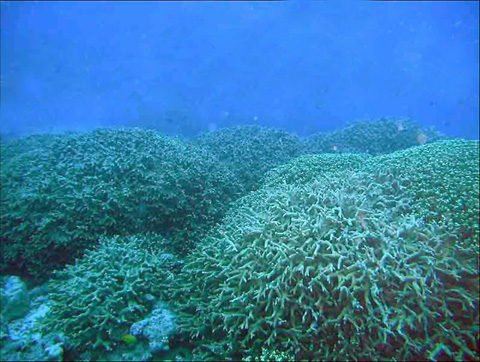
Distressingly normal corals infest nuclear test crater

bikinicorals.jpg

Corals are always quite photogenic, but pretty as these examples are, what’s most fascinating is where these things are growing: in one of the craters left by the US nuclear testing on Bikini Atoll in the 1940s and 1950s.
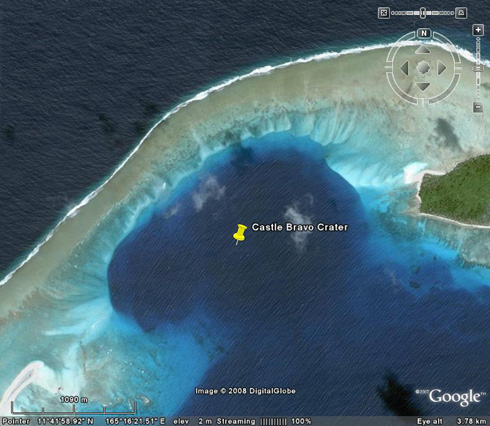
Castle_bravo_crater.jpg

Castle Bravo Crater was excavated by a 15 megatonne nuclear bomb in 1954, and it was recently visited by a team of divers from the Australian Research Council Centre of Excellence for Coral Reef Studies as part of a study of how the atoll is recovering from the effects this and the other Bikini nuclear tests. From the Centre’s press release:

After diving into the crater, Zoe Richards of the ARC Centre of Excellence for Coral Reef Studies and James Cook University says, “I didn’t know what to expect – some kind of moonscape perhaps. But it was incredible, huge matrices of branching Porites coral (up to 8 meters high) had established, creating thriving coral reef habitat. Throughout other parts of the lagoon it was awesome to see coral cover as high as 80 per cent and large tree-like branching coral formations with trunks 30cm thick. It was fascinating – I’ve never seen corals growing like trees outside of the Marshall Islands.

“The healthy condition of the coral at Bikini atoll today is proof of their resilience and ability to bounce back from massive disturbances, that is, if the reef is left undisturbed and there are healthy nearby reefs to source the recovery.”

However the research has also revealed a disturbingly high level of loss of coral species from the atoll. Compared with a famous study made before the atomic tests were carried out, the team established that 42 species were missing compared to the early 1950s. At least 28 of these species losses appear to be genuine local extinctions probably due to the 23 bombs that were exploded there from 1946-58, or the resulting radioactivity, increased nutrient levels and smothering from fine sediments.

“The missing corals are fragile lagoonal specialists – slender branching or leafy forms that you only find in the sheltered waters of a lagoon,” Zoe explains. While corals in general have shown resilience, Zoe adds that the coral biodiversity at Bikini Atoll has proven only partially resilient to the disturbances that have occurred there.

We all know that what should have happened is that the diving team vanished without a trace, leaving behind only grainy footage of an attack by mutated giant cnidarians, but I suppose that this is the next best thing. More pictures can be found here.
Categories: environment

Rocks on the airwaves

The geopuns just keep coming – the inaugural geology ‘podclast’ has just gone up over at goodSchist. Your hosts Chris Town and Ron Schott discuss the recent volcanic activity on Kilauea, the latest bout of navel gazing stirred up by Nature Geoscience, and how us geologists could all be stinking rich if we go and join Lab Lemming in Australia. It’s well worth a listen.

Categories: bloggery, links

I’ll be back soon…

Sorry for the lack of activity this week – my mental energies have been fully engaged by events in the Real World over the past few days, and as a consequence I haven’t managed to focus well enough to write anything worth reading. Next week, things will hopefully have settled down a bit, and normal service (such as it is…) will be resumed.

Categories: bloggery

Peperite: a basaltic sneeze into wet sediments

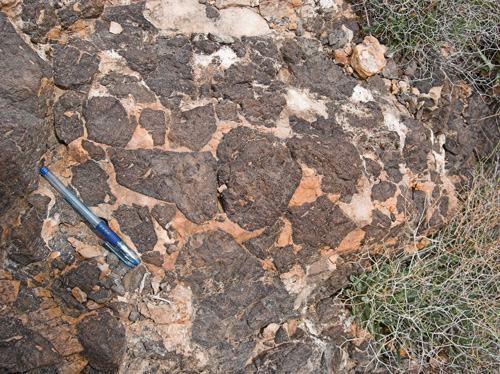
The outcrop that I gave you to ponder on Friday is pretty strange, but I can assure you that this isn’t a wall:

peperite, SE Spain

Most of you correctly guessed that the dark fragments are composed of a mafic (basalt-esque) igneous rock, but the nature of the intervening orange-weathering and crumbly matrix has been the cause of some puzzlement, as it looks like (and is) more sedimentary in nature. Probably the most important clue was spotted by Christie who noticed that the matrix fills in small gaps and fractures in the larger clasts, which you might not expect to happen so efficiently if the gaps in a volcanic breccia had been filled in by later sedimentation; instead, it seems more suggestive of intrusion of the basalt into pre-existing sediment. More specifically, the basaltic lava was intruded into wet, unconsolidated sediment, which allows interaction and a sort of mixing, although the relative viscosities of the lava and the sediment are so different that you still end up with distinctive, sharp edged chunks of basalt held within an altered sedimentary matrix.
This sort of deposit is known as a peperite, and I photographed this particular one on a trip to southeastern Spain a couple of years ago. I don’t just have Archean rocks in my photography library, you know! My little excursion back into my archives was partly inspired by the last week’s geoblogospheric discussions of culling and reanimating geological words; I’ve always liked the sound of ‘peperite’; it’s suitably explosive sounding for this sort of deposit. Apparently it comes from the fact that these deposits resemble ground pepper, although I’m not so convinced about that…
More on peperites here (a recent review paper), here and here.

Categories: geology, geopuzzling, volcanoes

Death Valley Dispatches

If you’re bored with the recent metabloggery here (don’t worry, I’m done, and with ‘nary a mention of the F-word), you could do much worse than to head over to The Dynamic Earth, where Eric has been posting an excellent and highly photo-giferous series describing his recent field trip to Death Valley.
Day 0.5: Devonian Spring Mountain Carbonates (carbonates galore).
Day 1: Meiklejohn Peak and the Death Valley Sand Dunes (zebra rock and modern day dunes).
Day 2.0: Furnace Creek Fm (lots of cool sedimentary structures).
Day 2.5: The Tufa Pinnacles near Trona, CA (suggestively shaped carbonates).
Day 3: The Break-up of Rodinia (Neoproterozoic sequence with alleged Snowball Earth deposits).
Day 4: Ubehebe Crater and Race Track Playa (volcanoes and wandering rocks).
A prime candidate for Google-Earthing, perhaps?

Categories: bloggery, fieldwork, geology, links