
Publication tag clouds

Brian’s had the cool idea of summarising some of his pending scientific papers using tag clouds, and I’m joining Lab Lemming, ReBecca and Maria in jumping on the bandwagon. The following two clouds, which may or may not provide some insight into what I’m all about scientifically, are generated from the text of a couple of my papers, sans references and figure captions, using tagcrowd on its default settings (hence the appearance of ‘et’, ‘al’, and ‘figure/fig’). I thought it also might be fun to compare the clouds to the list of keywords that you actually have to provide yourself. The first one is for my recent JGR publication about New Zealand tectonics (yes, the one I promised to write some posts about; something I will get around to once I’ve completed a couple of neccesary background posts).

My keywords: remagnetization, greigite, vertical axis rotation, New Zealand, Hikurangi margin.

created at TagCrowd.com


Number two was submitted to Earth and Planetary Science Letters just before I went away, and is based on work I did between finishing my PhD and leaving Southampton, and focuses on diagenetic changes to the magnetic mineral assemblage within marine sediments, and their effects on the paleomagnetic signal they carry.

My keywords: sediment diagenesis, sulfate reduction, magnetite dissolution, greigite, superparamagnetism, hysteresis.

created at TagCrowd.com


I’m apparently not too gratuitously self-citing, but it does seem that, since my PhD supervisor’s name appears on both lists, I’m a bit of a suck-up. That’ll surprise him – although since both papers concern the effects of evil greigite, and he’s been heavily involved in its ascent up the heirarchy of Important Magnetic Minerals in recent years, I could hardly help citing him lots. Given that certain recent reviews have suggested that I seem to be rather good at upsetting people I’m rather surprised that more researcher names don’t appear (the only other one on the JGR paper is retired).
There is also a reasonable degree of overlap between my chosen keywords and the ones that appear in the tag cloud. It’s no surprise that they’re not completely identical (as the most important concepts or themes in a paper are not neccesarily related to how frequently you mention them), but it does seem that you can potentially get a reasonable sense of what a paper might actually be discussing from this sort of thing. The question is whether it actually has any utility in finding papers and/or assessing whether you want to read them.
Categories: academic life, publication

Sabbatical

I’m off into the field again for a week. Since the geoblogging around here has been fairly light of late, you might not even miss me. Hopefully, a bit of fieldwork is just what I need to get me out of the slight creative hole that I’ve found myself in of late.
Also, since I’m going to be in the same area, I’m hopefully going to get a look at this outcrop again.

Categories: bloggery

A planet is for life, not just for Earth Day

Note added in proof: I see that Andrew has written eloquently on a similar theme, and is also hosting the latest Accretionary Wedge, which collects other geoblogospheric thoughts on Earth Day.
So, today is Earth Day. Whilst I’m never going to be completely opposed to attempts to get people to think more about their impact on our planet, and how we might do something to minimise it, it seems to me that focussing on today as a singular event is missing the point. If it’s to mean anything, this shouldn’t be the one day in the year when people “do something” for the environment; it should be the day when everyone reaffirms their commitment to do something every other day of the year, too.
As I commmented once on ye olde blog (you’ll need to head to the bottom), one of the problems with modern society is that the more environmentally sound choice is almost never the easiest, or the cheapest, or the most convenient, and hence our good intentions run into the plain fact that no-one can be bothered all of the time. I know that I don’t always switch off lights when I leave a room, or make sure I’m not overfilling a kettle, and I can hardly claim that I don’t know better. Sometimes, I’ll even feel a small pang of guilt when I realise that I’m taking the path more damaging, but this isn’t always enough to stay my hand. The problem is so vast, and in many ways so distantly related to our day-to-day life, that its hard to face environmental issues with any sense of personal urgency.
It’s certainly true that our individual impact on pollution or greenhouse gas emissions is very small on its own. But the fact that we do face serious environmental problems attests to the fact that when you multiply an action by five or six billion people, it can have a substantial effect on the world around us. But again, that’s a fairly abstract call to arms. It seems that we’re missing is a sense of connection with the planet, to make it’s welfare matter a bit more to us personally. And, I realise, I have felt such a connection many times before:

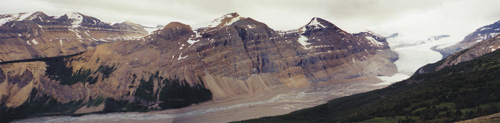
  • I hike up to the top of a ridge in the fading light of an overcast summer day. As I reach the brow, I’m treated to an awesome panorama – soaring mountains behind, wide valley in front, glacier in the middle.

    Parkerpan.jpg

    Although this is a popular viewpoint, at this time of day I’m the only one there. I sit down and for a good 30 minutes do nothing but drink in the spectacle and the silence.


  • A shadow suddenly falls on the path in front of me. I look up, and see a golden eagle gliding serenely past not ten feet above my head – I can make out individual feathers on its underside. It eyes me coldly, and having decided that I don’t look particularly edible, soars away on a thermal.

  • As I make my way across the hills towards a new outcrop, the wind is so strong that some gusts almost send me flying. Every step forward is a struggle. Sheets of water lifted up from some nearby lakes are periodically dumped on top of me. I feel so alive, I’m almost manic. It’s glorious.

These are just a few of a store of precious memories which I have called upon many times to calm me when I’m stressed or flustered, to lift me when I’m feeling depressed, or simply to remind me why I love my job when I find myself uninspired. But maybe I should give them a bit of unselfish work to do as well. In a certain sense, these experiences are gifts to me from the Earth, and they have enriched, and continue to enrich, my life in countless ways. Next time I’m tempted to drive rather than walk to the end of the street, or get the elevator rather than take the stairs, or forgo the trip to the bottle bank, I should remember what the Earth has given me, and let my gratitude inspire me to give something back. Perhaps you have some recollections which will help you do the same.

Categories: environment, ranting

Rock Gallery

You may or may not have noticed a new addition to the row of tabs just beneath my banner. The ‘Rock Gallery’ is a new way I’m trying out of showing what’s in the archives, taking advantage of the fact that I quite often illustrate my posts with pretty pictures or diagrams. I’m gradually producing thumbnails of the prettiest, and clicking on them will link back to the post in which they originally appear. It’s a bit of an experiment, so let me know what you think.

Categories: bloggery

How big was that asteroid? The latest geochemist/geophysicist smackdown

ResearchBlogging.orgGeophysicists estimate the size of asteroids associated with past impact events, such as the one associated with the Cretaceous-Tertiary extinction, by comparing the craters they form to the results of impact models. Geochemists estimate the size of these objects by measuring the amounts of exotic elements such as iridium that have been brought down to Earth with them. Because geophysicists and geochemists also love to disagree with each other (just ask them about mantle convection), it’s no surprise that these different methods disagree. In fact, as Francois Paquay of the University of Hawaii and his colleagues report in their recent Science paper, in the cases of the KT impact and one of several impacts in the late Eocene, they disagree by a factor of three or more. Who’s right?

Continue reading

Categories: geochemistry, geohazards, geology, planets