Pangaea Day, geology-style

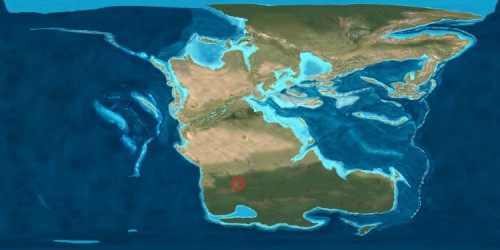
Over the weekend Chris of Goodschist challenged the geoblogosphere to reappropriate Pangaea Day, by taking advantage of Ron Blakey’s fantastic palaeogeographic maps to show where the rock beneath our current abode was located on the dinosaur-laden Mesozoic supercontinent. Callam and Brian have both responded, and I’m belatedly weighing in:

Pangea.jpg

In the late Triassic (around 220 million years ago), South Africa was actually pretty much where it is now in terms of latitude, but it was located in the centre of a much larger landmass (often referred to as Gondwana) consisting of Africa, South America, India, Antarctica, and Australia, which had amalgamated several hundred million years earlier, and then collided with Laurentia (North America) and the other ancient continents to form Pangaea towards the end of the Permian. Since then, of course, all of these other landmasses have rifted away, forming the modern oceanic basins which now separate them.

Categories: deep time, geology, Mesozoic, past worlds

Geopuzzle #11

Spot (and explain, if you can) the differences.

gp11-1.jpg

gp11-2.jpg

gp11-3.jpg

It’s not much of a hint to say that the last one is quite difficult – but the last one is quite difficult.
Update: Click through for the answer.

Categories: geopuzzling

Active, dormant, and extinct volcanoes

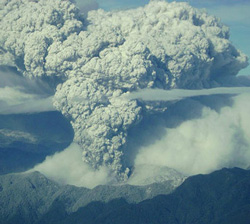
Chaiten eruption In the wake of this weeks rather spectacular eruptions of the Chilean volcano Chaitén (which is being well-covered by the Volcanism Blog; more cool photos are available here, and at NASA’s Earth Observatory), a commentator has asked for some clarification on “how geologists classify volcanoes as active, dormant or extinct.”

The simple answer to this question goes thusly:

  • An active volcano is one that is presently erupting (or at least growling a lot, with lots of seismic and thermal activity).

  • A dormant volcano is currently inactive, but could feasibly erupt in the future.

  • An extinct volcano is one that is both inactive and unlikely to erupt again in the future.

In many ways, I’m not sure that this classification is actually very informative, because these categories turn out to be rather fuzzy and tricky to determine. Even what constitutes a ‘presently active’ volcano is a little problematic: a cycle of magma chamber recharge and eruption occurs over geological timescales, so it makes little sense to only include volcanoes that have erupted in the past week, month or year (or even the past decade or century). For this reason, places such as the Smithsonian’s Global Volcanism Programme put any volcano that has erupted in recorded human history, or in the Holocene (the last 12,000 years or so), onto the active list.
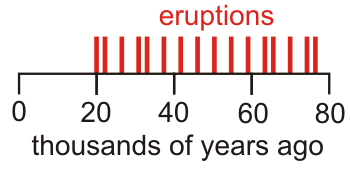
The division into ‘dormant’ and ‘extinct’ is also tricky, because what you need is some idea of a volcano’s eruptive history; not just the date of its last eruption, but the number and frequency of eruptions over a longer time. For example, lets say that you can date the last eruption of a particular volcano to 20,000 years ago, and dating of older lava flows shows that prior to that time there were eruptions every couple of thousand years or so:
erupthist1.png

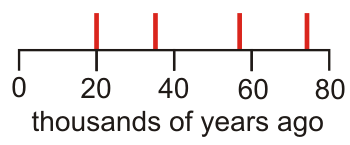
In this case, several eruptive cycles have been and gone since the last eruption, and we might be justified in saying that this volcano is extinct. In contrast, we might find that the eruptions are much more infrequent, say every 15,000 years or so:
erupthist2.png

In this case, we are still within the timeframe required for one eruptive cycle, and the magma chamber could still be refilling as a prelude to the next explosion. More detailed examination – trying to seismically image the magma chamber, or looking for gas emissions or hot springs, might give us some clues about whether your friendly neighbourhood mountain is dead, or merely dozing.
The problem, of course, is that for many of the world’s volcanoes this long-term information is just not available. If we look at Chaitén’s eruptive history, there was only one known eruption prior to this week’s pyrotechnics, which has been dated to around 10,000 years ago. The eruption has been described as a ‘surprise’, but in fact we don’t know enough to know if we should be surprised or not.

Categories: basics, geohazards, geology, volcanoes

What’s up with those Archean sandstones?

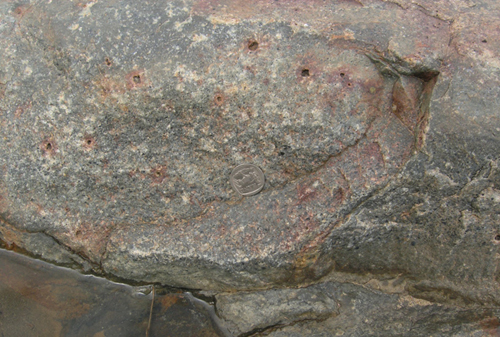
In addition to searching out evidence for Archean microbial mats, my revisitation of the Pongola sandstones gave me the chance to look a bit more closely at their lithology. When I last posted pictures from this sequence, there was a bit of discussion about why the beds appeared to be quite dark – sandstones are generally lighter in colour (being composed mainly of quartz). Is this due to some weird mineralogy? Or just an effect of modern day weathering?
Here’s a close-up of one of the dark beds:

WMpyrite2.jpg

It does appear that the dark colour does indeed seem to be a result of minerals actually in the rock, rather than formed by weathering on the surface. However, I’m still not sure what these minerals are; presumably there’s just enough squeezed in between this quartzite’s cemented quartz grains to change it’s optical properties. You’d probably have to make a thin section to know for sure what they are – any guesses?

Continue reading

Categories: Archean, fieldwork, geology, geopuzzling, past worlds

Archean bacterial mats under the hammer

Last week I ventured into the field in the company of Nora Noffke, of Old Dominion University in Norfolk, Virginia. who is an expert on the fossil record of ancient bacterial mats. It turns out that this record does not simply consist of the well-known stromatolites; in shallow marine environments mat-forming microorganisms can bind and stabilise the sediment surface, leading to the formation of distinctive structures that are not formed by purely physical processes. This is in contrast to the difficulties in distinguishing between those stromatolites that have been formed in association with bacteria, and those that have been precipitated entirely inorganically.
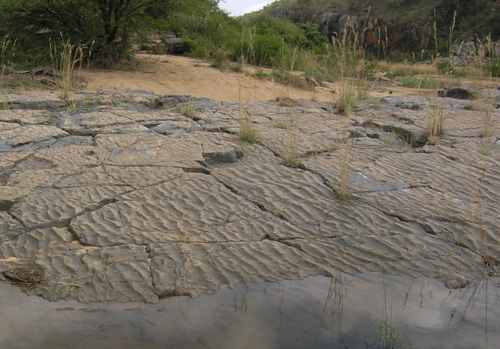
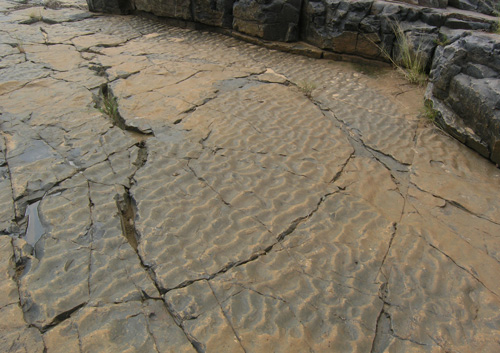
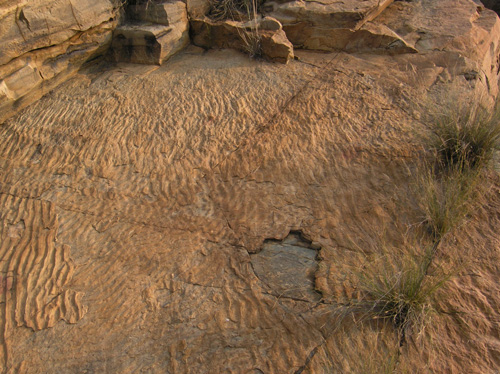
It turns out that the Pongola Supergroup – the Archean rocks that I am currently trying to extract a magnetic signal from – is a good place to look for these ‘microbially induced sedimentary structures’. As we’ve already seen, ripple marks, dessication cracks and other sedimentary features are extremely well preserved in the sandstones which make up the upper part of the sequence, despite their venerable age of 2.9 billion or so. Furthermore, the tidally-influenced shallow marine environment is which these rocks seem to have been deposited is prime mat-forming territory. Nora was kind enough to point out some of the outcrops that featured in her recent paper in Geobiology, which describes a section through the Pongola sandstones and makes the case that many of the preserved sedimentary features are consistent with the presence of a thriving bacterial mat ecosystem. I am not confident that I would have really noticed any of these myself: this is one of those times when knowing what you’re looking for – through a good grounding in the sort of features formed by modern mat growth in similar environments – is essential if you’re going to distinguish the real deal from modern weathering patterns on the bedding planes. Two examples are found beneath the fold.

Continue reading

Categories: Archean, fieldwork, fossils, geology, paper reviews, past worlds, ranting