Given some of the other shenanigans that were percolating through the geoblogosphere yesterday, I was understandably a little bit cautious when I noticed a couple of familiar names popping up in the contents list for Nature Geoscience that arrived in my inbox yesterday. It seems that both Kim and Julia decided to convey their thoughts (originally posted here and here) on a report on gender imbalances in the US geosciences community, which the journal published a couple of months ago, straight to the source. Bravo!
To compound the strange coincidences, in this issue there’s also discussion of the pros and cons of blogging, the pros being provided by Gavin Schmidt of RealClimate, and the cons by Myles Allen, an Oxford climatologist associated with Climateprediction.net (for those not in the know, basically SETI@home with climate models).
In his piece, Gavin has an interesting take on one of the ways that science blogs can contribute to science communication:
Much of the information in any field of science is tacit… Scientists generally absorb this background knowledge through a kind of osmosis in graduate school. They continue to pick it up at coffee and over dinner at conferences and workshops as they discuss the latest results…
…this kind of informal second-stage peer review is vital to the need to quickly process the vast
amount of information being produced. Scientists from all fields rely on it heavily to make a first cut between the studies that are worth reading in more detail and those that aren’t. Scientists writing in blogs can make this context available to anyone who is interested.
Meanwhile, I found Myles Allen’s comments a little bit odd (Update: he also comments below). He basically argues that science bloggers who post their opinions regarding a paper they’ve read are committing some sort of heinous crime against science communication, concluding:
criticism of peer-reviewed results belongs in the peer-reviewed literature. Direct communication over the Internet, far from creating a level playing field, just ploughs it up and makes the game impossible.
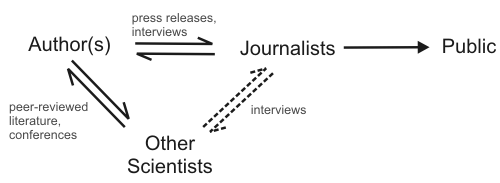
His motivation for this seems to be an incident a while back where the RealClimate people criticized a paper coming out of the Climateprediction.net project (about how certain combinations of model parameters produced very high climate sensitivities), and those criticisms were later part of a BBC programme on the over-hyping of climate change. Although if you look up the relevent posts on RealClimate (which really should have been linked to in the piece itself), it seems to me that they’re criticising the press coverage – the fact that you can get models with high sensitivity to increases in CO2 suddenly morphed into claims that the actual Earth also had a high sensitivity – rather than the paper itself. This being the case, Allen’s glowing tribute to the wonders of science coverage in the modern media jars even more. It’s certainly true that there are some excellent science reporters out there, who take the trouble actually read and understand the research itself, and interview the scientists involved to make sure they get it right; but they’re a distinct minority in a flock dominated by the “take a breathless press release and make it even more breathless” brigade.
As for Allen’s conclusion, whilst I fully concur that scientific debates should principally be conducted, and be resolved, within the peer-reviewed literature, I totally disagree that you should shield the public from that process, which is what Allen seems to be arguing. The general public’s poor understanding of how science actually operates is a gaping hole exploited by pseudoscientists and unscrupulous lobby groups of all stripes. The more real scientific debates – climate sensitivity, mantle plumes – that the public get to witness, the more obvious it will be how phony the climate change and evolution ‘debates’ really are.
Still, perhaps next time I get asked a tough question at a conference, I can just reply, “I’m sorry, your question is not peer reviewed.”