Geopuzzle #12

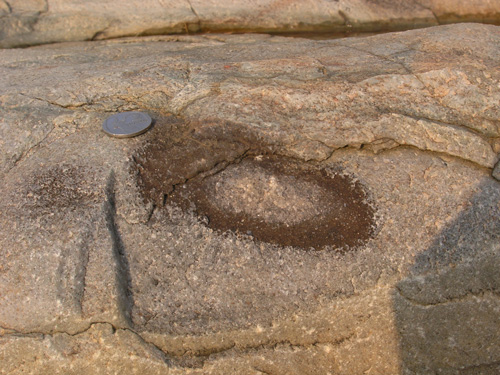
This is not so much a puzzle as a mystery, in that I’m not entirely sure myself what this is:

gp12a.jpg

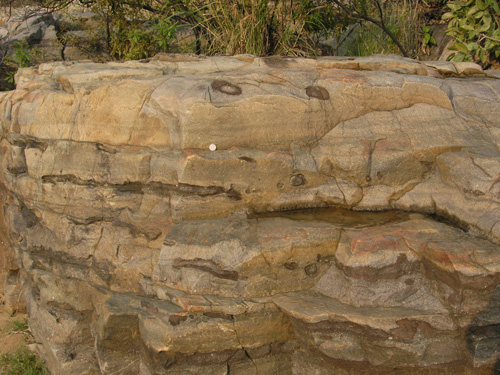
I do have a guess, of course, but I’ll be interested to see what all you clever folk think. Here’s a wider shot of the outcrop this feature is found in; hopefully you can see that it’s not alone.

gp12b.jpg

Have at it in the comments.

Categories: geology, geopuzzling

The slow death of a sedimentary basin

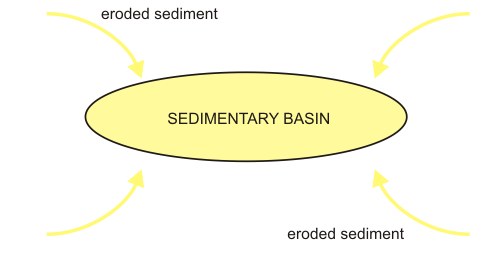
Sedimentary rocks are deposited wherever there is a hole that needs filling in. This hole – a sedimentary basin – can be created by tectonic events such as rifting, slower thermal subsidence caused by cooling of the crust (which increases its density), or things like a rise in sea level.

basin1.png

Continue reading

Categories: deep time, geology, tectonics

Earthquake in Iceland

As Steinn reported at the time, last Thursday Iceland was shaken by a magnitude 6.3 earthquake (Ole has more). Here’s the USGS moment tensor solution:
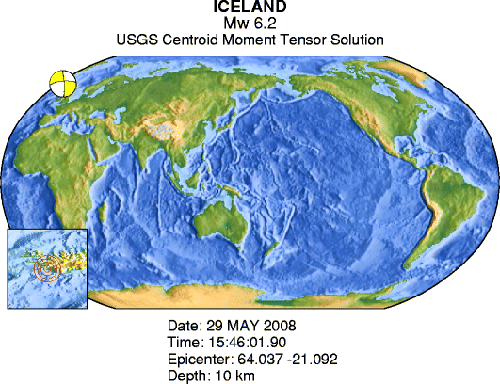
neic_sqba_cmt.gif

The pattern of first motions indicates a strike-slip earthquake, where the two sides of an almost vertical fault are moving past each other. This wasn’t actually what I was expecting when I clicked through to the USGS report. Iceland, after all, is basically just a particularly volcanic part of the Mid-Atlantic Ridge, which marks the extensional plate boundary between the North American and Eurasian plates. Western Iceland, which is on the North American plate, and eastern Iceland, which is part of the Eurasian plate, are moving away from each other at about the speed that your fingernails grow; as such, I was expecting to see an extensional earthquake mechanism. So why do we have such a large strike-slip earthquake occuring within a rift zone? The answer can be found by zooming in a bit on Iceland, to see exactly where the earthquake occurs:
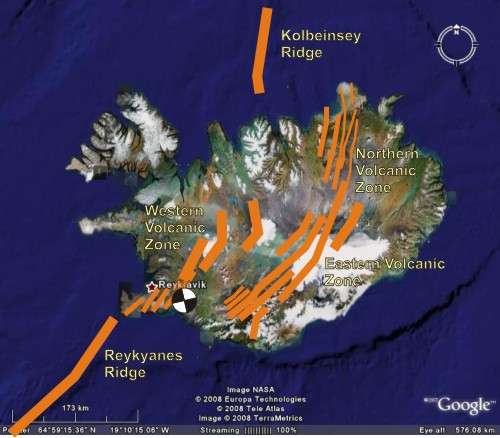
iceland_rift.jpg

Continue reading

Categories: earthquakes, geology, tectonics

Notables and linkables

Good news, everbody! It seems that the continuing growth of the geoblogosphere is starting to get noticed, with articles in both the AAPG Explorer and Geotimes, who together appear to have interviewed a good number of us. I’m quoted in the Geotimes article, and also in another piece about the metabloggery stirred up by Nature Geoscience a couple of months ago.
Following on from last week’s post about the subsidence around the Indonesian mud volcano Lusi, it turns out that Maria is a co-author on a soon-to-be published paper which pretty firmly establishes that the earthquake that proceeded the eruption was, as she puts it, too “rinky-dink” to have triggered it; it was totally the exploration well:

We calculated that the weight of the drilling mud, in addition to the pressure recorded at the top of the hole while it was sealed, was enough to muscle into the surrounding rock and force open fractures leading to an eruption.

Responses abound to the SVP report on Aetogate, including from the original plaintiffs (pdf). Chris Taylor, Darren, Brian, Mickey Rowe and PZ have all chimed in with thoughts and opinions, with the highlight being lots of typically smart and incisive analysis from Janet (with the promise of more).
Finally, check out the Carnival of Classic Science Papers over at Skulls in the Stars.

Categories: academic life, bloggery, geohazards, public science

Coolest. Image. Ever.

You’ve probably already seen the close-up of Phoenix descending to Mars, captured from orbit by HiRISE. Like me, you probably thought it was pretty cool. But have you seen the wide view?

Phoenix_descent.jpg

If that’s not a Sputnik moment, I don’t know what is.
(from the HiRISE blog)

Categories: planets