Lusi sinking into its own caldera

The latest from Lusi
ResearchBlogging.orgTwo years after it first erupted, Lusi is back in the news again, this time because the area around the vent (click through for this month’s satellite image) is starting to show signs of subsidence:

The world’s fastest-growing mud volcano is collapsing by up to three metres overnight, suggests new research.

As the second anniversary (May 29) of the eruption on the Indonesian island of Java approaches, scientists have found that the volcano – named Lusi – could subside to depths of more than 140 metres with consequences for the surrounding environment.

The sudden overnight three metre collapses could be the beginning of a caldera – a large
basin-shaped volcanic depression – according to the research team, from Durham University UK, and the Institute of Technology Bandung, in Indonesia.

Their findings, based on Global Positioning System (GPS) and satellite measurements, are due to be published in the journal Environmental Geology.

Continue reading

Categories: geohazards, Lusi, paper reviews

Survivor: Geologist

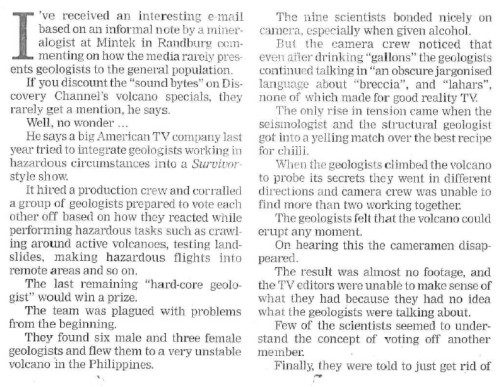
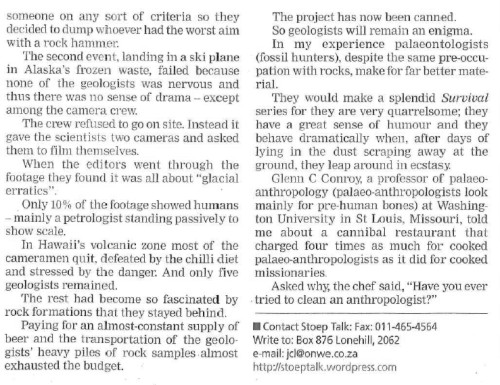
I was just forwarded this, although I’d actually got some chuckles out of it already; it’s one of the columns written by James Clarke for the Johannesburg paper, The Star (a tad more upmarket than the UK version). He titled it ‘Even TV cameras can’t excite geologists’ (here’s a full scan – pdf).

survivor.jpg

survivorb.jpg

Of course, I’m not sure that we should publicise this too much, since it looks like an ideal scam for getting TV companies to pay us for fieldwork…

Categories: bloggery

Aetogate: the final round?

Following the New Mexico Department of Cultural Affairs’ inquiry that wasn’t, many saw the Ethics Education committee of the Society of Vertebrate Paleontology’s inquiry into Bill Parker and Jeff Martz’s allegations that Spencer Lucas and his colleagues at the New Mexico Museum of Natural History and Science had engaged in “claim-jumping” and plagiarism (see Mike Taylor’s page for the full story) as the last chance for a satisfactory resolution. The Committee’s report was released last Friday (pdf), and is, given the circumstances, a creditable attempt to draw a line under the whole mess.

Continue reading

Categories: academic life, ranting

Chinese army go into the geoengineering business

As a follow-up to Anne’s post yesterday, it seems that the state of the Tangjiashan ‘quake lake’, near Biechaun – formed by landslide damming in the aftermath of the Sichaun earthquake – is rapidly becoming the focus of major concern. According to the BBC, the water level is quickly approaching the lip of the dam, at a rate that can only be accelerated by the storms forecast for the next couple of days.
So, whilst tens of thousands of people are being evactuated from the vicinity, the Chinese army is apparently also taking a more direct approach to alleviating the danger: breaching the barrier in a controlled fashion, using explosives. If that sounds like a contradiction in terms to you, I am also worrying about how much potential is there for this to go horribly wrong; but creating a small hole through the blockage should allow the 130 million cubic metres of trapped water to escape more gradually downstream than would be the case if the entire dam collapsed. Fingers crossed…

Categories: geohazards

What will Phoenix tell us about Martian geology?

Reports abound celebrating the successful touchdown of the Phoenix lander on the northern lowlands of Mars. This is a region where water (locked away in the form of permafrost) is thought to exist quite close to the surface, and Phoenix has a nifty robot arm which can (hopefully) dig down to it and retrieve samples for on-board analysis. Obviously we’re all interested to see what it finds with regards to the possibility of ancient or modern Martian life; but this is only part of a more comprehensive analysis of the subsurface around the landing site, which should help to answer questions about the geological development of Mars. From the University of Arizona’s Phoenix page:

Goal 3: Characterize the geology of Mars

As on Earth, the past history of water is written below the surface because liquid water changes the soil chemistry and mineralogy in definite ways. Phoenix will use a suite of chemistry experiments to thoroughly analyze the soil’s chemistry and mineralogy. Some scientists speculate the landing site for Phoenix may have been a deep ocean in the planet’s distant past leaving evidence of sedimentation. If fine sediments of mud and silt are found at the site, it may support the hypothesis of an ancient ocean. Alternatively, coarse sediments of sand might indicate past flowing water, especially if these grains are rounded and well sorted. Using the first true microscope on Mars, Phoenix will examine the structure of these grains to better answer these questions about water’s influence on the geology of Mars.

Just as the Earth’s surface can be divided into high continents and sunken ocean basins, Mars is also divided – the southern Martian hemisphere has quite high topography and is mostly heavily cratered, suggesting that it is quite old, where as the northern hemisphere is low, flat, and much less heavily cratered, suggesting a more recent resurfacing. It appears that early on in Martian history a deep hole formed in the northern latitudes of Mars – explanations range from a massive asteroid impact crater to a basin formed by tectonic rifting – and it has since been partially filled in by later sediments. The question is, were these sediments blown in by aeolian processes on a dry Mars? Or could they have settled out from lakes and oceans on a wet Mars? Knowing the answer to this question will help us understand exactly what Mars was like earlier in its geological history, and hopefully Phoenix will help us to answer it.

Categories: geology, planets