
Chris’s travels in 2010

A post by Chris RowanIt’s travel meme time! Following the example Silver Fox, Garry Hayes, Callan Bentley and Jess Ball, here’s a summary of my travels this year. If nothing else, it’s a good chance to (re)post pretty photos.

In January, a trip to the US saw me spending a few days in chilly New York City before heading to North Carolina for the ScienceOnline 2009 conference, and a day trip into the foothills of the Appalachians.
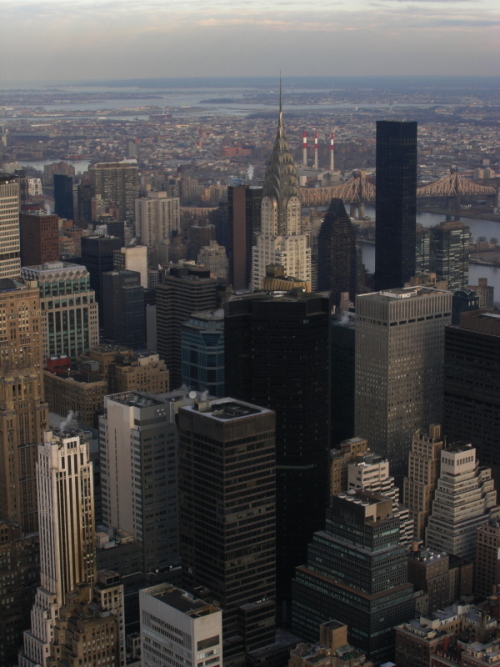
New York from the Empire State Building. Photo: Chris Rowan, 2010
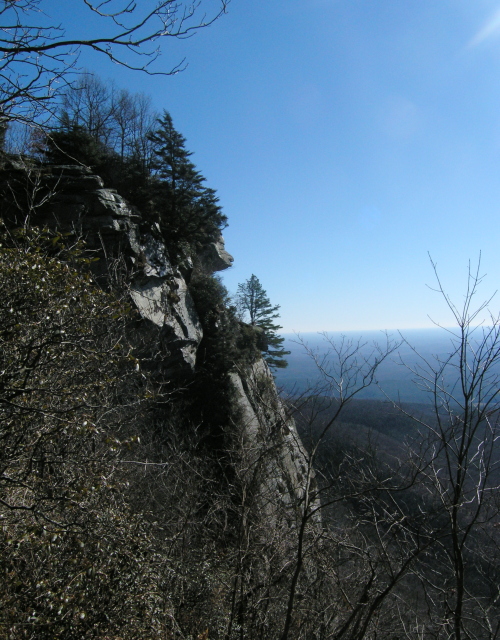
Caesar's Head, North Carolina. Photo: Chris Rowan, 2010

In February, my travels were limited and distinctly ungeological in nature, although I did end up in the birthplace of the world-famous Melton Mowbray pork pie – with predictable (if unphotographed) results.

March saw me hunting plunging folds and baby geology students from the cliffs south of St Andrews.
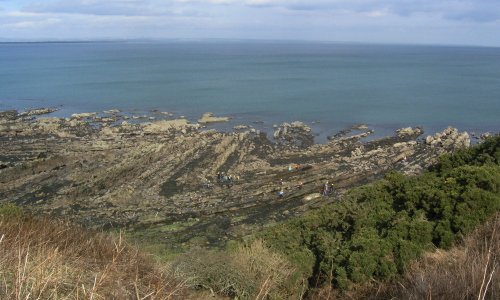
Plunging Paleozoic Folds near St Andrews, Scotland. Photo: Chris Rowan, 2010.

In April, I was fortunate not to be travelling to far during the rather disruptive eruption of the Icelandic volcano Eyjafjallajoekull, although I did hike up Arthur’s Seat one evening to take some pictures of the ash-enhanced sunset.
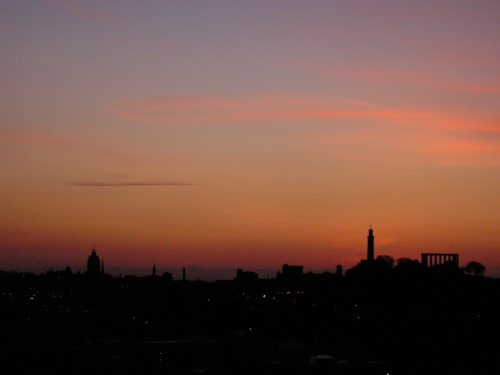
A volcanic sunset from Arthur's Seat, Edinburgh. Photo: Chris Rowan, 2010.

In May I stayed mostly in Edinburgh, but this did include a walk in the Pentland hills just south of the city – one of my favourite places for an afternoon wander.
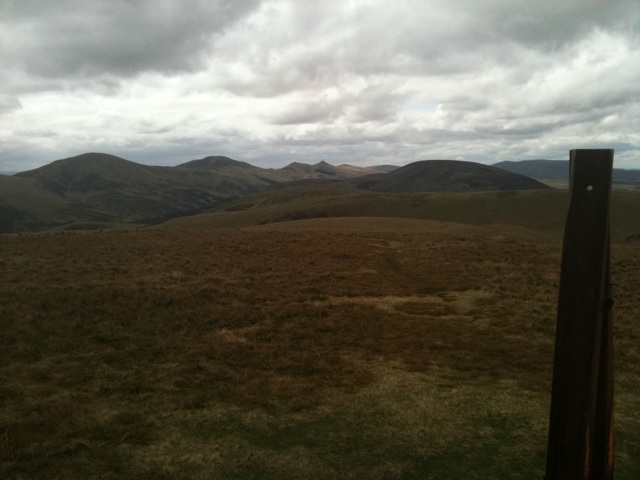
Pentland Hills near Edinburgh. Photo: Chris Rowan, 2010

June was my big trip to Yellowstone and the Grand Tetons: a geological wonderland of mountains and geysers.
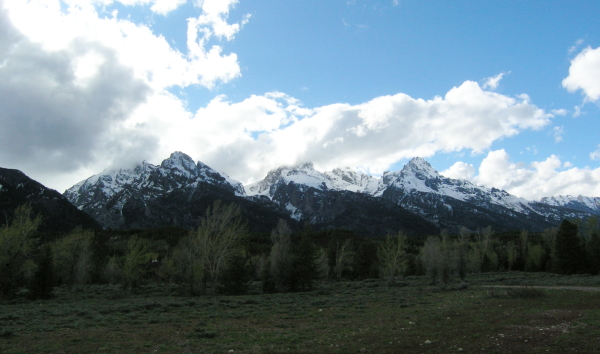
The central part of the Grand Teton Range. Photo: Chris Rowan, 2010
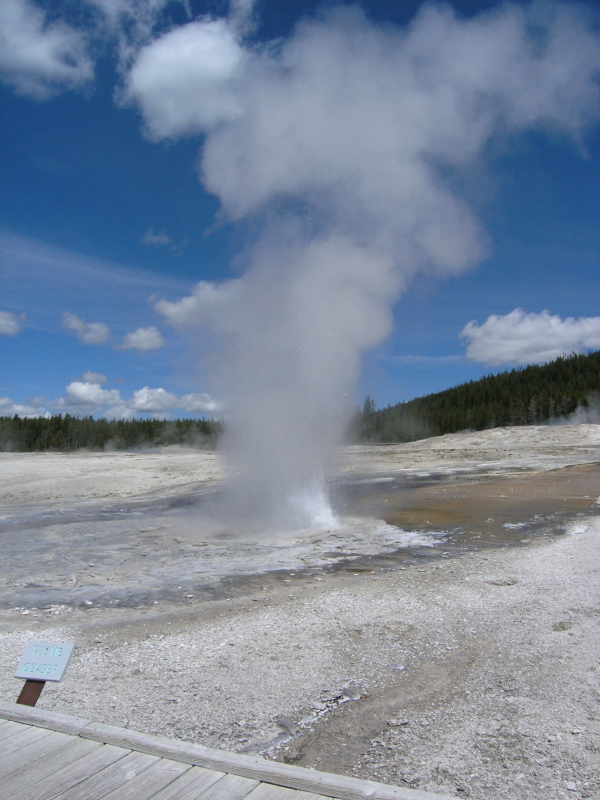
Plume Geyser, Upper Geyser Basin, Yellowstone National Park. Photo: Chris Rowan, 2010.

July I was visited by my co-blogger Anne, and together we explored the geology of Edinburgh Castle.
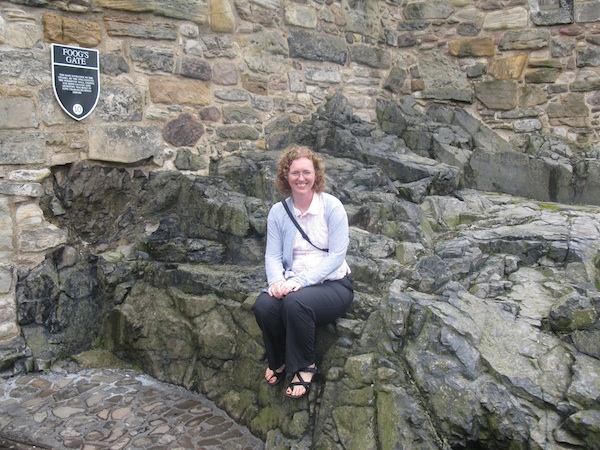
My co-blogger Anne on the basaltic foundations of Edinburgh Castle. Photo: Anne Jefferson, 2010

August I ventured to the whisky-soaked Island of Islay, also hope to some impressive 6-700 million year-old glacial deposits.
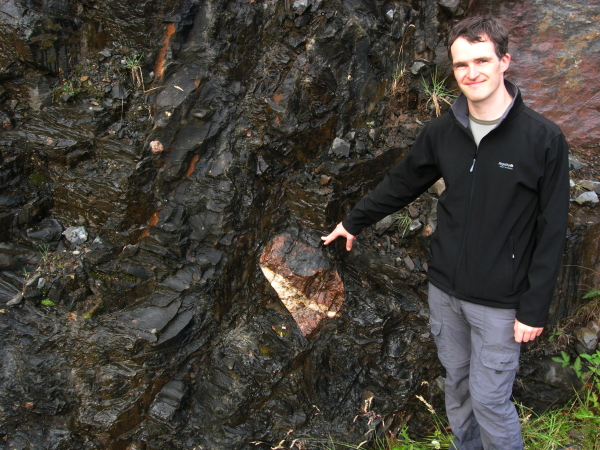
Boulder in the Port Askaig Formation

Boulder in the Port Askaig Formation, with Chris for scale

September saw me visiting Boston for a conference – although I did take the time to walk some of the Freedom Trail, trying to avoid making snide comments in the accent of the evil English occupiers.

October was spent encamped in my lab, as I attempted to tidy up all of my loose research ends before…

November, when I made the move across the Atlantic to Chicago, to start a new post-doc. It’s very flat here – unless you count downtown, of course.
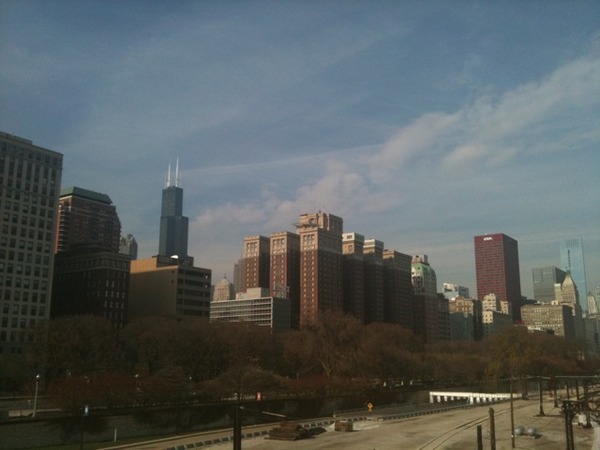
Downtown Chicago. Photo: Chris Rowan, 2010.

I had barely settled in before December, and the AGU Fall conference, came around, and I was off to San Francisco!

All in all, it’s been a pretty busy year for this blogger. Perhaps it’s a good thing for my wallet, my body clock, and my carbon footprint that – for the moment at least – next year is looking a bit more sedate.
Categories: bloggery, photos

12 Months of Highly Allochthonous

While one year is but a proverbial blink of the eye to those who think in geologic time, we’re still indulging in some year end reflections and looking back on our posts from 2010. On the off chance you want to look back with us, here are the first lines and links to the first posts from each month this past year.

January: Wind gaps are fossil rivers: water once flowed through these valleys, but now that water has been diverted to flow elsewhere. [On the 8th day of Christmas my true love sent to me: 8 streams reversing…, a post by Chris, part of his epic 12 days of Christmas series]

February: Today President Obama announced that in his next budget he was going to cut funding for NASA’s Constellation Program, and with it the plan to send people back to the Moon. [What is a manned space programme actually for?, a post by Chris]

March: The further back in time we go, the more and more fragmented the Earth’s geological record becomes. [Earth’s forgotten youth – and beyond, a research blogging post by Chris]

April: Late on Tuesday (or Wednesday morning local time) western China was shaken by a magnitude 6.9 earthquake. [Tectonics of the Qinghai Earthquake, a post by Chris]

May: The causes of the explosion on the Deepwater Horizon rig that has led to 5000 barrels (210,000 gallons) of oil a day being leaked into the Gulf of Mexico, and an oil slick that can be seen from space, are still murky. [Drilling for oil is more risky than it used to be, a post by Chris]

June: Welcome to the latest edition of the Accretionary Wedge geoblogging carnival. We’ve been delighted by the response to our call for your favourite geological imagery, and the number of nominations we’ve received has been matched by their diversity – images have ranged from the microscopic to continental scales, from the depths of geological time to the present day, from the igneous to the sedimentary. [Accretionary Wedge #25: An Illustrated Glossary of Cool Geologic Things, compiled by Chris and Anne from contributions by geobloggers far and wide]

July: The fossil record prior to 550 million years ago is so patchy that every discovery is going to cause some fanfare. [How do we know Gabon’s ‘multicellular’ fossils are 2.1 billion years old?, a research blogging post by Chris]

August:I’ve just spent the last few days travelling around western Scotland, with the furthest point I visited being the Scottish island of Islay. [Glacial deposits new and old in the Scottish isles, a post by Chris]

September: One year ago, Kim Hannula, Pat Campbell, Suzanne Franks, and I launched a survey about women geoscientists reading and writing in the blogosphere. [Diversity in the geosciences and the impact of social media, a research blogging post by Anne]

October: Last October, geobloggers lead by Kim Hannula, Erik Klemetti and us raised nearly $10000 for earth science education in US public schools through a fundraising challenge with DonorsChoose.org. This year we’re going to do even more to bring needed supplies, books, and field experiences to science classrooms around the US. [Teaming up with DonorsChoose to bring Earth Science to Schools, a post by Anne. To date, $1674 has been given through our challenge.]

November: Geomorphologists increasingly recognize that the way water is delivered to and moves through a hillslope, river, or landscape affects surficial processes and geomorphic form. [What do you mean by “hydrogeomorphic processes”? (Some thoughts following my GSA session on the topic.), a post by Anne]

December:
It turns out that, by US standards at least, I’m quite close to the Driftless Area that Anne posted about earlier this week. But unlike that corner of Minnesota, Illinois is whatever the opposite of ‘driftless’ is: it was covered by ice 20,000 years ago, and was blanketed with a thick layer of sediment released from that ice as it melted over the next 10,000 years or so. [The flat of the land, a post by Chris]

Categories: bloggery

The 12 geological days of Christmas: a reprise

A post by Chris RowanMerry Christmas, everyone! I’m having a rather strange Christmas this year – most of my unwrapping this year has been of the flat-pack furniture variety, as my new flat in Chicago slowly starts to look a little less minimalist. Whilst I’m busy doing that, I thought new readers and old might enjoy my 12 geological days of Christmas series: conceived in a fit of bored madness as I rode a train to see my family last December, it not only proved to be quite a challenge to actually keep up the once-a-day posting schedule, but also a huge amount of fun. For me, anyway.

The words below are sung to the obvious tune, and (mostly) just about scans – although my festive gift to you is not to post anything resembling audio of me trying to sing it myself.

On the 1st day of Christmas, my true love sent to me:

an APWP

On the 2nd day of Christmas, my true love sent to me:

2 concordant zircons

…and an APWP.

On the 3rd day of Christmas, my true love sent to me:

3 Helmholtz coils

…2 concordant zircons,
and an APWP.

On the 4th day of Christmas, my true love sent to me:

4 index fossils

…3 Helmholtz coils,
2 concordant zircons,
and an APWP.

On the 5th day of Christmas, my true love sent to me:

5 focal mechanisms!

…4 index fossils,
3 Helmholtz coils,
2 concordant zircons,
and an APWP.

On the 6th day of Christmas, my true love sent to me:

6 fields a-flipping

…5 focal mechanisms!
4 index fossils,
3 Helmholtz coils,
2 concordant zircons,
and an APWP.

On the 7th day of Christmas, my true love sent to me:

7 glaciers melting

…6 fields a-flipping,
5 focal mechanisms!
4 index fossils,
3 Helmholtz coils,
2 concordant zircons,
and an APWP.

On the 8th day of Christmas, my true love sent to me:

8 streams reversing

…7 glaciers melting,
6 fields a-flipping,
5 focal mechanisms!
4 index fossils,
3 Helmholtz coils,
2 concordant zircons,
and an APWP.

On the 9th day of Christmas, my true love sent to me:

9 isotopes fractionating

…8 streams reversing,
7 glaciers melting,
6 fields a-flipping,
5 focal mechanisms!
4 index fossils,
3 Helmholtz coils,
2 concordant zircons,
and an APWP.

On the 10th day of Christmas, my true love sent to me:

10 probes a-probing

…9 isotopes fractionating,
8 streams reversing,
7 glaciers melting,
6 fields a-flipping,
5 focal mechanisms!
4 index fossils,
3 Helmholtz coils,
2 concordant zircons,
and an APWP.

On the 11th day of Christmas, my true love sent to me:

11 terranes amalgamating

…10 probes a-probing,
9 isotopes fractionating,
8 streams reversing,
7 glaciers melting,
6 fields a-flipping,
5 focal mechanisms!
4 index fossils,
3 Helmholtz coils,
2 concordant zircons,
and an APWP.

On the 12th day of Christmas, my true love sent to me:

12 folds a-plunging

…11 terranes amalgamating,
10 probes a-probing,
9 isotopes fractionating,
8 streams reversing,
7 glaciers melting,
6 fields a-flipping,
5 focal mechanisms!
4 index fossils,
3 Helmholtz coils,
2 concordant zircons,
and an APWP!

Categories: geology

Participate in the AGU panel on geoblogging, even if you are not at the meeting

Later this afternoon, your friendly neighborhood geobloggers will convene at the AGU meeting for a panel on the payoffs and perils of blogging. Panelists include both Chris and Anne, Brian Romans from Clastic Detritus, Jess Ball from Magma Cum Laude, Cian Dawson from Point Source, and Erik Klemetti from Eruptions. We’re aiming to set up a very participatory discussion, so if you are a current blogger or blog reader or are thinking about starting to blog, we are looking for your thoughts and questions.

If you are at the meeting, please join us from 2 to 4 pm in Moscone West room 3000. Even if you are not at the meeting, you can still participate. Here’s how:

Go to this website: http://handouts.projectionnet.com/AGUPress/FM2010.aspx, where you will see a webstreaming window on top that will show, to the right, the speakers’ PowerPoint slides in real time (including video), and, to the left, live video of the speaker table and panelists. You will be able to hear audio of the press conference via the same web page. Below the webstreaming window, there’s a chat window: If you want to use the chat room to send questions, etc., you will have to first register (clicking on the Register link at the bottom of the page).

Categories: bloggery, conferences

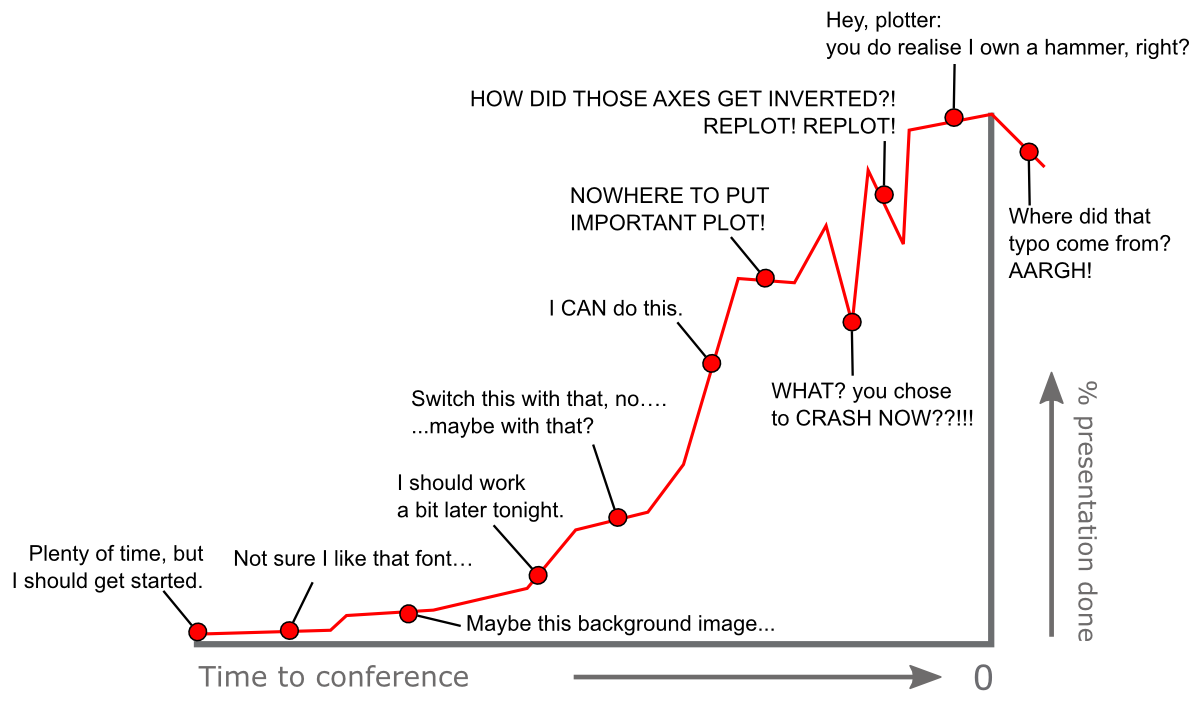
How the conference presentation was done

Any resemblance to the task of producing my poster for AGU is purely coincidental.

(Click for a larger version)

Categories: academic life, bloggery, conferences