Earth’s magnetic field: still not reversing

A post by Chris RowanSome rather apocalyptically minded people – a couple of whom have actually contacted me – have seen a connection between two recent odd occurrences. First came all those birds falling from the sky over the Christmas period. Then, there was this rather odd report of runways in Florida having to be repainted due to ‘the shift in the location of the Earth’s magnetic north pole’. Perhaps fuelled by fuzzy memories of The Core, my worried correspondents – and others around the internet – are musing whether this is a sign of an imminent magnetic field reversal (or ‘pole flip’ as it is often called), with all of the nebulously dire consequences that would ensue.

Well…no.

In fact, neither the bird deaths, nor the runway realignment, are heralds of anything particularly unusual. On the avian mortality front, some digging by the Christian Science Monitor reveals that on average, mainland North America seems one mass wildlife die-off every two days. According to this report from the USGS, there were eight events that involved more than 1000 bird deaths in 2010, and if anything it was a quiet year. Furthermore, although birds do have the ability to sense magnetic fields, it seems unlikely that some disruption of that ability would cause them to fall from the sky. It might make them a little lost and confused, perhaps.

But crucially, there is no sign of any unusual disruption of the Earth’s magnetic field – the reported runway re-alignment is certainly not one. Here’s what the article from the Tampa Bay Online site linked to above says:

Scientists say the magnetic north pole is moving toward Russia and the fallout has reached — of all places — Tampa International Airport…

…The busiest runway will be re-designated 19R/1L on aviation charts. It’s been 18R/36L, indicating its alignment along the 180-degree approach from the north and the 360-degree approach from the south.

To check what is going on, I plugged the co-ordinates of Tampa Airport (around 28°N, 82.5°W) into NOAA’s handy online magnetic field calculator, which allows you not only to calculate the magnetic field direction and strength at any point on the Earth, but also track how it has changed over time. Below is the declination – the deviation of magnetic north from true, geographic north – at Tampa airport for the last 20 years.

January 1991: – 2° 37′
January 1992: – 2° 45′ (-8 minutes)
January 1993: – 2° 54′ (-9 minutes)
January 1994: – 3° 2′ (-8 minutes)
January 1995: – 3°11′ (- 9 minutes)
January 1996: – 3° 18′ (- 7 minutes)
January 1997: – 3° 25′ (- 7 minutes)
January 1998: – 3° 33′ (- 8 minutes)
January 1999: – 3° 40′ (- 7 minutes)
January 2000: – 3° 47′ (- 7 minutes)
January 2001: – 3° 53′ (- 6 minutes)
January 2002: – 3° 59′ (- 6 minutes)
January 2003: – 4° 5′ (- 6 minutes)
January 2004: – 4° 11′ (- 6 minutes)
January 2005: – 4° 17′ (- 6 minutes)
January 2006: – 4° 23′ (- 6 minutes)
January 2007: – 4° 29′ (- 6 minutes)
January 2008: – 4° 35′ (- 6 minutes)
January 2009: – 4° 42′ (- 7 minutes)
January 2010: – 4° 48′ (- 6 minutes)
January 2011: – 4° 54′ (- 6 minutes)

What this shows is that the ‘shift in the location of the pole’ that has necessitated the Tampa runway realignment is not a big, recent jerk – instead, it’s the result of the gradual – and entirely unremarkable – motion of the magnetic pole relative to the geographic pole over the past few decades (what people who study the Earth’s magnetic field call secular variation). In the figure below, I’ve included a British Geological Survey plot of the magnetic pole’s motion from a location in the northern reaches of Canada into the Arctic ocean in the past century. This motion has produced a steadily more negative declination in the vicinity of Tampa Airport over the past couple of decades. A look at Google Maps indicates that the main runways at Tampa have an absolute (geographic) orientation close to due north. Many aircraft (particularly smaller, non-commercial aircraft) still use a compass to direct their course, and pilots need to know what direction the runway is oriented, particularly at night or in bad weather, when visibility is limited. With a negative magnetic declination, you would have to fly at a magnetic bearing a few degrees east of north to parallel the runway.
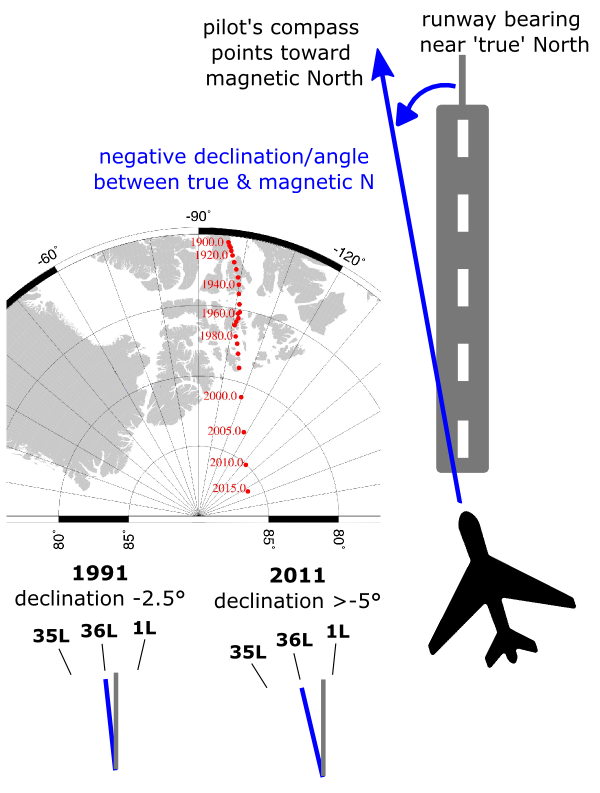
Pilots must compensate for magnetic declination when lining up with a runway. In Florida, declination is now closer to -10° than 0° due to gradual drift of magnetic north.

The numbers on runway numbers are their bearing relative to magnetic north to the nearest 10 degrees, divided by 10 (e.g., 5=50°, 22=220°). For the past few decades the small declination at Tampa has effectively rounded to 0, and the runway numbers reflected this. Now however, the declination is on the verge of being more than -5 degrees*, which rounds to 10; this means that the runway markings must be updated to tell pilots that they should set their landing course to a bearing of 10° rather than 0, or 190° rather than 180 if you’re flying in the opposite direction.

So move along, nothing to see here. For those who are interested in what the real prospects for a future reversal of the Earth’s magnetic field are, I’ve already written an opus on this subject. Basically, the magnetic field will not be reversing any time soon, unless you are talking about ‘soon’ in the sense of ‘in the next few tens of thousands of years at the earliest’. When it does begin to reverse, it will take several thousand years – probably longer than currently recorded human history – to do so. And given that there is absolutely no correlation between extinction events and magnetic field reversals in the geological record – rather fortunate as there’s a reversal every half a million years on average – I don’t think we have much to worry about when it does happen. Except, perhaps, we might need to repaint our runways more often.

Still, I do have my own premonition. Somehow I can’t help thinking that, as we get closer to some arbitrary milestone in the Mayan’s cyclical calendar, I may have to revisit this subject again.

Update 24th January 2010: Apparently, Stanstead airport in the UK, close to where I grew up, is also having to repaint it’s runway markings for the same reason. Given that this has to be a semi-regular occurence in the aviation world, I wonder why such things are getting more play in the media world right now. Are they deliberately trolling people who are worried about 2012?

*given that the Tampa runways appear to run a little east of true north, their magnetic bearing may already be more than 5°. Also, the numbers above are from a global field model, so are probably not completely accurate at such a local scale. I’d suspect that Tampa airport has performed it’s own direct measurements before deciding to change their markings.

Categories: antiscience, palaeomagic

A flood is a disaster when people are in the way

A post by Anne JeffersonAt any given moment, somewhere in the world, there is a flood occurring. Most of the time, those floods don’t make the international news circuit. When they do, it is because there are people in harm’s way. But the intensity of the media spotlight doesn’t always scale with the scope of the disaster.

In the last several weeks, Queensland, Australia has been drenched by strong La Nina rains, breaking a long drought. Waters began to rise in late 2010, covering a land area greater than France and Germany combined (> 1 million km2).

NASA image of Rockhampton Queensland, 7 January

NASA image of Rockhampton Queensland, 7 January 2011

In east central Queensland, floods peaked on 5 January, isolating or submerging many communities, including the town of Rockhampton, where 75,000 people live. The Fitzroy River, which flows through Rockhampton, peaked about 2.2 m above flood stage, about 0.9 m short of the 1918 flood of record there. In that area, the waters are slowly receding, leaving hundreds of people to clean up and salvage their homes and businesses, while dodging displaced poisonous snakes and angry crocodiles.

But with the floodwaters beginning to recede along the Fitzroy, the crisis in Queensland has entered a new phase as flooding has struck rivers farther to the south in the state. On 10 January, a spectacular flash flood washed through the town of Toowoomba, to the west of Brisbane. As shown in the video below, the waters rose extremely quickly, picking up cars and even houses, and leaving people clinging to sign posts and trees. At least 10 people died in the flooding in Toowomba and dozens of people are still missing.

Now those floodwaters, along with floodwaters from other streams, are heading towards the Brisbane River and Queensland’s capital and largest city. Flooding in Brisbane in 1974 precipitated the construction of a flood control reservoir upstream of the city, but that reservoir is already way over full and officials have no choice but to release floodwaters into the city.

Flooding in Brisbane in 1893

Flooding in downtown Brisbane in 1893 (photo from Wikimedia, in public domain)

Flooding in Brisbane is expected to exceed the 1974 floods and approach the record flood of 1893, the central business district is being evacuated, power is being cut to up to 100,000 homes, and up to 40,000 properties are expected to be affected. Many surrounding towns will also experience significant flooding.

More rain is in the forecast for large parts of Queensland (and northern New South Wales), so the floods will continue for the next few days or weeks. In addition to the human toll, this set of floods has significant economic consequences because of its effects on the coal industry and environmental consequences because of the sediment delivery to the Great Barrier Reef.

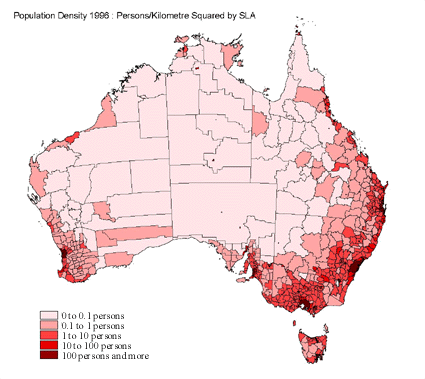
But, stepping back a bit from the immediacy of the crisis in Australia, the scope of the disaster there pales in comparison to the continuing crisis in Pakistan, where nearly six months after the flood began, water still submerges poorly drained agricultural lands in the southern part of the country. An estimated 600,000 Pakistanis are still without even temporary shelter and many more are in danger of starvation and water-borne diseases. Six. Months. Later. Compare that to a total of ~300,000 people affected in Queensland. There are vast differences in the population densities of the affected regions (see the maps below). The sheer number of people affected in the Pakistan floods would probably overwhelm the most resource-rich and prepared country in the world, which Pakistan certainly was not.

1996 Australian Population Density

1996 Australian Population Density (source: Australian census)

Population density of Pakistan

Population density of Pakistan (from Pakistani census data, created by nomi887, uploaded to Wikimedia)

Note the differences in population density of the two countries. One way to do this is to look at the darkest read category in each case. In Australia is is 100+ people per km2. In Pakistan, it is 1000+ people per km2. Now look at the prevalence of those dark red areas.

So while our hearts go out to those who are losing lives and property in Australia, let us not forget that there is a flood tragedy still unfolding in Pakistan, largely out of the media spotlight. Let us also remember that when we see increases in the human impacts of meteorological and geological phenomena, it’s usually not changes to the size or frequency of the phenomenon that drives the trend, but the increasing number of people in nature’s way.

The Brisbane Times and Courier Mail are providing excellent comprehensive, coverage of the floods affecting their readers. I’ll be traveling for the next few days, to ScienceOnline 2011, so I may not be able to keep up-to-date on the flooding in Australia. I hope you’ll use the comments below to add links to news, images, and videos.

Categories: by Anne, geohazards, hydrology

New at Earth Science Erratics: Meteorites and Geology

We’re pleased to introduce the first Earth Science Erratics blogger: Simon Wellings, also known as Metageologist. In his first post, he discusses the geological record of meteorite impacts:

One of the few advantages of having being on the Earth for a while (0.00004 Ma in my case) is that I’ve had time to see new things come along in Science. For example one of the big themes in Geology in the last 20-30 years has been the realisation of the importance of asteroid impacts in Earth History. A lot of attention has rightly been focused on the role of massive impacts in causing mass extinctions (K-T boundary, Chicxulub) but since meteorite impacts follow a power-law relationship of size to frequency alongside a few ‘earth-shattering’ impacts there should be lots of *smaller* ones. Even a ‘small’ impact will make a trace in the Geological record. So where are they?

Head over to to find out – and welcome Simon to the geoblogosphere!

Categories: links, planets

An avalanche at the museum

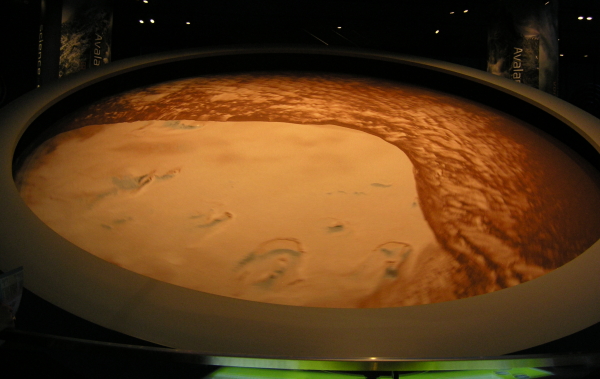
A post by Chris RowanThis weekend saw my first visit to Chicago’s Museum of Science and Industry (which is within walking distance of my apartment), and I have to say I’m pretty impressed with what I saw – not least by the fact that it was clear that I didn’t even manage to see a fraction of what it has to offer in the few hours I was there. Of what I did see, I was especially impressed by the ‘Science Storms’ exhibit, a highly interactive exploration of the science behind natural phenomena such as lightning, tornados and tsunamis. One highlight was the ‘Avalanche Disk’. This is a massive, slanted, rotating disk with granular material – a mixture of white glass beads and red garnet sand – piled on top. As the disk spins, the grains are lifted to the top and avalanche down its face. Visitors can vary the speed of rotation, which changes how the system behaves. It’s quite hypnotic to watch.

An avalanche in progress down the face of the disk. Photo: Chris Rowan, 2011

Perhaps some of the more landslide/debris flow oriented amongst my readers will be able to provide a more detailed interpretation of what’s happening in my video.

Categories: geohazards, geology, geophysics, public science, science education

Stuff we linked to on Twitter last week

A post by Chris RowanA post by Anne Jefferson Now the holidays are over, it’s back to your regularly scheduled link-fest.

New Geoblogs

The new year has already seen some new voices added to the geoblogosphere

As part of Chris’s New Year’s resolution to update the allgeo combined geology blog feed, he’s also added a couple more geoblogs that you may not have come across yet:

For those who are tempted to dip their toes into the geoblogging waters, we’d like you to consider writing for our Earth Science Erratics blog, which we introduced to the world this week.

Also in blogging news: the composition of the latest OpenLab blogging anthology has just been announced. Congratulations to all the exemplary bloggers, and @jgold85 and the judges for the hard work of putting it together. However, aside from Brian’s excellent post on rapid canyon formation, geology is once again poorly represented, which is probably a reflection of the small number of geoblog posts that were nominated. Perhaps we should all make it our new year’s resolution to submit more of the excellent geology writing we come across in the next year.

Earthquakes, Volcanoes, Landslides

Water

Environmental

Fossils

(Paleo)climate

Planets

General Geology

Interesting Miscellaney

Categories: links