The many faces of earthquake triggering

A post by Chris RowanResearchBlogging.orgCan large earthquakes beget more large earthquakes? It’s an easy question to ask, but much more difficult to answer. Depending on the distance from, and time since, the initial earthquake, the processes that may result in ‘seismic triggering’ are very different – and the evidence of there actually being any effect to explain at all varies from fairly solid to rather tenuous.

The basic concept of seismic triggering is that if a particular fault is already stressed close to the point of failure, seismic energy produced by an earthquake elsewhere may, by slightly increasing the stress across the fault still further, provide the extra nudge necessary to cause a rupture. The triggering event doesn’t so much cause the earthquake as change its timing; the resultant earthquake would have happened eventually anyway, because the overall cycle of stress build-up and release on any fault is ultimately driven by regional tectonic forces that continue to operate in the background regardless.

There are two ways that a large earthquake can change the state of stress on surrounding faults: deformation of the crust around the rupture produces permanent stress changes, and seismic waves radiating away from the rupture point (which, like more standard sound waves, jostle around the material they are travelling through) produced short-lived transient or dynamic stress changes. The figure below shows how permanent and temporary stress increases on a fault, due to seismic activity elsewhere, can push it over the threshold where it will be likely to rupture. It also illustrates one of the key differences between these two modes of triggering: permanent stress changes due to deformation can not only push a fault over its rupture threshold, but keep it there, months or even years later, until the fault finally fails in an earthquake. In contrast, the stress changes due to the passage of seismic waves can only temporarily push a fault over the threshold, before the stress settles back down to its initial level. The time window in which an earthquake can be triggered by seismic waves is therefore much shorter: probably days at most.
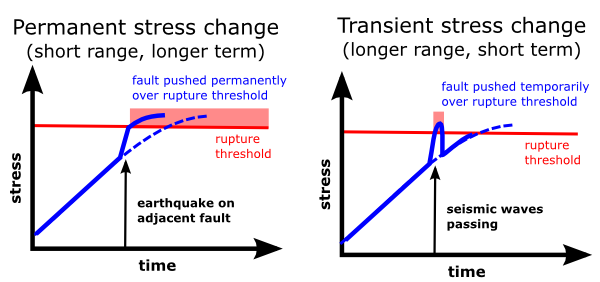
A comparison of seismic triggering due to permanent and transient stress changes. The stress across a fault gradually increases over time due to regional tectonic forces, but additional stresses from an earthquake elsewhere can push the fault over its rupture threshold earlier than expected.

These mechanisms also differ in the range over which they operate. Unlike seismic waves, which can propagate all the way around to the other side of the globe, permanent stress changes are restricted to a fairly localised area of crust around a fault rupture; deformation dissipates the forces generated by the fault’s movement before they can be transmitted large distances*. Even in the case of the very large earthquakes like March’s magnitude 9.0 Tohuku earthquake, significant static stress changes only occurred out to a couple of hundred kilometres from the rupture.
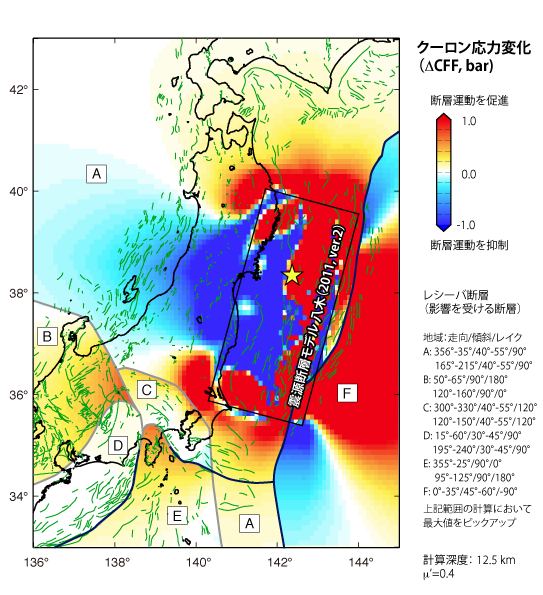
Permanent stress changes in the crust in Japan due to the March 11 Tohuku earthquake. Source: Shinji Toda, Kyoto University

Despite these differences in range and timescale, there is ample evidence that both of these mechanisms cause large earthquakes to trigger other quakes. Calculations of permanent stress changes in the wake of the magnitude 9.1 subduction megathrust earthquake that occurred off the coast of Indonesia in December 2004 indicated increases in stress on the subduction zone to the south-east: this segment then ruptured in a magnitude 8.7 earthquake in March 2005, less than a month after the stress calculations were published. A global spike in background seismic activity also tracked the passage of seismic waves from the 2004 Sumatran earthquake around the world, and the Tokohu earthquake appears to have produced the same effect. Events dynamically triggered by seismic waves from distant earthquakes tend to be small, detectable only by seismometers. A recently published study indicates that dynamically triggered earthquakes of greater than magnitude 5 – the potentially damaging ones – only occur within 1000 km** (and 20-30 hours) of the initial rupture.
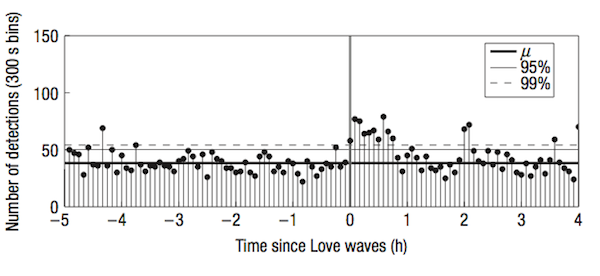
Increase in seismic activity following passage of surface waves produced by the M 9.1 2004 Sumatran earthquake. Source: Velasco et al. 2008, Fig 2.

So, earthquakes can trigger other earthquakes by inducing permanent stress changes on nearby faults: the effects are local, but the resulting triggered earthquakes can be large, and there is a long term increase in the seismic hazard on the faults affected. Earthquakes can also trigger other earthquakes due to temporary stress changes from passing seismic waves: these effects can work at great distances from the initial rupture, but are short-lived and do not appear to trigger large earthquakes at such distances. But the outstanding question is whether there is potentially a third domain of seismic triggering: a mechanism that acts at long ranges, but can trigger earthquakes sooner than they would occur otherwise, but months or years after the initial triggering event.
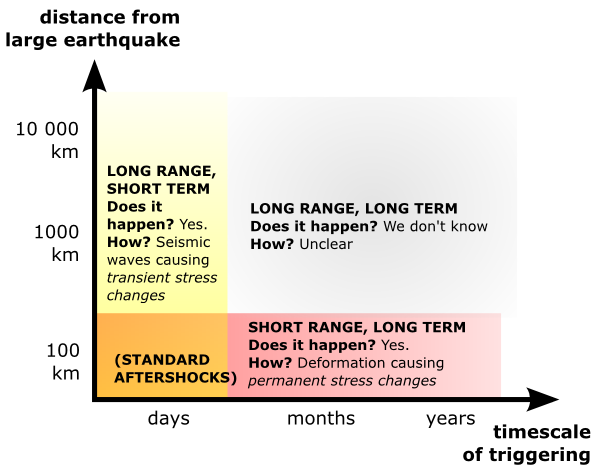
The three domains of seismic triggering. Two are proven, and understood. The third is neither, even though it probably excites the most speculation.

(Note: as Eric Fielding points out in the comments below, I neglected to mention – and show in the now amended original figure – that standard aftershocks plot in the bottom left.)

If this sounds a little bit familiar, this is exactly the sort of effect that Simon Winchester was rather recklessly speculating about a few weeks back. Unfortunately, our records of seismic activity are not long enough to tell if such a mechanism does exist, and our understanding of how faults rupture does not provide many clues as to why faults would react in such a way to a transient stress change. This doesn’t mean that they don’t, and the possibility that large earthquakes can trigger further seismic disasters at a distance clearly needs to be rigorously investigated, even if it’s only to definitively rule it out. In the meantime, however, if you’re hearing talk about seismic triggering, make sure you’re clear on which of the very different kinds of triggering is being discussed.

*Tectonic plates are often described as rigid, because they mostly move as if they are – most of the action takes place at their edges. But they’re not truly, totally rigid in the mechanical sense, as is attested by the presence of faults and earthquakes in plate interiors, and even the distribution of aftershocks following a large earthquake at a plate boundary. If you want to get technical, its probably more accurate to say that a plate is in a state of dynamic equilibrium – the driving forces on the edges and base of the plate all combine to produce coherent motion.

**Interestingly, this is the same sort of distance over which seismic waves from large earthquakes are able to trigger volcanic eruptions.

References

McCloskey, J., Nalbant, S., & Steacy, S. (2005). Indonesian earthquake: Earthquake risk from co-seismic stress Nature, 434 (7031), 291-291 DOI: 10.1038/434291a

Velasco, A., Hernandez, S., Parsons, T., & Pankow, K. (2008). Global ubiquity of dynamic earthquake triggering Nature Geoscience, 1 (6), 375-379 DOI: 10.1038/ngeo204

Parsons, T., & Velasco, A. (2011). Absence of remotely triggered large earthquakes beyond the mainshock region Nature Geoscience DOI: 10.1038/ngeo1110

Categories: earthquakes, geohazards, tectonics

Hydrologist + professor = Anne’s answers to career profile questions

A post by Anne JeffersonA few weeks ago, I was asked to answer some questions for a career profile section of a website aimed at students looking at college degree options. The website creators wanted to use me as their profile of a hydrologist, maybe because hydrology has been dubbed one of the “50 best careers for 2011” and “should have strong growth in the next decade.” As US News reported in December, “There were 8,100 hydrologist jobs in 2008, and the Labor Department projects that employment will grow more than 18 percent by 2018.”

I’ve included below my answers to the generic career profile questions I was asked, but I was unable to completely disentangle my scientific profession as a hydrologist from my career as a university professor. Hydrologists working in industry or government would have somewhat different takes on day-to-day work life than I do. Nonetheless, I hope my answers might be useful to students trying to decide “what to be when I grow up.”

What do you do, and why did you decide to pursue this career field?
I am an assistant professor in the Department of Geography and Earth Sciences at the University of North Carolina at Charlotte. My research and teaching focus on water, so I am a hydrologist.

The sorts of research questions that fascinate me are: “What controls whether a rain drop ends up running over or through the soil into a stream channel within hours to weeks versus sinking down and becoming groundwater that spends years to centuries underground before maybe emerging in that same stream at a spring? How do the topography and geology of a landscape affect the sensitivity of streams and groundwater to floods, droughts, and climate change? How do human activities like urban development, stormwater management, and stream restoration affect floods, low flows, groundwater recharge, and water quality?”

My hometown is on the Mississippi River and its identity and economy is strongly tied to the river. In 1993, while in high school, I got to see the incredible dynamism of the river in action during a record-breaking flood. I was hooked, and decided to study geology in college. My first experiences with scientific research thrilled me – being the person to collect and analyze the data and answer a question that had never before been answered. In order to choose my own research projects in hydrology, I knew I needed a Ph.D.

What type of preparation did you do to get into this field, such as educational experience and work experience?

I have a BA degree in Earth and Planetary Science from The Johns Hopkins University, a MS degree in Water Resources Science from the University of Minnesota, and a PhD in Geology from Oregon State University. After my PhD, I spent time as a post-doctoral researcher before getting my job at UNC Charlotte.

All through school, I was involved with research. As an undergraduate, I did a summer “Research Experience for Undergraduates” at the Smithsonian and a senior thesis on soil water isotopes. Graduate degrees in the sciences are heavily research oriented, and both my MS and PhD projects involved lots of work in the field – wading in streams to measure the amount of flow and collecting stream water, snow, and rock samples. They also involved a lot of time in front of the computer trying to make sense of all of the data I had collected.

While I was in school, I had a couple of work experiences related to water policy and management, since those are also interests of mine. As an undergraduate I did an internship with an environmental organization in Washington, DC, and as a MS student I worked for a county planning department and for the University of Minnesota’s Water Resources Center. These sorts of experiences aren’t required for a hydrology professor, but, for me, they provide valuable context for my scientific research.

If your education was directly related to your career, what types of classes and projects did you have to do?

There are many different undergraduate majors possible for people interested in working with water. Among the most common are civil and environmental engineering, geology or earth science, and geography. There are only a handful of universities that offer undergraduate degrees in hydrology or watershed science, though graduate programs specifically related to interdisciplinary training in water resources science are increasing. As an undergraduate, I recommend getting a strong base in the fundamental courses and concepts in your major, and then adding water-related classes as you have time. If you don’t get a deep enough base in a traditional discipline, you may find that potential employers or graduate advisors don’t understand what skills and knowledge you have.

Regardless of your major, if you are interested in hydrology, take as much math, chemistry, and physics as you possibly can during your high school and undergraduate years. Those classes will give you critical background for your hydrology classes. By the time I was done with my PhD, I’d taken the equivalent of six semesters of math (calculus, differential equations, and beyond), two semesters of statistics, two semesters of physics, and three semesters of chemistry. I sometimes wish I’d taken more, and I definitely wish I’d taken a computer programming class. Another thing I I recommend for almost anyone interested in hydrology is a class (or more than one) in Geographic Information Systems (GIS). GIS is a powerful tool for anyone interested in understanding how natural resources are distributed across a landscape, and some employers may expect at least a little familiarity with GIS.

If you decide to go to graduate school, you may find the array of classes that you can choose from to be dizzying. Work carefully with your graduate advisor and your committee to select a set of classes that will serve your graduate research project *and* your future career plans well. There’s no one standard set of classes for people seeking graduate degrees in hydrology, but I took classes like “Forest and Wetland Hydrology”, “Hillslope Hydrology”, “Groundwater Hydraulics,” “Sediment Transport,” and “The Role of Fluids in Geological Processes.” I also took classes that wouldn’t appear to have anything to do with water, things like “Volcanology” and “Glacial Geology”. Those classes were helpful as I continued to increase my depth of knowledge in geology, and because they provide a supporting framework for understanding problems in hydrology. However, the most important part of graduate school is learning to do scientific research and to communicate it well. You’ll learn that outside the classroom through working with your advisor, your committee members and collaborators, and your fellow graduate students.

How did your education help you in your career?

My education through a Ph.D. was absolutely essential to enable me to become a university professor in hydrology. While there are some limited teaching-intensive positions that might not require a completed Ph.D., if your goal is to teach and do research at the university level, you must complete a Ph.D.

What was your career path like in this field? For example, did you begin in one position and advance through others to reach where you are now?

I am in my first position as a university professor. Before getting my job at UNC Charlotte, I had gained some valuable teaching experience as an instructor for an Oregon State University summer session class, and I spent about a year as a post-doctoral researcher expanding my research skills, but this position is the first one to call on all aspects of my training – and then some.

What types of skills is someone required to have to work in your position?

My job requires me to have both deep and broad knowledge of hydrology and related fields, but there are many other skills that are necessary to be a successful hydrologist and university professor. In no particular order, someone like me needs skills in:

  • Written communication – I need to be able to communicate to both technical and non-technical audiences. The written form is the primary way I share my research results with other scientists and secure funding to continue doing my work. I spend a lot of time reading and commenting on student writing, and I also have to write things like letters of recommendation.
  • Oral communication – My job involves speaking to large groups, creating an interactive classroom environment, and communicating one-on-one or in small groups with students and colleagues. Teaching is about 50% of my job and being a communicator and a good listener is vital to being a good teacher.
  • Quantitative, statistical, and computer usage– I spend lots of time in front of a computer analyzing data and doing spatial analysis in GIS. Of course, computing grades also requires low level quantitative skills. 😉
  • Creativity – As a PhD-level scientist, I get to pick the research projects on which I want to work. That means I get to dream them up, and then figure out how to make them feasible.
  • Outdoors – When I get out in the field, skills like map reading, water safety, wilderness survival, and being able to “read” the landscape and weather are essential to keeping my students and I safe and getting the data we want to collect. For some hydrologists, the necessary outdoor skills might include whitewater kayaking or rafting or operating motorboats or snowmobiles.
  • Lab skills – Although most of my data comes from the field, I also do some more traditional laboratory analyses. That means that I need to do things like pipette, clean glassware, and properly store chemicals.
  • Construction – This might sound odd, but I’ve learned to be handy with PVC, wood, metal cable and various other construction materials. My students and I are constantly designing and building our own apparatuses to measure things like peak water height and to safely secure them at our field sites.
  • Personnel and budget management – In some ways, being a researcher is a lot like being a small business owner. It is important for me to be a good mentor to my students, so they learn how to do research, write a scientific paper, and get their degrees. For each research project with which I’m involved, I have to carefully manage the budget so there’s enough money to do the work to completion.
  • Time management – There is absolutely never, ever enough time in the day to get through all of the things that I need to do for my job. Figuring out how to prioritize, work efficiently, and just let go of the things that can’t be done is probably one of the hardest challenges for a new assistant professor. Four years in, the time crunch hasn’t gone away, all I can say is that I’ve gotten inured to it.

What do you do on a typical work day?

Over the course of a typical work week, I spend 4-12 hours in the classroom teaching, 12-30 hours preparing for class and grading papers, 3-8 hours meeting with undergraduate and graduate students about classes or research, a couple of hours in faculty or committee meetings or meetings with research collaborators, several hours dealing with email accumulation, and an hour or two doing what is called “service”, which includes things like peer-reviewing papers or grant proposals and evaluating scholarship applications.

And all of that is before I get to my own research time for generating and analyzing data and writing papers and grant proposals. If I’m really lucky I get to go in the field by myself, with students, or with collaborators. Or I sneak into the lab and run some samples. I try to carve out at least a full workday per week for research time, and I wish I could do more. Summers and holidays give me a bit more room to spend time on research, but in order to keep research going smoothly, it’s imperative that I make time for it even during the busiest teaching periods.

You can probably see that it is very easy to work far more than 40 hours per week as an assistant professor. That’s why I listed time management skills as a requirement for my job.

Do you plan to advance to another position within your career field? If so, to what position and why?

The general progression for a university scientist is to spend about six years as assistant professor, before applying for tenure and a promotion. The next stage is associate professor, and after that you can go onto become a full professor. If you have an interest in and a knack for management, you can try to become the head of a department or even a dean.

As for me, for now, I’m focused on doing good quality research and teaching to prepare myself to apply for tenure in less than two years. I’m trying to mix writing up completed projects, with keeping on-going projects progressing steadily, and writing grants to support new research. That’s not going to change, even with tenure.

What type of person do you think is best suited for a job in your field?

In order to be successful in my career, you have to be highly self-motivated. Love of the outdoors, being thrilled by discovery and data, a passion for teaching, a fascination for your subject…all of these are necessary things too. But they are not sufficient unless you are motivated enough to keep working hard in the face of failure (experiments gone wrong or equipment breakage), rejection (lack of funding for a grant proposal or negative reviews on a paper), long hours (there’s lots of grading), bad weather (working in 100 degree heat or freezing weather), and no one looking over your shoulder (you are your own boss). What keeps me motivated in the face of all that? That’s where the love of the outdoors, the thrill of discovery, a passion for teaching, and a fascination for water come in to play. I’ve got the best job in the world. For me.

Do you have any advice for those who are looking to launch a career in your field?

To summarize: Pick something that fascinates you. Get involved with research projects early and often. Take lots of math. Learn your field deeply and broadly both in the classroom and outside it. Don’t neglect to develop important skills just because they are not taught in formal classes. Learn to manage your time well. Have a passion for what you do and let that be your motivation. And make sure to get outdoors and be around water as often as you can, because that’s what reminds you of the fascination and passion that motivated this career choice in the first place.

Categories: academic life, by Anne, hydrology, science education

Stuff we linked to on Twitter last week

A post by Chris RowanA post by Anne Jefferson

Volcanoes

Earthquakes

Fossils

(Paleo)climate

Water

Flooding on the Red River has crested in both Fargo and Grand Forks. Now it’s on its way north to Manitoba, and farms and towns in Minnesota and North Dakota are left to clean up the mess it left behind (and take down all those sandbag levees they worked so hard to put up just a few weeks ago).

Environmental

General Geology

Planets

Interesting Miscellaney

Categories: links

Not to scale

A post by Chris RowanIn earth science, you often find yourself working and thinking over a range of different lengthscales and timescales – from micrometres to megametres*, from seconds to petaseconds**, or more. Because of this, making sure you’re clear on exactly what scale you’re meant to be thinking at today is an important part of a geologist’s mental toolkit, and in some of us it translates into a certain obsession with scale bars. For example, when folds kilometres across can – and do – resemble centimetre scale ones, it is nice to know exactly how big the photo or sketch you’re looking at actually is.

Folds the size of an outcrop? The size of a cliff? The size of a mountain? You decide!

This obsession with scale bars is mostly harmless, generally manifesting itself in stationary choices entirely motivated by how good they look in field photos.

I've yet to meet a geologist who doesn't think that these are awesome. From Steve Gough.

But it does give us a tendency to mutter about wrong, inappropriate and missing scales wherever we come across them (or, in the latter case, where we don’t – generally in students’ field notebooks). Of course, nowadays, Twitter allows those mutterings to be transmitted to a much larger audience.
http://twitter.com/#!/eruptionsblog/status/58255092364742656
Oddly enough, Erik’s particular penchant for scale pedantry had come up in a discussion with my co-blogger just a couple of days ago.
http://twitter.com/#!/highlyanne/status/58260934967312384
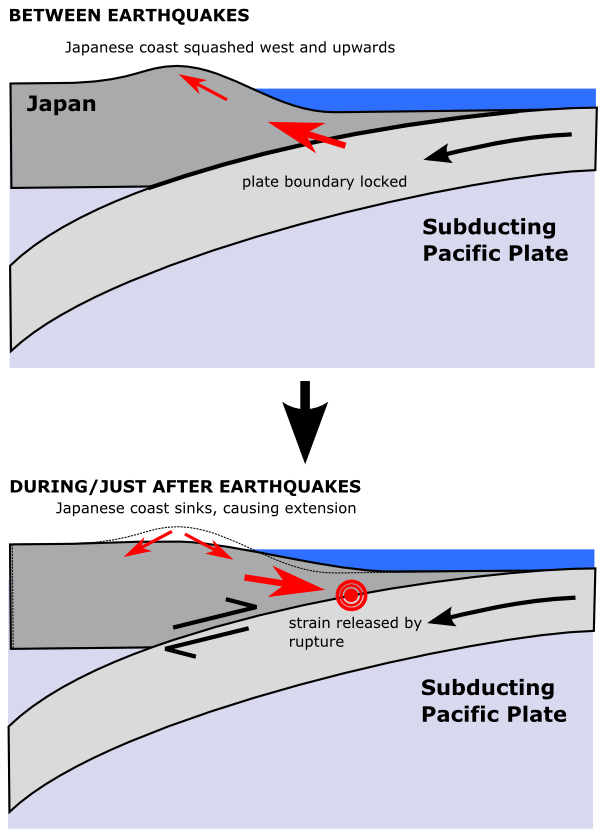
Erik’s tweet has got me wondering if I am as rigorous in this regard as I should be on this blog. Take, for example, this figure from my last post, which illustrates the elevation and subsidence of the Japanese coast over an earthquake cycle. These movements are measured in metres to tens of metres, so on this figure they have been clearly exaggerated; for reference, the width of this cross section is around 250 kilometres, and the crust on the Pacific plate is 10-15 km thick.

Click to see the post that features this figure

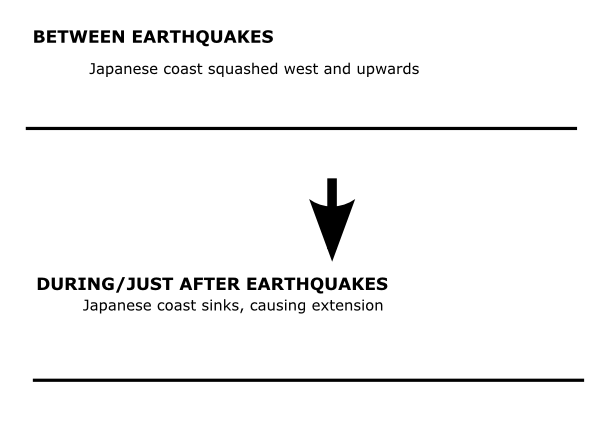
The problem here is not my selective application of a massive vertical exaggeration on this figure. I’m talking about the uplift and subsidence is terms of regional tectonics and seismology, so I needed to show the structure of the subduction zone. If, having done this, I kept to the same scale for the coastal movements, the topographic profiles would look like this.

No vertical exaggeration.

This may be more accurate, but it’s not particularly illuminating. However, not highlighting the vertical exaggeration is a potential problem. I, and other geologists reading this blog, can automatically compensate for the lack of proper scaling, but we can only do this because we already know that these motions are of the order of 10 metres, rather than 100 metres, or 1000. Without this prior knowledge, even if interested laypeople work out, without being told, that the scale is off, they may not know by how much – which may lead to confusion. This confusion could be avoided with a bit more rigour on my part.

Of course, compared to the offence that prompted Erik’s original tweet, I don’t think I’m in too much trouble.
http://twitter.com/#!/eruptionsblog/status/58261090999599104
But I do think that I need to be more careful in future. I also have at least one past figure caption to amend…

*One million metres or 1,000 km
**One petasecond – 1015 seconds – is about 30 million years.

Categories: geology, public science, science education

Backyard science: isotope hydrology style

A post by Anne JeffersonA few days ago, someone asked me whether I’d done any Citizen Science projects with my 4 year old daughter. I said “no”, but then spouted off a couple of projects I was looking forward to starting in the next few years, including CoCoRAHs and Project Budburst. After the conversation ended, I spent a few moments berating myself for failing to have introduced my child to Citizen Science projects before age 4, but then I realized I was being an idiot. Not only is my daughter exposed to a wealth of scientific experiences – museum visits, mixing things together in the kitchen, throwing sticks into streams, hiking and camping in national parks, watching nature documentaries, helping Cookie Monster test hypotheses – but she’s also been helping me with my scientific research for over two years. (Actually, earlier than that – her first field expedition was at 2 months.)

One of my research interests is in understanding the sources of water in streams and the flowpaths and timescales water takes to get there. The isotopes of hydrogen and oxygen in the water molecule give me important information about these sources, flowpaths, and timescales. But in order to know what’s going on in the stream, I must also understand the input signal, i.e., precipitation. I need to know how the isotopic composition of precipitation varies between storms and seasonally in my field area – which is largely in and around Charlotte, North Carolina. No one else is measuring precipitation isotopes in this region, so I need to. And what better place than my backyard.

Precipitation collection apparatus for isotopic analysis

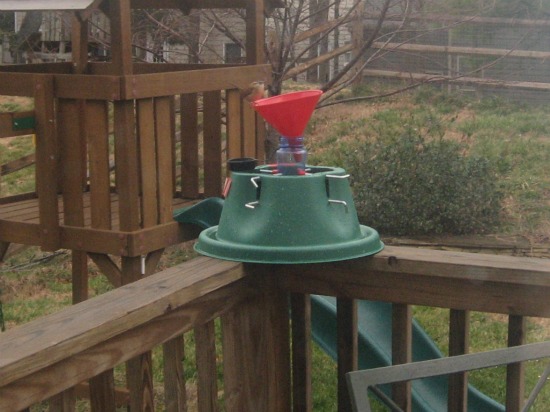
Precipitation collection apparatus, iteration 1, January 2009

In January 2009, I set up a simple collection apparatus on the edge of my back deck. Basic elements of it included my recently disused Christmas tree-stand, a funnel, and an abandoned bisphenol-A containing Nalgene bottle. This set up certainly made it convenient to retrieve the samples as soon as it stopped raining, but it had a couple of drawbacks. I was worried about interference from the house, the funnel tended to tip at an odd angle, and in a few gusty winds, the whole thing blew off the deck railing.

Precipitation collection apparatus, iteration 2

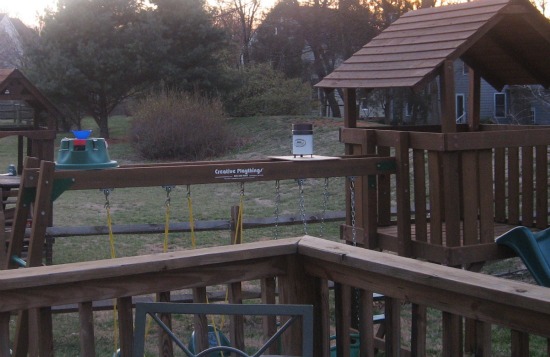
Precipitation collection apparatus, iteration 2, February - August 2009

By February 2009, with an undergraduate student committed to analyzing the data for an independent study, I had somewhat upgraded my collection technique. I moved the collection site to the top of my daughter’s monkey bars, because that was the farthest from any roofline or tall tree in the backyard. I started using tape to secure the funnel to the (shorter) collection bottle and make sure it was pointedstraight up.

And, for a while, I had a tipping bucket rain gage installed a few feet away. That rain gage position represents a compromise between ability to stretch the short download cord to a relatively secure position from which to connect it to a laptop (i.e., the “tree house” rather than the ladder to the monkey bars) and potential interference from the tree house roof. Unfortunately, the rain gage never did work properly and a few months later it was removed from the play set.

The swing set set-up had a few drawbacks though. My backyard has low permeability clay-rich soils (i.e., extremely poor drainage) and it collects standing water after heavy rain storms, and I’d always forget about that before dashing outside to collect a sample in barefeet or sandals. Also, the ladder was rather perilous to climb up because it got quite slippery when wet and covered in mud (from that poorly drained backyard). There was a particularly memorable evening when I needed to retrieve a sample just as a heavy downpour became a heavy snowstorm at 0 degrees C.

Eventually, after careful consideration, I moved my sampling location again. Now, when I collect precipitation samples, I do it at the very end of my driveway, a few feet away from my mailbox. That’s as far away from any roofs or trees as I can get on my property, there’s no ladder to climb, and the pavement is never slippery or muddy. The only problem here is that I need to deploy the collection apparatus (i.e., tree stand, bottle, and funnel) only when there’s an anticipated rain event, so my daughter has experienced a couple of occasions where we’ve raced home from school, driving with one eye on the darkening sky, and set up the collection apparatus as the first heavy rain drops begin to fall.

My child loves to help me collect water samples. “Mommy, do you need to collect a water sample?” is a reasonably frequent refrain in my house. And it’s not just precipitation. Since I work in urban watersheds, I’ve also gotten interested in isotopes in municipal drinking and wastewater. My daughter loves to collect samples from our kitchen faucet, and she’s very adept at getting vials full to the brim and tightly sealed. She’s also been to the wastewater treatment plant with me to collect treated effluent, and we had lots of good conversations around our trip to “the poopy and pee-pee factory.”

So, yes, my daughter has experienced citizen science. While she hasn’t entered data into an online form and we didn’t find the project in a list on the internet, my four year old has had first-hand experience with the process of collecting good-quality scientific data. The next step: getting her to run the lab analyses. Muahahahahaha.

Liquid water isotope analyzer, my lab, UNC Charlotte

Liquid water isotope analyzer, my lab, UNC Charlotte

Categories: academic life, by Anne, fieldwork, hydrology