Chris talks earthquakes in Chicago

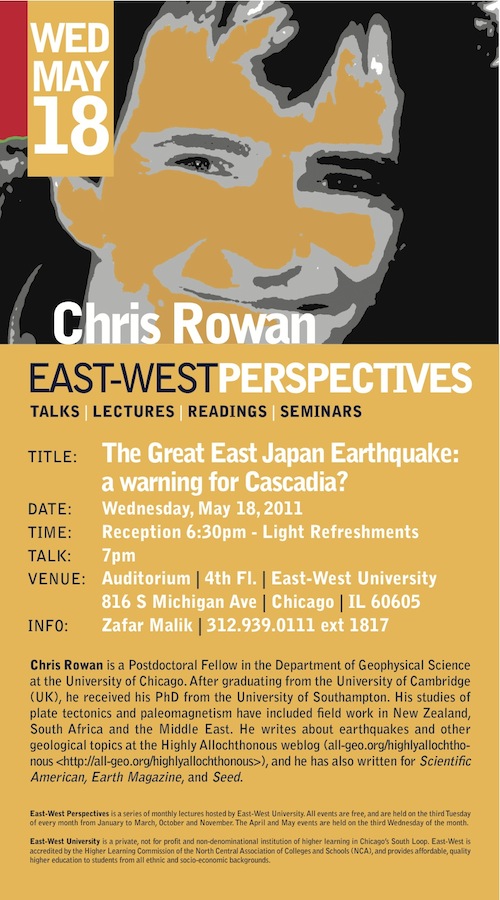
A post by Chris RowanIf any of you happen to live in the Chicago area, you’re at a loose end tomorrow (Wednesday) evening, and you fancy hearing yours truly talk about earthquakes, then I’ve been invited to give a talk at East-West University in Downtown Chicago (map).

I’ll be talking about the recent seismic activity at the Japan trench, and what it can tell us about the future of its eastern Pacific twin, the Cascadia subduction zone. It starts at 6.30pm, admission is free, and you’d be very welcome.

Categories: public science

New at Erratics – Biofuels: state of the science and industry

Will Dalen Rice becomes our fourth contributor to Earth Science Erratics with the first of three posts on The Advanced Biofuels Leadership Conference, held in Washington, DC in April. Will offers the newbie’s perspective on the state of the biofuels science and industry. He writes:

When looking at ways to reduce our energy dependence on foreign countries, biofuels are one solution. In an attempt to learn more about biofuels, I subscribe to and receive a daily newsletter about the biofuels industry. In early 2011, I found out about the Advanced Biofuels Leadership Conference in April. I figured I would go to this conference and learn about what biofuels were. The scope of this conference ended up being way beyond the basics, spending most of its time over my head. So, hopefully I can condense and recount what was presented, despite a much less “advanced” understanding of the products and practices of the biofuels industry.


Read the rest of his post on Erratics.

Will previously blogged at Highly Allochthonous on the topic of carbon capture and storage and urban streams with green walls.

Remember: Earth Science Erratics welcomes contributions from anyone who is tempted to dip their toes into the geoblogging waters, for one post or several, or from new bloggers who want to promote their work through cross-posting. If you’re interested, please contact us.

Categories: conferences, environment, links

Natural disasters may not always hit hardest where you’d expect

A post by Chris RowanThe week before last, the southeastern US was pummelled by a swarm of tornadoes that killed more than 300 people in 6 states, including Alabama (which appears to have borne the brunt of the damage) and Mississippi. Although tornadoes are hardly an uncommon occurrence in these states, if you were simply assessing the hazard based on the frequency of tornadoes, you might expect to be in more danger in states like Kansas and Oklahoma to the west. However, a recent study has shown that this is not the case: the most fatalities caused by tornadoes do not occur in the regions with the highest frequency of tornados, but in the states further to the east – like Alabama and Mississippi.
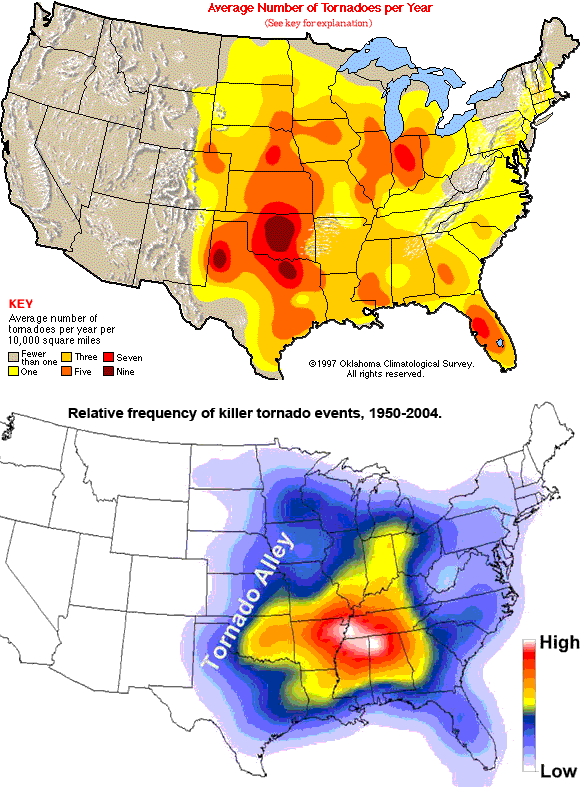
A comparison of the frequency of tornados in the USA (top) with the frequency of tornadoes that have caused fatalities (bottom). Note that the two peaks do not coincide.


(For another way of looking at the dataset plotted above, the New York Times has a nice interactive map/timeline of deadly tornados since 1950)

There are several reasons for this mismatch, the most important of which seem to be the higher density of mobile homes, which are much more susceptible to tornado damage, in the more easterly states; and less appreciation of tornado risks because of the lack of a focussed tornado season, and the perception of safety due to ‘Tornado Alley’ being further to the west. Sadly, the reduced risk of tornadoes occurring is more than matched by the lower resilience and preparedness of communities, which magnifies tornadoes’ impact when they do occur.

I’ve been wondering if similar factors are also an issue when considering the risk from earthquakes. Not unreasonably, a lot of attention is focussed on the seismic hazard in places which are located on plate boundaries, and where damaging earthquakes strike fairly regularly: places like California, or New Zealand, or Japan. However, while most large earthquakes do occur at the edges of plates, earthquakes large enough to do significant damage can and do occur in the interior of plates, the most famous example in the mainland US being the three magnitude 7.5-7.7 earthquakes that struck the New Madrid region between December 1811 and February 1812. In general, the risks from ‘intraplate’ earthquakes within plates are much more poorly known than the risks from ‘interplate’ earthquakes between plates: they follow less regular patterns in time and space, and because strain build up is much, much slower away from plate boundaries, there are much longer periods between one big earthquake and the next in any one area. If an active fault capable of producing large earthquakes only ruptures every few centuries or millennia rather than every few decades, they may not have left their mark in our historical records, and we may be almost completely ignorant of the danger they pose.

In the absence of this knowledge, similar factors to those that increase fatalities from tornadoes in less active areas may be important. The damage and potential casualties from even a moderate intraplate earthquake will be amplified because it will be striking an area with many, many more buildings that are not designed to withstand seismic shaking. Second, away from the regular, low level seismic activity near plate boundaries, people will not only not realise that large earthquakes are a possibility, they will we far less aware of how to respond if one does strike. Events like the recent Central US Shakeout, timed to coincide with the 200-year anniversary of the New Madrid earthquakes, are attempting to at least partially address the public awareness problem. But the fact remains that for many natural hazards, the actual risk is not purely a function of frequency and magnitude: politics, regulation and psychology are also a large influence on the potential human impact.

Categories: earthquakes, geohazards, society

Flooding along the Mississippi River

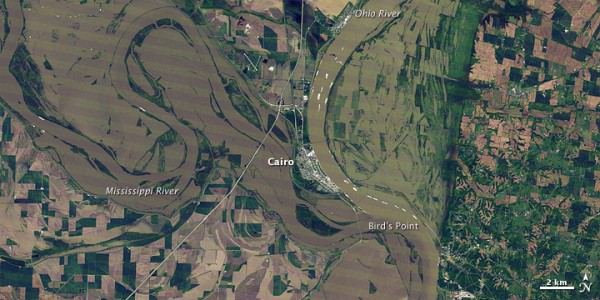
A post by Anne JeffersonIn case other events have crowded it out of your news feed, there’s record-breaking flooding going on in the Mississippi River basin. Snowmelt in the headwaters, combined with weeks of heavy rains in the middle reaches of the river basin, have pushed the system to its engineered limits. The Mississippi River basin is home to more than 100 million people, and when the water flows past Natchez, it’s carrying flow from 41% of the contiguous United States, making it the third largest river basin in the world. The volume of water carried by the Mississippi River in flood can be measured in the same unit as ocean currents — within the next few days, the Mississippi River at Natchez will be flowing more than 2 Million cubic feet per second.

Flooding at the junction of the Mississippi and Ohio Rivers, 3 May 2011, NASA image

Flooding at the junction of the Mississippi and Ohio Rivers, 3 May 2011, NASA image

Start here

For hands-down the best analysis on the flooding, the engineering, the politics, and the media coverage of the flooding, you need to turn to Steve Gough’s Riparian Rap blog. Go there now to get caught up. Then when you want some other perspective, check out the links and resources below.

General information on the flooding

Floodways doing what they were designed to do

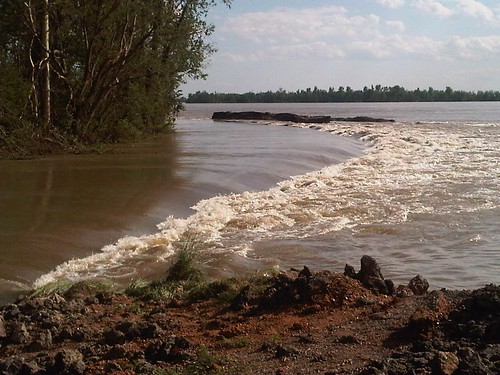
Edge of the inflow section, Bird's Point floodway. image by the US Army Corps of Engineers

Edge of the inflow section, Bird's Point floodway. image by the US Army Corps of Engineers


Early in the week the big Mississippi news story was on the opening of the Bird’s Point Floodway in Missouri. Media reports tended to focus on the sensationalist “us vs. them” people stories, with most of the stories completely missing the fact that the floodway was designed for this purposes and residents in it had known about and been compensated for its existence. Steve Gough had great coverage, including this piece.

The next big to-do will be over opening the Morganza floodway in Louisiana, expected to happen on Thursday 12 May. So far, the news media seems to be taking a bit more reasonable perspective here, but I expect there will be hysterical stories as well. My two cents: Based on experience with devastating past Mississippi River floods, our national policy has been to design and designate floodways to relieve pressure on levees on the mainstem of the Mississippi River. This means that some people miles from the main river will lose homes and property (and have been compensated for that risk), but it is for the benefit of much larger populations. Further, the areas that lie in floodways are part of the natural floodplain of the Mississippi River, and they would flood much more frequently without the levees.

More information on Bird’s Point and Morganza floodways can be found below.

Background Reading

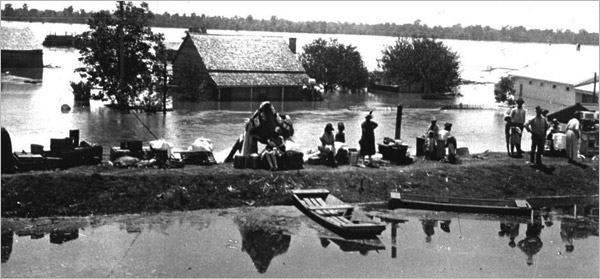
1927 Mississippi River flooding, image from the Library of Congress

1927 Mississippi River flooding, image from the Library of Congress


The best general background information on floods and flood control on the Mississippi River can be found in John M. Barry’s book “Rising Tide: The Great Mississippi River Flood of 1927 and how it Changed America” and John McPhee’s essay on the Old River Control Structure in The Control of Nature, available on-line through The New Yorker.

Categories:
by Anne, geohazards, hydrology, Uncategorized

Stuff we linked to on Twitter last week

A post by Chris RowanA post by Anne Jefferson

Things we’ve written elsewhere

  • In an invited commentary for Earth magazine (solicited in the aftermath of the arsenic life controversy), Chris discusses the impact of social media like blogs and Twitter on peer review and the discussion of published science (spoiler: they’re neither a threat nor a replacement, but could be a useful addition).
    http://www.earthmagazine.org/earth/article/43a-7db-4-1c

Water

Note: Anne will have a separate post up later today with selected links on the on-going flooding on the Mississippi River.

Environmental

Earthquakes & Tectonics

Volcanoes

Planets

(Paleo)climate

General Geology

Interesting Miscellaney

Categories: links