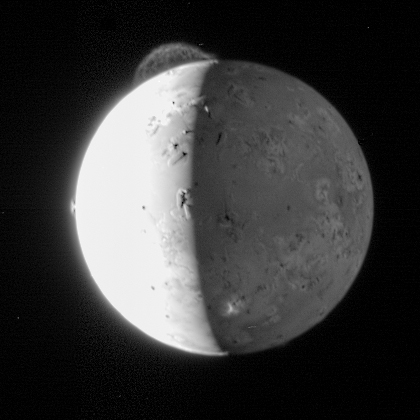
Planetary geology is going through a really fertile period at the moment, with numerous probes and rovers sending back mouthwatering images and data from many different parts of the solar system. However, as well as being extremely interesting in its own right, the information being sent back also highlights an important general point for all us geologists: the dominant processes which shape the Earth are not necessarily the same, or as important, or even present, on other planetary bodies.
An example: what do you need for a planet or moon to be volcanically active? Just from looking at how volcanoes work on Earth, you’d say that it needs to be above a certain size, so that it retains enough internal heat (left over from its formation, and from radioactive decay) to sustain mantle convection.
Earth with a diameter of 12,800 km, is large enough to still be volcanically active: Mars (diameter 6800 km) and our Moon (diameter 3400 km) are too small. They were once, but have now lost too much heat and are volcanically dead. However, as this fabulous picture from the New Horizons probe shows, Io (diameter 3600 km) breaks the rules, and not in a small way either: Io is the most volcanically active body in the solar system.