Lusi quieting down?

The latest from Lusi

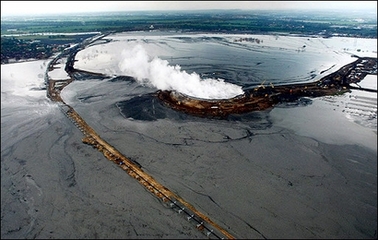
Lusi from the air

Despite the sarcasm, I have been following the attempt to stem the flow of mud from Lusi with some interest, if only because the whole thing sounds like its been dreamed up by the Star Trek technobabble generator (not to mention the guilty schoolboy pleasure of seeing so many headlines containing the phrase ‘concrete balls’). However, reports on exactly what the situation was last week seemed heavily dependent on whom you talked to. For example, the two guys in this report didn’t seem to be on the same page:

“We are still evaluating. We are studying the volume of the flow, which has now increased from 125,000 cubic metres to 160,000 cubic metres a day,” said Rudi Novrianto, a spokesman for the government team tasked with dealing with what scientists dub the “mud volcano”.

He said pebbles, sand and stones the size of tennis balls had now been found in the mud, in addition to clay.

But Satria Bijaksana, a member of a separate team of scientists who initiated the concrete ball experiment, said mud pressure had eased after the balls were dropped.

“We have noticed an increase in hydrogen sulphide, indicating that pressure is decreasing,” Bijaksana told Reuters.

Continue reading

Categories: geohazards, Lusi

Want to know about Monazite? Then phone a friend

At the beginning of the week, I came across this story, about the new ‘Ultrachron’ machine (developed by Michael Williams and Michael Jercinovic at the University of Massachusetts), which seems to offer some exciting possibilities for extracting the detailed tectonic history of a rock.
Continue reading

Categories: geology, links, rocks & minerals

Who are we to define Christianity?

Over at Galactic Interactions, Rob Knop has managed to kick off yet another “robust exchange of views” by talking a bit about his beliefs as a Christian and a scientist. By doing so, Rob has of course been taking a fair amount of flak from those who believe that those two words have no right appearing in the same sentence without a ≠ sign inserted between them. I want to say nothing about that at the moment beyond, “what John said”, but I’ve also noted another, somewhat more disturbing, theme in the comments, for example this one:

You say that you don’t have to throw out your faith to believe in science. But, at least in your case, you most certainly have thrown out your faith. You describe a mix of absolutism and relativism that I find quite confusing (how does it differ from ‘live and let live’, really?), but in any case it bears no resemblence to Christianity.

Or this one:

You did redefine both God and Christian right to the line of irrecognizability. I was a hardcore catholic, and I would never have considered you a christian. .

and, over at his blog, Jason expresses a similar sentiment:

One wonders, however, what it means to describe yourself as a Christian and then write a paragraph like the one above .

This strikes me as a rather silly, and also rather insulting, criticism. The key lies in the second comment: in a depressingly large number of cases, if you ask a Catholic whether a Protestant or a Mormon was a Christian, they would answer no. And multiply vice versa. Hell, at the moment large chunks of the Anglican Church are accusing other parts of not being True Christians; and, to a first approximation at least, Rob’s beliefs seem to be resemble Ken Miller’s, so we have a professed Catholic who would also fall foul of a ‘hardcore Catholic’. So even within the same denomination there’s obviously a fair amount of variability in what people feel defines ‘Christian’.
The point is, ‘Christianity’ is not a discrete trait like black hair or six toes or an addiction to coffee. Christians self-identify. All religious people do. Even if Rob is in a Church of one (almost certainly not the case, I suspect) he clearly has a right to call himself a Christian, and state a belief in God, without being told that he doesn’t know his own mind.* As most of us have probably been burned ourselves by non-scientists telling scientists that science is ‘unethical, godless materialism’ (or ‘a social construct of white patriarchs’), and non-biologists telling biologists that evolution is ‘random unethical, godless materialism’, we should well know the dangers of trying to define other peoples’ terms for them.

Personally, as someone who has long been interested in trying to understand what people believe and why, I’m hoping that Rob will continue to talk about the relationship between science and his faith; I’m sure I won’t be the only person who learns something if he does.

*as distinct from discussing how his Christian beliefs differ from other peoples’. There is a difference.

Categories: ranting

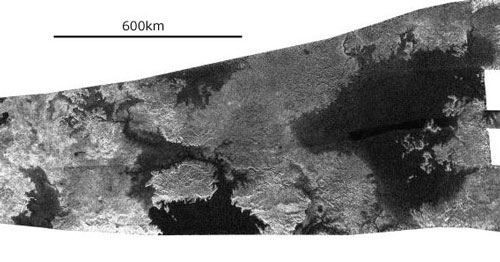
Now that’s what I call an extraterrestrial lake!

We’ve been waiting…. and hoping… and finally Cassini has delivered.

Titanlakes.jpg

Click on the image above to access the full swath at a range of resolutions. These things are much bigger than anything previously imaged on the surface of Titan – JPL have a nice side-by-side comparison with Lake Superior in which the Titanian contender comes off pretty well (more discussion here).

The usual caveats about radar not being able to unequivocally say that these depressions are filled with liquid apply, of course, but it’s pretty exciting all the same.

Categories: planets

Geological Basics: the composition of the Earth

It has been mentioned a couple of times in the back-channels that the ever-growing Basic Concepts series is seriously lacking in Geology. I wonder who’s supposed to do something about that? Misplaced delusions of my importance in the grand scheme of things aside, it’s an excellent idea, and I should also point out that a scroll down Thermochronic’s sidebar will lead you to some excellent geological reference posts by himself and other geoblogospheric luminaries.

Deciding where to begin is a bit tough: my plan is to concentrate on things which will be a useful reference for planned, more cutting-edge posts, but suggestions from interested/puzzled readers and commentators are of course welcome. I’m going to start with the old favourite: What is the earth made of? And how do we know?
Continue reading

Categories: basics, geology