Some interesting data from Mars Odyssey about the distribution of sub-surface ice on Mars were published in Nature last week by Joshua Bandfield at Arizona State University (see also here and here). Mars Odyssey had already detected the presence of extensive water ice at depths < 1-2m by using its Gamma Ray Spectrometer to measure the concentration of hydrogen. However, this instrument does not have a very high spatial resolution (of the order of hundreds of kilometres), so cannot resolve any local variations in the thickness or depth of the subsurface ice layer.
In contrast, the Thermal Emission Imaging System (THEMIS) has a much higher resolution – of the order of 100 metres. However, inferring the presence of subsurface ice with this instrument is a slightly more indirect process. Detection is based on the idea that martial soil, or regolith, will have a much higher thermal inertia when bound together with ice than it does as a loose aggregate; this means that regions with a lot of ice near the surface will cool or heat up more slowly in response to daily and seasonal changes in temperature than areas where there is no ice, or it is more deeply buried.
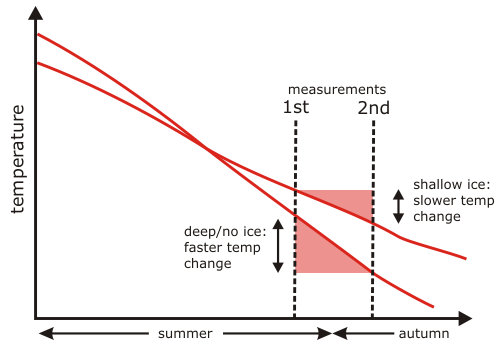
In order to exploit this principle, Bandfield used THEMIS observations of the same region in mid to late summer and early autumn to calculate how much the ground temperature changed as Mars cooled down. Because changes in air temperature take time to propagate into the subsurface, the amount of cooling depends mostly on the thermal properties of the top metre or so of the Martian surface. The figure below, adapted from Figure 1 of the Nature paper, shows that if there is shallowly buried ice, the thermal intertia of these top few tens of centimetres is high, and the temperature change is small. If the ice is buried deeper, beneath a thicker layer of unbound regolith, the thermal inertia of the surface layer is lower and the temperature change is larger.