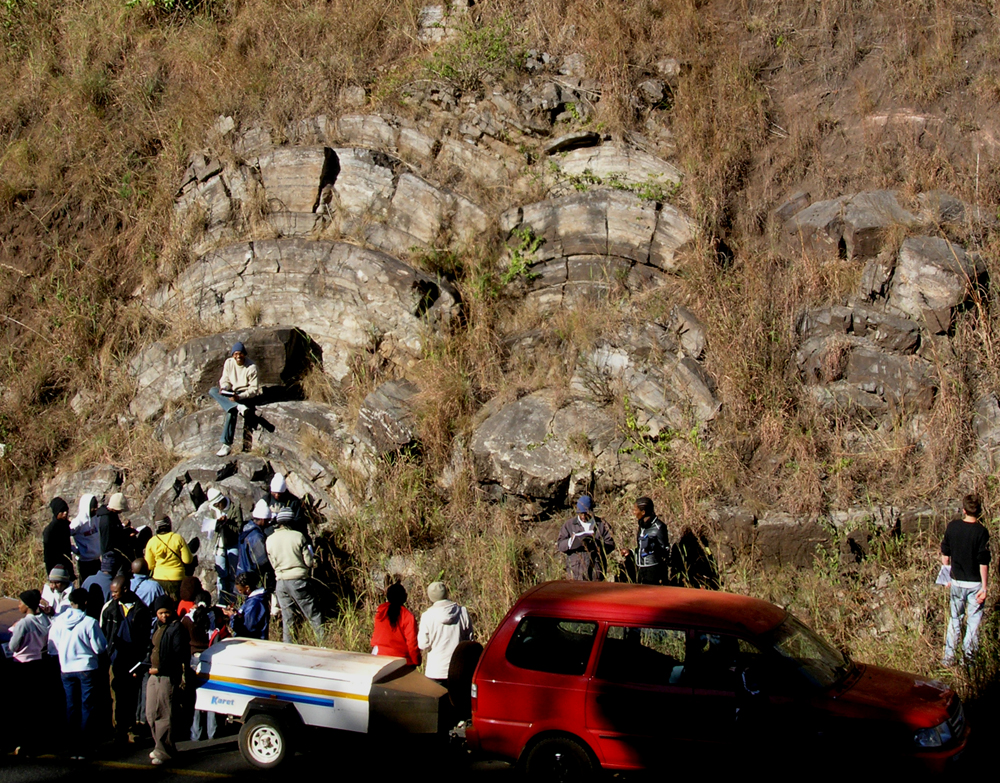
A vast array of suggestions were put forward for the identity of the dome-like structures in Friday’s geopuzzler, including lava tubes, folds (both pre-and post lithification) and Arrakian sandworms. How I wish the latter were true…
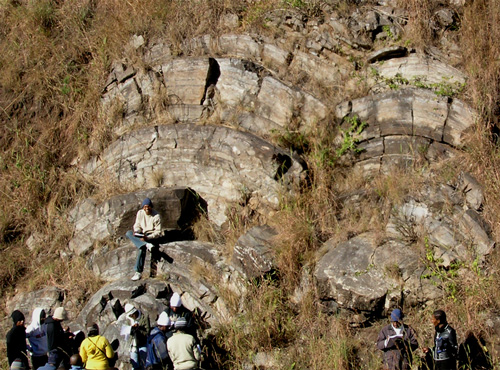
Anyway, smug points go to those of you that figured out that we are in fact looking at some some impressively large domal stromatolites – layered carbonate structures precipitated by algal mats. These ones are much older than the Namibian ones that I’ve blogged about previously – a good two billion years older in fact. As Greg correctly speculated, these are from the lowest part of the Late Archean to early Proterozoic Transvaal Supergroup. During this time, a large shallow marine platform extended over much of South Africa, which provided a very welcoming home to reef-building cyanobacteria (thanks to some preserved bacterial microfossils we know these particular stromatolites were definitely biological in origin).
That’s worth considering for a minute: for at least two billion, and possibly 3 billion years of the Earth’s history, the algal mats that precipated stromatolites such as this were pretty much the only macroscopic expression of life. We might think of Precambrian ecology as ‘simple’ compared to what followed from the Cambrian onwards, but in fact we find a great diversity of stromatolite forms and sizes, each adapted to different environments and conditions; perhaps things weren’t quite as ‘simple’ as we tend to imagine.

 Anthropocene! Naming a new geological time period after ourselves certainly has a nice dramatic ring to it, even if it smacks of the hubris that got us into our current climatic mess in the first place. But can our species, as The Straigraphy Commission of the Geological Society of Londo claim in the GSA Today paper that everyone is talking about (update: Brian and Greg has also contributed enlightening perspectives), really justify claiming a place on the geological timescale?