Geospatial data and the web (#scio10 preparation)

A post by Chris RowanAfter busting my gut in the last couple of weeks to put out 12 posts in 12 days – and many thanks for the positive feedback, both public and private, that I’ve received for the series – it’s now more than time to look ahead to the fast approaching ScienceOnline 2010 conference. Amongst all the fantastically interesting sessions and discussions on offer, I’m co-chairing a session with Jacqueline Floyd entitled Earth Science, Web 2.0+, and Geospatial Applications.
For people working in geology and other field sciences like oceanography and ecology, the geographic context, and the 2D or even 3D spatial distribution of our data, is often extremely important, and the ability to store, access and visualise this information using web tools is gradually developing. This therefore seems like the ideal time to get a dialogue going about how web and social media tools might be used to distribute, use, and in the latter case even generate, geospatial datasets. I am hoping with this post to get some discussion going here which can feed into the session next weekend, but Jackie and I are also hoping that the conversation will continue in the next few months, with some moves towards realising some of the ideas that seem to be floating around this subject in the geoblogging community (and beyond). We believe that the discussion can be focussed around three questions:

  • What’s available? With help from other geobloggers, I’ve been trying to compile a list of currently available geospatial datasets. Even though it’s still far from comprehensive – please feel free to suggest any additions, either on the wave, the wiki or in the comments here – it does show that quite a lot of interesting data available on the web already. However, availability doesn’t necessarily mean usability, so we’d also like your thoughts on the good, the bad and the ugly of the nascent geospatial web. By contrasting good sites where data are easily and intuitively accessed and visualised (something like ClimateWizard springs to mind), against sites where getting the data is still a bit fiddly (such as the USGS earthquake search page, which is a stark contrast to a lot of its offerings), we can try to identify ‘best practices’ which would be useful when developing geospatial resources in the future.
  • What would you like to see? What data are not available that could/should be? This could be in terms of specific datasets, or in types of data – should we be geocoding papers, blog posts, photos? In the second case, I have been playing around with this idea, but it’s still a bit ad-hoc. As a subsidiary question, there is also the issue of what other contextual tagging is required in addition to geocoding (e.g., age is just as important in many geological contexts).

  • What tools are we missing?. If the geospatial web is going to take off, we need to make more user-friendly tools to encode, access and visualise geospatial data sets, so that people not familiar with the inner workings of web protocols will use them. We need easy searching, perhaps using a graphical map interface where you can select areas you want to search for data in. We need ways of integrating different data sets into the same visualisation (perhaps through broad mash-ups like a Google Earth geology layer or the excellent, if tightly focussed GeoMapApp). And there is also the prospect of the ability to construct new geospatial databases from geotagged data harvested from the web – crowdsourcing efforts like the USGS’s Twitter Earthquake Detector, and the #uksnow twitter aggegator demonstrate two different ways of collecting data with a geospatial component. There’s probably all sorts of other data you could collect in a similar fashion: but how can we make it easy for people to submit data? What I’d like to see is some sort of generic app that makes allows you to add geocoded photos/notes/voice memos/videos/other data such as structural to a specified feed that can then be viewed on Google Maps/Earth – either a personal one for a particular field trip project or a collective one for crowdsourcing projects. Perhaps a bookmarklet for your browser that allows you to geocode things you encounter on your browsing via a map interface.
    One potential consideration here is that there may be a difference between using such data for simple sharing, and possibly using it for research. What is required to make web-harvested datasets scientifically useful? For example, how to you determine the accuracy of the location provided? How to you filter out bad or irrelevent data?

I’ll be interested to hear everyone’s thoughts and ideas – remember, even if you can’t make the session, you can still help to make the discussion more fruitful there, and give it some momentum in the aftermath.

Categories: fieldwork, general science, geology

Anne’s picks of the December literature

A post by Anne JeffersonI’m a few days behind on sharing my picks from December’s journals, but Chris has been doing such a stupendous job of sharing absolutely wonderful geology posts (and of deconstructing terrible science reporting), that I hardly feel guilty waiting until he’s occupied with travels before sneaking this post onto the blog.
Without further ado, here is the odd assortment of articles that hit my email box in December that I found most intriguing. They reflect a mixture of my past, present, and future research and teaching interests and should not be considered a reflection of anyone else’s tastes in science.
Burbey, T.J. (2010) Fracture characterization using Earth tide analysis, Journal of Hydrology, 380:237-246. doi:10.1016/j.jhydrol.2009.10.037
Tides are popping up all over in the geology literature these days, from the Slumgullion earthflow (atmospheric tides) to the San Andreas fault (earth tides). Here Burbey uses water-level fluctuations in fractured rock confined aquifers to quantify specific storage and secondary porosity. Fractured rock aquifers are notoriously tricky to understand, and this method gives hydrogeologists one more tool in their arsenal for understanding places like the Blue Ridge Mountains and the Piedmont. Since I’m getting interested in the fractured rocks in just those areas, this paper caught my eye.
Burnett, W.C., Peterson, R.N., Santos, I.R., and Hicks, R.W. (2010) Use of automated radon measurements for rapid assessment of groundwater flow into Florida streams Journal of Hydrology, 380:298-304. doi:10.1016/j.jhydrol.2009.11.005
Radon is a conservative tracer with concentrations several orders of magnitude higher in groundwater than surface water. That means that it can be used to evaluate the groundwater inputs into different stream reaches, though it is often used in conjunction with other tracers to get quantitative estimates. In this paper, Burnett and colleagues lay out a method for using radon as a sole tracer to quantify groundwater discharge. I’m looking around for tracers to separate overland flow, flow through the soil/saprolite, and groundwater from rock fractures, so this paper piqued my interest as radon is one candidate I’m learning more about.
Garcia-Castellanos, D., Estrada, F., Jim?©nez-Munt, I., Gorini, C., Fern?†ndez, M., Verg?©s, J. and De Vicente, R. 2009. Catastrophic flood of the Mediterranean after the Messinian salinity crisis. Nature, 462, 778-781, doi:10.1038/nature08555.
5.6 million years ago the Mediterranean basin was nearly dry and highly saline in the midst of a period known as the Messinian salinity crisis, but 5.33 million years the Atlantic Ocean rapidly refilled the basin by overtopping and incising through the sill at the Straits of Gibraltar. How fast did that sea refill? How big was the peak discharge? And what did all that water do the straits itself? Those are the questions tackled in this paper, which combines borehole and seismic data with hydrodynamic and morphodynamic modeling. The story that Garcia-Castellanos and colleagues tell as a result of their work is truly astounding. The Atlantic Ocean overtopped the sill and slowly began to refill the Mediterranean, but as the sill eroded, discharge (and incision) increased exponentially until peak discharges on the order of 108m3/sec were reached and sea levels in the Mediterranean were increasing by up to 10 m per day. While the beginning and the end of the flood may have stretched out for thousands of years, the modeling work suggests that the vast majority of water transfer and the incision of greater than 250 m deep canyons across the Straits of Gibraltar was done on a time scale of several months to two years. That peak discharge is ten times greater than that estimated for the Missoula Floods, themselves not trifling events, and there may have been profound paleoclimate repercussions from such a significant change in the region’s hydrological status.
Grimm, R. E., and S. L. Painter (2009), On the secular evolution of groundwater on Mars, Geophys. Res. Lett., 36, L24803, doi:10.1029/2009GL041018.
Grimm and Painter created a 2D pole-to-equator model of subsurface water and carbon dioxide transport, initiated the model by simulating sudden freezing, and then looked at the effects over geologic time scales (secular evolution). According to their abstract, their model predicts water to be found in different places on the Martian landscape than previous ideas had suggested. I guess we’ll just have to go look and see who is right.
Jiang, Xiao-Wei; Wan, Li; Wang, Xu-Sheng; Ge, Shemin; Liu, Jie Effect of exponential decay in hydraulic conductivity with depth on regional groundwater flow Geophys. Res. Lett., 36, L24402, doi:10.1029/2009GL041251.
In soils and in the Earth’s crust, hydraulic conductivity (K) generally decreases exponentially with depth. This phenomenon is the result of the compaction and compression of the overlying strata. In this paper, Jiang and colleagues examine the implications such decreases in K on local versus regional groundwater flow systems. They find that the more quickly K decreases, the less water makes into the deeper regional flow systems and local flow systems extend deeper into the subsurface. They suggest that when hydrogeologists try to interpret regional flow problems, that we need to bear in mind the effects of decreasing K on the systems.
Knight, D.B. and Davis, R.E. 2009. Contribution of tropical cyclones to extreme rainfall events in the southeastern United States. J. Geophys. Res., 114, D23102, doi:10.1029/2009JD012511.
Knight and Davis used 25 years of observational, wind-corrected, and reanalysis data for the southeastern Atlantic coastal US states and found that extreme precipitation from tropical storms and hurricanes (TCs) has increased over the study period. They find that this increase in TC contribution to extreme precipitation is a function of increasing storm wetness and frequency, but not storm duration. If TCs are producing more precipitation, their flood hazards are also increasing, and flooding is already the leading cause of deaths associated with TCs.
Meade, R.H. and Moody, J.A. 2009. Causes for the decline of suspended-sediment discharge in the Mississippi River system, 1940-2007. Hydrological Processes. 24, 35-49. doi:10.1002/hyp.7477
Dams on the Missouri and Upper Mississippi Rivers have been blamed for trapping almost 2/3 of the sediment that used to reach the Lower Mississippi and Delta. Here, Meade and Moody show that the dams are only trapping half of the missing sediment, while engineering practices such as bank revetments and meander cutoffs, combined with better erosion control practices in the drainage basin, probably account for the rest. Meade and Moody suggest that this river system, in the largest basin in North America, has been transformed from transport-limited to supply-limited, which is a pretty amazing fundamental shift in the behavior of the river and its ability to deliver sediments to the Gulf of Mexico. [Note that there’s another article in the same issue on “A quarter century of declining suspended sediment fluxes in the Mississippi River and the effect of the 1993 flood.” Both articles are in the public domain and not subject to US copyright laws, though there doesn’t seem to be an obvious way to take advantage of that from the Wiley website.]
Neumann, R.B., Ashfaque, A.N, Badruzzaman, A. B. M., Ali, M.A., Shoemaker, J.K., and Harvey, C.F. 2010. Anthropogenic influences on groundwater arsenic concentrations in Bangladesh, Nature Geoscience 3, 46-52. doi:10.1038/ngeo685
The story of groundwater of southeast Asia’s deltas, where tens of millions of people live at risk of arsenic poisoning from their drinking water, is perhaps the most compelling contemporary scientific story of how geology, geomorphology, hydrology, and humans intertwine. It’s also an extremely complicated story, with arsenic-laden sediment from the Himalayas settling in the deltas , irrigated rice fields and ponds changing the local groundwater flow patterns, and microbially mediated oxidation of organic carbon driving the geochemical release of the arsenic into the groundwater. This story has been being pieced together in many papers in the last several years, and in this paper Neumann et al. show that groundwater recharge from the ponds, but not the rice fields, draws the organic carbon into the shallow aquifer, and then groundwater flow modified by pumping brings the carbon to the depths with the greatest dissolved arsenic concentrations. Add some biogeochemistry data, isotope tracing of source waters, incubation experiments, and 3-D flow modeling, and this paper adds some important elements to our understanding of how this public health risk came to be – and how we might be able to mitigate the risks for the people who have little choice but to drink the water from their local wells. [Also note that the same issue of Nature Geosciences has another article on “arsenic relase from paddy soils during monsoon flooding” as well as an editorial, commentary, backstory, and news and views piece on the southeast Asia arsenic problem.]
Pritchard, D., G. G. Roberts, N. J. White, and C. N. Richardson (2009), Uplift histories from river profiles, Geophys. Res. Lett., 36, L24301, doi:10.1029/2009GL040928.
In rivers that have adjusted to their tectonic and climatic regimes, the long profile of a river is smooth and concave. The interesting places are where river profiles don’t look like that ideal. This paper interprets river longitudinal profiles as a way to understand the tectonic uplift history of the area, through a non-linear equation. They check their interpretation against an independently constrained uplift history for a river in Angola.
Stone, R. 2009. Peril in the Pamirs. Science 326(5960): 1614-1617. doi: 10.1126/science.326.5960.1614
Dave Petley at Dave’s Landslide Blog has the must-read summary of this article on the risks associated with the giant lake impounded by the world’s tallest landslide dam. This is seriously fascinating stuff. I already talked a bit about the Usoi Dam in my dam-break floods spiel in my Fluvial Processes class, and now I have more ammunition for this year’s crop of students. In the same issue of Science, Stone also summarizes some of the other water issues facing Central Asia.

Please note that I can’t read the full article of AGU publications (including WRR, JGR, and GRL) until July 2010 or the print issue arrives in my institution’s library. Summaries of those articles are based on the abstract only. UNC Charlotte also does not have access to Nature Geosciences.

Categories: by Anne, climate science, geochemistry, geomorphology, hydrology, paper reviews, planets

Fox News: volcanic coal kills off dinosaurs before they even evolved

A post by Chris RowanTwitter can be cruel sometimes. Without it, I never would have come across (via user @DoubleBeam) this aneurysm-inducing travesty on the Fox News website. I’ve italicised sentences of particular ‘interest’ in the first three paragraphs.

Cataclysm That Killed Dinos Still Taking Lives Today

Coal from China’s Xuan Wei County, widely used for cooking and heating, may contribute to unusually high rates of lung cancer among women in the region.

The tremendous volcanic eruption thought to be responsible for Earth’s largest mass extinction which killed more than 70 percent of plants and dinosaurs walking the planet 250 million years ago is still taking lives today.

Scientists investigating the high incidence of lung cancer in China’s Xuan Wei County in Yunnan Province conclude that the problem lies with the coal residents use to heat their homes. That coal was formed by the same 250-million-year-old giant volcanic eruption termed a supervolcano that was responsible for the extinction of the dinosaurs. The high silica content of that coal is interacting with volatile organic matter in the soil to cause the unusually high rates of lung cancer.

That’s right. In just that second highlighted sentence, Fox News tells its readers that:

  • The dinosaurs were made extinct before they actually evolved (in reality they radiated after the Permian extinction killed off the mammal-like reptiles that were the dominant large land animals at the time0.

  • Volcanos erupt coal (if you read later in the article, this might just be clumsy wording – but I’m not sure that makes it any better).

My browsing of the various science news feeds indicates that the Fox News story was probably adapted from this press release. Compare the first sentence (my emphasis again) to the second paragraph of the Fox piece:

The volcanic eruptions thought responsible for Earth’s largest mass extinction — which killed more than 70 percent of plants and animals 250 million years ago — is still taking lives today.

So, the Fox reporter replaced ‘animals’ with ‘dinosaurs’. Because all extinct animals are dinosaurs, right?
Seriously, if you’re planning to actually expand on a press release for your story – a laudable aim, in principle – perhaps it might be best to fact-check your additions. I’d prefer churnalism to gratuitous insertion of wrong. On a more positive note, Alexis Madrigal wrote up what is actually quite an interesting story properly for Wired. It can be done, allowing us to ponder the actual point of the story – the potential impact of long-ago geological events on human health today – without having to grind our teeth to do so.
Update: The Volcanism Blog is also understandably perturbed about this story, and has a bit more on the actual research behind it.

Categories: general science, public science, ranting, science education

12 folds a-plunging

A post by Chris RowanOn the 12th day of Christmas my true love sent to me: 12 folds a-plunging…

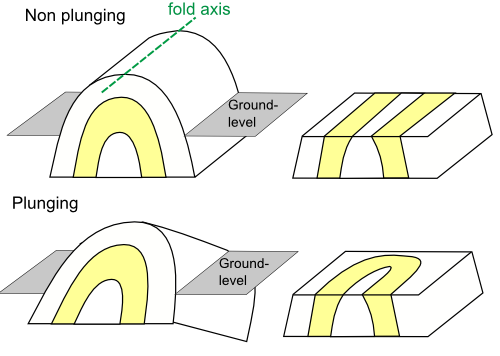
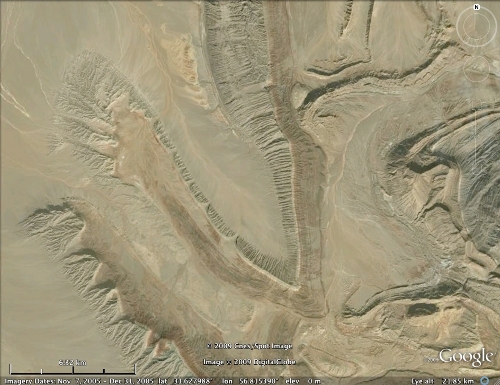
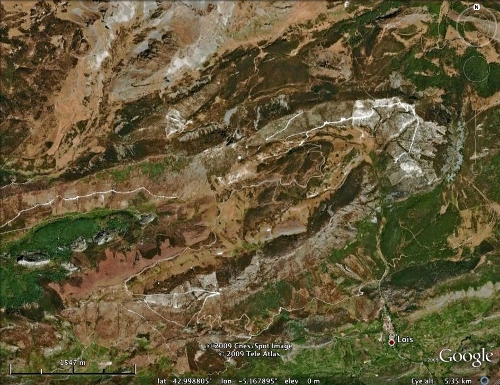
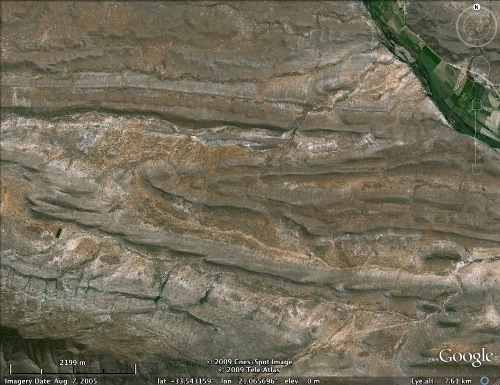
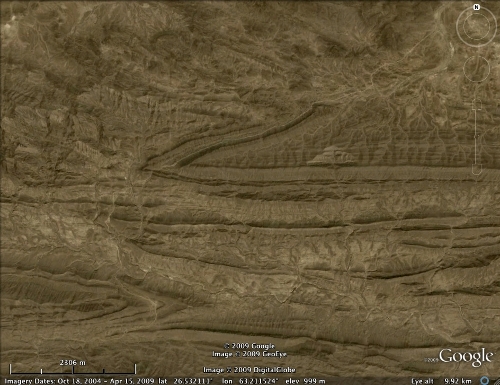
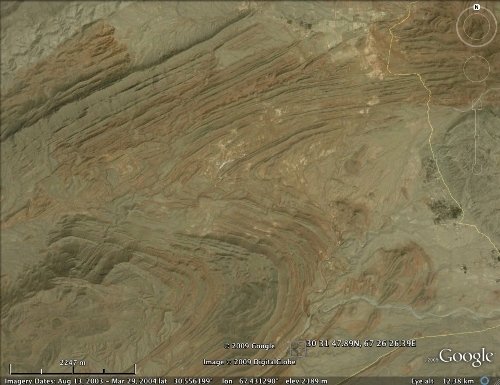
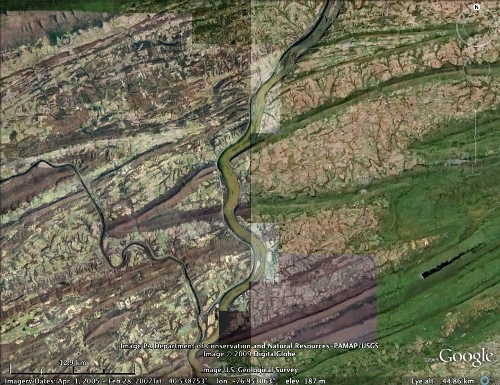
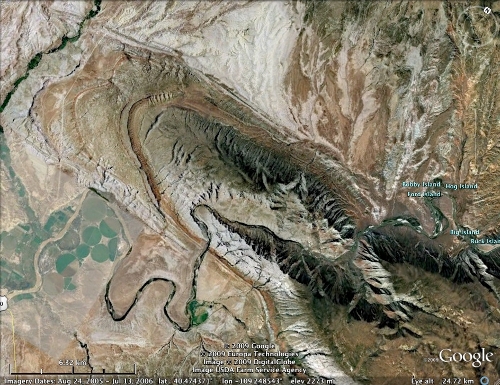
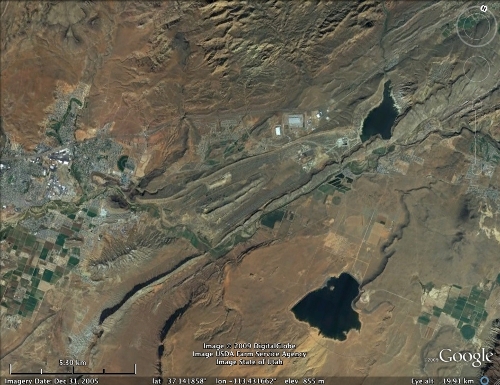
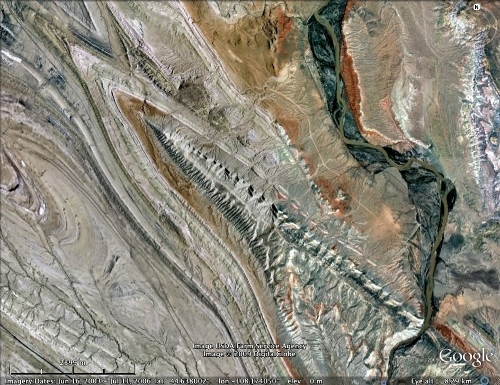
Anyone with even a hint of structural geologist in their soul loves a good fold. As well as their geometrically appealing curves, they represent a tangible, easily read footprint of the tectonic forces that have lifted up the hills and mountains around you. A fold is said to plunge if its axis of curvature has been tilted away from the horizontal, such that the landscape will cut through the fold, rather than running parallel to it.

plunge.png

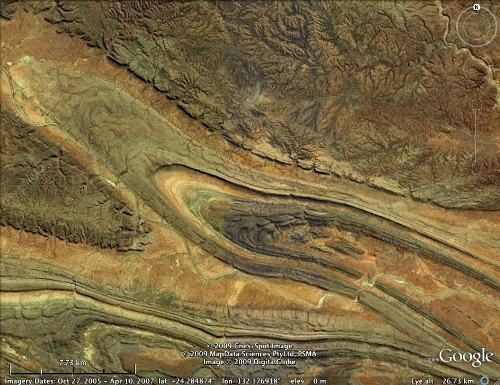
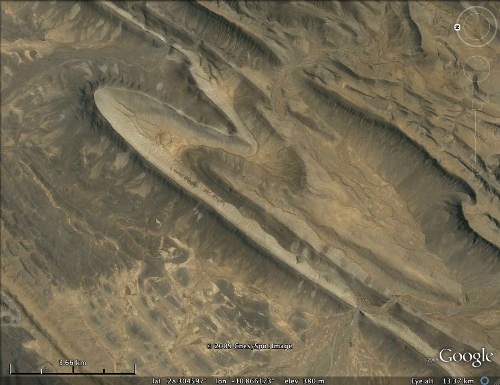
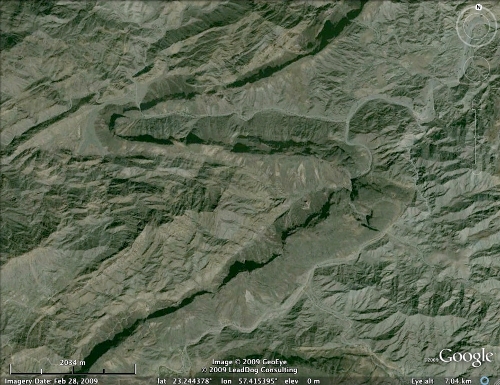
This means that when seen from above, plunging folds look rather beautiful; the differently eroding beds form a tableau of warped ridges and valleys, all co-operating to tell their tale of orogonies past.

Australia.jpg
Australia (click images to open in Google Earth)

Algeria.jpg
Algeria

Oman.jpg
Oman

IranFold.jpg
Iran

Cantabrians.jpg
Cantabrians

SouthAfrica.jpg
South Africa

Pakistan.jpg
Pakistan

Pakistan2.jpg
Pakistan again

Harrisburg.jpg
Pennsylvania

SplitMt_Utah.jpg
Utah

StGeorgeUT.jpg
Utah again

Wyoming.jpg
Wyoming

For the examples above (click here to open the full set in Google Earth) I’ve borrowed heavily from the SERC page of Google Earth mapping locations, as well as adding a few from my own personal experience. I was hoping to include at least one from the UK, but none of the examples I know of show up well on satellite; if you know of any, in Britain or elsewhere, I’d be happy to hear of them in the comments.

11 terranes amalgamating,

10 probes a-probing,

9 isotopes fractionating,

8 streams reversing,

7 glaciers melting,

6 fields a-flipping,

5 focal mechanisms,

4 index fossils,

3 Helmholtz coils,

2 concordant zircons,

and an APWP.

Thus ends my Christmas epic. Phew. I hope it provided some interest and enjoyment over the festive season.

Categories: geology, tectonics

11 terranes amalgamating

A post by Chris RowanOn the 11th day of Christmas my true love sent to me: 11 terranes amalgamating…

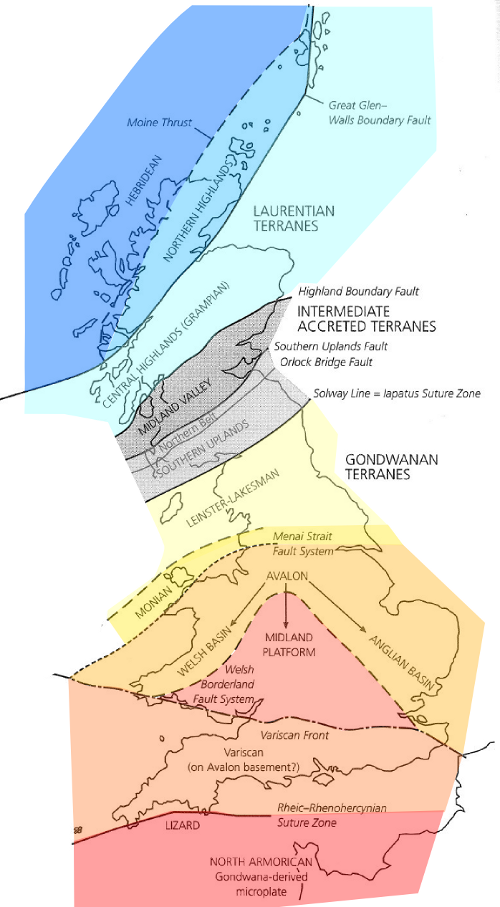
Strip away the last 200 million years or so of sediment covering the British Isles, and you discover a complicated jigsaw of different pieces of crust (in deference to Christie, I shall avoid calling it ‘basement’):

UKterranes.png
Adapted from Woodcock and Strachan (2000) Fig 2.8

The different coloured blocks are separated from each other by major faults, and have distinctive geological records: in other words, sequences of roughly the same age on adjacent blocks were formed in different depositional settings, and have different geochemical and fossil signatures. This suggests that these different crustal fragments – usually referred to as exotic blocks or terranes – started off their lives widely separated from each other, and have been juxtaposed by later tectonic activity involving the faults that surround them.
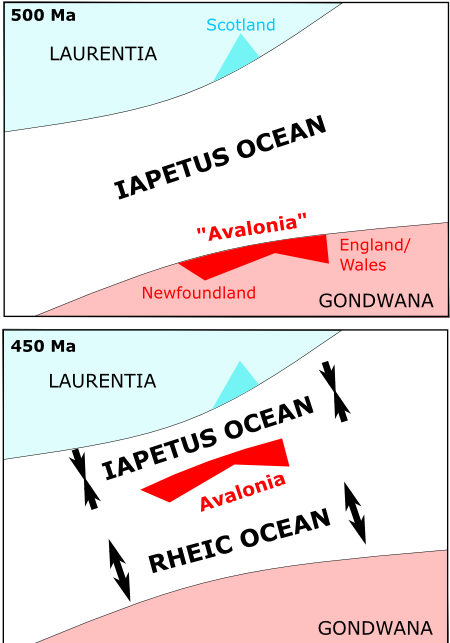
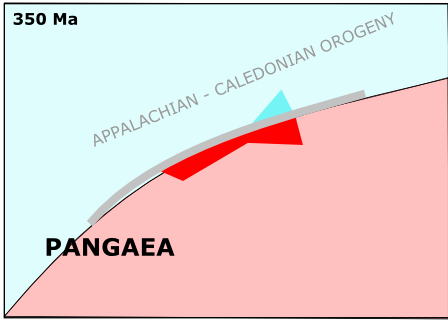
I have, in a previous post, discussed the period between about 500 and 350 million years ago, which started off with the crust underneath England and Wales (Avalonia) attached to Africa (or, as it was known in those times, Gondwana) on one shore of an ocean, and Scottish crust attached to North America (Laurentia) on the other shore; and ended with the closure of that ocean bringing them together, followed quickly thereafter by the rest of Gondwana, forming the Caledonian mountain chain in the process.
Avalonia1.png

Avalonia2a.png
Read this if you want the details

Following this story, then, you might expect to see that the underbelly of the British Isles was composed of at most three independent terranes, representing Laurentia, Avalonia, and Gondwana. So why are there so many more? That is most easily explained by looking at what is happening, and what is going to happen, all the way round the other side of the world:

Aus_Asia.jpg

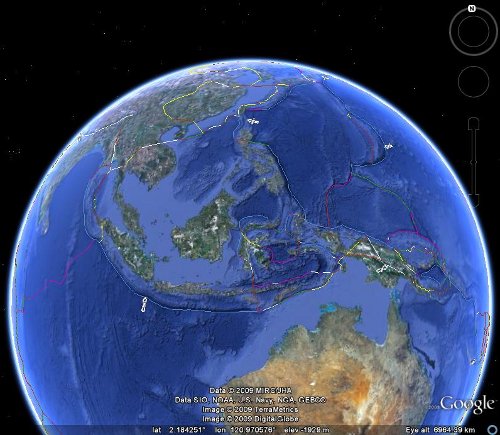
It might not be immediately obvious, but we’re looking here at the very early stages of another continental collision: that of Australia and south east Asia. If you run current plate motions forward for a few tens of millions of years, Australia will slowly move northwards with respect to the Eurasian plate, and eventually collide with it. However, if you look within the steadily closing ocean between them, it is obvious that this collision will involve more than the two bounding continents; there are also lots of smaller continental fragments, such as Indonesia and Papau New Guinea, lying between them. These fragments will not be subducted, but will also be swept up into the collision zone and crammed together into a geological mishmash of numerous unique crustal blocks, all with different origins and trajectories.
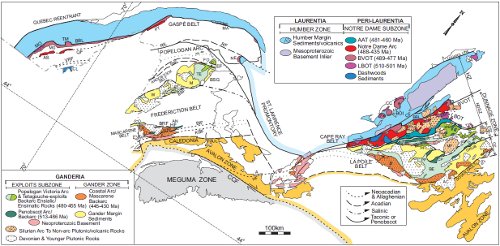
‘Imagine’, a lecturer of mine once said, ‘trying to sort out that mess in 50 million years’ time’. But it is a similar mess, made 350 million years ago, that awaits those trying to unravel the roots of the British Isles. The different terranes represent Palaeozoic Indonesias and Papau New Guineas, which were crushed together with Avalonia as they all collided with the margin of Laurentia; even, the southernmost terrane in the first figure, Armorica, is actually another crustal fragment that rifted away from a completely different part of the Gondwana margin than Avalonia, and was only eventually merged with it on the other side of an ocean. The eagle-eyed amongst you will also note that the Avalonian block itself can be divided into at least two distinctive terranes; a further complication that suggests an earlier history of amalgamation. And if you think Britain looks complicated, remember that the Appalachians formed along the same long-lived convergent margin:

NorthAppalachianterranes.jpg
Source: Natural Resources Canada

and lets not even start on the Pacific Northwest.
Basically, as a rule of thumb, if you keep subduction going for a few tens of millions of years, you end up with a geological mess. Or, if you’re willing to look at it the right way, the coolest and most challenging jigsaw puzzles ever.

10 probes a-probing,

9 isotopes fractionating,

8 streams reversing,

7 glaciers melting,

6 fields a-flipping,

5 focal mechanisms,

4 index fossils,

3 Helmholtz coils,

2 concordant zircons,

and an APWP.

Categories: geology, Palaeozoic, past worlds, tectonics