Stuff I linked to on Twitter last week

A post by Chris RowanAnother 7 days’ worth of interesting links I shared on Twitter.
Kelvin Wave Renews El Nino [image]
http://earthobservatory.nasa.gov/NaturalHazards/view.php?id=43200
(via @NASA_EO)
Barchan dunes / marauding jellyfish advancing north of Winnemucca
http://geopathology.posterous.com/barchan-dunes-marauding-jellyfish-advancing-n
(via @geo_pathology)
One part of @brianshiro‘s job is monitoring the Earth’s magnetic field for the @USGS. Learn about it here (PDF):
http://www.intermagnet.org/publications/Magnetic_monitoring_of_earth_and_space.pdf
Epic satellite picture of massive dust storm sweeping across S Sahara, Africa
http://earthobservatory.nasa.gov/NaturalHazards/view.php?id=43200
@rschott has an updated list of geo blogs broken out into active and inactive
http://ron.outcrop.org/blog/?page_id=716
(via @sfoxx, @clasticdetritus)
What are all those grooves on Phobos? Possible Martian impact ejecta? Cool.
http://webservices.esa.int/blog/post/7/1078 , see also http://bit.ly/dupEHa
(via @elakdawalla)
Friday Field Foto no. 105: Lava channel frozen in time [beautiful!]
http://clasticdetritus.com/2010/03/19/friday-field-foto-105-basalt-channel/
(via @clasticdetritus)
Why Evolution is very right thank you very much. Beyond a ‘Darwin was wrong’ headline
http://www.guardian.co.uk/commentisfree/2010/mar/19/darwin-evolutionary-science-media-coverage
(via @AdamRutherford)
Engaging the public on science? Surely you\u2019re joking! [UK Research councils have strategy for encouraging public engagement. Who knew?]
http://2020science.org/2010/03/10/engaging-the-public-on-science-surely-youre-joking/
(via @BoraZ, @Mary_Spiro)
Students who understand earth is 4.5 biillion years old much more likely to understand evolution.
http://www.minnpost.com/scientificagenda/2010/03/18/16696/understanding_earth’s_geological_age_and_evolution_linked
(via @RonsGeoPicks)
World’s oldest rivers mapped under huge desert dunes. [Can’t access journal to see actual map. Boo]
http://www.newscientist.com/article/dn18636-worlds-oldest-rivers-mapped-under-huge-desert-dunes.html
(via @ScienceSoWhat)
The Oldest Trees on the Planet
http://www.wired.com/wiredscience/2010/03/old-tree-gallery/
(via @ScienceSoWhat)
Corot finds Jupiter-like exoplanet with orbit in right temperature range for icy moons .
http://www.esa.int/SPECIALS/COROT/SEMJOMCKP6G_0.html
(via @esa)
Largest global earthquakes. [Nice plot showing that few large eqs release almost all seismic energy]
http://shakingearth.blogspot.com/2010/03/largest-global-earthquakes.html
(via @Geoblogfeed)
Follow Scripps scientists this week as they map the Chile earthquake rupture site on the seafloor
http://www.siosearch.com/
(via @Scripps_Ocean)
The study that launched the @USGSted Twitter earthquake detector project: [Looking forward to the follow-up!]
http://www.seismosoc.org/publications/SRL/SRL_81/srl_81-2_es/
LD PPC Mark Wright on importance of having scientists and engineers in parliament
http://blog.sciencecampaign.org.uk/?p=840
(via @UKRC, @sciencecampaign)
Astoundingly beautiful. Planck sees tapestry of cold dust [in intragalactic space] (via , )
http://www.esa.int/SPECIALS/Planck/SEMMN9CKP6G_0.html
(via @kejames, @esa)
Do you want people to discuss your published work? [and do you mind that discussion being on blogs?]
http://scienceblogs.com/ethicsandscience/2010/03/do_you_want_people_to_discuss.php
(via @docfreeride)
America\u2019s largest shake table can test quake resilience of entire buildings (via )
http://news.discovery.com/videos/tech-earthquake-shake-table-rocks-buildings.html
(via @RonsGeoPicks)
Landslide in Maierato, Italy
http://earthobservatory.nasa.gov/NaturalHazards/view.php
[the one which was caught on video: ]
http://bit.ly/awuJjH
(via @NASA_EO)
BALLS CONDEMNS EXPERT FOR KNOWING STUFF. Classic.
http://www.thedailymash.co.uk/news/society/balls-condemns-expert-for-knowing-stuff-201003162562/
(via @thedailymash)
Mars Express sees the far side of Phobos Nice one onto the north pole too.
http://www.planetary.org/blog/article/00002390/
(via @elakdawalla)
Except for 1 section in N Chile, whole plate boundary off W coast of South America has ruptured in last 150 years.
http://www.sciencedaily.com/releases/2010/03/100309083656.htm
You should also check out this animation of the rupture.
http://blogs.discovery.com/.a/6a00d8341bf67c53ef01310f8c04b3970c-pi
Volcano Profile: Erta Ale
http://scienceblogs.com/eruptions/2010/03/volcano_profile_erta_ale.php ,
Home of the worlds most awesome lava lake: see also:
http://www.swisseduc.ch/stromboli/perm/erta/index-en.html
(via @Geoblogfeed)
Deep-sea volcanoes play key climate role. Source of iron, often a limiting nutrient for phytoplankton.
http://uk.reuters.com/article/idUKTRE62E0QJ20100315
(via @geology4u)
Geo-neutrino anti-matter detected. Produced by radioactive decay inside Earth. Interesting
http://www.timesonline.co.uk/tol/news/world/europe/article7061848.ece
(via @TimesScience)
Ocean acidification: Why the climate change deniers don’t want to talk about it
http://resourceinsights.blogspot.com/2010/03/ocean-acidification-why-climate-change.html
(via @Geoblogfeed)
Pakistani Mud Volcanoes at NASA Earth Observatory [Natural ones]
http://earthobservatory.nasa.gov/IOTD/view.php?id=43127
Categories: links

Haiti: what next for the Enriquillo Fault?

A post by Chris Rowan I’ve been invited to contribute to Haiti Rewired, Wired’s collaborative conversation about rebuilding post-earthquake Haiti. Obviously, geology – in particular, future seismic hazard – is an important consideration when making decisions about rebuilding Haiti, and ensuring that the inevitable future earthquakes are better prepared for. Anything I post there will get cross-posted (with a delay) here, but I encourage you all to go and have a look at Haiti Rewired, and see whether you can make any contributions to the discussion yourself.

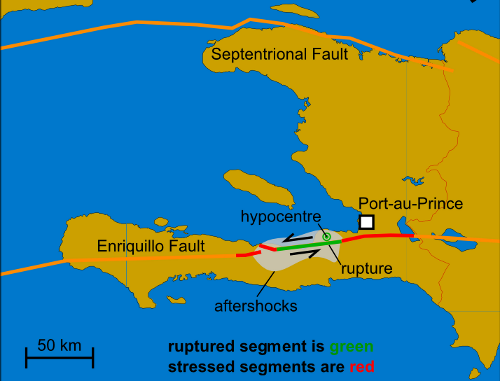
The earthquake that rocked Haiti two months ago was produced by the rupture of a roughly 50 kilometre section of the Enriquillo Fault that runs through southern Haiti. The total length of this fault system, which accommodates about half of the westward motion of the North American plate relative to the Carribean plate that occurs in this region, is several hundred kilometres. This means that on the sections of the fault adjacent to January’s rupture, the strain built up by several hundred years’ of plate motions is still there, waiting to be released. The only question is when, and how.

In fact, the recent seismic activity may have actually increased the risk of one of these neighbouring segments failing in another large earthquake. When a fault ruptures, the sudden motion stresses the surrounding crust. The aftershocks that followed the January 12th earthquake were one result of this. But the ‘surrounding crust’ includes the adjacent, unruptured segements of the Enriquillo Fault, and placing more stress on them can potentially bring these sections closer to the point where they too will fail. Modelling of the deformation resulting from January’s rupture (shown in green on the figure below) indicates that the largest stress increase (red) has been on the 50 km section immediately to the east, with a significant but smaller increase on a 20 km section just to the west.

Haiti_rupture2.png

The increased stress on these parts of the fault potentially mean that they will rupture sooner rather than later. This is of particular concern for the eastern fault section, which runs only a few kilometres to the south of Port-au-Prince. This is so close that even a moderately large earthquake could do a lot of damage (the actual shaking intensity due to an earthquake is strongly dependent on the distance from the rupture point, as well as the total energy released).

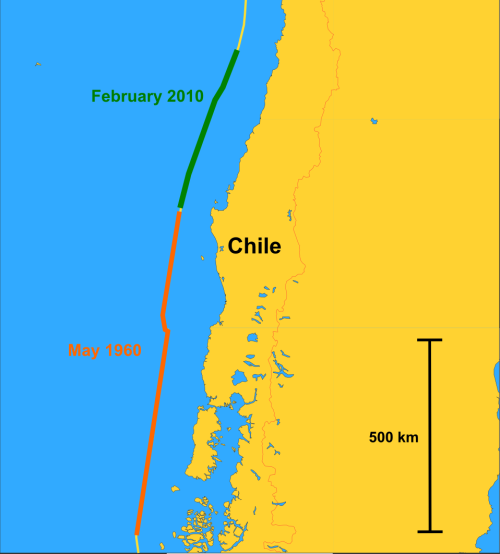
Of course, in geological terms, ‘soon’ does not necessarily mean next month, or even next year. To take a topical example, in May 1960 the largest earthquake ever recorded, with a magnitude of 9.5, was the result of a rupture almost 1000 km long on the subduction thrust off the west coast of Chile. This placed more stress on the fault segment immediately to the north, which eventually ruptured. Fifty years later.

Chileruptures.png

In contrast, stresses induced by the magnitude 9.1 earthquake that occurred off the coast of Indonesia in December 2004 probably contributed to the rupture of a neighbouring section of the Sunda Trench in a magnitude 8.7 earthquake a mere 4 months later. The problem is that the effect of these additional stresses depends on how close a particular part of the fault is to failing already. If it is already quite close to the point of failure, adding a bar or two of additional stress may push it right to the brink of rupturing or beyond; if not, then the additional loading will not have such an immediate effect. How do you tell the difference? Not very easily, although hopefully collecting data on current and recent deformation around the Enriquillo Fault, through close study of comparative radar imagery (several examples are available here) and new GPS data might provide some clues. More detailed study of the historical activity of the Enriquillo Fault – how large past ruptures were, and how activity on adjacent sections was correlated – might also provide some insight into the possible seismic future.

Categories: earthquakes, geohazards, tectonics

Highlights of the Geological Society of America NE/SE Section Meeting

A post by Anne JeffersonI’ve just returned to Charlotte after spending a few days in Baltimore, Maryland attending the combined Northeastern and Southeastern Section Meetings of the Geological Society of America. It was a really good conference, with lots of cool science, good people, and a fun setting.
I tried to tweet some highlights of the conference as I went, but for those of you not following me (@highlyanne) on Twitter, I’ve attempted to reassemble the conference based on my 140 character soundbites. Note that the unofficial conference hashtag (a way of following topics on Twitter) was #geoBAL, so I incorporated that into most of my messages. There wasn’t a lot of users of the hashtag, but I did get sneak peeks into some of the other sessions. Below the fold, you can get a sneak peek into my conference experiences, both scientific and touristy.

Continue reading

Categories: by Anne, conferences

Lecture notes

A post by Chris Rowan Some wag in the comments to my last post not-so-subtly noted the slight lack of blogging activity from yours truly in the last few weeks. There are actually three inter-related reasons for this impromptu break. Firstly, I’ve been lecturing three times a week for most of the last month, so quite a few of my evenings have been spent preparing for them. Secondly, I had to fight off a bout of stomach flu, which meant that the times when I wasn’t preparing for lectures I didn’t really feel like doing anything. Thirdly, my days at work have been spent in the lab trying to get our new magnetometer working properly. All this has meant that my blogging muse has had to get used to being crowded out.
Lecturing has, as usual, left me feeling rather ambivalent. Standing up in front of an entire class is where I suffer the most from imposter syndrome. I’ve never received any formal education training, after all, and the lecture theatre is when I feel that lack the most. When demonstrating in labs and on field trips, and supervising students on projects, there is at least the prospect of being able to assess your own effectiveness, by talking with the students, and checking their work, and asking them questions. Through these constant interactions, I’ve managed (hopefully) to become a better teacher – I can see which approaches work, which don’t, and, more importantly, identify problems in understanding as they come up and deal with them accordingly. Standing up at the front of a lecture theatre, it’s much more difficult: you do most of the talking, they do most of the listening. Even if you encourage the students to ask questions, it’s not exactly common, so you find yourself wondering whether they’re not asking questions because they’ve understood what you’ve been talking about, or because they don’t want to admit that you lost them within the first five minutes. Of course, given how tentative most post-grads/docs are in asking questions during and after talks, you can hardly blame first years for being a little cautious about speaking up.
So although I’ve done a fair amount of lecturing now, it worries me that I really can’t say with any confidence if I’m actually any good at it or not. I think I’ve gotten much better at pacing myself, and not trying to cram too much information into too short a time – lectures are sort of like anti-conference talks, which is a bit of a problem when that’s your only real experience when you first start lecturing. I’ve also begun to appreciate that a pen and whiteboard can be much more effective than a powerpoint slide and laser pointer, especially when you’re talking about basic concepts. But still, I fret. Perhaps my readers have some suggestions for how you can objectively assess your effectiveness in the lecture theatre beyond the quality of answers in the exam. Just remember – I’m not a member of the teaching staff; I was covering part of a course for a member of staff who was on sabbatical. So it’s hardly my place to completely retool the teaching model.

Categories: academic life, ranting, science education

Earth’s forgotten youth – and beyond

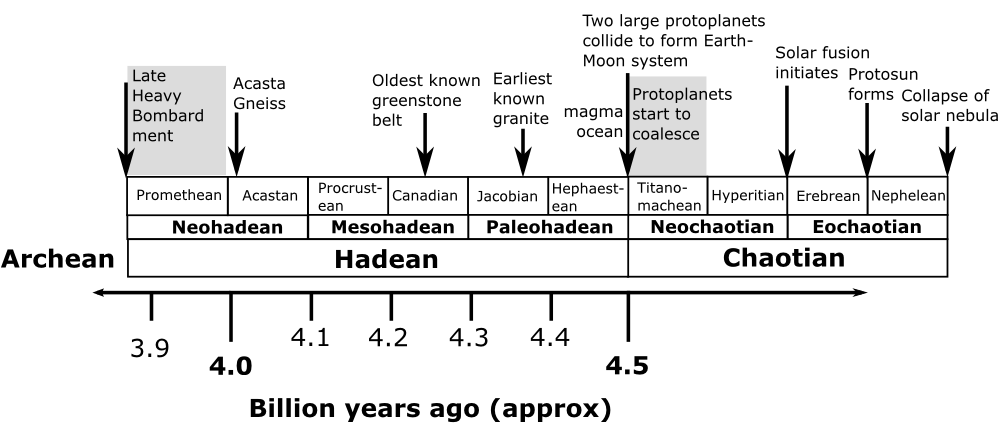
A post by Chris RowanResearchBlogging.orgThe further back in time we go, the more and more fragmented the Earth’s geological record becomes. Whilst not exactly common, rocks with ages up to about 3.5 billion years old are found at multiple points on the Earth’s surface. However, rocks older than this are much less common. Extensive outcrops older than about 3.8 billion years are exceptionally rare, possibly because a series of very large meteorite impacts prior to this time – the Late Heavy Bombardment – largely destroyed any older bits of crust. The Acasta Gneiss in northern Canada, dated at around 4.03 billion (4030 million) years, is generally regarded as the oldest known outcrop of crust, although a recent study has claimed that the Nuvvuagittuq greenstone belt, also in northern Canada, may be as old as 4280 million years. The only known bits of the Earth that are older are 4.2-4.4 billion year-old zircon crystals found in the Jack Hills Conglomerate in Australia; the conglomerate itself was deposited about 3 billion years ago, but it contains debris eroded from much older, and now long-vanished, bits of crust.
Two or three data points is not a hell of a lot to go on when trying to reconstruct the evolution of the early Earth, especially when the material involved is far from pristine (the Acasta Gneiss, being a gneiss. has been partially remelted, for example). It is therefore no surprise that the geological timescale for the period between the Earth’s formation, about 4.56 billion years ago, and the start of the Archean Eon, usually pegged at about 3.8 billion years ago, is rather lacking in detail. This period is usually referred to as the ‘Hadean’, which is more of a reference to the presumed conditions on the Earth’s surface than a subtle pointer to the fact that we don’t know what the hell was really going on.
However, this has not stopped Colin Goldblatt and his co-authors having a go at adding a bit more structure to the Earth’s earliest days – and beyond. The ‘Chaotian’ eon at the start of their proposed new timescale is a common framework for the entire solar system, beginning with the gravitational collapse of the gas cloud that it would eventually form from. Key events – such as the initiation of solar fusion, or the first interactions between sizeable protoplanets that condensed from the protoplanetary disk – mark the boundaries between different eras and periods within the Chaotian. The start of the Hadean is marked by the collision of the proto-Earth, which the authors call Tellus, with another Mars-sized protoplanet, forming the Earth-Moon system.

Hadean.png
Proposed new timescale for the formation of the solar system (Chaotian) and the evolution of the early Earth (Hadean). Click for a larger image

Thus, the Chaotian marks the time when solar system first became a distinct entity from the galactic neighbourhood; the beginning of the Hadean is when the Earth’s geological history begins to be shaped as much by internal processes, such as mantle convection, as by external events such as collisions with other protoplanets, Similarly, from beginning of the Archean, at the end of the Late Heavy Bombardment, internal processes start to completely dominate the Earth’s geological evolution; extraterrestrial collisions can still have significant geochemical and biological impacts, but they no longer melt the entire crust. Conceptually, I find this quite a nice way of looking at it.
The authors also attempt to subdivide the Hadean, but because we still don’t understand the key events in the Earth’s geological development over this period, it’s not quite as successful. The Hephaestean period probably covers the recovery from the Moon-forming impact. The Jacobian, Canadian and Acastan periods refer to the Jack Hills zircons, Nuvvuagittuq greenstone belt and Acasta Gneiss, respectively, but although these outcrops can give us clues about what the Earth was like when they first formed, it is a bit risky to try to characterise an entire planetary system from one sampling point. For example, the Jack Hills zircons tell us that granite – in other words, continental crust – was forming 4.4 billion years ago, but this is only a minimum age; we have no evidence that it wasn’t forming before that. Also, for all we know greenstone belts were also forming at exactly the same time, and have just not been preserved. The small amount of data we have available means that a single new outcrop might force the entire timescale to be redrafted.
It’s difficult to know if we’re ever going to be able to construct a truly robust, process based timescale for the first 700 million years of Earth’s history, because it’s unclear how much we’ll ever truly know about the Hadean. Still, this is an interesting attempt to set the story of our planet’s birth into a slightly more structured framework.
Goldblatt, C., Zahnle, K. J., Sleep, N. H., & Nisbet, E. G (2010). The Eons of Chaos and Hades Solid Earth, 1, 1-3

Categories: deep time, geology, paper reviews, past worlds