Stuff I linked to on Twitter last week

A post by Chris RowanMore interesting geo-stuff I’ve highlighted for my followers on Twitter in the past 7 days, unsurprisingly dominated by the ongoing eruption of Eyjafjallajoekull. I’ve yet to find the definitive link on how to pronounce it, though.
I’m trying out dividing things into sub-categories this week, to make it seem like a bit less of a firehose.

Volcanoes

Clear View of The Vent [of Eyjafjallajoekull]
http://outsidetheinterzone.blogspot.com/2010/04/clear-view-of-vent.html
(via @RonsGeoPicks)
Ice cap thaw may awaken Icelandic volcanoes [reduced pressure on magma chamber -> eruption?]
http://www.washingtonpost.com/wp-dyn/content/article/2010/04/16/AR2010041604363.html
(via @RonsGeoPicks)
Iceland has 50-60-year cycles of volcano & quake activity. New eruption could signal years of heavy action to come:
http://www.newscientist.com/article/dn18786-get-ready-for-decades-of-icelandic-fireworks.html
(via @Reillymj)
Impact of Eyjafjallajoekull eruption on CO2 emissions. One for next climate sceptic rant on volcs.
http://www.informationisbeautiful.net/2010/planes-or-volcano/
(via @theneweconomics)
Incredible images & footage of Icelandic volcano [Some look almost unreal…]
http://www.flickr.com/photos/yahooeditorspicks/galleries/72157623855495574
(via @SciencePunk, @AlistairReid)
Good source of Iceland eruption links/webcams/videos/blogs/data:
http://islande2010.mbnet.fr/2010/04/eyjafjallajokul-links-liens-a-propos-de-leyjafjallajokul/
(via @CPPGeophysics)
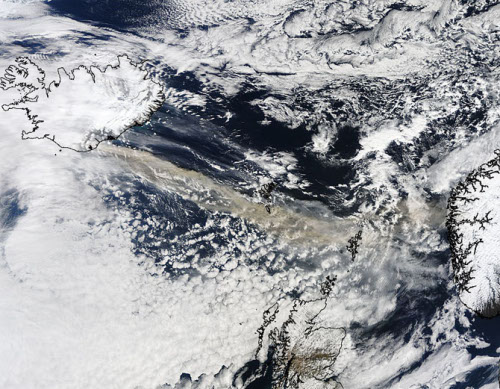
Very cool satellite image of volcanic plume from Eyjafjallajokull.
http://www.nasa.gov/topics/earth/features/iceland-volcano-plume.html
(via @NASA, @NASA_EO)
Footage of the Eyjafjallajokull volcano erupting under the Eyjafjallajokull glacier:
http://www.youtube.com/watch?v=5Pazzn44zDs
(via @polarwander)
The effects of volcanic dust on Britan’s climate could be severe [& everywhere else, presumably…]
http://www.timesonline.co.uk/tol/news/science/article7098303.ece
(via @TimesScience)
A geopal who has studied sub-glacial eruptions in Iceland blogs some thoughts on Eyjafjallajokull eruption
http://johnalexanderstevenson.blogspot.com/2010/04/fire-and-ice-again-baby.html
Great piece on (slow) ecological recovery in wake of 1980 Mt St Helens eruption
http://www.sciencenews.org/view/feature/id/58034/title/A_fresh_look_at_Mount_St._Helens
(via @tpenews)
A tale of two volcanoes (very interesting)
http://www.nytimes.com/2010/04/16/opinion/16winchester.html
(via @geographile, @swellyn)
Fascinating article on Toba eruption & early human migration – poss more complex than catastrophe->genetic bottleneck
http://www.newscientist.com/article/mg20627561.300-supervolcano-how-humanity-survived-its-darkest-hour.html

Earthquakes

Is recent earthquake activity unusual? Scientists say "no." [& apocalypse nuts across the net ignore them]
http://www.usgs.gov/newsroom/article.asp?ID=2439
(via @USGS)
NASA’s Earthquake related visualizations:
http://svs.gsfc.nasa.gov/cgi-bin/advsearch.cgi?query=earthquake&req=search
(via @geographile, @caroldn)
NYT addresses the "so many earthquakes these days" perception [and q well, too]
http://www.nytimes.com/2010/04/11/opinion/11musson.html
(via @callanbentley)

Planets

Microbial life found in Hydrocarbon Lake raises hopes for exo-life on Titan? Though much lower temps there..
http://www.technologyreview.com/blog/arxiv/25051/
(via @kzelnio)
Great shots of Saturn’s moon Dione, showing (putative) tectonic faults via
http://www.space.com/common/forums/viewtopic.php?f=12&t=23632
(via @rowanNS, @Spacedotcom)
Water on Mars yet again
http://blogs.nature.com/news/thegreatbeyond/2010/04/water_on_mars_yet_again.html
(via @NatureNews)

General Geology

10 Great Places to See Geology in Action!
http://geotripper.blogspot.com/2010/04/10-great-places-to-see-geology-in.html
(via @Geoblogfeed)
Stalagmite reveals carbon footprint of early Native Americans [through land use changes]
http://www.sciencedaily.com/releases/2010/04/100415110007.htm
(via @tpenews)
Peruvian glacier split triggers deadly tsunami: [could be ongoing hazard as Andean glaciers melt?]
http://www.guardian.co.uk/world/2010/apr/13/peru-glacier-ice-lake-tsunami
(via @CPPGeophysics)
Magnetic poles may once have been at equator [during ‘low latitude’ Neoproterozoic glaciations]
http://www.newscientist.com/article/mg20627554.000-magnetic-poles-may-once-have-been-at-equator.html
(via @newscientist)
Time-lapse video of Hawaiian lava flows
http://geographile.blogspot.com/2010/04/time-lapse-lava-flow-and-rock-making-in.html
(via @dafydd2277, @geographile)

Interesting miscellaney

Good advice for academic writers. Avoid Bad Writing [Agree w/ major point if not *all* the specifics]
http://chronicle.com/article/Bad-WritingBad-Thinking/65031/
(via @history_geek)
(via @CPPGeophysics)
Hannibal\u2019s real Alpine trunk road to Rome is revealed [technically just strong candidate]
http://www.timesonline.co.uk/tol/life_and_style/court_and_social/article7029508.ece
(via @history_geek)
Newspaper comments: Forget anonymity! The problem is community management: by Excellent!
http://www.wordyard.com/2010/04/13/newspaper-comments-forget-anonymity-the-problem-is-management/
(via @BoraZ, @scottros)
Oooh. : Cook’s first voyage around the world 1768-1771 (with Joseph Banks), maps, journal entries:
http://southseas.nla.gov.au/journals/maps/01_world.html
(via @SmallCasserole)
Spreading the seed of science [inc. how to identify that rarest of creatures, a science-literate MP]
http://timesonline.typepad.com/science/2010/04/spreading-the-seed-of-science.html
(via @TimesScience)
Twittering is a difficult art form – if you are doing it right: (Think I’m roughly 80/20 mind/life casting)
http://scienceblogs.com/clock/2010/04/twittering_is_a_difficult_art.php
(via @BoraZ)
Another perspective: http://k8grrl.blogspot.com/2010/04/gendered-use-of-social-media.html
Unlectures [More discussion, less powerpoint?]
http://www.possibilitiesendless.com/?p=106
(via @kjhaxton)
Science and art, all in one: Sun’s cumulative path from June to December, as seen by a pinhole camera
http://helpmyphysics.co.uk/wordpress/?p=276
Categories: links

A volcanic sunset over Edinburgh

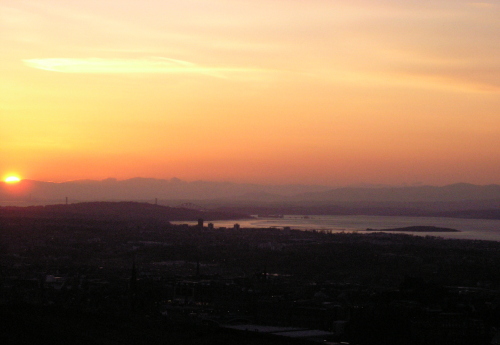
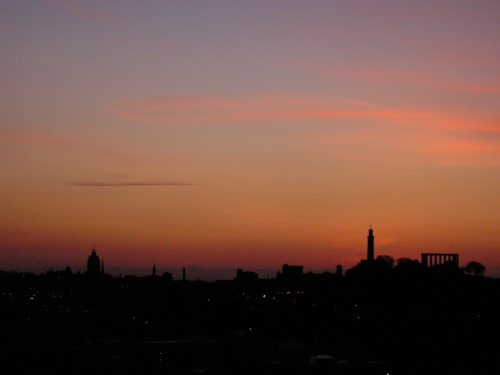
A post by Chris RowanIn the last couple of days in Edinburgh, we’ve been treated to some rather spectacular sunsets.

P4160095s.JPG

P4160124s.JPG

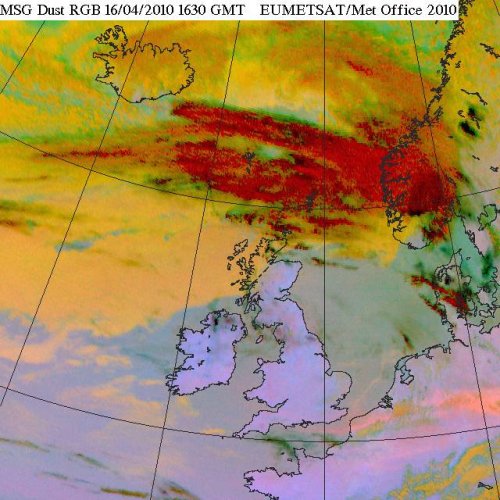
You could argue that in Scotland a clear sky is more unusual than a nice sunset, but it’s likely that the beauty of this one has been enhanced by the light-scattering effects of volcanic ash thrown up into the stratosphere by the sub-glacial eruption of Eyjafjallajoekull, and blown by the prevailing Atlantic winds across Northern Europe (those familar with Edinburgh may have noted the geological irony of my taking photos of the effects of an active volcano from an extinct one).

Iceland-ash-plume.jpg
Source: NASA.

iceland-ash-plume2.jpg
Source: UK Met Office, where a nice animation is also available.

All this volcanic material in the air may have a pleasing aesthetic effect, but as you’re no doubt aware, it doesn’t react too well with jet engines. For that reason most flights out of UK and northern European airports have been grounded for the past couple of days, and may stay grounded until at least tomorrow. It’s somewhat humbling how what is really only a fairly minor volcanic eruption can completely disrupt the life of an entire continent. On the other hand, it is doing wonders for our collective carbon footprint: the estimated amount of carbon dioxide that has been emitted by Eyjafjallajoekull is 30 times less than only three quarters (revised figure – thanks kai) of the amount not being emitted by all those grounded planes.
For more on the Eyjafjallajoekull eruption, both Eruptions and The Volcanism Blog are providing excellent ongoing coverage. You should also check out a post by my friend John Stevenson, an expert on sub-glacial eruptions. And if you want to see a few more photos of yesterday’s sunset in Edinburgh, click below the fold.

Continue reading

Categories: photos, volcanoes

Tectonics of the Qinghai Earthquake

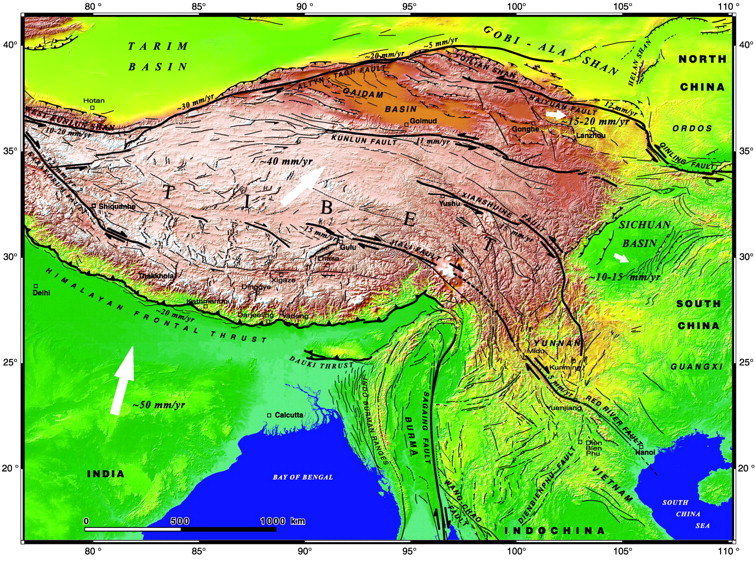
A post by Chris RowanLate on Tuesday (or Wednesday morning local time) western China was shaken by a magnitude 6.9 earthquake. The focal mechanism, courtesy of the USGS, tells us that it occured on a strike-slip fault like the San Andreas fault and the Enriquillo fault in Haiti. In fact, it is located along the trace of the Xianshuihe fault system, one of several large strike slip faults that cut through this region. The focal mechanism can be interpreted as left-lateral (the two sides of the fault move left relative to each other) motion on a northwest-southeast trending fault, which is consistent with this earthquake being due to a rupture of a segment of the Xianshuihe fault.

Chinaquakemech.png
Focal mechanism and location of the 13 April earthquake in the Qinghai region of China. Map from Tapponnier et al. 2001 (Click for a slightly larger version).

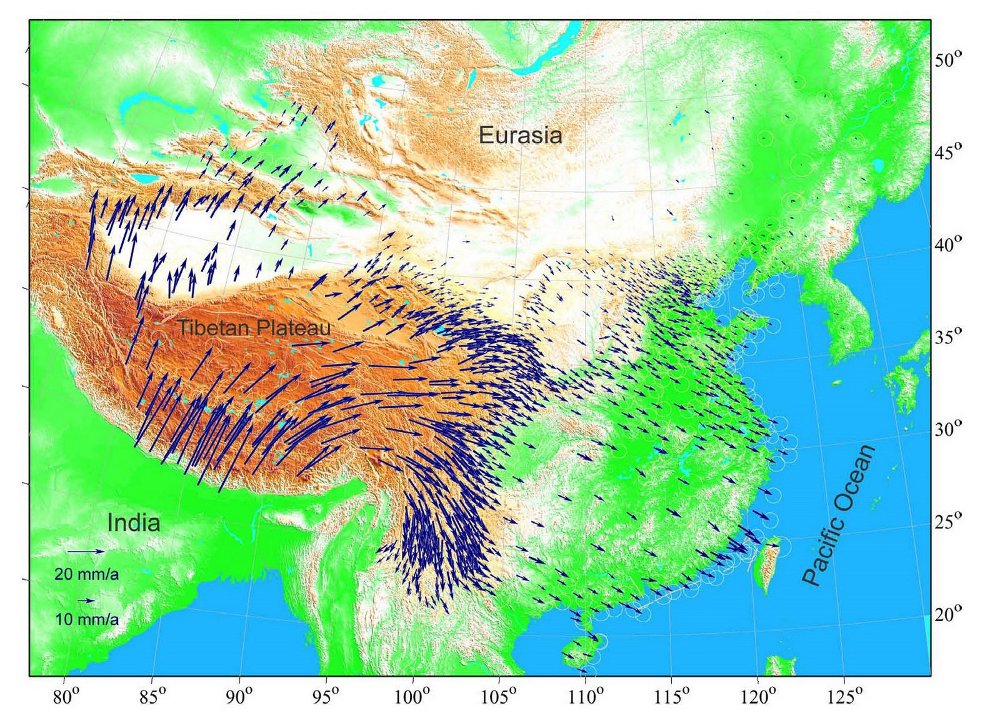
The Xianshuihe fault is one of several similar faults spread over a wide region, indicating that something tectonically interesting is going on in this part of Asia. Since we are located at the eastern edge of the Tibetan plateau, it’s no surprise that deformation in this region is driven by the continuing continental collision between India and Asia. India is moving northwards at around 5 centimetres a year, and the Indian crust and lithosphere is old, cold, and strong, much more so than the accreted island arcs and marine sediments that it is colliding with. Thus the Asian crust is intensely deformed, being squashed and crumpled and uplifted to form the Himalayas and the Tibetan plateau, the highest region on Earth. But there are limits to how high the mountains can get before they will collapse under their own weight, and the Himalayas and Tibet are at or beyond this limit; therefore the Asian crust is also being pushed away to either side by the encroaching Indian plate, just as the prow of a ship parts the water it is moving through. This ‘tectonic escape’ explains the fairly westward motion of the crust in western China relative to the rest of Asia, which can clearly be seen in GPS measurements of the current deformation.

GPS-Asia-s.jpg
(Click for larger version)

This motion is ultimately accommodated by strike-slip motion on faults such as those that make up the Xianshuihe system.

Categories: earthquakes, geology, tectonics

Toads: seismic prognosticators?

A post by Chris RowanIs a pet toad the new must-have earthquake detector? This paper, which is getting a lot of media attention today, claims that in the 5 days before the L’Aquila earthquake in April last year, toads which should have been massing to engage in their annual mating instead left their ponds and ran for the hills. The authors speculate that this exodus was linked to very low frequency electromagnetic perturbations in the atmosphere which happened around the same time.
I’m not going to go into detail on this, because Michael Reilly has produced an excellent write-up already, even interviewing Susan Hough, who has written a book on the science of earthquake prediction that is high on my to-read list. Dave Petley also has some interesting thoughts. Given my previous thoughts on claimed earthquake precursors, it should come as no surprise that I share their scepticism about all of this. One data point does not a robust detection system make.

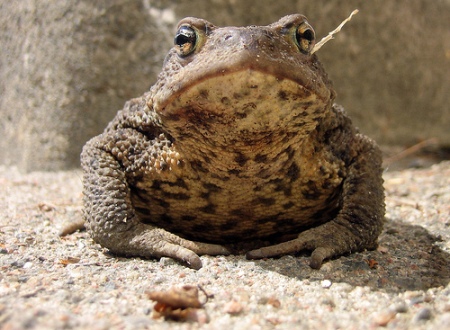
commontoad.jpg
Not a seismologist.

Of course, it’s no surprise that this story has legs: earthquake detection is extremely topical in the wake of two large earthquakes in the last three months, and being able to give it the “serendipitous discovery” spin (study toad breeding, publish on earthquakes!) just adds to the appeal. However, this study suffers from the usual problems with claimed earthquake precursors: is this ‘precursor’ replicated in other places, before other earthquakes? More importantly, is it only associated with earthquakes? Is there a consistent correlation between the appearance of the precursor, and the size and/or the timing of the earthquake that follows? These are the questions that need to be answered before you can move from anecdata to something that is actually useful. They are also questions that have yet to be definitively answered for any claimed percursor, be it animal, electrical, or gaseous. It’s not that the various types of signals that have been observed before large earthquakes have no connection to what’s going on beneath our feet – it’s entirely plausible that in some cases they do – but I suspect that without some new theoretical insights into what that connection might be, we’re never going to be able to interpret with confidence what these signals mean before it’s too late to matter.

Categories: earthquakes, geohazards, geology

Stuff I linked to on Twitter last week

A post by Chris RowanAnother week’s worth of interesting links I shared via Twitter
Blog Post by @brianshiro – Earth and Space 2010 [great write-up of what sounds like an interesting conference]
http://www.astronautforhire.com/2010/03/earth-and-space-2010.html
Active reading techniques to improve understanding & retention [how to read sci papers effectively]
http://a-life-long-scholar.blogspot.com/2010/03/active-reading-techniques-to-improve.html
(via @Geoblogfeed)
Relative relatives [how do you accurately describe evolutionary relationships to a layman?]
http://archosaurmusings.wordpress.com/2010/03/27/relative-relatives/
(via @Geoblogfeed)
Icelandic eruption from space [shows lava flowing along drainage to east of lava fountains]
http://scienceblogs.com/eruptions/2010/03/icelandic_eruption_from_space.php
Plans to drill into Antarctic sub-ice lakes, including Vostok, are well underway it seems
http://www.nature.com/news/2010/100324/full/464472b.html
Magnetotactic bacteria FTW! : Bacteria build a mini-pyramid
http://blogs.sundaymercury.net/weirdscience/2010/03/bacteria-build-a-mini-pyramid.html
(via @ScienceSoWhat)
How small planets can have self-sustaining magnetic fields [inc. poss. asteroid Vesta! Only short lived ones of course]
http://www.physorg.com/news188753199.html
How China overtook the US in renewable energy [with data on global clean energy spending/usage]
http://www.guardian.co.uk/news/datablog/2010/mar/25/china-renewable-energy-pew-research
(via @guardianscience)
Telegraph Reports, "Oil Reserves ‘Exaggerated by 1/3’" An Analysis and Some Charts–Going In Depth
http://www.theoildrum.com/node/6324
(via @TheOilDrum)
Japan creates elastic alloy to make earthquake-proof buildings. [if it works, lets hope its cheap-ish]
http://www.inhabitat.com/2010/03/23/elastic-iron-alloy-could-be-used-to-make-earthquake-proof-buildings/
(via @geology4u)
Haiti, After the Quake [Interview with medic who has been on the ground in Port-au-Prince]
http://news.discovery.com/earth/haiti-after-the-quake.html
(via @RonsGeoPicks)
Island disputed by India and Bangladesh sinks below waves [Anyone else instantly think of Jingo?]
http://www.guardian.co.uk/world/cif-green/2010/mar/24/india-bangladesh-sea-levels
(via @guardianscience)
6 Ways We’re Already Geoengineering Earth [yes, it counts even when its unintended]http://www.wired.com/wiredscience/2010/03/geoengineering-gallery/
(via @highlyanne, @ScienceSoWhat)
Strain Is Accumulating On Istanbul
http://suvratk.blogspot.com/2010/03/strain-is-accumulating-on-istanbul.html
(via @Geoblogfeed)
Extreme palaeontology! How to collect a skeleton from cliff face with 200 m of sandstone as overburden
http://archosaurmusings.wordpress.com/2010/03/24/guest-post-how-to-collect-a-skeleton-from-a-cliff-face-with-200-meters-of-sandstone-as-overburden/
(via @Geoblogfeed)
When are freak weather events considered normal? How the unusual are becoming the expected:
http://www.abc.net.au/local/stories/2010/03/24/2854603.htm
(via @geographile, @BraveNewClimate)
More impressive "curtain of fire" movies from Iceland eruption: [night shots towards end]
http://www.telegraph.co.uk/earth/earthvideo/7500544/Active-Icelandic-volcano-new-pictures.html
(via @CPPGeophysics)
Mississippi River looking mighty indeed outside Saint Anthony Falls Laboratory today:
http://mediamill.cla.umn.edu/mediamill/embed/64513
(via @stcNCED)
I am out-geeked. What is the tensile strength of rock and roll? (from @geographile)
http://bit.ly/bw6SXk
(via @callanbentley @stressrelated, @geographile)
More detail on possiblity of Eyjafjallaj\u00f6kull eruption triggering Katla – has happened before, 3 times in 1100 years
http://www.newscientist.com/article/dn18690-iceland-waits-for-volcanic-shoe-to-drop.html
Chileans’ quake knowledge saved thousands of lives [that, plus 30 seconds before most intense shaking]
http://www.newsdaily.com/stories/tre62i4ao-us-quake-chile-knowledge/
How dinosaurs rose to prominence: early Atlantic rift volcanism linked to end-Triassic mass extinction
http://www.sciencedaily.com/releases/2010/03/100322153947.htm
Earth’s rivers from space
http://www.wired.com/wiredscience/2010/03/gallery-rivers/
(via @clasticdetritus)
Earthquakes, urbanization & fatalities [nice plot of fatalities vs quake magnitude – sadly, Haiti an outlier]
http://shakingearth.blogspot.com/2010/03/earthquakes-urbanization-and-fatalities.html
Perry Mason & the climate change deniers Great post on confusion over criminal vs scientific standards of evidence.
http://resourceinsights.blogspot.com/2010/03/perry-mason-and-climate-change-deniers.html
Weathering the Grenvillian landscape [outcrop photos of Neoproterozoic rift sediments]
http://mountainbeltway.wordpress.com/2010/03/21/transect-debrief-2-weathering-the-grenvillian-landscape/
(via @Geoblogfeed)

Categories: links