Urban Hydrology
Spring 2013 GEOL 4/5/60095 Special Topics: Urban Hydrology
Kent State University, Department of Geology
Instructor: Dr. Anne Jefferson, McGilvrey 235C
Office Hours: Tuesday and Thursday: 1:45 to 4:15 pm or by appointment. Tuesday in 235C McGilvrey, Thursday in 333 McGilvrey
Course Meetings: Tuesday and Thursday, 12:30 to 1:45, McGilvrey 234
Final Exam: Thursday, May 9, 12:45 to 3 pm
Official Course Syllabus
Urban Hydrology Spring 2013 Final Exam Study Guide
Course Description: In this course we will investigate the science and management of water in cities and built environments. We will approach the subject from an interdisciplinary perspective, integrating hydrology, geology, biology, architecture/engineering, and the social sciences. The course will include readings, discussions, data analysis, field trips, and designing an urban rain garden.
Learning Outcomes:
- Understand the natural and human factors that regulate hydrologic processes in urban areas
- Evaluate watershed land use changes and associated hydrologic impacts
- Describe methods to mitigate the effects of urbanization on aquatic systems
- Analyze the scientific literature on urban aquatic systems and discuss the approaches and main conclusions with fellow scientists and the public
Assessment
Grades will be distributed based on the percentage of points earned. Point values needed to achieve a given grade may be adjusted downward at the end of the term, but will not be adjusted upward.
A = 90-100%, B = 80-90%, C = 70-80%, D = 60-70%, F < 60%
[dropdown_box expand_text=”Details of Assessment and Assignments” show_more=”Show” show_less=”Hide” start=”hide”]
- Exams will cover material from lecture, assignments, class discussions, and the assigned readings. Questions may be short answer, essay, or data analysis. Exams are 40% of the undergraduate grade and 35% of the graduate grade. Exams will be on 5 March and 9 May.
- Mini-assignments will be near-weekly short writing exercises or quizzes that require you to reflect on the assigned reading and/or to engage with urban hydrology in your surroundings. These assignments will generally be due on Tuesdays, unless another assignment or exam is due that week. Mini-assignments are 10% of the undergraduate grade and 9% of the graduate grade.
- The Data Collection project will involve each student being assigned a day to make water quality measurements in the Cuyahoga River in Kent. If you participate in class activities surrounding the project and, on your assigned day, complete the measurements, report the data, and return the equipment in working order, you will receive all the points for this assignment. This project is 10% of the undergraduate grade and 9% of the graduate grade and will occur throughout February. Details of the assignment are here.
- In the Data Analyses, you will use real-world hydrologic datasets to explore the effects of urbanization on water quantity and quality. Techniques will be introduced in class, but the analyses and a short write-up will be completed individually. Analyses are 30% of the undergraduate grade and 26% of the graduate grade. Tentative due dates are 19 February and 4 April.
- In the Rain Garden Project, the class will work through a design manual and complete the measurements necessary to design a rain garden for a property near campus. If you participate in the in-class activities surrounding the project, and complete a write-up, you will receive full points for the project. This project is 10% of the undergraduate grade and 9% of the graduate grade. This project will be due on 2 May.
- Essay: Graduate students will also complete a 1000-2000 word essay focused on some topic relevant to urban hydrology. This essay should draw from the scientific literature, may be pertinent to current events or issues in a particular region, and should include at least one image. Good examples can be found at http://thenatureofcities.com/. Good drafts will be due by 21 March, and revisions may be required before an essay is acceptable. All essays will be finalized by 2 May. I will be happy to discuss potential topics and scope with you before the deadline. This essay is 13% of the graduate grade.
[/dropdown_box]
Tentative Timetable
Dates are subject to change. Please attend class and ask me if you have questions.
15 – 31 January: Introduction to Water and Cities
Introduction to Hydrologic Science
[dropdown_box expand_text=”Reading and Assignment” show_more=”Show” show_less=”Hide” start=”hide”]In the Course Dropbox, find 2 pdfs that start with “Modern Hydrology and Sustainable Water Development” and read:
- Section 1.3 Hydrologic cycle and global water distribution
- Section 1.3 Units and dimensions
- Section 1.5 Significant figures and digits
- Section 2.3 Streams
- Section 2.4 Watershed concept
- Section 2.6 Runoff processes and flow measurement
- Section 2.9 Stream characteristics
- Section 2.11 Scales and scaling
- Section 2.12 The invisible resource: groundwater
- What is one thing you learned that you thought was particularly interesting or important, and why?
- What is one thing that you would like more help understanding?
- If you want to see what I’m looking for with these sorts of questions, look at some example responses here.
[/dropdown_box]
[dropdown_box expand_text=”Selected Slides from Class” show_more=”Show” show_less=”Hide” start=”hide”]
[/dropdown_box]
Introduction to Urban Areas and Land Use Change and
Introduction to Urban Water Management
[dropdown_box expand_text=”Reading and Assignment” show_more=”Show” show_less=”Hide” start=”hide”]Reading: In the Course Dropbox, find the folder “Intro to Urban Areas and Water Management.” First read Chapter 2 of the Urban Ecology textbook and then read the paper by Brown et al., focusing particularly on the sections beginning with “KEY TRANSITION STATES: HISTORICAL, CURRENT AND FUTURE.”
Mini-assignment due January 29: In 1-2 paragraphs, describe your hometown (or some other city you know well) in terms of its location, size, and form and why it is that way (i.e., historical context). Then write a paragraph describing your city’s relation to water. For example, what is the water supply and where is wastewater disposed? Are there local water bodies or water issues important to the community? You don’t need to include references with your assignment, but you should check your facts if you are unsure about anything. Here is an example write-up.
[/dropdown_box]
31 January – Learning and Studying & this course as research (guest presentation, Dr. David Dees) and Hydrographs and Runoff Calculations (Mr. Dan Ross, guest presentation)
5 – 28 February: Effects of Urbanization on Aquatic Systems
Data Collection project (on-going)
For a calendar with each student’s assigned data collection date, look in the Course Dropbox.
Changes to Hydrology and Geomorphology
Lecture slides on hydrology and geomorphology from 12 February
[dropdown_box expand_text=”Reading and Assignment” show_more=”Show” show_less=”Hide” start=”hide”]Reading:
- Leopold, L.B., 1964, Hydrology for Urban Land Planning – A Guidebook on the Hydrologic Effects of Urban Land Use: USGS Circular 554.
- Coles, J.F., McMahon, Gerard, Bell, A.H., Brown, L.R., Fitzpatrick, F.A., Scudder Eikenberry, B.C., Woodside, M.D., Cuffney, T.F., Bryant, W.L., Cappiella, Karen, Fraley-McNeal, Lisa, and Stack, W.P., 2012, Effects of urban development on stream ecosystems in nine metropolitan study areas across the United States: U.S. Geological Survey Circular 1373, available at http://pubs.usgs.gov/circ/1373/. (large PDF, read Chapter 2 and then Chapter 1)
Mini-assignment: This mini-assignment has two parts, which can be handed in on a single sheet of paper on February 5th.
- Using the information in the reading and your existing knowledge of the area, create two hypotheses related to our Data Collection Project. A hypothesis is a proposed explanation for a phenomenon, so you should explain what you think we will observe and why. In other words, what do you think happens to the hydrology and water quality of the Cuyahoga River as it flows through Kent, and why? One of your hypotheses should be testable with the data we are collecting, but the other can be anything, as long as you explain why your hypothesis makes sense to you.
- Impervious surface is a central concept in urban hydrology, and is often cited as the cause of many hydrologic ills. But impervious surface is literally the roof over heads. When rain hits the roof over your head, where does it go? Write the story of where that rain goes as far as you can trace it. Can you follow it all the way to the waterway where it is discharged? For example, the rain goes into a gutter, which drains to a downspout, which dumps out onto my driveway. But then where does it go? If you don’t know where a storm drain goes, tell me your hypothesis based on the topography and history of the area you are writing about. Your story doesn’t need to be more than a paragraph long.
[/dropdown_box]
Urban Watersheds – February 12-14
[dropdown_box expand_text=”Reading” show_more=”Show” show_less=”Hide” start=”hide”]
Reading:
- Kaushal and Belt, 2012, The urban watershed continuum: evolving spatial and temporal dimensions, Urban Ecosystems, 15:409-435.
- Chapters 1-4 of USDA, Urban Hydrology for Small Watersheds, (TR-55).
There is no mini-assignment for 2/12. But please still do the reading, as you’ll need it for the data analysis assignment and the exam.
[/dropdown_box]
Data Analysis #1 – Due February 21
[dropdown_box expand_text=”Details of Assignment” show_more=”Show” show_less=”Hide” start=”hide”]
- Assignment Details (pdf)
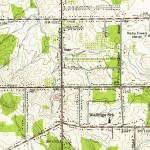
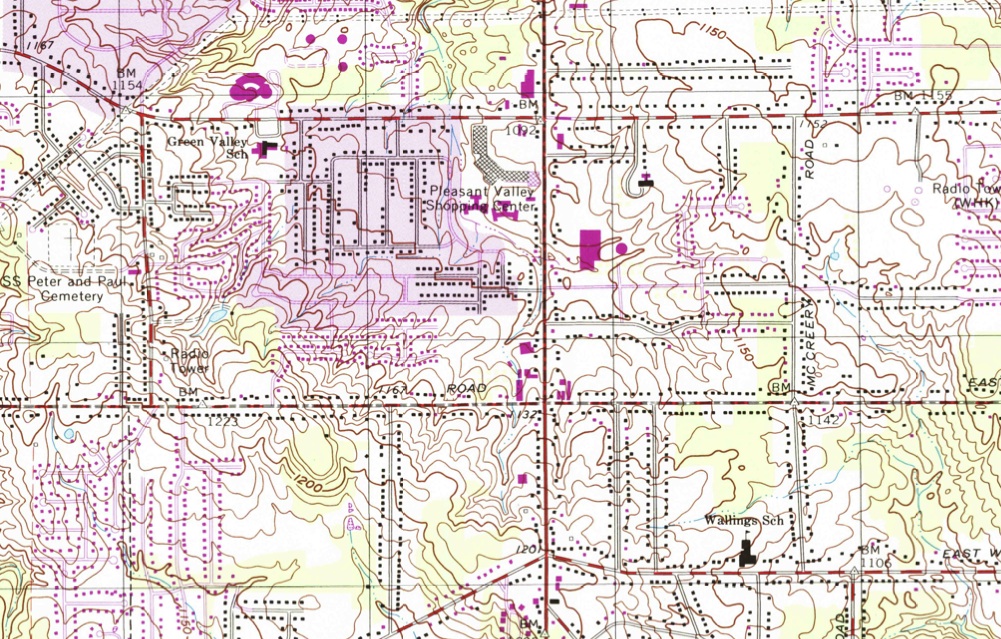
- 1953 topo map. Click on the image for a full size version.
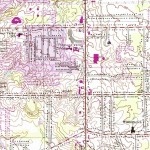
- 1994 topo map. Click on the image for a full size version.
- Urban Hydrology for Small Watersheds, (TR-55).
- Extra copies of Worksheets 2-4
- Topographic Map Symbols
- USGS data for West Creek at Pleasant Valley Road
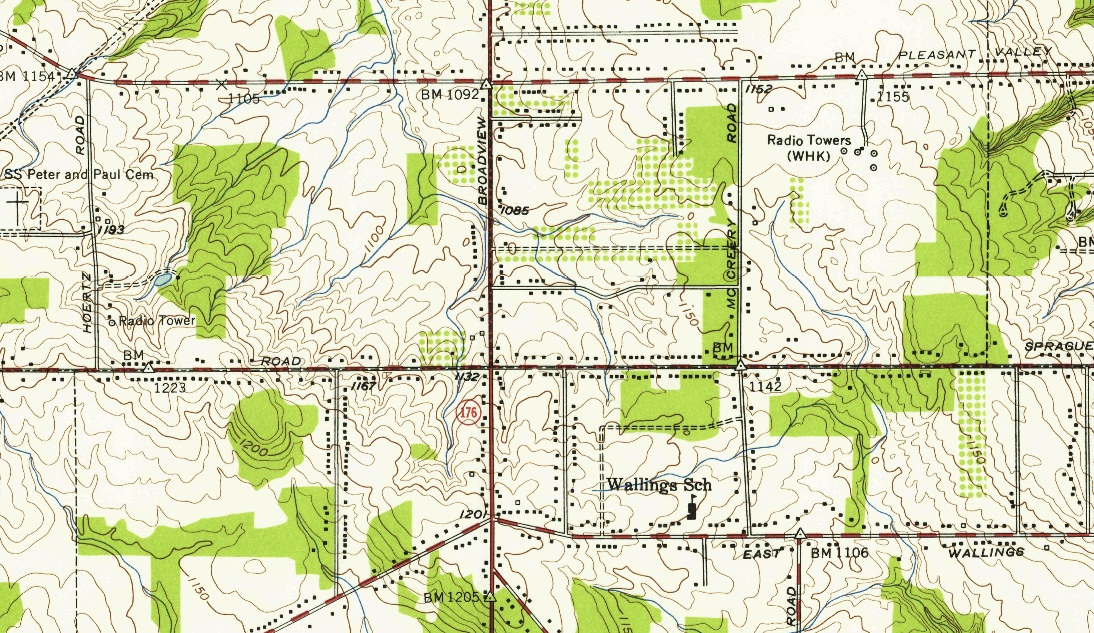
- On the USGS Store Map Locator website, search for “Broadview Heights, OH” to get the full USGS topographic maps for the area around the West Creek watershed.
[/dropdown_box]
Urban Groundwater, Hydrogeochemistry and Isotopes – February 19-28
Lecture notes from February 14-19: Tracers
Lecture notes from February 19-21: Hydrograph Separation
Lectures nots from February 28: Chloride as a tracer of road salt and wastewater can be found in the Course Dropbox
[dropdown_box expand_text=”Reading and Assignment” show_more=”Show” show_less=”Hide” start=”hide”]The following readings can be found in the Course Dropbox:
- Wong et al., 2013, Impact of Urban Development on Physical and Chemical Hydrogeology, Elements, 8:429-434
- Pellerin et al., 2007, The application of electrical conductivity as a tracer for hydrograph separation in urban catchments, Hydrological Processes, DOI: 10.1002/hyp.6786.
- Perera et al., 2013, Groundwater chloride response in the Highland Creek watershed due to road salt application: A re-assessment after 20 years, Journal of Hydrology, 479: 159-168.
- Sidle and Lee, 1999, Urban Stormwater Tracing with the Naturally Occurring Deuterium Isotope, Water Environment Research, 71(6): 1251-1256.
There is also a chapter on “Hydrologic Tracing” in the Modern Hydrology textbook. This is not a required reading, but I have added it to the dropbox for your use as a reference or background material as needed.
Mini-assignment – due February 26th by email to ajeffer9 at kent
For each of the readings above, select one figure or table that you think is important, explain what’s going on the in the figure (or table), and how the information in the figure (or table) contributes to one or more of the main points of the paper. Your explanation for each figure should be about one paragraph.
[/dropdown_box]
5 March: Midterm Exam
7 March – Experiences of Teaching and Learning (Dr. David Dees)
7 March – 4 April: The Future of Water in Cities
Stormwater Management
Blog post based on the lecture on combined sewer overflows and how different cities are trying to solve them, with embedded videos and links.
[dropdown_box expand_text=”Reading and Assignment” show_more=”Show” show_less=”Hide” start=”hide”]
Reading for 12 March: Rooftops to Rivers: Green Strategies for controlling stormwater and combined sewer overflows. Read chapters 1-3 and at least one case study of your choice.
Mini-assignment for 14 March 2013
[/dropdown_box]
Green Infrastructure
19 March – Dr. Reid Coffman – site-based best management practices
Dr. Coffman’s slides are in the Course Dropbox.
21 March – Graduate Essays due
26-28 March – No class, spring break
Stream Restoration – April 2-4
Lecture slides are available in the Course Dropbox.
[dropdown_box expand_text=”Reading and Assignment” show_more=”Show” show_less=”Hide” start=”hide”]Readings:
- E.S. Bernhardt and M.A Palmer, 2007, Restoring streams in an urbanizing world, Freshwater Biology, 52: 738–751.
- S.L. Niezgoda and P. Johnson, 2005, Improving the Urban Stream Restoration Effort: Identifying Critical Form and Processes Relationships, Environmental Management, 35(5): 579-592.
- Kenney et al., 2012, Is urban restoration worth it?, Journal of the American Water Resources Association, 48(3): 603-615.
Mini-assignment due 4/9: Using the three articles above as references, write a 1-2 page analysis of the effectiveness of urban stream restoration from geomorphic, aquatic ecosystems, and financial perspectives. First, you will have to decide how you will judge effectiveness. If you decide urban stream restoration is highly effective, you should explain your reasoning with evidence from the papers. If you decide that urban stream restoration is not highly effective, you should argue for alternative approaches, using evidence from the papers. [/dropdown_box]
Data Analysis #2, due April 18 at 12:30 pm
Assignment Details. Data are in the Course Dropbox.
Field Trips
Participation in a field trip is optional, but will be awarded 10 points of credit (= one mini-assignment). If you can’t or don’t go on a field trip, you can complete a written mini-assignment and earn the same credit (details here now). There will be two trip options:
A) Stream restoration and dam removal in the Upper Cuyahoga River watershed, led by Dr Jefferson, on Sunday, April 14th from 2 to ~5pm. We will start at Plum Creek park in Kent, which was the site of a dam removal and stream restoration. From there we will go to the Munroe Falls dam rempoval site, Kelsey Creek in Cuyahoga Falls (dam removal and future stream restoration site).
B) Stormwater management in West Creek, led by Cleveland Metroparks, on Saturday, April 20th from 8 am to ~2 pm. We will meet in Kent and take a van or carpool up to Parma to meet up with the larger tour. Please RSVP to me by Thursday 4/4.
9 April – 2 May: Current Research in Urban Hydrology
Case studies from Baltimore, Charlotte, Cleveland, etc.
25 April: Urban Soils
In class we’ll be talking about the impacts of urbanization on soils and water flow through soils. Before class, please read the USDA NRCS Urban Soils Primer and check out the Guide to Texture Classification by Feel and Evaluation of Urban Soils: Suitability for Green Infrastructure or Urban Agriculture.
30 April: Watershed Scale Stormwater Management
Our second-to last class will focus on an in-depth study of the effectiveness of watershed-scale stormwater retrofits in the Cincinnati area of Ohio. This was work lead by the US EPA, with many partners. Lecture slides are available in the Course Dropbox. The lecture will draw heavily on this following resources: “Shepherd Creek: A Case Study of Watershed?Scale Stormwater Retrofits and Ecological Monitoring in Cincinnati, Ohio”, Roy and Shuster, 2009, ASSESSING IMPERVIOUS SURFACE CONNECTIVITY AND
APPLICATIONS FOR WATERSHED MANAGEMENT, Mayer et al., 2012 Building Green Infrastructure via Citizen Participation: A Six-Year Study in the Shepherd Creek (Ohio) (available in the Course Dropbox), and Shuster et al., 2007 Prospects for enhanced groundwater recharge via infiltration of urban storm water runoff: A case study available in the Course Dropbox).
2 May: Residential Rain Garden Project Presentations
Design of a residential rain garden Due: 2 May
Mini-assignment: By 4/11, find and familiarize yourself with a rain garden design manual available on the web. See here for details.
For assignment details, see the Course Dropbox.
9 May: Final Exam
University and Course Policies
University Policies
- Registration: The official registration deadline for this course is January 27, 2013. University policy requires all students to be officially registered in each class they are attending. Students who are not officially registered for a course by published deadlines should not be attending classes and will not receive credit or a grade for the course. Each student must confirm enrollment by checking his/her class schedule (using Student Tools in FlashLine) prior to the deadline indicated. Registration errors must be corrected prior to the deadline.
- Withdrawal: The course withdrawal deadline is January 27th (for no W grade recorded) or March 24th (W grade recorded).
- Academic Dishonesty: University policy 3-01.8 deals with the problem of academic dishonesty, cheating, and plagiarism. None of these will be tolerated in this class. The sanctions provided in this policy will be used to deal with any violations. If you have any questions, please read the policy at http://www.kent.edu/policyreg/policydetails.cfm?customel_datapageid_1976529=2037779 and ask for help. If you are academically dishonest in this class, you will at a minimum receive 0 credit for the assignment or exam and be referred to Plagiarism School. Greater sanctions are also possible.
- Student Accessibility: University policy 3-01.3 requires that students with disabilities be provided reasonable accommodations to ensure their equal access to course content. If you have a documented disability and require accommodations, please contact the instructor at the beginning of the semester to make arrangements for necessary classroom adjustments. Please note, you must first verify your eligibility for these through Student Accessibility Services (contact 330-672-3391 or visit www.kent.edu/sas for more information on registration procedures).
Course Policies
- Late and Absence Policy: Your attendance and participation in all class sessions is expected. If you cannot attend class for an approved and documented absence (illness, family emergency, religious observance, or University-approved event) and you cannot complete the associated assignment by its due date, please let me know as soon as possible and I will arrange a substitute assignment. Late mini-assignments will not be accepted.
- Outdoor Activities: On dates announced in advance, we will meet outdoors for some or all of the class period. On these days, you are expected to come to class prepared to participate in outdoor activities. You should bring a notebook, sharpened pencils, and an eraser to all outdoor sessions. Colored pencils, a ruler, and a calculator may be helpful in some cases. If we are meeting outdoors, you should dress appropriately for the weather and for outdoor terrain and vegetation. This includes rugged shoes and appropriate cold weather and sun protection. Make sure to bring adequate water.
- Professional Behavior: This is a class for advanced undergraduate and graduate students who are preparing to be geoscience professionals. I expect professional behavior and communication from you, and I will try to model those behaviors for you. These behaviors include promptness and attentiveness in the classroom, a can-do approach in the field, and typed, grammatically-correct writing, free of spelling errors and slang. This includes email communication. Assignments not meeting these standards may be returned for revision and resubmission.