Watershed Lab’s 2025 in review
We are good people, doing good science, supporting each other.
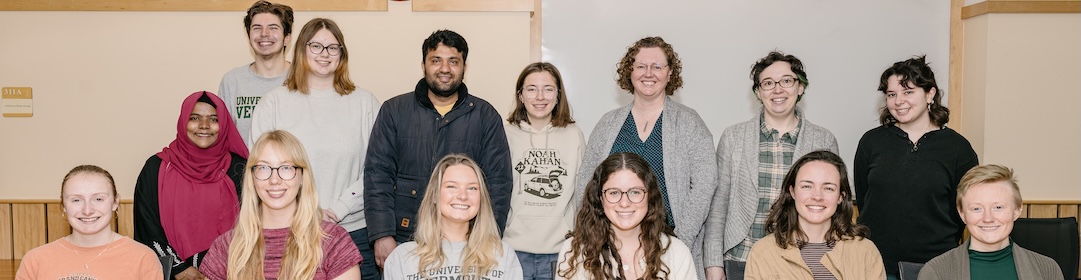
Most importantly, the Watershed Lab includes amazing human beings. We include faculty, staff, postdocs, PhD students, MS students, undergraduate researchers, and friends of the lab. All members of the Watershed Lab had big milestones in 2025.
- Andrea Stumpf was promoted to Research Specialist.
- Lakelyn Taylor finished her post-doc and moved on to a new adventure – thru-hiking the Appalachian Trail! Post-doc Rodrigo Soares is continuing our group’s work on flood communications.
- Suffiyan Safdar sent his dissertation to his committee and has a PhD defense scheduled for January 12, 2026.
- Nurjahan Begum moved up from the MS to PhD program in Natural Resources.
- Katie Hauer joined the Watershed Lab as a MS student.
- Sabrina Koetter received the Rubenstein School’s graduate service award.
- Henry Motes, Alyssa Warbeck, Abbey Morse, and Grace Massa joined our lab as undergraduate research assistants.
- Arden Degrennier, Morgan Fletcher, and Hope Lagemann graduated in May, and Grace Massa graduated in December with BS degrees.
We study what matters.
Borrowing a phrase from the draft UVM strategic plan, we believe that we “study what matters” in the Watershed Lab, developing fundamental and applied understanding of the complex interactions between humans and water resources. This year we had funding to study trash in streams, quantify microplastics in Lake Champlain, understand municipal stormwater adaptations to changing weather patterns (and how stormwater management affects sediment and phosphorus fluxes), and for several projects related to flood communications and decision support.
We wrapped up field work for the trash in streams project and probably, mostly for the microplastics work, though Nurjahan still has a lot of microscope and FTIR work left. Suffiyan completed a year of suspended and bed load sampling at 6 sites in South Burlington’s Potash Brook, and then Jill Sarazen took on two of them, added two new ones, and began collecting samples for total and soluble reactive phosphorus analysis. All told, we conducted 75 beach or stream trash surveys, collected 350 beach samples for microplastic analysis, and I don’t even know how many filters were used and ISCO bottles were cleaned, filled with stream water, and cleaned again. And that’s before we even mention the >500,000 rows of water level and turbidity time series data that Suffiyan and Jill have generated
We share our science in many ways.
We published four papers in peer-reviewed journals.
- Taylor, L.E.*, Brown, J.A., Jefferson, A.J., Doran, E.M.B., DeBree, S., Johns, C., Luukinen, B., Milazzo, J., Motes, H., van Werkhoven, K., Van Houtven, G., and Southwell, B., 2025. Applying the IDEA Model to Flood Risk Communication. Crisis and Risk Communication. 1–23. https://doi.org/10.1080/29986907.2025.2561036
- Blinn, A.J., Jefferson, A.J., Bhaskar, A.S., Hassan, Z.U., Safdar, S., Costello, D.M. 2025. Stream metabolism response to storm flow in urban watersheds near Cleveland, OH and Denver, CO. Freshwater Science. 44(4): 584-597. https://doi.org/10.1086/738247.
- Farooq, N., Jefferson, A.J., Greising, C., Kearns, K., Muratori, S., Snyder, K. 2025. Prediction of anthropogenic debris and its association with geomorphology in US urban streams. Science of the Total Environment. 975: 179317. doi: 10.1016/j.scitotenv.2025.179317. (open access)
- Jefferson, A.J., Kearns, K., Snyder, K., Mitchell, A., Muratori, S., Rowan, C.J. 2025. Anthropogenic litter and plastics across size classes on a mechanically groomed Great Lakes urban beach. Journal of Great Lakes Research, 51(2): 102505, doi: 10.1016/j.jglr.2024.102505. (open access)
In the list above, italics represent student co-authors from UVM (2) and Kent State University (8), and the asterisk indicates a paper led by post-doc Lakelyn Taylor.
Watershed Lab research was presented at 7 conferences.
- Our CIROH-funded flood communications work was presented at the American Meteorological Society meeting in January by collaborators Elizabeth Doran and Jill Brown.
- In April, 5 members of the lab (Suffiyan, Nurjahan, Casey, Kayleigh, and Hope) shared their work at the UVM student research conference.
- Post-doc Lakelyn Taylor shared lessons from the CIROH work at the HEPEX workshop in April.
- Andrea Stumpf presented trash in streams work at the Society for Freshwater Science in May.
- Lakelyn also presented at Natural Hazards Workshop Researchers Meeting in July.
- Elizabeth Doran shared outcomes of the flood work at the CIROH science meeting in September.
- In December, at AGU, Nurjahan Begum presented Lake Champlain microplastics work and Suffiyan Safdar shared his urban suspended sediment regimes synthesis work.
We also found other ways to share our science and knowledge.
- The CIROH flood communications work was shared in a Lake Champlain Sea Grant webinar in February and in webinars tailored to participants from each of our study communities.
- Anne presented trash in streams work in the Women Advancing River Research seminar series in September.
- Anne also presented at the UVM Water Resources Institute Water Connects seminar series in November, integrating the trashy streams and Lake Champlain microplastics stories for the first time.
- This fall, Suffiyan used his research as a spring board for guest teaching in the Civil Engineering department’s Applied River Mechanics class, while Anne talked about trash in streams in RSENR’s “Plastics, Petrochemicals, and Life” class.
- Nurjahan, Andrea, and Anne helped with microplastics field days on the beach for >120 7th graders in Burlington in May and Plattsburgh in October.
We are looking ahead to 2026
- We are super-excited about Suffiyan Safdar’s PhD defense January 12.
- We’ll be sharing our science at the Lake Champlain Research Conference in January (Andrea, Suffiyan, Nurjahan, Grace, and Sabrina) and the American Ecological Engineering Society meeting in June (Suffiyan, Nurjahan, Jill, & Anne).
- We’ve wrapped up the trash in streams funding, except for getting the last two papers submitted. Anne’s not ready to be done thinking about “trashy streams” though, so she’ll need to find time to write the next proposal.
- We’re launching an exciting new project early in 2026, looking at pre- and post-small dam removal fine sediment and phosphorous fluxes. It will be a fun new challenge to take our field methods well-suited for the urban streams near campus and put them to the test in larger streams, farther from Burlington. Fingers crossed for good data!
- We’re going to keep supporting each other while we do and share science that matters.