Flooding in Pakistan

A post by Anne Jefferson For the past two weeks, unusually heavy monsoon rains have deluged Pakistan, resulting in flooding and landslides. Pakistan is heavily populated all along the Indus River valley, so this is a slow-moving disaster of epic proportions. The latest news reports estimate that flooding has displaced 14 million people – more than the number of people affected by the 2010 Haiti earthquake, 2005 Kashmir earthquake, and 2004 Indian Ocean tsunami combined.

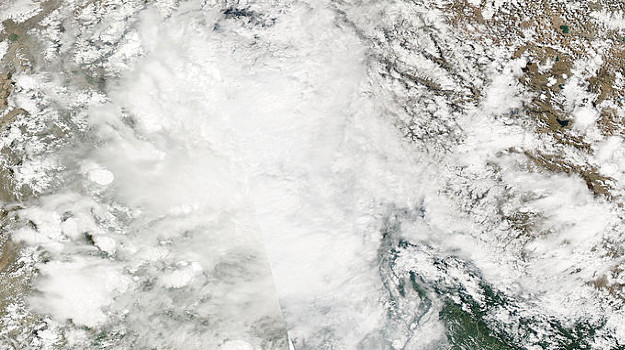
In the first 10 days of August, parts of Pakistan received almost 24 mm per day more rainfall than usual – during what is usually the wettest part of the year, when the monsoon rains fall.  During June-September, the relatively cool Indian Ocean has high atmospheric pressure system, while the intense summer sun heats up the Indian subcontinent and forms a low pressure system. Much like a river flows downhill, air in the atmosphere flows from high pressure to low pressure areas. So moisture rich air from the ocean flows toward India and Pakistan – bringing months of cloudy weather and intense rain. The images below are from true color images from NASA’s MODIS satellite showing the Indus and Chenab rivers in the area around Islamabad. The top image shows the clearest day from recent weeks (9 August), while the bottom image shows a more typical day (6 August).
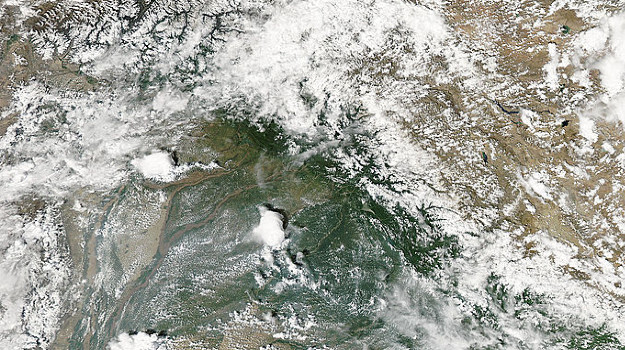
NASA MODIS image on Northern Pakistan from 9 August 2010
NASA MODIS image on Northern Pakistan from 9 August 2010

NASA MODIS image of northern Pakistan from 6 August 2010

NASA MODIS image of northern Pakistan from 6 August 2010

This year, the monsoon precipitation has been especially intense in Pakistan, because the jet stream is experiencing a blocking event – when the normal eastward progression of weather patterns in the midlatitudes gets stalled out and you get the same weather for weeks on end. This created an additional low pressure zone over Pakistan’s northern mountains, bringing even more moisture to the headwaters of the Indus River. The rain also seems to be exacerbating the landslide and landslide dam problems in the region of the Hunza River, a tributary to the Indus in the northern mountains. (Update: Jeff Masters has a nice explanation of this jet stream blocking event and how it links the Russian heat wave and Pakistan floods.)

Flooding on the Indus is not an instantaneous disaster – it is one that will continue to occur for weeks, with consequences that last years. Because the flooding is being caused by prolonged intense precipitation, there can be multiple flood peaks – where the water level crests, starts to fall, and then rises again. There are already two flood peaks moving downstream, and if further rain falls, there may be three peaks to the flooding, and it could last through the end of August. Also, since much of the rain has fallen in the north, closer to the headwaters of the Indus, the flooding began in the north, and the flood waves are  transmitted downstream over a matter of days to weeks. While river levels are now slowly declining in the north, the first flood peak is just reaching Hyderabad – the largest city along the river, with a population of 1.5 million. How fast the flood moves downstream depends on the storage properties of the channel and floodplain. There is some possibility that if the first flood peak stalls out in an area with lots of floodplain storage or obstruction of flow by debris-choked bridges, the second flood peak could catch up, creating an even larger disaster.  NASA has a series of wonderful images showing the flood progressing downstream from Sukkur, north of Hyderabad, from 8 -12 August. The latest image is shown below.
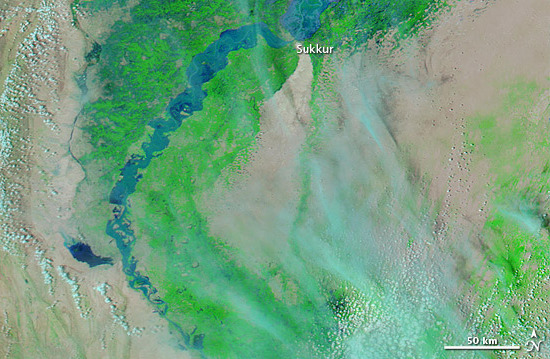
Flooding on lower Indus River, 12 August 2010 (NASA MODIS image, combination of infrared and visible light)

Flooding on lower Indus River, 12 August 2010 (NASA MODIS image, combination of infrared and visible light)

Even when the final flood peak reaches the ocean and the Indus River returns to its banks all along its course, the human disaster will continue to unfold. 14 million people have been displaced by this flood – and those people may have lost everything they own. Beyond the personal losses, there has been devastation  to infrastructure such as roads and bridges, complicating relief efforts and even making access to some areas nearly impossible. The Indus is the source of water for irrigation canals throughout Pakistan and damage to them is likely to be intense, especially near the river, so agricultural productivity will suffer even in areas that escaped inundation. Village wells will have been contaminated by floodwaters, so access to safe drinking water will be an issue for months.

That’s a lot for any nation to handle – 1 in 12 residents directly affected by the flood – but for Pakistan’s already fragile national government it will be an especially difficult challenge. As the flooding has unfolded, Pakistan’s government has appeared less equipped to provide immediate relief to flood victims than Islamist charities, which will probably increase their support as they fill empty stomachs and provide shelter. There are other aid groups working to ameliorate the suffering. Two of my favorites are MercyCorps, providing clean water, food, and clean up tools in the Swat Valley, and Medecins Sans Frontiers/Doctors Without Borders, which is providing sanitation kits and basic supplies in Kyber Pakhtunkhwa and Baluchistan.  Dave Petley, who has worked in Pakistan, recommends FOCUS Humanitarian Assistance.

Categories: by Anne, geohazards, hydrology

Yellowstone: where did all the ash go?

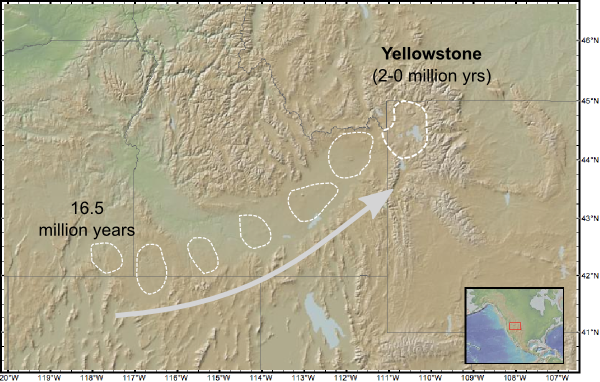
A post by Chris Rowan A couple of weeks ago, I showed the trough excavated through the mountains of the western US by explosive caldera eruptions above the migrating Yellowstone hotspot.

Path of the Yellowstone hotspot

The chain of caldera left in the wake of the Yellowstone hotspot.

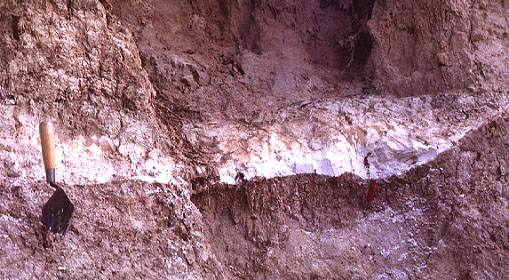
These eruptions excavated a lot of rock: the most recent eruption of the Yellowstone caldera, 600,000 years ago, pulverised 1000 cubic kilometres of crust into ash and threw it into the atmosphere. When it finally settled to the ground again, a lot of it had drifted or been blown hundreds of miles away from Yellowstone. It settled in Kansas.

Lava Creek Tuff exposed near Desoto, Kansas. Photo: J. S. Aber

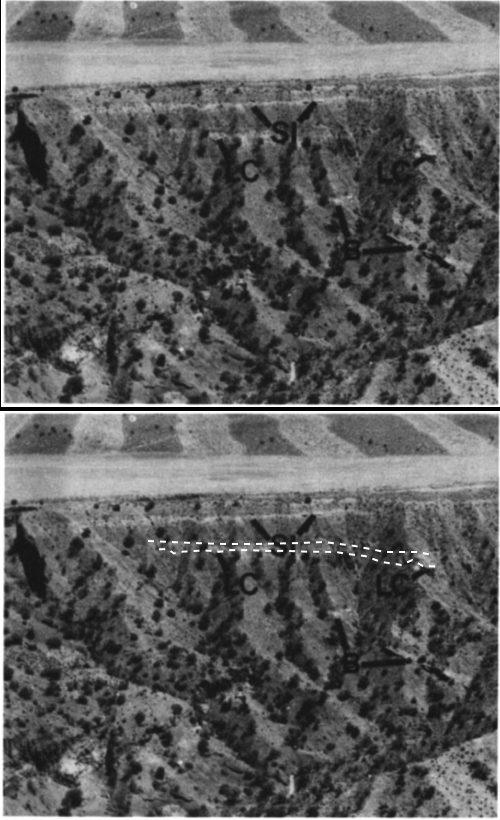
It also settled in Utah (apologies for the rather distant and grainy photo).

Cliff exposure of Lava Creek Tuff (LC) in Fisher Valley SE Utah. Source: Colman et al. (1986)

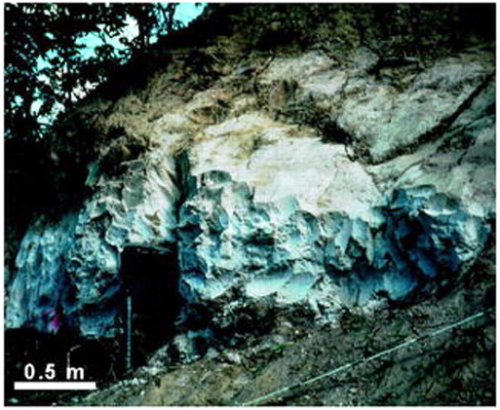
And some floated as far as Western Iowa.

Lave Creek Tuff, exposed in Western Iowa. Source: Roy et al. (2004)

In fact, 0.6 million year-old ash layers, with a distinctive mineral composition that links them to the same eruptive event and to the Yellowstone caldera, can be found in sequences over a sizeable proportion of the continental US. Collectively, this unit is known as the Lava Creek Tuff (sometimes referred to as the Pearlette ash in older literature).

Distribution of Lava Creek Tuff in continental United States. Orange dots - ash layer outcrops pictured above.

This is another way that the almost unimaginable scale of a large caldera eruption compared to the kind of volcanic activity we have direct experience with can be highlighted. The ash from the Eyjafjallajokull eruption earlier this summer was dispersed more than 1000 km from Iceland by strong winds, totally disrupting air travel as it went; but the ash that settled on the ground in Western Europe was, at most, a light dusting – it would be generous to say half a millimeter. As the outcrops above demonstrate, an equivalent distance (1000 kilometres) from Yellowstone, the Ash Creek tuff is about half a meter thick – one thousand times thicker. Three orders of magnitude. Somewhat eye-opening, don’t you think?

On the plus side, the Lava Creek tuff, and similar widely distributed ash layers from earlier eruptions of the Yellowstone caldera chain since 16 million years ago, provide a set of useful correlative markers between sequences in widely seperated sedimentary basins in the US – igneous index fossils, if you will.

Categories: outcrops, volcanoes

Anne’s picks of the literature: river and floodplain sediments

A post by Anne JeffersonResearchBlogging.orgIn July, four geomorphology papers particularly piqued my interest, and, as I started to summarize them, I realized they were loosely connected by a common theme. These four papers all attempt to understand what controls the sediments that make up the streambed and floodplain and that get preserved in the geologic record. White et al. look at how riffle positions are governed by valley width variations, while Jerolmack and Brzinski find striking similarities in grain size transitions observed in rivers and dune fields. Hart et al. examine the relationship between glacial advances and downstream sediment deposition, while Sambrook Smith et al. investigate the sedimentological record of floods.

White, J., Pasternack, G., & Moir, H. (2010). Valley width variation influences riffle–pool location and persistence on a rapidly incising gravel-bed river Geomorphology, 121 (3-4), 206-221 DOI: 10.1016/j.geomorph.2010.04.012

In gravel-bed rivers, channels commonly take the form of alternating pools and riffles. During low flows, pools have deep, slow flow, while riffles are shallow and fast. During floods, pools scour deeper, while riffles may get sediment deposited. This counter-intuitive behavior is explained by channel width variations during high flow – riffles tend to be wider than pools. As the water level rises, valley width may come into play. If the river is confined by valley walls, it will be deeper and faster and able to carry more sediment than where the river is unconfined by the valley walls. By what is known as flow convergence routing, deposition occurs where the river is least width-confined and has the lowest transport capacity. In this paper, White et al. examine the location and persistence of riffles in relation to oscillations in valley width for one reach of California’s Yuba River. Using repeat aerial photography, they show that many riffle crests are located in the widest portions of the valley, and that these riffle crests were persistent for decades. Despite being downstream of several dams, the study reach was geomorphically active – with frequent overbank flows, planform change, and rapid incision (0.16 m/yr), and yet riffles located in the widest parts of the valley remained stationary. Conversely, where riffles were created by large mid-channel gravel bars, and were not in sync with valley width oscillations, they tended to be destroyed by large floods. These results support the idea that flow convergence routing is an important control on pool-riffle channel form and stability and that the common assumption of uniform flow is invalid. Many river restoration practices are based on uniform flow assumptions, and the authors assert that without considering the implications of flow convergence routing, restoration practices are fundamentally misguided.

Jerolmack, D., & Brzinski, T. (2010). Equivalence of abrupt grain-size transitions in alluvial rivers and eolian sand seas: A hypothesis Geology, 38 (8), 719-722 DOI: 10.1130/G30922.1

Rivers generally exhibit downstream fining of sediments – in which the coarsest sediments are found near the headwaters and the finest sediments are found near the mouth. This fining trend occurs exponentially downstream – rapidly in steep rivers as boulders and cobbles give way to gravel-bed streams and much more slowly in low-relief settings where sand and silt can form the streambed for hundreds of kilometers. One interesting phenomenon is that the transition from gravel-beds to sand-beds occurs much more abruptly than might be expected, and many rivers have a deficit of sediment in the coarse sand/fine gravel size ranges (1-10 mm). Downstream fining in rivers has been attributed both to abrasion and to selective deposition of the coarse particles, but laboratory abrasion studies often show much lower rates of downstream fining than are observed in real rivers. Like rivers, wind-blown eolian sediments also exhibit an abrupt grain size transition – between sand and silty loess. Jerolmack and Brzinski (2010) examine the transport and abrasion dynamics of dunes and gravel-bed rivers to understand what mechanisms might be creating the abrupt grain size transition in both systems. Maximum geomorphic work (sediment transport times frequency of the event) in both gravel-bed streams and sand dune fields occurs when Shields’ shear stress is only less than two times greater than the stress required to mobilize the sediment. Similarly, the two systems are comparable in terms of abrasion collision dynamics, as estimated by the collision Stokes number. Abrasion produces smaller particles as big ones collide into each other and chip small pieces off. Abrasion efficiency decreases rapidly as grain size decreases, resulting in a minimum sediment size, which for rivers is in the range of ~10 mm gravel. Meanwhile, the small chipped-off pieces are sand-size (less than 2 mm) and continue to be transported downstream in suspension when the gravel settles out. As Jerolmack and Brzinski conclude “abrasion produces a bimodal grain-size distribution while sorting acts to segregate these grains to produce an abrupt transition.” While the authors acknowledge that the sediment transport in rivers and air are each subject to different constraints, they maintain that their abrasion/sorting hypothesis may explain the longitudinal sediment distribution in both environments. They also propose several additional areas where work is needed to test their hypothesis – including studies of gravel and sand source regions in multiple river systems.

Hart, S., Clague, J., & Smith, D. (2010). Dendrogeomorphic reconstruction of Little Ice Age paraglacial activity in the vicinity of the Homathko Icefield, British Columbia Coast Mountains, Canada Geomorphology, 121 (3-4), 197-205 DOI: 10.1016/j.geomorph.2010.04.011

Paraglacial geomorphology refers to landscape forms and processes that occur in areas adjacent to glaciers and the movement of large amounts of sediment from valley slopes to river systems that accompanies glacial advances and retreats. How rapidly this sediment is transferred from glacial areas to paraglacial areas is of interest to geomorphologists working in alpine and polar landscapes. This paper uses dendrochronology and geomorphic mapping to investigate paraglacial geomorphology and the time lags between glacier activity and downstream sediment deposition in the southern British Columbia coastal mountains. In 1997, a moraine dam overtopped and breached, draining a proglacial lake, and flooding the rivers downstream. The floodwaters eroded through 4 m of paraglacial valley-fill units with in-situ tree stumps and woody detritus. Tree rings from the stumps indicate that they died because of rapid burial by overlying sediment (i.e., from flood deposits). Multiple valley-fill deposits indicate and provide dates for six aggradation events between 718 and 1794, and correlation of these dates with independent regional glacial chronologies suggest that all of the aggradation events occurring during periods of glacier advance. This suggests that river valleys downstream of glacier limits were affected by synchronous redistribution of sand and silt from glacial forefields, moraines, and valley slopes when climates were cold and wet and glaciers were active, and that there was little lag between glacial erosion and advance and sediment delivery to downstream areas. This is paper is cool because it provides data that speak to the rapid delivery of sediment from glacial to paraglacial areas and because it uses trees in the paraglacial deposits themselves to give a much longer dendrochronology than can usually be obtained in glaciated areas.

Sambrook Smith, G., Best, J., Ashworth, P., Lane, S., Parker, N., Lunt, I., Thomas, R., & Simpson, C. (2010). Can we distinguish flood frequency and magnitude in the sedimentological record of rivers? Geology, 38 (7), 579-582 DOI: 10.1130/G30861.1

Over time, the flows that commit the most geomorphic work are those moderately high flows that occur moderately frequently – generally every 1-2 years. But large floods – like those that occur every 50 to 500 years on average – can dramatically reshape the form of the river and floodplain. These generalizations are based on observations of modern river systems, but how do they apply to the sedimentological record that will preserve the river’s legacy for future eons? Using detailed digital elevation models (DEMs) and ground penetrating radar (GPR) surveys of the South Saskatchewan River, Sambrook Smith et al. investigated the legacy of a flood with a 1 in 40 year recurrence interval (i.e., 0.31% probability). What they found is that while there were significant erosion and deposition across the braided river, the depth of sediment scoured or deposited was not substantially greater than that observed following much smaller floods. The larger high bars steered flow around them, even during the flood, forcing channel erosion, but only facilitating less than 0.5 m of deposition on bar surfaces. While erosion and deposition was spatially extensive in the large flood, the style and scale of the deposits was similar to small floods. Thus, there was no distinct legacy of this flood event that would differentiate it from smaller events in the geologic record. More generally, the authors conclude that in rivers which can widen during floods (i.e.,are not valley confined), there may be little preserved evidence in the sedimentological record to identify low-frequency high magnitude events from run-of-the-mill annual floods. The present is the key to the past, but the past that is preserved in the geologic record loses some of the sweet details of the dynamic events that act on the earth’s surface.

Categories: by Anne, geomorphology, paper reviews

Stuff we linked to on Twitter last week

A post by Chris RowanA post by Anne JeffersonSince Anne and I have both been away, this is actually the last two weeks’ worth of interesting links for your clicking pleasure.

Blogs in motion

Tectonics

Geohazards

Environment and Water

Planets

General Geology

Interesting Miscellaney

Categories: links

Friday-ish focal mechanisms

A post by Chris RowanObviously, my holiday has slightly disrupted my weekly seismic updates, but the magnitude 4.8 earthquake that shook Wyoming on Thursday did catch my eye, mainly because I was right in the area only six weeks ago.

Location of Magnitude 4.8 earthquake in Wyoming, Aug 5.

The earthquake was located just to east of Grand Teton National Park, just south of Yellowstone National Park and if, anything, even more beautiful. They host as perfect a range of mountains as you’re ever likely to see; this vista is possibly only matched by a western view of the Southern Alps of New Zealand.

Part of the Teton Range, from the shore of Jackson Lake. Photo: Chris Rowan, 2010

The Teton Range is on the eastern edge of the Basin and Range, a region of extension that has created a series of fault-bounded mountain belts across a large region of the western US, and the topography here is also created by extensional faulting. With that in mind, I looked up the focal mechanism fully expecting to see an extensional fault plane solution. Surprisingly, however, this is not what I found; there is a small component of extension, but the focal mechanism is largely strike-slip, indicating two bits of crust sliding past each other, rather than being pulled apart.

The rupture was at a shallow depth (5 km) and not actually located in the Teton Range, but further east in the Gros Ventre range, a region with several northwest-southeast trending escarpments, suggesting this earthquake was due to right lateral shear on a NW-SE fault. The USGS Quaternary fault map for Wyoming indicates a few faults with similar trends, and that might have recently-produced fault scarps, further to the east (such as the South Granite Mountains Fault System). But the sense of movement on these faults is reported to be extensional, meaning that this earthquake seems inconsistent with even fairly local tectonics.

So, it’s a bit of a mystery; but remember that a magnitude 4.8 has very little regional tectonic significance (it’s a relatively low energy event), so it could be just relieving a bit of local shear strain built up by deformation around it. Of course, it is always possible that some strike-slip displacement did occur across the faults to the east as well, but has gone unrecognised.

I’m planning to post bit more about the larger scale tectonics in the Grand Teton region next week, as I return to blogging about my Yellowstone trip. Meanwhile, just to add to the topicality, Julia is reporting that, in the latest act in a long-running financial dispute with Washington, the Wyoming state governor is is threatening to sell some state-earned parts of the National Park. All I can say is: don’t do it, Wyoming!

And next week, I will actually post a Friday Focal Mechanisms on the Friday. Maybe.

Categories: earthquakes, focal mechanisms, geohazards