Snow, water, digital imaging, metamorphism…and a guillotine!

A post by Anne JeffersonResearchBlogging.org

When water infiltrates past the ground surface and begins to percolate through the soil’s unsaturated zone, it doesn’t move downward like an even sheet. Instead, fast fingers of water move downward along pores, roots and other places where flow is easier than through the soil matrix, and water lenses accumulate horizontally where there are changes to less permeable soil horizons. The same principles apply to snow, with the added bonus that the water flowing and the matrix is flowing through are made up of the same substance, separated only by a temperature threshold. So you can get some really complicated dissolution/melting and precipitation/freezing reactions going on throughout the snow profile.

A good way to see these patterns is to apply dyed water to the land or snow surface and then dig a soil or snow pit to examine where the dye ends up. Now Williams et al. (2010) have devised a really cool device for taking sequential, thin, uniform slices of snow off the wall of a snow pit, so that they can see and measure the 3-D structure of preferential flow within the snow profile. They call their device a snow guillotine, because it is basically a sharp blade mounted on a frame that sits on top of the snow surface. A camera is also attached to the frame, at fixed distance from the blade. The blade and camera are mounted on a slider, so after taking a slice and an image of the snow and dye, the scientists can slide it a specified distance and take another slice exposing a new snow surface. (Of course, being good field scientists, all of this can be packed into a remote site, as shown below.)
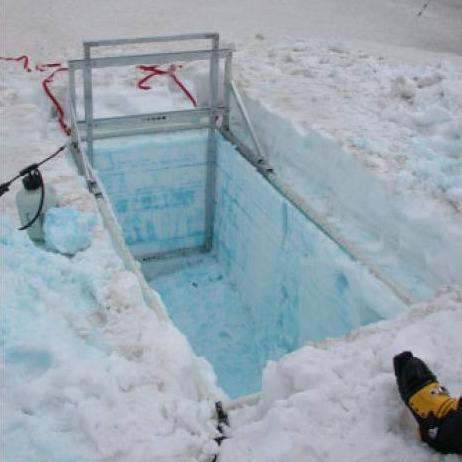
Figure 4 from Williams et al (2010)

Image from Williams et al (2010) showing the snow guillotine in operation in a dyed snowpack in Colorado. Ski boot for scale.

After the scientists have taken all the slices and photos they want, they can go back to their warm, cozy offices and apply digital image processing techniques to the photos to quantify the 3-D patterns of preferential flow. The vertical images are rectified and can be stacked together into data cubes, allowing the researchers to examine the horizontal centimeter-meter scale patterns as well. You can see this in animated movie of one of their snowpacks in the supplemental materials (no paywall!).

This paper details the results of two dye experiments conducted in Colorado in May and June 2003. Both experiments occurred in isothermal (0 C) snowpacks, but in the second experiment the snow had been isothermal for a longer period of time and had ablated (melted + sublimated) more extensively than in the first dye application. The first experiment showed significant vertical and horizontal heterogeneity, particularly in the upper 20-55 cm of the snowpack, where there were up to 300 distinct vertical preferential flowpaths per square meter. At interfaces between snow layers (i.e., snow that fell at different times) there was significant lateral flow, probably as a result of permeability changes at those boundaries. In lower parts of the snowpack, downward flow was somewhat more evenly distributed and the preferential flowpaths tended to be larger. In the second experiment, more snow metamorphism had occurred, resulting in larger grain sizes and open spaces. In this snowpack, there was still some preferential flow, but, in general, flow was much more evenly distributed throughout the matrix. This finding brings into focus how the snow’s thermal history controls meltwater pathways.

All together then, the dye experiments, cut and photographed by the guillotine setup, and digitally processed in the lab emphasize the importance the small scale (cm to m) heterogeneity on flow through porous media. This isn’t super surprising to people who have spent time studying water flow through soils, but when you are dealing with snow, you add thermodynamics and a matrix that can dramatically metamorphose over time scales of hours to days to weeks to the mix. That adds a level of complexity that makes my mind boggle a little bit, yet Williams et al. have found a simple method to collect to field measurements and process the images in a way that lets them quantitatively describe these flowpaths and will hopefully contribute to a better understanding of the processes and interactions between snowpacks and snowmelt.

Williams, M., Erickson, T., & Petrzelka, J. (2010). Visualizing meltwater flow through snow at the centimetre-to-metre scale using a snow guillotine Hydrological Processes, 24` (15), 2098-2110 DOI: 10.1002/hyp.7630

Categories: by Anne, hydrology, paper reviews

The fault that made a mountain range

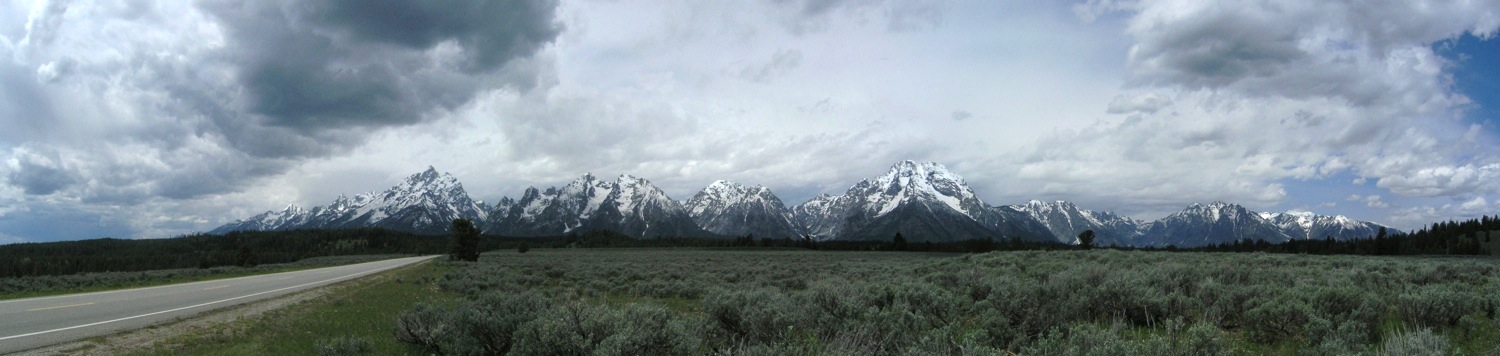
A post by Chris RowanApparently Grand Teton National Park suffers somewhat from being in the shadow of Yellowstone, just to the North. I really can’t think why.

Click for larger image. Photo: Chris Rowan, 2010

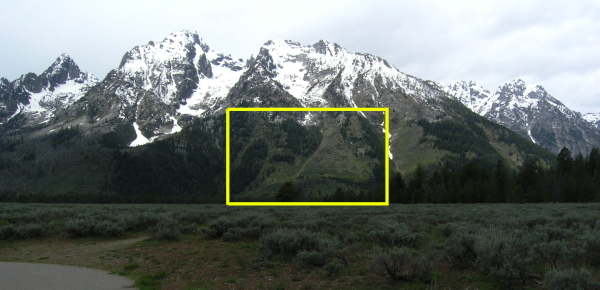
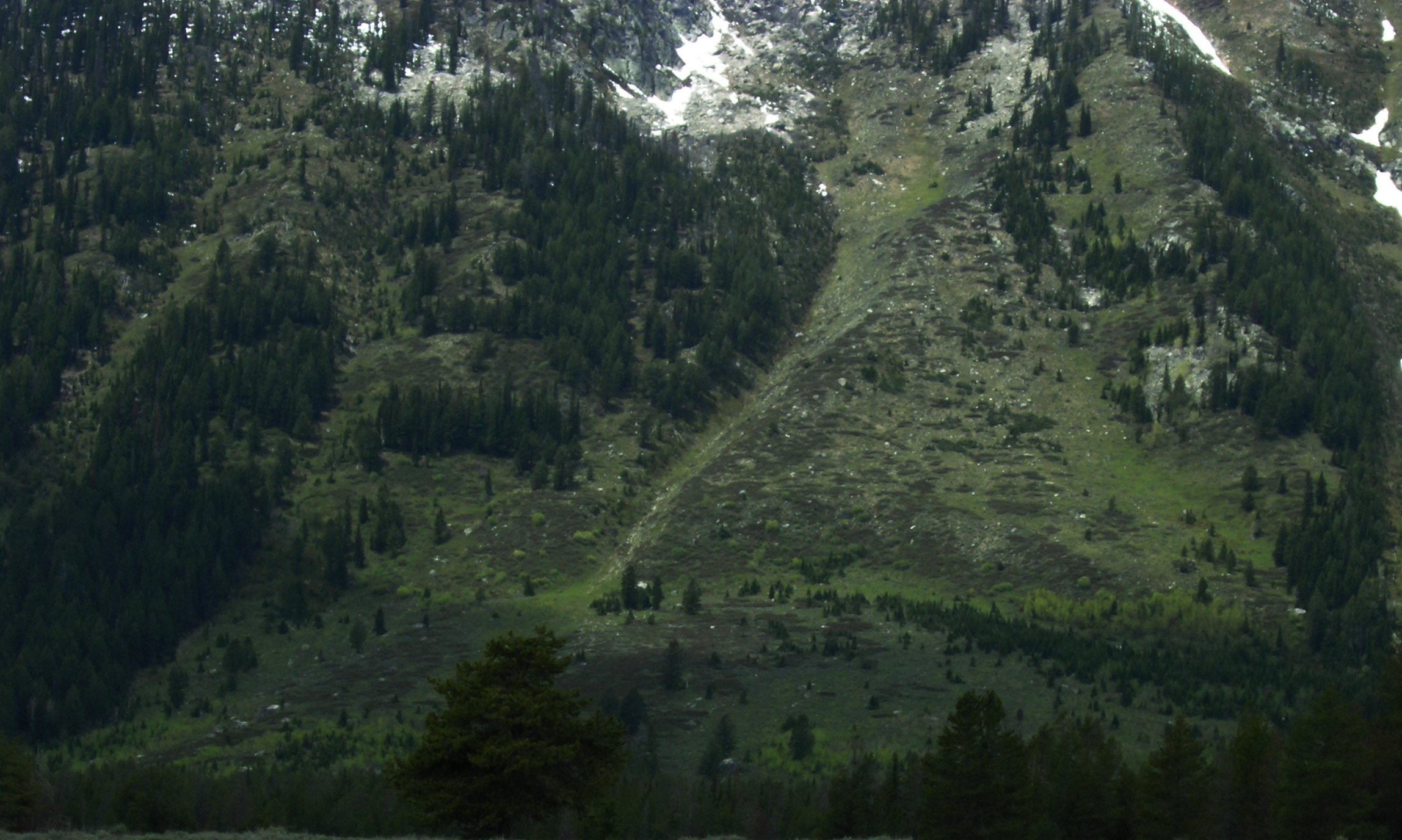
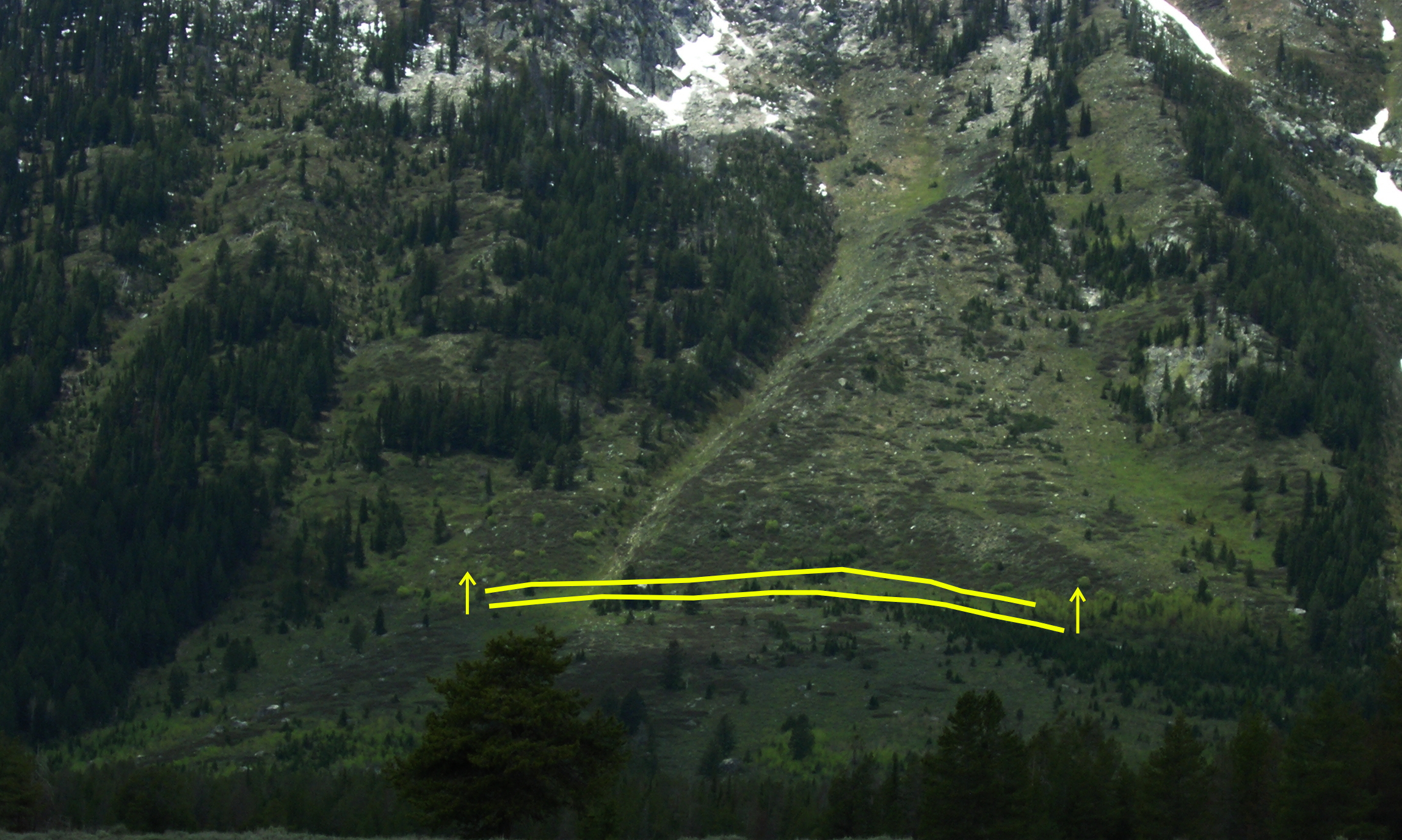
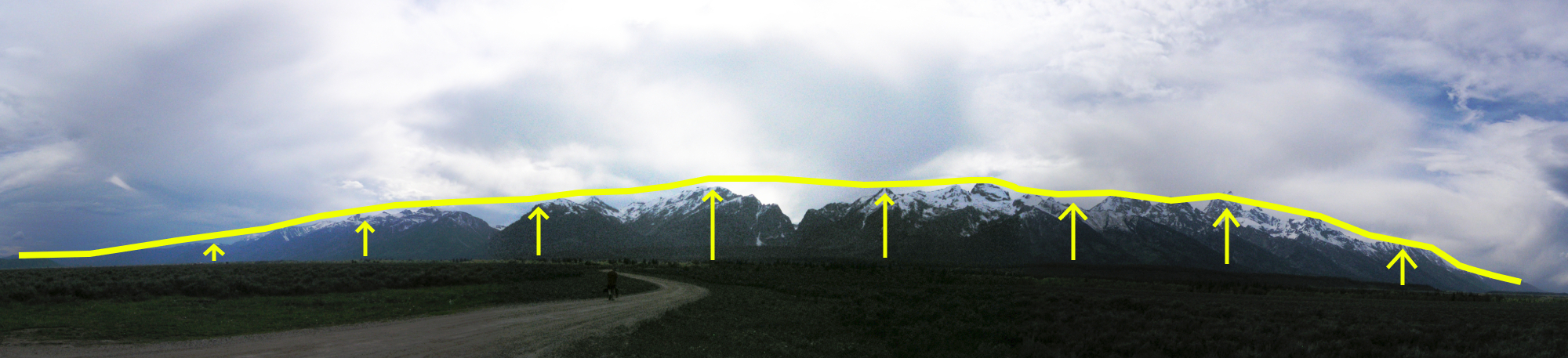
The tendency of this handsome panorama to be cut off by rain clouds hovering a few hundred feet above the valley floor may be an issue for some, but on a clear day the view is pretty much unbeatable. And for a geologist, there’s an additional source of wonder and excitement: the presence of such an abrupt jump in the topography, the extreme linearity of the range front, and the abrupt transition from gravel and silt only a few thousand years old on the valley floor, to hard, crystalline granites and metamorphic rocks that are more than 1.5 billion years old in the mountains, all scream, ‘fault!’. You don’t have to take my word for it, either: if you turn your eyes towards the lower slopes of the mountains just north of Jenny Lake, it is relatively easy to trace a linear scar disrupting the glacial till deposited by melting glaciers at the end of the last ice age, about 14,000 years ago. This initially smooth surface has since been broken; multiple earthquakes have lifted the far side of the breach upwards about 30 metres relative to the near side, creating a sizeable fault scarp.

View from the Cathedral Group Turnout. Can you see the fault scarp? Photo: Chris Rowan, 2010


Teton Fault scarp, annotated

Scarp marking movement on the Teton Fault since the end of the last glacial period (click for larger images). Photos: Chris Rowan, 2010.

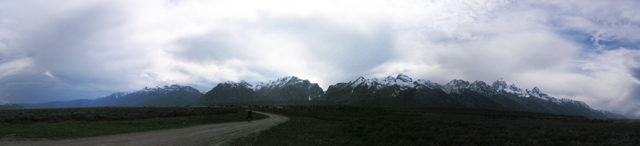
Multiply that up a few orders of magnitude, from maybe ten earthquakes in ten thousand years to ten thousand earthquakes in 10 million years, and voila: your fault scarp forms the face of an entire mountain range. And what is really striking about the Tetons is how clearly this fact – that the Teton Range and the Teton Fault are essentially the same thing – is firmly written in their geomorphology. The total displacement that accumulates across a fault is not constant along its length; faults do not go on forever, and the points where they peter out are, by definition, places where there is no displacement. This means that the total movement on a fault is greatest towards its centre, and decreases towards either end. If you look you trace the profile of the Teton Range from north to south, it matches this form pretty closely, even if erosion has carved numerous large gap.


The morphology of the Teton Range matches the displacement profile for a growing fault, with the middle moving furthest (click for larger image). Photos: Chris Rowan, 2010.

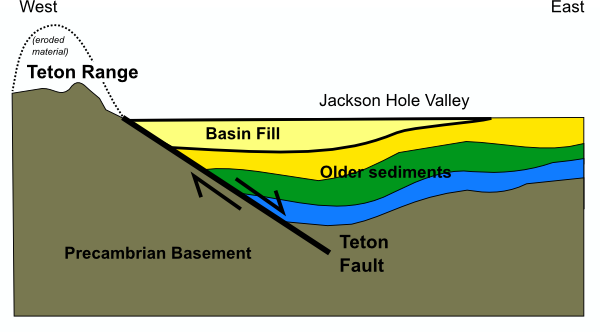
The total distance from the valley floor to the highest peak is about two thousand metres. But if you think a two kilometre-high fault scarp is pretty impressive, remember that the total displacement on the Teton Fault is even greater than. Not only is material constantly being removed from the peaks by erosion, but that material is then transported, by water or ice, down into the hole being created by the faulting, filling it and raising the level of the valley floor. On the western side of the fault, the Precambrian rocks equivalent to those towering above Jackson Hole valley on the eastern side of the fault are at least two kilometres beneath our feet. That implies a minimum displacement of about four kilometres. [Update: I was being far too conservative, it seems: Callan demonstates how exposures of Cambrian sandstones on Mount Moran indicate more like 9 km of displacement.]

E-W cross section through the Teton Range, showing the half-graben structure created by uplift on the Teton Fault

It’s a big fault – and furthermore, it’s a big fault that hasn’t ruptured for a while. When it does, it will produce a magnitude 7-8 earthquake, and throw the Teton Range a few metres higher up into the clouds.

(with regards to the video, it’s a bit of an experiment – I’m not sure it works well as a standalone, but it does provide a nice sweep over the whole range, showing how it rises and falls again as you trace along its length.)

Categories: geology, geomorphology, outcrops, photos, structures

Heat in the Southeast

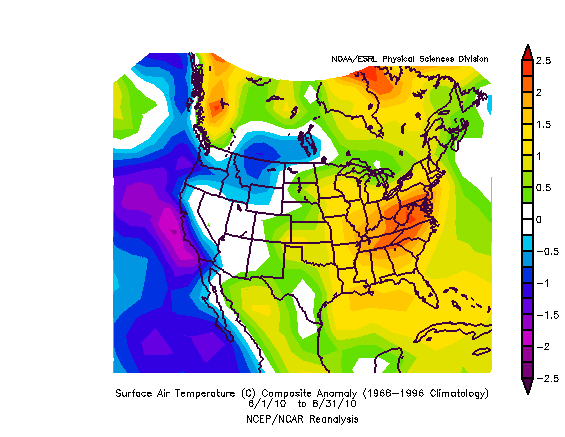
A post by Anne JeffersonHere in Charlotte we had a hot summer. We barely escaped the dubious distinction of hottest summer on record, with an average temperature of 81.1° F (27.3 ° C) between 1 June and 31 August. The record had been set in 1993, when Charlotte recorded an average temperature of 81.5° F (27.5 ° C). In terms of record breaking heat, we actually fared better than many parts of the east coast, where temperature records from New York City to Greenville-Spartanburg, South Carolina were broken. Below there’s a nice map from NOAA of how far average temperatures deviated from the 30-year climate normal period (here, 1966-1996).

U.S. surface temperature departure from average (°C), June 1 to August 31, 2010, from NOAA/ESRL Physical Sciences Division, Boulder Colorado

U.S. surface temperature departure from average (°C), June 1 to August 31, 2010, from NOAA/ESRL Physical Sciences Division, Boulder Colorado

Of course those average temperature records belie the minima and maxima experienced by each place over the course of those three summer months, so there’s another statistic that I’m finding even more interesting: the number of days where maximum temperatures exceeded 90° F (32.2 ° C). I think of it as Anne’s index of intolerable heat, especially when combined with the Southeast’s oppressive humidity. In Charlotte, between 1 June and 31 August, we had 67 days that exceeded 90° F. That means that 73% of days this summer were intolerably hot (at least for me). Also, that’s only counting the days in the climatological summer. We had 90+° F degree heat in early April, some in May, and we’ve already had some in September, with more in the forecast this week. I suspect that by the time the year is out, our total days above 90° F will be something around 80, if not more.

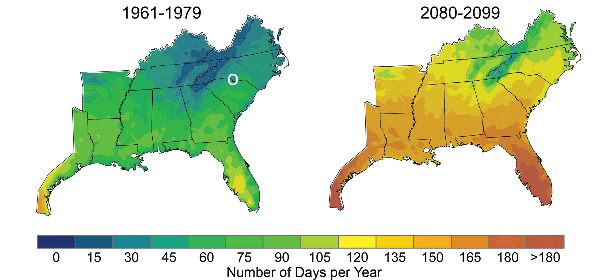
The long-term predictions for the index of intolerable heat look grim for Charlotte and the rest of the southeast. The image below shows historical and modeled days with peak temperatures exceeding 90° F. By the end of the century, at least under a high emissions scenario, 80+ days of intolerable heat will be considered a cool summer in North Carolina. We’re heading towards 120 days or more of hot, hot weather, a doubling of our historical average. In parts of Florida and Texas, more than half the year will be hotter than 90° F. Yuck. Glad I won’t be around here then.

Historical and predicted days with peak temperatures above 90 degrees Fahrenheit

These temperature trends are not just bad news for people who like to play (or do field work) outside in the summer, but are too wimpy to drop bucketloads of sweat. Hotter average temperatures and more days with ridiculous heat have real health consequences. On hot days, the chances go up that people playing outside end up with heat exhaustion or life-threatening heat stroke. People without air conditioned homes or workplaces, people too poor to pay tremendous energy bills for air conditioning, or people who just happen to have their AC break do not even need to play outside to be at risk of heat related illness or death. About 700 people already die each year from heat-related causes, and the elderly are a disproportionate share of the victims. Those with cardiovascular disease are also at substantially increased risk of heat-related mortality.

And it’s not the heat alone that spells bad news for the Southeast. With hotter temperatures come increasing rates of photochemical reactions…such as the production of ground-level ozone from nitrous oxides and volatile organic compounds released by car exhaust, power plants, and natural sources. The chemistryof photochemical ozone production is pretty complex and we don’t have a fantastic handle on how coming climate changes will impact the percent of hot days with sun versus clouds, but if the number of hot sunny days increases, it is likely that ozone production will increase too. Ozone brings its own host of adverse health effects, particularly respiratory problems, so even if you don’t mind the heat, running around outside on hot, sunny days can be a bad idea. Once again, children, the elderly, and those with asthma and other respiratory problems are most at risk on high ozone days. Such days, labeled as orange alerts, occur sporadically thoughout the summer already. In Charlotte, we’ve had 13 days with air quality in the orange category since May 1 this year. On those days, people at risk are encouraged to avoid outdoor exercise, and daycare centers limit the time kids spent playing outside. Some days, the air quality is bad enough (red alert) that even healthy adults are encouraged to avoid to outdoor exercise. That’s happened once this year in Charlotte.

As Charlotte and other parts of the southeast move towards one-third of their days in the intolerably hot range, with the probable added bonus of worse air pollution, it will be interesting to watch the societal shifts in attitudes toward the climate. Will Southerners get serious about reducing emissions from cars? Will Charlotteans end their love affair with sprawl in order to improve air quality? Will the Southeast be depopulated of Yankee transplants like me, who finally decide that they can’t take the heat? Or will we just stay inside and crank up the air conditioning units and complain about the weather?

Categories: by Anne, climate science

Stuff we linked to on Twitter last week

A post by Chris RowanA post by Anne JeffersonBefore we get on with the link sharing, Lockwood has issued the call for the next Accretionary Wedge Geo-carnival. The theme is
‘Important Geological Experiences’ and the submission deadline is September the 27th.

Also this week, the geology PodClast is back: episode 15 covers everything from the latest earthquake research in Tonga, Haiti and California, to the floods in Pakistan, and is now available for your listening pleasure. And Anne discusses her blogging in a nice interview in the Charlotte Observer.

Blogs in motion

Erik Klemetti’s excellent Eruptions blog, and its knowledgeable and lively community of volcano spotters, has now moved to Big Think, and another new voice has added itself to the geoblogosphere in the form of Glacial Till. It’s a good thing that there only 2 new science blogging networks launched this week, at PLoS and the Guardian, or we might not be able to keep up.

Earthquakes and Tectonics

Volcanoes

General Geology

Environmental

Water

Interesting Miscellaney

Categories: links

Tectonics of the M7 earthquake near Christchurch, New Zealand

A post by Chris RowanThis post was written in response to the Darfield earthquake in September 2010. The most recent seismic activity is discussed here.

[Updated 8th September 1200 GMT – see bottom of post. And check out the PodClast discussion of this earthquake, featuring Kiwi Chris Town, Ron Schott, and myself.]

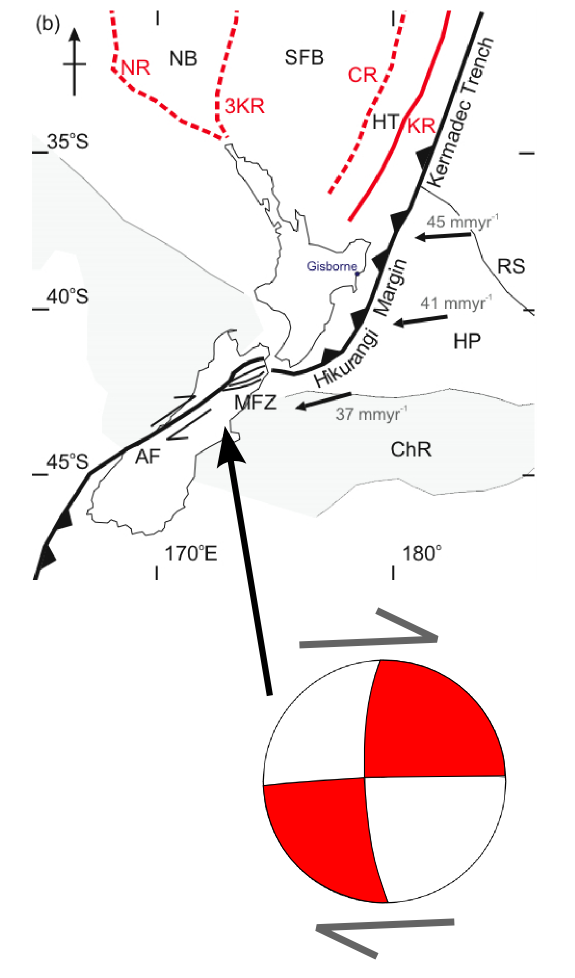
The South Island of New Zealand has just been shaken by a large earthquake, reported as a magnitude 7.0 by the USGS. It appears to be quite a shallow rupture, on the Canterbury Plains close to Christchurch, and the focal mechanism indicates largely strike-slip motion.

Focal mechanism of September 3rd earthquake, and it's location with respect to the plate boundary in New Zealand

As the figure above illustrates, New Zealand is not just located on top of the boundary between the Pacific and Australian plates: it is located at a point where the nature of that plate boundary changes in some rather fundamental ways. The subduction zone running down the East Coast of the North Island terminates off the Northeast coast of the South Island, about 100 kilometres north of Christchurch, and gives way to a transform boundary cutting through the continental crust of the South Island, where the plate motions are accommodated by largely dextral strike-slip on the faults of the Marlborough Fault Zone (MFZ in the figure above) and the Alpine Fault (AP). Whilst this latest rupture clearly occurred some way south of both of these fault systems, the focal mechanism can be interpreted as showing as dextral strike-slip on an east-west oriented fault, suggesting that it is still linked to deformation at the plate boundary.

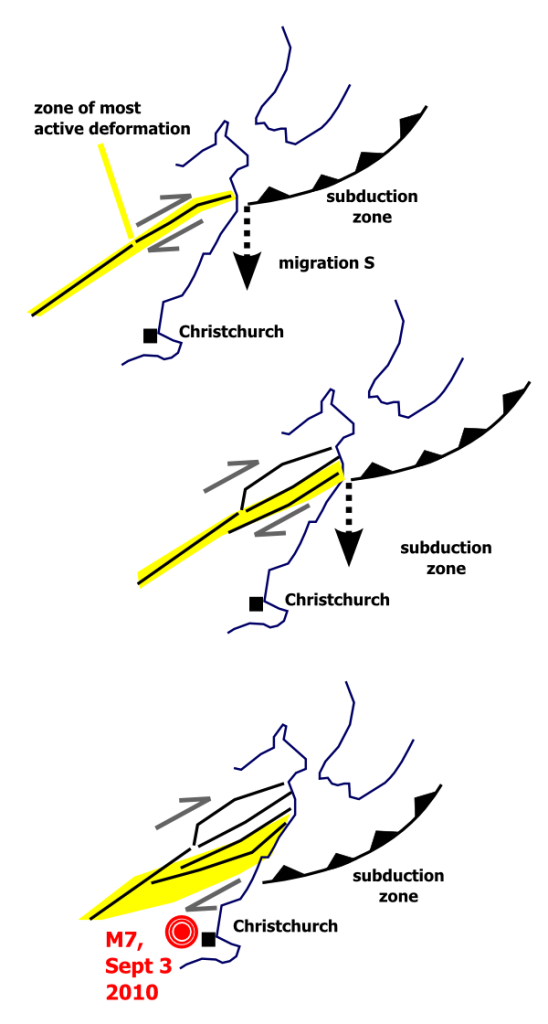
New Zealand is a region of distributed deformation: the relative motions between the Australian and Pacific plates are not accommodated on one or two faults in a narrow zone, but on many faults across a much wider zone. It is therefore perhaps not surprising to observe large earthquakes accommodating plate motions some distance from where the two plates actually meet. However, the occurrence of such earthquakes in this particular region of the South Island is probably also linked to ongoing changes in the nature of the plate boundary at the junction between the subduction zone and the continental transform. If you look at the displacement history of the individual faults in the Marlborough Fault zone, the northern faults are older, were more active in the geological past, and have quite small recent (in the geological sense of ‘the last few 100,000 years’) displacements; the southern faults are younger, and have much larger recent displacements. The most obvious explanation for these changes is that the most northern of the Marlborough faults was originally directly linked with the end of the subduction zone, but that these two structures moved out of alignment as the subduction zone moved south, causing new strands of the Marlborough Fault system to grow in order to more efficiently accommodate plate motions.

Growth of new plate boundary faults on the South Island of New Zealand in response to southward propagation of the subduction zone

This tectonic evolution is ongoing, and since the end of the subduction zone is now actually to the south of the southernmost and youngest of the Marlborough faults. Some of the plate boundary deformation is probably therefore being shunted into the region around Christchurch, where it needs to be accommodated by dextral strike-slip faulting. Eventually, over geological time, this deformation will lead to the formation of a new, more southerly strand of the Marlborough Fault system. It also means that earthquakes of this type of size are unlikely to be a one-off event in this area. Unsurprisingly, then, seismic surveys have identified a number of active faults beneath the recent sedimentary cover on the Canterbury plains (although they were identified in the linked study as reverse faults accommodating compression, strike-slip deformation is very difficult to identify if you only have a 2 dimensional cross section to work with).

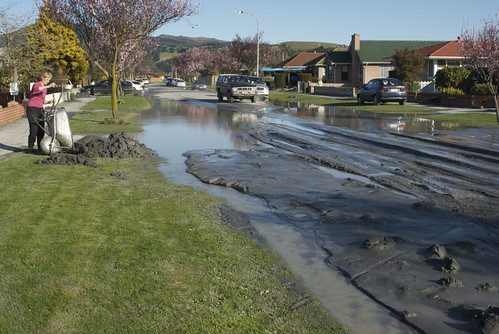
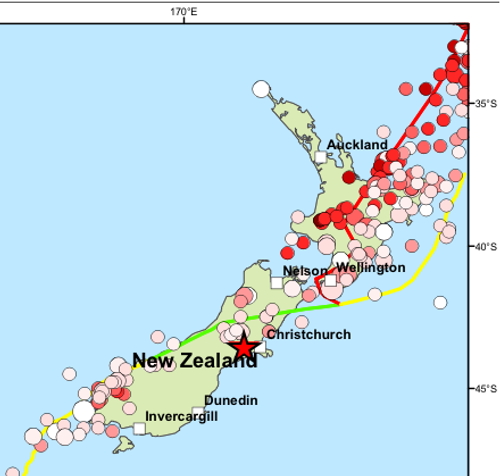
Whilst this map of large historic earthquakes in New Zealand shows that earthquakes of this magnitude can occur pretty much anywhere in New Zealand, seismicity in this particular area has some particular hazards; it is close to a heavily populated region (Christchurch) built mainly on unconsolidated Quaternary sediments, which will intensify the potential shaking and damage to unreinforced buildings. Fortunately, whilst this earthquake appears to have caused a fair amount of damage, from the early reports casualties seem to be light.

Update: 4/9/10 Here’s a couple more plots to that help to further put this earthquake in context. Via GeoNet, here’s a plot of all the earthquakes in New Zealand over a ten year period, including magnitude 3 and 4 tremors that only really disturb seismometers. This gives us a much more complete picture of how the crust in New Zealand is deforming, and shows us that yesterdays earthquake occurs towards the edge of, but still within, a zone of distributed plate boundary deformation on the northeast South Island.

The historical seismicity map from the USGS shows that in the last couple of decades there were a couple of earthquakes with very similar strike-slip focal mechanisms a bit further to the north-west, closer to the actual plate boundary, with magnitudes of around 6-6.5.

>M 5 earthquakes on the South Island since 1990. Source: USGS

Some other useful links:

Update: 5/9/10 More useful links:

Update: 6/9/10

  • New Zealand geologists have been doing a sterling job of getting good information out to the public. In this press release from New Zealand’s Science Media Centre, Professor Euan Smith of Victoria University in Wellington has done a great job of describing the quake (he thinks that we’re looking at sequential ruptures of the same fault) and the seismic hazard going forward.
  • The British Geological survey have put out a bulletin (pdf) that includes a plot of every >M 6 earthquake since 1843 – which must be pretty much the entire historical record.

    Magnitude 6+ earthquakes in New Zealand since 1843. Source: BGS

    The most striking feature of this map is the section of the Alpine fault in the central South Island that has not ruptured in the last couple of centuries – which suggests there might be a fair amount of strain belt up waiting to be released.

  • There is a Christchurch earthquake group on flickr, with a good collection of earthquake damage photos.
  • For those interested in learning more about liquefaction, this (pre-quake) poster from Environment Canterbury (pdf) gives both general background and a hazard map for the whole region – it would be interesting to see how it matches up to the reality.


Update: 8/9/10

  • New Zealand’s GNS have posted a video of their survey of the fault surface rupture on their YouTube channel.

  • GNS have also been calculating the focal mechanisms for all of the past weeks’ aftershocks. The pattern of strike-slip to the east of the main shock and compression to the west is quite interesting. Thanks to commenter Lanthanide for the link.
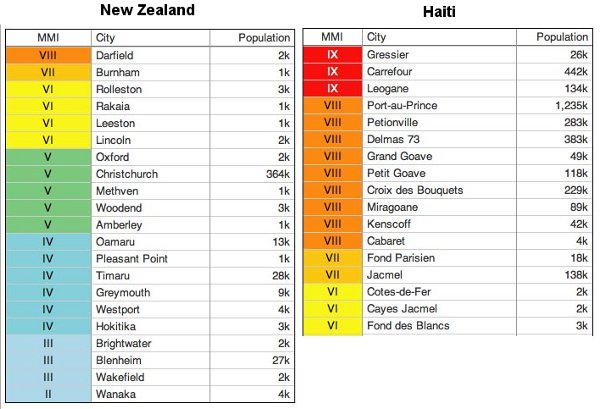
  • Many people, myself included, have contrasted the Canterbury earthquake with the Haiti earthquake as an illustration of how poverty, and the consequent lack of building standards or preparedness, contributed to large differences in the damage and casualties. This is certainly an important point, but via Andy Revkin on Dot Earth, a comparison of the shaking intensity and population exposure for these two earthquakes should caution us about pushing the comparison too far. [Update: As is discussed in the comments, this USGS chart seems to underestimated the intensities in New Zealand: Christchurch, for example, is more like a VI-VII than a V. Nonetheless, the point still stands.]

    Comparison of shaking intensity and population exposure for Canterbury and Haiti earthquakes. Source: USGS, via Dot Earth

Categories: earthquakes, focal mechanisms, geohazards, tectonics