Geomorphologists increasingly recognize that the way water is delivered to and moves through a hillslope, river, or landscape affects surficial processes and geomorphic form. Hydrogeologists recognize that geomorphology drives the spatial and temporal distribution of shallow groundwater. But both groups have sometimes seemed to lack the vocabulary and interdisciplinary tools to facilitate making advances truly at the intersection of geomorphology and hydrogeomorphology. The goal of the session I convened yesterday at the Geological Society of America meeting was to highlight studies of hydrologic-geomorphic linkages relevant to a variety of surface processes at timescales ranging from instantaneous (e.g., landslide initiation) to millions of years (e.g., fluvial landscape dissection).
Hydrogeomorphology has been defined as “an interdisciplinary science that focuses on the interaction and linkage of hydrologic processes with landforms or earth materials and the interaction of geomorphic processes with surface and subsurface water in temporal and spatial dimensions (Sidle and Onda, 2004).” The term hydrogeomorphology has not been widely adopted by American geoscientists, although work at the intersection of hydrology and geomorphology is increasingly common and useful for identifying hazards and understanding the impacts of land use and climatic change. Japanese geologists have published a number of outstanding works examining the role of surface and subsurface flow regimes and flowpaths on fluvial erosion and mass wasting, and ecologists have found the concept of hydrogeomorphology useful to describe the linked water and geomorphic conditions that define habitats in wetlands, rivers, and other environments. My co-conveners and I wanted to bring the concept of hydrogeomorphology to the forefront of the American geological community, or at least to fill a day or two with fascinating talks and see who identified their research as fitting within the scope of hydrogeomorphologic processes.
In the paragraphs that follow, I’ve attempted to give you a snapshot of the talks in our session so that you can have a taste of the scope of research that was covered in our session and some of the key themes that emerged in multiple talks.
We started our session on the steep mountainsides of Japan, with an invited talk by Roy Sidle who has worked on landslides and debris flows around the world and collaborated extensively with Japanese researchers who have contributed so much to hydrogeomorphology. Roy did a fantastic job of setting up the idea of connectivity between processes and events, a theme which we heard repeatedly over the afternoon. In Roy’s case, he was looking at whether landslides stopped on the hillslope, reached the channel, or continued downstream as debris flows and whether debris flows occurred during the same hydrologic event that triggered the landslides which supplied the sediment.
Alan Mayo gave us a tour of two intriguing sandstone landscapes where fractures have englarged into ravines deep and wide enough to carry a river, but in which no surface water occurs and whose drainage areas are too small to support one. He previewed the work that he and collaborators are doing to examine the chemical weathering processes (driven by subsurface flow) that may explain these unique landscapes and give us insight into the inception of fracture-controlled river drainages.
Eleanor Griffin of the USGS showed us how the position of an arroyo channel within the valley bottom and the orientation of the thalweg relative to valley gradient (e.g., in meanders) controlled the dynamics of erosion during an extreme flood.
Tom Lisle of the USFS showed lovely field and flume results from a pair of California rivers that have gone through multiple cycles of aggradation and incision. With these rivers he showed us that the relationship between sediment transport capacity and sediment storage was full of hysteresis loops, whose intensity are controlled by channel morphology and armoring.
Mark Lord brought us explicitly back to theme of connectivity by showcasing work in the Great Basin and South Africa and how discontinuities (like wetlands) or artificial connections (like drainage ditches) can alter the hydrology and geomorphology downstream. For example, he showed how the temporal and spatial variability of stream channel connections throughout the watershed affect downstream channel morphology and sediment flux.
Our next invited speaker was Robb Jacobson of the USGS who did a really great job integrating hydrological time series with geomorphic processes and how analysis of those together can be used to determine habitat availability and ecological success. He showed examples from the Missouri River and gravel bed streams in the Ozarks.
After a break, we switched time scales to thinking about the role of hydrology in driving landscape evolution. Our third invited speaker was Jeff Niemann who showed us some really clever results from landscape evolution modeling on how the popular “geomorphically effective event” was no substitute for a whole range of storm sizes, in part because this event was different for hillslopes and river channels. He also showed us how limited storm sizes can drive local incision in otherwise depositional parts of the landscape.
Stephanie Day showed us preliminary results of her master’s research using a laboratory flume to look at the influence of hydrograph shape on the evolution of a channel network subjected to a single base level drop. The natural analogue for her research are tributaries to the Minnesota River basin, in which the mainstem was significantly incised by glacial melt floodwaters from Lake Agassiz, leaving the tributaries hanging.
Miguel Castillo took us to the Scottish Hebrides island of Jura where isostatic rebound since the last glacial maximum has resulted in retreating knickpoints and where he is using cosmogenic isotopes to look at the erosion rates of bedrock rivers above and below the knicks.
Philip Prince told an engaging tale of stream capture on the Blue Ridge plateau – a place not normally thought of as a dynamic, transient landscape – but where stream profiles, the provenance of relict gravels, and fish assemblages suggest that the Roanoke River which drains to the Atlantic Coast has been busy (over millions of years) stealing watershed area from the New River, which drains into the Ohio-Mississippi system.
Robin Mattheus kept us on the Atlantic coast but told us about three very different modes of formation for estuaries in North Carolina. His question was “How do you get an estuary (drowned river valley), if there’s no watershed area upstream?” It turns out that you can get one by headwater gullying or knickpoint retreat from a confluence during sea level lowstands.
Christopher Esposito kept us on the coast, but brought our time scale back to the short-term present, by chronicling the deposition on a distributary mouth bar on the Mississippi River delta over the course of a single flood in April of this year. In some places he measured more than 3 cm of accumulation from suspended sediment deposition associated with a single event.
Finally, we had the privilige of hosting the award lecture by Vic Baker, the Quaternary Geology and Geomorphology Distinguished Career Award winner for 2010. Vic began his career with the Missoula Floods and has only gone on to bigger and better things since then, shaping the field of paleohydrology and giving rise to the terms “paleofloods” and “megafloods.” Vic truly embodies one aspect of hydrogeomorphology as much of his research has been about the causes and consequences of monster floods that dramatically shape their landscapes. Rather than try to recount the lecture, I think I’ll just repeat one of his many quotable moments of the lecture: “From the flood’s point of view, [it is]…getting a bad rap, because people are doing all the stupid stuff.”
And that, my friends, is the nutshell version of what hydrogeomorphology is all about. Pretty cool, eh?

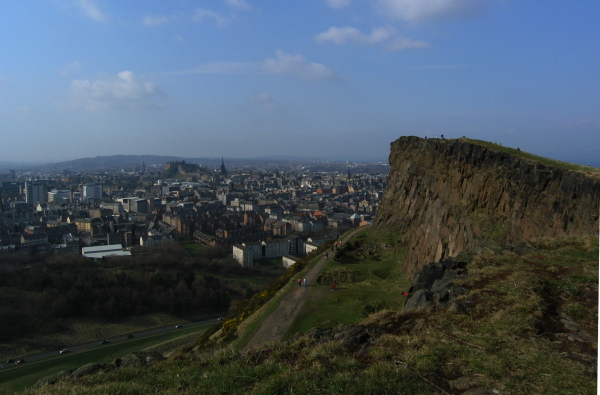
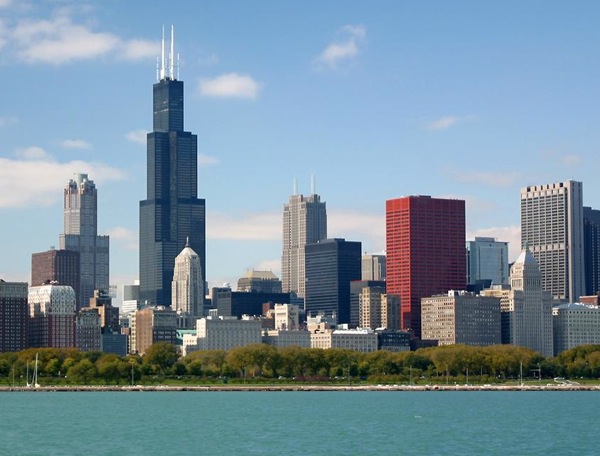
 You may have noticed that I’ve been a bit quiet on the blogging front in recent weeks. The fact is, I’ve been a little busy in the real world. The funding for my project in Edinburgh ended at the end of October, so I’ve been rather busy in the lab trying to get all of my samples from Oman properly measured. I’ve also been preparing for the fact that this weekend, I am moving from here: