The flat of the land

A post by Chris RowanIt turns out that, by US standards at least, I’m quite close to the Driftless Area that Anne posted about earlier this week. But unlike that corner of Minnesota, Illinois is whatever the opposite of ‘driftless’ is: it was covered by ice 20,000 years ago, and was blanketed with a thick layer of sediment released from that ice as it melted over the next 10,000 years or so. Because sediment tends to fill in all the low bits of the landscape first, the end result of this inundation is unlikely to inspire people to break out their rock climbing gear (there is, of course, some topography in the form of the Great Lakes, which have been filled in by water rather than sediment).
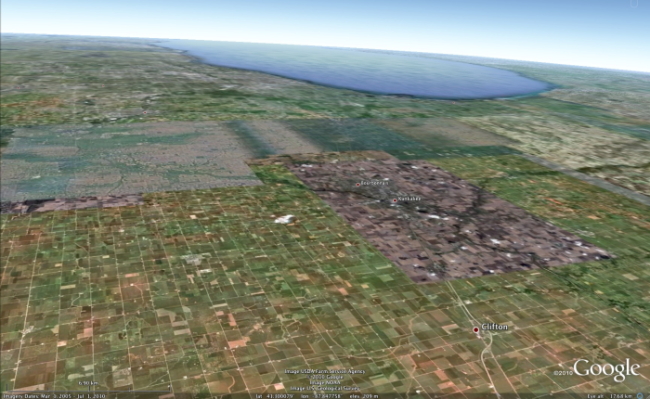
Illinois, looking NE towards Lake Michigan and Chicago.

This is hardly the first time that I’ve found myself living in an area with a distinct lack of inspiring topography. For the first 21 years of my life, I lived in East Anglia, a region of the UK whose maps are well known for marking hills scarcely worthy of the name.
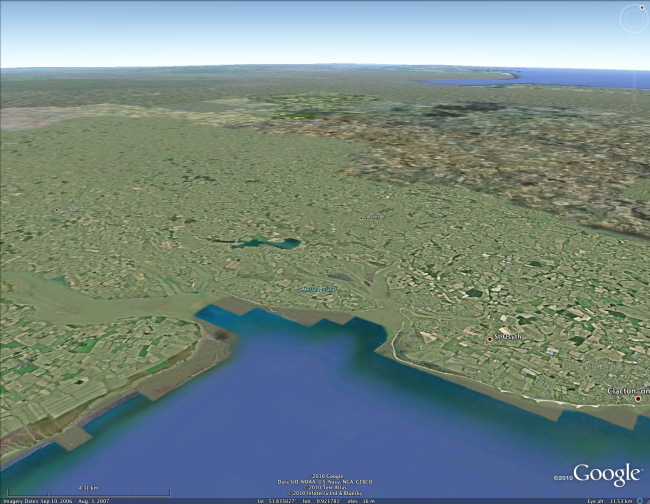
Northern Essex and Suffolk, looking NW.

East Anglia is flat for the same reason Illinois is flat – it is covered in gravels, sands, and muds laid down by melting ice sheets – although in Southern England most of this drift was deposited a few glacial cycles before the last one.

I studied for my PhD in Southampton, on the south coast of England. Hampshire is not quite as flat as East Anglia, but it’s still only mildly hilly.
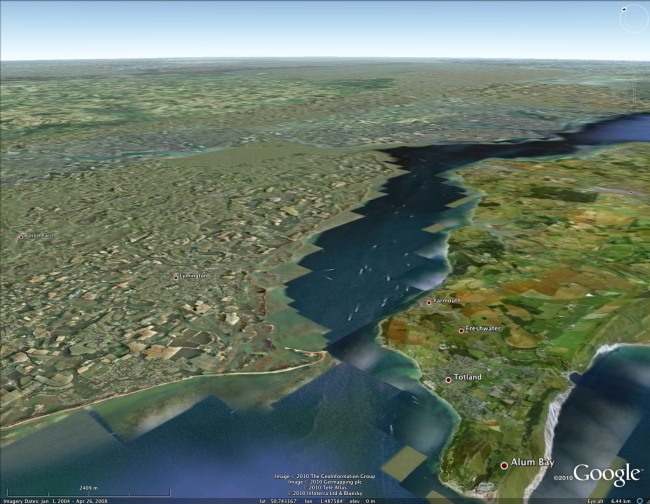
Southampton, the Solent and the Isle of Wight (right). Looking ENE.

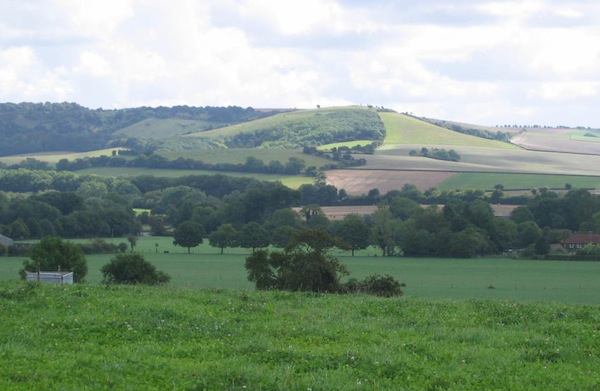
However, the flatness here is nothing to do with glacial deposits; bedrock is at or close to the surface over much of the region. However, that bedrock is mainly chalk, with some clays. With these weak and crumbly rocks underfoot, you’re never going to get topography more dramatic than the rolling hills of the Downs.
After Southampton, I moved a bit further afield, to Johannesburg. The quartzite ridges of the gold-bearing Witwatersrand Formation aside, the amount of relief is surprisingly low when you consider you’re at an altitude of 1750 m, and situated mostly on hard, old granites, volcanics, and sandstones. But these hard, old rocks have sat there for hundreds of millions of years, having most of their rough topographic edges smoothed off by hundreds of million years of erosion (the high elevation is a more recent development, a result of hot upwelling mantle beneath the African continent). The flatness here is not due to recent sedimentation, or lithology, but time.
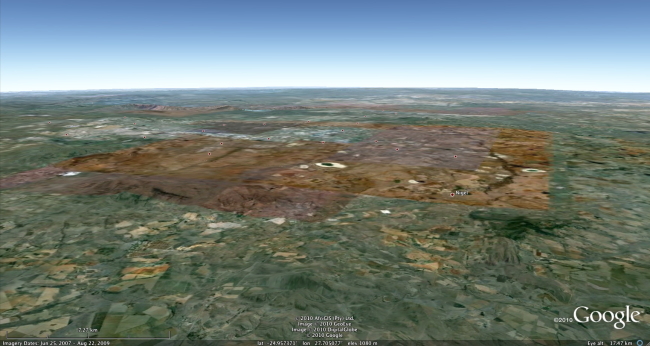
Johannesburg, looking NW.

Geologists like mountains. I’ve often grumbled about how, with the honourable exception of Edinburgh, I’ve often ended up living a long way away from any peaks; and, by implication, the cool geology. It’s not true, of course. But I haven’t really considered before how just as there are many ways that a landscape can end up being pointy, there are several ways that it can end up being flat.

Categories: geology, geomorphology

The Driftless Area: Fewer glaciers but more topography than the rest of Minnesota

A post by Anne JeffersonTucked into the corner where Minnesota, Wisconsin, and Iowa meet there’s a special area with a Quaternary history that sets it apart from the rest of the northern United States.

At the Last Glacial Maximum, the Des Moines lobe lay to the west of this area and the Green Bay lobe lay to the east. But in this area, the land surface was not covered with ice. For this reason, extreme southeastern Minnesota, northeastern Iowa and western Wisconsin together are known as the Driftless Area, because drift is an old name for till, and where there were no glaciers, no till could be deposited.

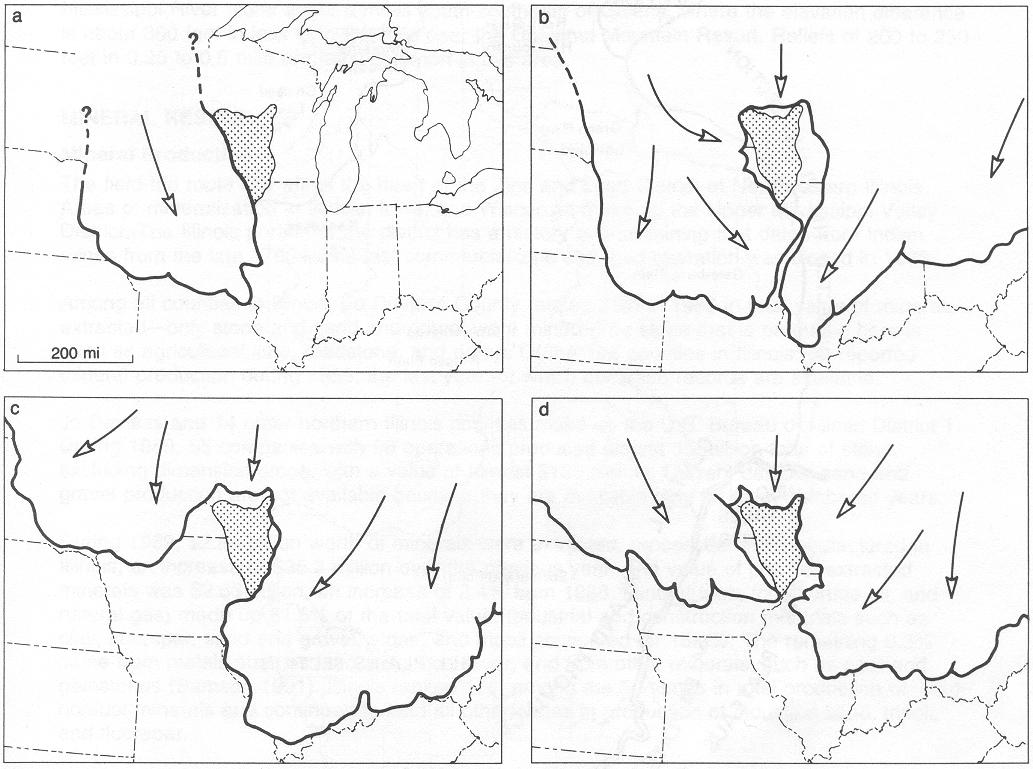
Even before the last glacial period, the Driftless Area seems to have uniquely escaped the terrain smoothing, till depositing influences of the ice sheets. (Play with this animation to watch southeastern Minnesota avoid glacial advance after glacial advance.) The map below shows the maximum extent of glaciers at (a) 1 million years ago, (b) ~600,000 years ago, (c) ~250,000 years ago (the Illinoian glaciation) and (d) ~22,000 years ago (Wisconsinan glaciation). In all of those reconstructions, there’s a stippled doughnut hole that defines the Driftless Area.

Glacial advances relative to the formation of the Driftless Area (Reinertsen, 1992*)

Glacial advances relative to the formation of the Driftless Area (Reinertsen, 1992*)

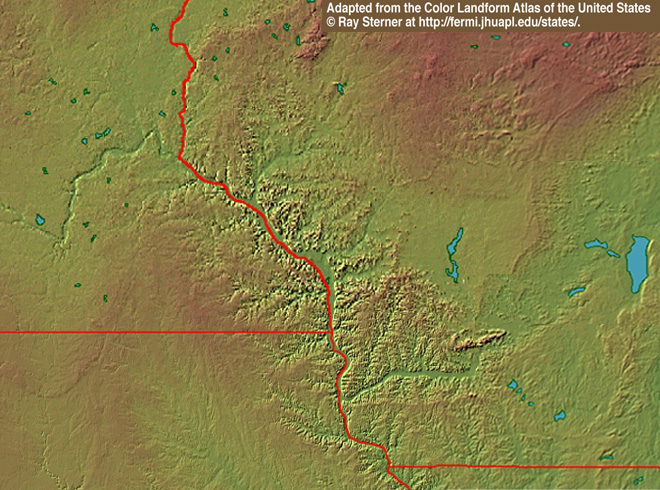
While in most parts of the Upper Midwest, the Paleozoic stratigraphy is buried under glacial deposits, millions of years of uninterrupted erosion have spectacularly dissected the landscape of the Driftless Area, creating 150+ m bluffs and narrow valleys. This dissected landscape stands out in sharp contrast to the flatter glaciated areas which surround it, as shown in the image below.

Topography of the Driftless Area and surrounding regions

Topography of the Driftless Area and surrounding regions

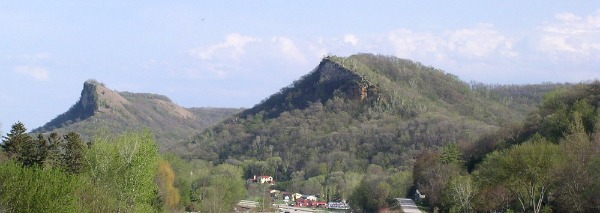
On the ground, the topography is even more dramatic, particularly along the Mississippi River valley. In the image below, two hillsides part of Great River Bluffs State Park in Minnesota show the steepness of relief that can be found in the area.

Hillsides of the Driftless Area (image by McGheiver on Wikimedia)

Hillsides of the Driftless Area (image by McGheiver on Wikimedia)

Growing up in this region, I always wondered why people said the Midwest was flat!


*If anyone can help me track down the full citation of this article, I’d be most appreciative. I borrowed the image from here.

Categories: by Anne, geomorphology, outcrops, Pleistocene

Stuff we linked to on Twitter last week

A post by Chris RowanA post by Anne Jefferson

Blogs in motion

Volcanoes

(Paleo)climate

Planets

Water

Environmental

General Geology

Interesting Miscellaney

Categories: links

Thankfulness

A post by Chris RowanThanksgiving holds an odd place in my mind. Like anyone exposed to modern culture, with its strong twist of Americana, I am aware of the holiday’s existence and many of its associated trappings. And yet I have never really paid much attention to it as an event. Of course, now that I have established myself on the western side of the Atlantic, there’s no chance of that this year.

Despite the somewhat contentious historical roots of Thanksgiving, I do quite like the concept of taking a moment to navel-gaze about the better aspects of one’s life. We’re fairly melodramatic as a species, which means that we often end up paying more attention to the bad things in our imperfect world. But ‘imperfect’ does not mean ‘thoroughly horrible’*, and making sure that there’s at least one day in the year where tradition forces us to balance out our whinging tendencies seems like a good idea to me.

Of course to fully embrace Thanksgiving, I myself need to list all of the things that I should be thankful for. Well, technically, I suppose I should also be stuffing my face with as much roast turkey as I can, watching some deviant approximation of rugby on the TV, and getting in an epic family argument. But I can start with the list.

  • Despite some equipment arrival and functionality issues, my last post-doc appears to have produced some publishable data. It might even be interesting.
  • It’s still early days on the new post-doc, but I believe I’m really going to enjoy my time here in Chicago. I’m getting a good vibe from both the place and the project.
  • Having jumped through all the requisite bureaucratic hoops required of me both before and after arrival in the US, it should be several months before I have to wait for hours in some joyless concrete monstrosity to get a form stamped.
  • I get to go to AGU this year. There will be beer, and geoblogger/tweeter meet-ups. And more beer. And interesting conversations with friends and colleagues. And yet more beer. And interesting science. Did I mention the beer?
  • I live on a planet where plate tectonics creates lots of interesting geology, that I can spend my life puzzling out.

So it seems that I do have a lot to be thankful for. In fact, 2010 has been pretty awesome in ways that I would never have thought possible this time last year – and 2011 looks like it’s going to be even better. And it is a good feeling to acknowledge that. Fear not, though. I’m not going to let sunny American optimism overwhelm my British cynicism too much – which you may or may not be thankful for…

Right. Now where’s the turkey?

*Calvinists may beg to differ.

Categories: Uncategorized

Stuff we linked to on Twitter last fortnight

A post by Chris RowanA post by Anne JeffersonBusy real lives and low Twitter activity led us to forgo last weeks link-fest, which means this week you’re all being treated to two weeks’ worth of interesting stuff which caught our eyes. But first…

DonorsChoose Update

We’ve finished out the month-long Science Bloggers for Students challenge and Highly Allochthonous readers generously contributed $1674. If you gave to our challenge or any of the Science Bloggers for Students challenges, you should have received an email from DonorsChoose with a $75 gift card from HP to put toward the project of your choice. Don’t let those dollars go unused, there are lots of great projects that still need our help. Thanks to everyone who participated by setting up their own challenge, donating to ours, or just spreading the word. We appreciate your help, but the students with new sets of rocks, books, GPS units, and other scientific tools appreciate your help even more. You’ve made a real difference in their lives. Thank you so much.

And now, on with the linking:

Volcanoes

Earthquakes

Fossils

Water

(Paleo)Climate

Environmental

Planets

General Geology

Careers and Diversity in Science

Interesting Miscellaney

Categories: Uncategorized