Stuff we linked to on Twitter last week

A post by Anne JeffersonChris has been on Twitter holiday this week, so you’ll be treated only to Anne’s Twitter obsessions in this week’s linkfest.

Volcanoes

Fossils

(Paleo)climate

Water

Environmental

General Geology

Interesting Miscellaney

Categories: by Anne

Stuff we linked to on Twitter last week

A post by Chris RowanA post by Anne Jefferson

Earthquakes

The big earthquake news this week has obviously been the magnitude 6.3 earthquake that hit Christchurch. For those interested, Chris has been adding links to the latest information, images and videos to his initial post on the quake. But he would also like to highlight this BBC article on the aftermath of the magnitude 8.8 earthquake that shook Chile a year ago today, which illustrates how the road to recovery following a major quake – both physical and psychological – is a long and hard one. And, as a former Pacific Northwest resident, Anne was fascinated by the parallels between the Christchurch earthquake and the little appreciated seismic hazards in Portland, Seattle, and Corvallis, which are discussed in this Oregonian article.

Volcanoes

  • Erik Klemetti highlights the latest media volcanic reporting fail: a study on how volcanic tremor may predict eruptions becomes ‘Mt. Baker is overdue!’ Sigh, indeed.
    http://bigthink.com/ideas/31357

Fossils

(Paleo)climate

Water

Environmental

Planets

General Geology

Interesting Miscellaney

Note: Anne is on a mission to finish a manuscript in the next two weeks. Her twitter presence may be light until the paper is off her desk.

Categories: links

Aftershocks, triggered earthquakes, and Christchurch’s seismic future

A post by Chris RowanAs more scientific information becomes available regarding last week’s magnitude 6.3 earthquake in Christchurch, we can look a bit more closely at the nature of this earthquake, how it fits into the overall tectonic picture in New Zealand, and future seismic risks in the region.

Aftershock, or triggered earthquake?

There seems to have been a bit of ambiguity in discussions about the nature of this week’s earthquake: was it an aftershock of September’s earthquake? Was it a separate earthquake that was possibly triggered by September’s earthquake? What’s the difference, anyway?

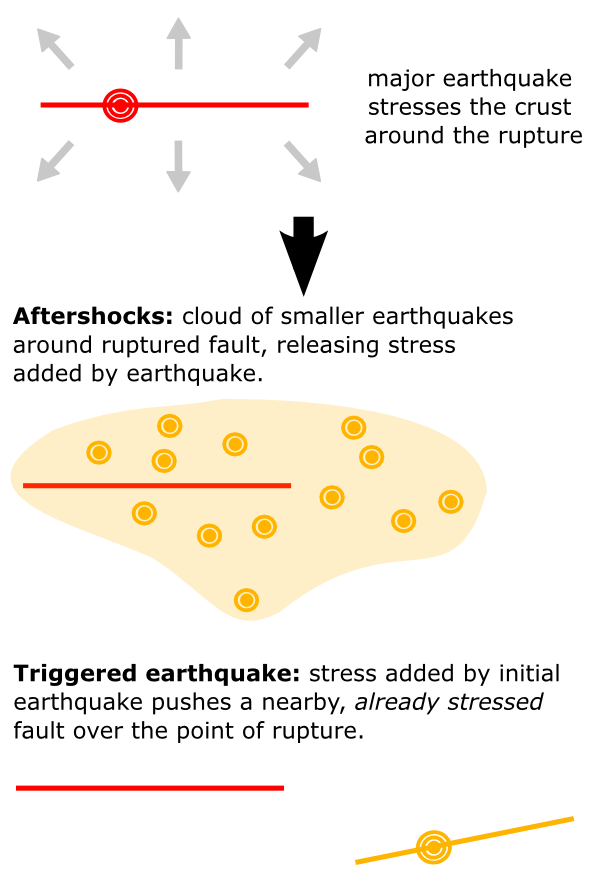
When any fault ruptures in an earthquake, movement along the fault plane itself also stresses and deforms the the surrounding crust. These stress changes can often induce further smaller earthquakes – aftershocks – that take the form of a cloud of tremors that encompasses the initial rupture. In other words, aftershocks are mainly caused by the stress added to the crust by the initial earthquake. However, very few faults are found in glorious isolation within the crust. More often that not, other faults, that may have themselves accumulated a large amount of tectonic stress over the previous decades and centuries, will be found nearby. In such cases, the stress change due to the first rupture may be large enough to push these nearby faults over the edge, resulting in a triggered earthquake. The difference between this and an aftershock is that the stress added by the first earthquake is only a small component of the stress released when the second fault fails – most of it was already present, and the fault would have ruptured at some point in the future anyway.

The difference between aftershocks and triggered earthquakes

The difference between aftershocks and triggered earthquakes.

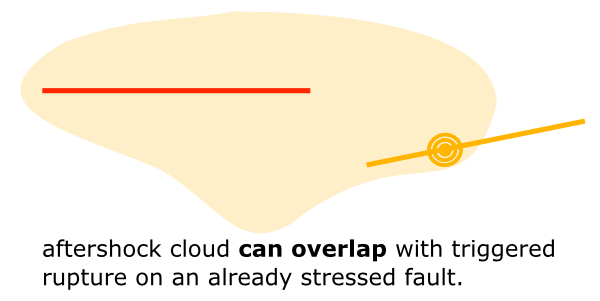
Where things get complicated is in regions where major faults are quite close to each other – perhaps segments of a large fault boundary fault, or different strands of the same fault system – so that the cloud of aftershocks from a large earthquake on one fault overlaps with the trace of another fault that hasn’t ruptured yet. If that second fault then does rupture, what do we call that? It’s in the same region as all the other aftershocks; but most of the stress being released was not a result of the first earthquake – it was already there on the fault, and the additional loading was just the straw that broke the camel’s back.

When aftershocks and triggered ruptures overlap

When major faults are closely spaced, things can get complicated.

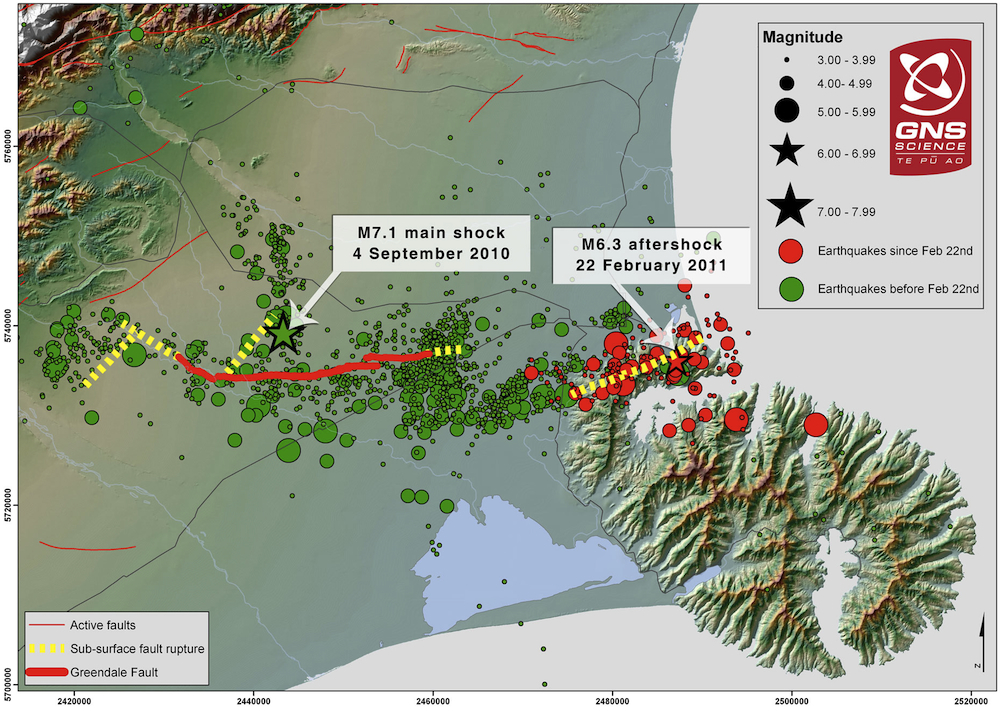
This weeks’ events in New Zealand seem to fall into this ‘it’s complicated’ category. Last September’s Darfield earthquake was centred 40 km to the west of Christchurch, but the epicentres of the aftershocks in the months that followed gradually migrated east towards the city. The map below (courtesy of Geonet) shows that these smaller aftershocks – the green circles – do encompass the area containing the fault which ruptured on Tuesday. So it could – technically – be described as an aftershock. However, for reasons that I discuss below, it seems probable (to me, anyway) that this fault is releasing tectonic stress built up over geological timescales – centuries or more – which would also make this a triggered earthquake. If that is the case, simply referring to it as an aftershock obscures its wider tectonic significance.

Christchurch Earthquake Sequence

All earthquakes in the Christchurch region since September 2010. Earthquakes since 22 Feb 2011 in red. Click to enlarge. Source: Geonet.

The big tectonic picture

And what is that wider tectonic significance? In my discussion of last September’s magnitude 7 earthquake, I wrote the following:

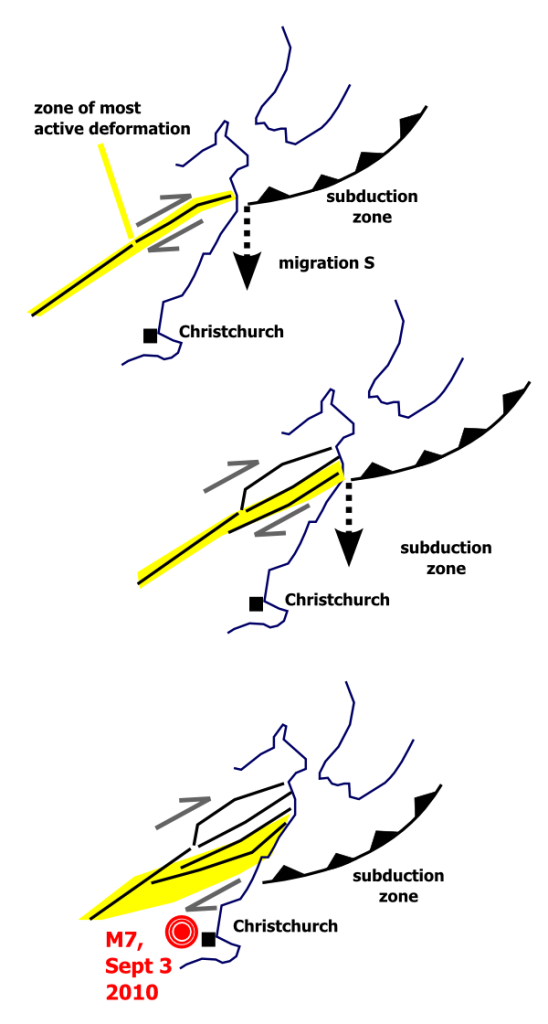
…the occurrence of such earthquakes in this particular region of the South Island is probably also linked to ongoing changes in the nature of the plate boundary at the junction between the subduction zone [off the East Coast of the North Island and the continental transform [The Alpine and Marlborough Faults]. If you look at the displacement history of the individual faults in the Marlborough Fault zone, the northern faults are older, were more active in the geological past, and have quite small recent (in the geological sense of ‘the last few 100,000 years’) displacements; the southern faults are younger, and have much larger recent displacements. The most obvious explanation for these changes is that the most northern of the Marlborough faults was originally directly linked with the end of the subduction zone, but that these two structures moved out of alignment as the subduction zone moved south, causing new strands of the Marlborough Fault system to grow in order to more efficiently accommodate plate motions.

This tectonic evolution is ongoing, and since the end of the subduction zone is now actually to the south of the southernmost and youngest of the Marlborough faults. Some of the plate boundary deformation is probably therefore being shunted into the region around Christchurch, where it needs to be accommodated by dextral strike-slip faulting. Eventually, over geological time, this deformation will lead to the formation of a new, more southerly strand of the Marlborough Fault system.

Growth of new plate boundary faults on the South Island of New Zealand in response to southward propagation of the subduction zone

Looking at the traces of the Darfield Fault, and the fault that ruptured this week, mapped out the Geonet aftershock plot above, it looks to me like two strands of the same, mainly strike-slip, fault system, which is exactly what you would expect for the early stages of a new branch of the Marlborough Fault. Over geological time, then, you would expect to see these faults developing into a much more prominent part of the plate boundary zone. But that’s over the next couple of million years. What about the next few decades?

The future seismic risks for Christchurch

People in Christchurch are unsurprisingly feeling a little overwhelmed by the recent seismic chaos, and fearful for the future. Now that New Zealand geologists have been made aware of the active faults running across the Canterbury Plains, they will be racing to study them and their past behaviour, in order to assess how much risk they pose to Christchurch in the decades and centuries ahead. But the very fact that these faults were unknown actually provides us with some information about them – namely, that although they are active, they have not been particularly active in the recent past. Earthquake-generating faults are identified from the historical record – quite short in the case of New Zealand – and looking for features of the landscape that indicate fault motion, such as scarps and uplifted terraces. The fact that these faults don’t seem to have generated such features, and have instead managed to be totally buried beneath the river-borne debris coming off the uplifted Southern Alps to the west, tells us that these faults do not rupture particularly frequently; if they were, the Canterbury Plains would not be so flat.

The Canterbury Plains

Not a particularly tectonically shaped landscape (mountains not included, obviously)

This makes sense: we know how much motion occurs across the plate boundary that bisects New Zealand, and we know that the motion on the main boundary faults of the South Island – the Alpine and Marlborough Faults – accounts for around 80% of that motion. The remainder is probably distributed across many faults on the South Island, not just the ones near Christchurch, which means that they need much longer to build up enough stress to rupture in an earthquake – probably the high hundreds, or low thousands of years. It would be unwise to relax before some detailed geological work is done, of course, but I suspect that these particular faults have done all the damage that they are going to do to Christchurch for the foreseeable future.

Categories: earthquakes, geohazards, society, tectonics

Shaking in Christchurch boosted by seismic lensing?

A post by Chris RowanEven taking into account how close the rupture point of Tuesday’s earthquake was to Christchurch, the intensity of the shaking – and the amount of damage that the city suffered as a consequence – seems to be very high for a magnitude 6.3 earthquake. The fact that the city is built on soft sediments that amplify shaking is an obvious factor here, but an article in the New Zealand Herald raises the possibility that geological structures in the region may have acted as a ‘seismic lens’, focussing the seismic energy released in the earthquake towards Christchurch.

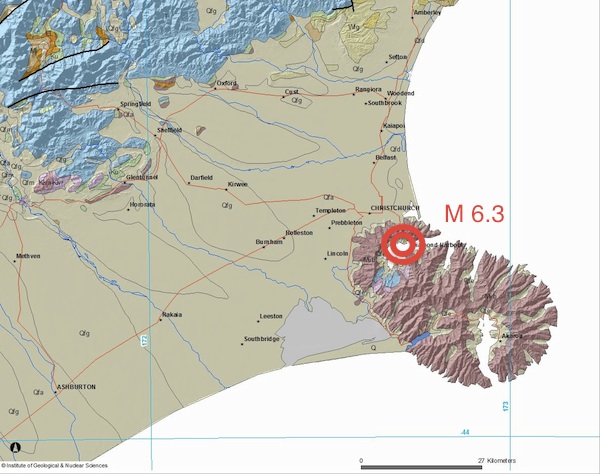
If we plot the earthquake’s epicentre on a geological map of the central South Island of New Zealand (courtesy of this handy interactive map from GNS), we can see it is close to the edge of the Banks Peninsula – the eroded remnants of two basaltic shield volcanoes that were active around 10 million years ago.

Location of Feb 22 earthquake plotted on a geological map of the Christchurch region, showing the Miocene volcanics of the Banks Peninsula (pink) rising above the young clays, silts and gravels of the Canterbury Plains (tan). Source: GNS

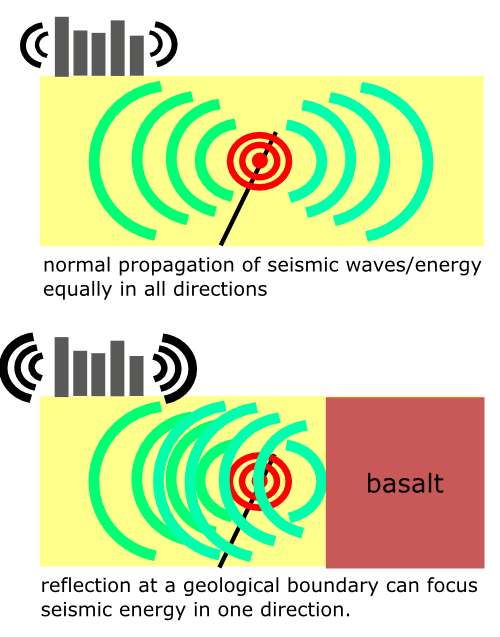
The hard volcanic rocks that make up the Banks Peninsula are very different from the soft sediments that underlie Christchurch. The huge contrast in physical properties across the boundary between these two units means that any seismic waves hitting the boundary would mostly be reflected back the way they came. So, instead of spreading out equally in all directions, a large proportion of the seismic energy released in a nearby earthquake would end up being sent away from the boundary with the basalts – which, unfortunately, is towards Christchurch.

How seismic lensing might concentrate seismic energy and boost shaking intensity.

As it stands, this idea is rather speculative – more work will be required to pin down the location of the fault before it can be proven one way or the other. But if seismic lensing was a factor in the very intense shaking Christchurch endured, the location of this week’s earthquake – in an ideal position to produce this effect – was doubly unfortunate.

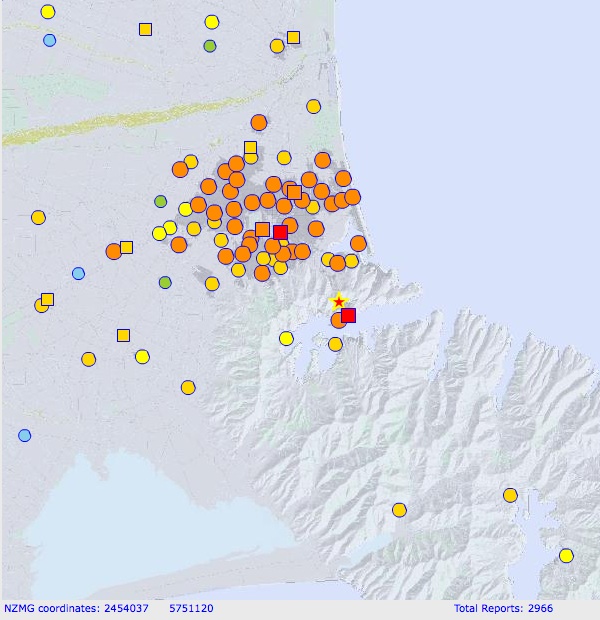
Update Callan requested a shakemap that includes the Banks Peninsula. This is from GNS’ Geonet site, and included felt earthquake reports (circles) and instrumental peak ground accelerations (squares). As you can see, there is not much useful coverage on the Banks Peninsula, and although what is there could be interpreted as showing less shaking at an equivalent distance from the epicentre, this does not account for the effects of being on hard rock (basalt) rather than soft sediment, which will probably amplify the shaking even in the absence of other factors.

Shakemap for the Feb 22 earthquake (star)

Categories: earthquakes, geohazards, geophysics

The scientist-journalist divide: what can we learn from each other?

A post by Anne JeffersonResearchBlogging.orgLast week, the journal Nature published two research papers on the effects of human-caused global warming on extreme precipitation events. I’m working on a post on the papers, and they’ve already received quite a bit of attention in the media.

As glamour mag journals often do when they publish papers that they think are going to catch wide attention, the two articles in Nature were accompanied by feature stories designed to add explanation and context to the necessarily succinct and technical writing of the articles themselves. One of these features fell under the heading “News in Focus”, while the other was in the category “News and Views.” Here are the first lines of each of those features.

The varying distribution of fresh water across the globe, involving complex patterns of rainfall in space and time, crucially affects the ecosystems and infrastructure on which human societies depend.

Climate change may be hitting home.

Which of those stories do you suppose was written by an academic scientist and which was written by a science writer? No bonus points for being correct. I’m not going to call either sentence out as good or bad, because I think they both have strengths and weaknesses. Overall, both were very well written pieces. But their first sentences sure do strikingly exemplify the differences in the culture of written expression between research scientists and journalists.

Scientists can definitely learn a thing or two about communication from science journalists. I don’t want to transform my manuscripts into text that reads like journalism, because the two forms of writing serve very different purposes for very different audiences. But reading good science writing online and practicing my own writing here have immeasurably improved my consideration of word choices, sentence structure, the value of an engaging first paragraph (or lede), and sense of narrative arc. I think these skills are carrying over from blogging into my manuscript and grant writing, my interactions with graduate student writing, and even my teaching. Maybe I’ll start asking my students to read both primary papers and the accompanying feature stories, so that they might absorb some writing skills from their reading assignments. So my unsolicited advice to fellow scientists is: “If you want to write better, start by carefully reading good writing.”

But science journalists can learn some tricks from the scientists too. After I read the first article, I understood why extreme precipitation might increase as a result of a warming climate (warm air holds more moisture; additional moisture in the air makes dry places even drier). When I read the second article, that “why” explanation was completely missing. In both articles, I got an overview of what the studies did and what they found, and in the second article I learned about implications for the insurance industry, adding context. But I lost the “why.” And it’s the why that allows us to translate what we’ve learned in one situation or study into another. Given the physical basis (the why) for a study, an interested reader can conjecture that if extreme precipitation is increasing in the Northern Hemisphere, then it’s likely increasing in the Southern Hemisphere as well, and that droughts may becoming more severe in arid regions. (And eventually scientists can test those conjectures.) Without the why, a reader only knows what that the insurance industry is concerned about climate change. If I may be so bold as to give some advice to science journalists, it is this: Explain not just what the paper of the week found, but why the result was obtained. Use those fantastic writing skills to communicate the science behind the science.

If both scientists and journalists are concerned that Americans are ill-informed and apathetic about science, and climate science in particular, then it behooves both groups to change the way we communicate science. And maybe the place to start is to look to each other for advice.


For those who are interested in reading more about extreme precipitation and less about writing, the sentences above came from these two sources.

Allan RP (2011). Climate change: Human influence on rainfall. Nature, 470 (7334), 344-5 PMID: 21331034

Schiermeier Q (2011). Increased flood risk linked to global warming. Nature, 470 (7334) PMID: 21331014

Categories: by Anne, climate science, public science, ranting