Scenic Saturday: Sliced, diced and weathered

A post by Chris RowanFollowing on from Anne’s pretty photo last weekend, let’s nip over to southwest Spain to see a place where art meets tectonics:

Carboneras Fault Zone, SW Spain. Photo: Chris Rowan. Click to enlarge

We’re looking at a section throughout the Carboneras Fault zone. Africa and Spain are still very slowly colliding with each other, and although it’s very hard to draw a neat plate boundary in the collision zone, this fault and others in the region (including one that ruptured earlier this year) are accommodating this motion in a variety of ways. The Carboneras Fault is a left-lateral strike-slip fault that is cutting through a number of different units – metamorphic rocks that were formed and brought to the surface in a collision event, a range of younger sediments (mainly limestones and sandstones, deposited in the last 10 million years) deposited in small extensional basins, and some volcanic rocks of a similar age. One quite common feature of strike-slip motion is the formation of multiple parallel strands, or splays. In the area this photo was taken, as you walk along the valley that cuts through the fault zone, you are walking over several such splays, each containing slices of these very different rocks juxtaposed against each other. Because fault motion tends to grind things up, the exposed rocks weather quite easily, and because all the different units are so different lithologically, they also weather quite differently, producing a colourful striped appearance. The lack of vegetation in southern Spain (it’s practically a desert) enhances the effect rather nicely.

Carboneras Fault Zone, SW Spain. Photo: Chris Rowan. Click to enlarge

Some more details on the Carboneras Fault can be found at Paleoseismicity.
Categories: outcrops, photos

Scenic Saturday: Ropy pahoehoe on a biogenic beach

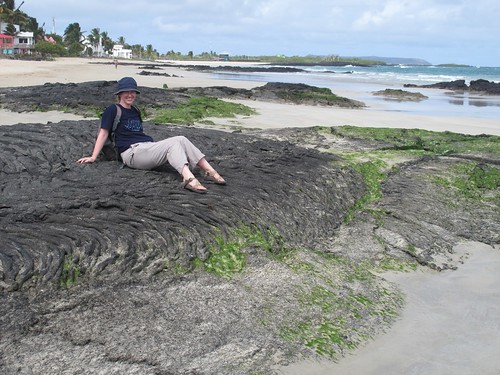
Anne on a ropy pahoehoe flow on the beach

Anne enjoying the scenery on Isabella Island, Galápagos, July 2011

In this inaugural Scenic Saturday post, I offer up very happy volcano/landscape nerd enjoying the stunning geologic scenery on Isabella, Galápagos Islands, July 2011. I was there as a participant in the Chapman Conference on the Galápagos as a Laboratory for the Earth Sciences. I may manage to blog in more detail about the islands and the conference, but for now enjoy the scenery, just as I did on my first few days in the archipelago.

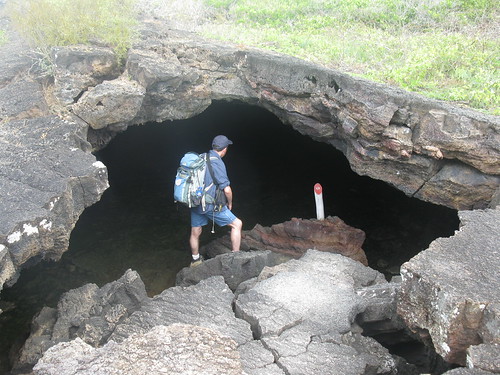
In the image above, I’ve got my back to the village of Villamil, on the southern flank of Sierra Negra volcano, and I’m actually sitting on some of the oldest exposed lavas from that volcano. You’re looking at the crust of a pahoehoe flow that is probably about 5000 to 9000 years old. A short distance up the beach, I could peek under the skin of the lava and walk a few meters into a lava tube. The floor of this lava tube was below sea level and covered by sea water, so this was really a chance to experience the water table in a very macro-pore.

Lava tube, geologist for scale

Lava tube, USGS scientist for scale. Isabella Island, Galápagos, July 2011

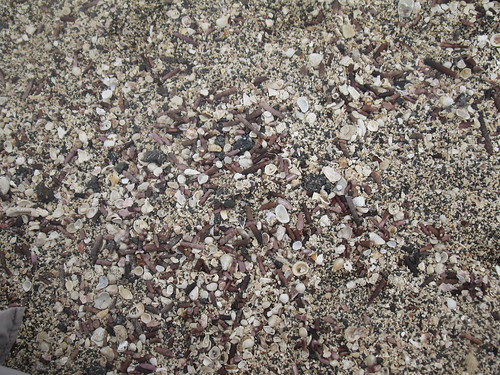
The lava along this stretch of seafront is largely covered by sand that is clearly not basaltic. Instead it is made of little bits of broken shells and sea urchins from the incredibly rich marine ecosystem that surrounds the islands.

Beach sediments

Beach close-up, near Villamil, Isabella Island, Galápagos, July 2011

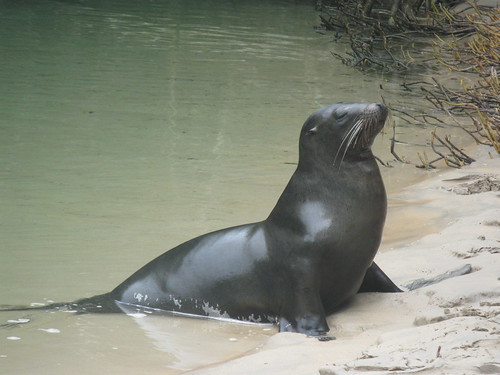
Elsewhere, the biogenic beach was covered by rather more living parts of the marine ecosystem. This sea lion put on a quite a performance for some appreciative visitors to a mangrove lagoon (and freshwater spring).

Isabella 105

Sea lion, sand, and mangrove roots, near Villamil, Isabella Island, Galápagos, July 2011

Categories: by Anne, geomorphology, hydrology, photos, volcanoes

Anne’s suspended summer

A post by Anne Jefferson

photo by A. Jefferson, May 2011

Travel safely, until we meet again.

It was always going to be a trick for me to feed the blog in the latter bit of the summer, as I’ve been planning almost 5 weeks of travel, much of it without internet access. A few days ago, though, an unfortunate event pushed the timetable forward a few weeks. My 4-year-old daughter had a playground accident that left her with a broken leg, which is encased in a cast from toes to thigh for a month or more. So, until at least September, I’ll be resisting the urge to blog and tweet, while I focus on the non-negotiable jobs of taking care of an immobile, injured child and keeping up with professional obligations.

Categories: by Anne

Flooding around the world (3 July edition)

A post by Anne JeffersonHere is a brief update on the floods I covered in the last edition of flooding around the world. Note that there has also been flooding in Xiengkoung, Viengtian, Boolikhamxay, and Xayaboury provinces of Laos, as a result of heavy rainfall from a tropical storm; in Russia’s Khabarovsk region (Kiya and Khor rivers), from heavy rainfall; and in the Philippines’ Davao city, from heavy rainfall.

China and the Yangtze River

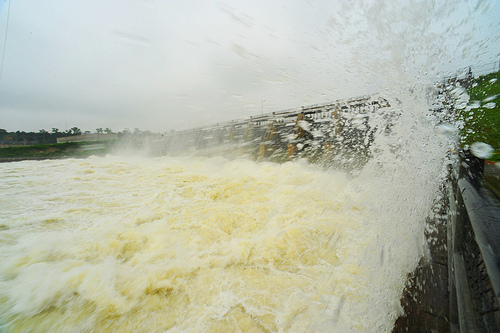
The U.S. Corps of Engineers increased the output of the Gavins Point Dam spillway to 150, 000 cubic feet per second June 14, 2011. The flow was increased to help regulate the Missouri River due to record snow and rain fall earlier this year. (SDNG photo by Master Sgt. Donald Matthews)

Flow from the Gavins Point Dam spillway was 150, 000 cubic feet per second on June 14, 2011. (SDNG photo by Master Sgt. Donald Matthews, image on Flickr)

Missouri River

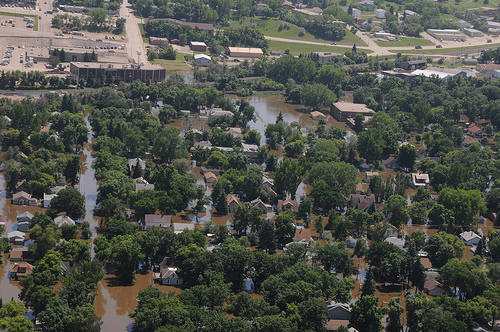
The Souris River, continues to flow over Minot, N.D. flood levees June 23, as the water begins to inundate residential neighborhoods. (DoD photo by Senior Master Sgt. David H. Lipp)

The Souris River, continues to flow over Minot, N.D. flood levees June 23, as the water begins to inundate residential neighborhoods. (DoD photo by Senior Master Sgt. David H. Lipp, image from Flickr)

Souris River

Categories: by Anne, geohazards, hydrology

Stuff we linked to on Twitter last week

A post by Chris RowanA post by Anne Jefferson

New Geoblog

Earthquakes

Volcanoes

(Paleo)climate

Water


(via @revkin)

Environmental

General Geology

Interesting Miscellaney

Categories: links