Where tsunamis and nuclear power could meet

A post by Chris RowanOut of all the devastation wrought by the Tohuku earthquake and tsunami in March 2011, the escalating disaster at the Fukushima nuclear plant has ended up having the biggest global impact. A catastrophic loss of cooling led to meltdowns, explosions and a release of radioactive material into the atmosphere – and seems to have slammed the brakes on a nuclear industry that had been pretty bullish about its role in weaning us off of our fossil fuel addiction, as safety concerns have once more come to the fore.

Japan, which prior to Fukushima generated almost a third of its electricity at nuclear power stations, is reconsidering its generation mix: the government recently announced that it plans to shut down all 50 of its presently operating reactors (many of which have already been shut down in the months following Fukushima for safety checks), although this commitment seems to be somewhat at odds with a commitment to go ahead with constructing new, already-approved nuclear plants. In the wake of an incident which elevates safety concerns above the perceived benefits of greater energy independence and lower carbon emissions that nuclear power promises, it’s easy to grasp the reasoning behind this; especially in the light of the parliamentary investigation that uncovered a disturbing degree of collusion between the TEPCO power company and the Japanese government to water down or circumvent earthquake safety measures.

It has been more puzzling to see the responses from Germany, who last summer decided to phase out all of it’s nuclear power plants by 2022, and France, who this summer elected a new government that has promised to slash the proportion of nuclear in their generation mix by a third, from 75% to 50%. Although some public concern is unsurprising, the fact remains that a Fukushima-type incident requires a nuclear plant built on the coast near a subduction zone capable of generating a major earthquake and subsequent tsunami. Unlike Japan, Germany and France are not high up on my list of possible places where these criteria are met. However, it is also unlikely that Japan is the only place on earth which faces these risks – a possibility that is the subject of a recent short paper in the Journal Natural Hazards, which adds up all the nuclear plants built or in the process of being built in coastal areas that could get in the way of a tsunami generated by a great subduction zone earthquake. Although the vast length of coastline at risk from large tsunamis includes much of the Pacific Rim, it is only in South-East Asia that these danger areas host nuclear power plants. The Natural Hazards study identifies 17 separate sites hosting a total of 49 reactors that are potentially at risk, distributed between Japan, China, South Korea, Taiwan, India and Pakistan. Four of these sites are in the process of being expanded, adding 9 reactors to the total; and a further 16 reactors are being built at 7 entirely new at-risk sites, 5 of which are in China.

It is unclear – and this paper does not address – what, if any, impact the Fukushima disaster has had on the safety measures in place at the at-risk nuclear plants outside of Japan, and the worst-case scenarios being designed into the plants under construction. It seems unlikely that the seismic risks have been completely ignored, but one of the lessons of the Tohuku earthquake is that our understanding of the long-term tsunami hazard is still extremely tenuous, and our assumed worst-case scenarios may be nowhere near the actual worst.

On the flip side, it is easy to be critical of decisions to locate a nuclear plant in areas with high tsunami hazard, but that ignores the fact that many other factors, such as population distribution,access to cooling water, and the viability of other generation sources, are also important constraints. Nonetheless, it seems clear that the nuclear backlash from Fukushima has perhaps not been focussed where the geological facts suggest it should be.

Discussions like this emphasise how important it is to teach think properly about geological hazards: our DonorsChoose Giving Page includes several projects that get students thinking about how earthquakes work. Please think about donating a few dollars to the cause!

Categories: geohazards, society

Inspiration for Earth Science education

A post by Anne JeffersonToday is the second day of the 2012 DonorsChoose Science Bloggers for Students challenge. It’s also Earth Science Week, with this year’s theme “Discovering Careers in the Earth Sciences.” Today, in particular, is “No Child Left Inside Day.” Finally, it’s Ada Lovelace Day, for celebrating the achievements of women in science, technology, engineering, and mathematics. So there can be no more appropriate day to contemplate who inspired us to love the Earth (sciences) and how we can help the next generation find their own inspiration and education.

For me, I need to look no further than my own family for the reasons I study the Earth and care about giving kids access to high quality science education at all grade levels. There’s my mother:

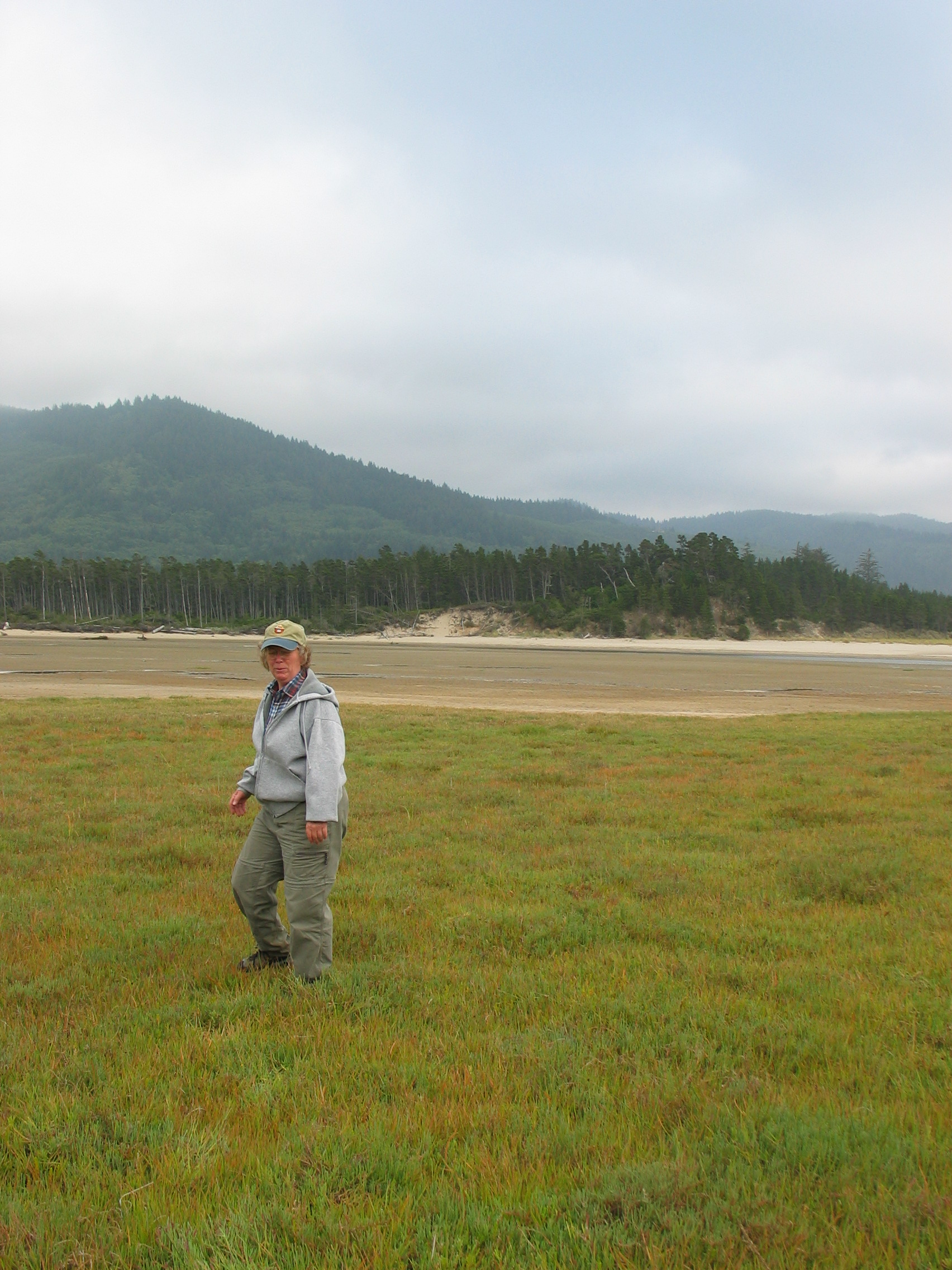
Woman scientist walking through a slat marsh with mountains in the background

Carol Jefferson, plant ecologist, professor, and environmental educator revisits a salt marsh along the Oregon Coast. This was one of her field sites for her 1973 PhD. Photo by A. Jefferson, 2004.


And my daughter:
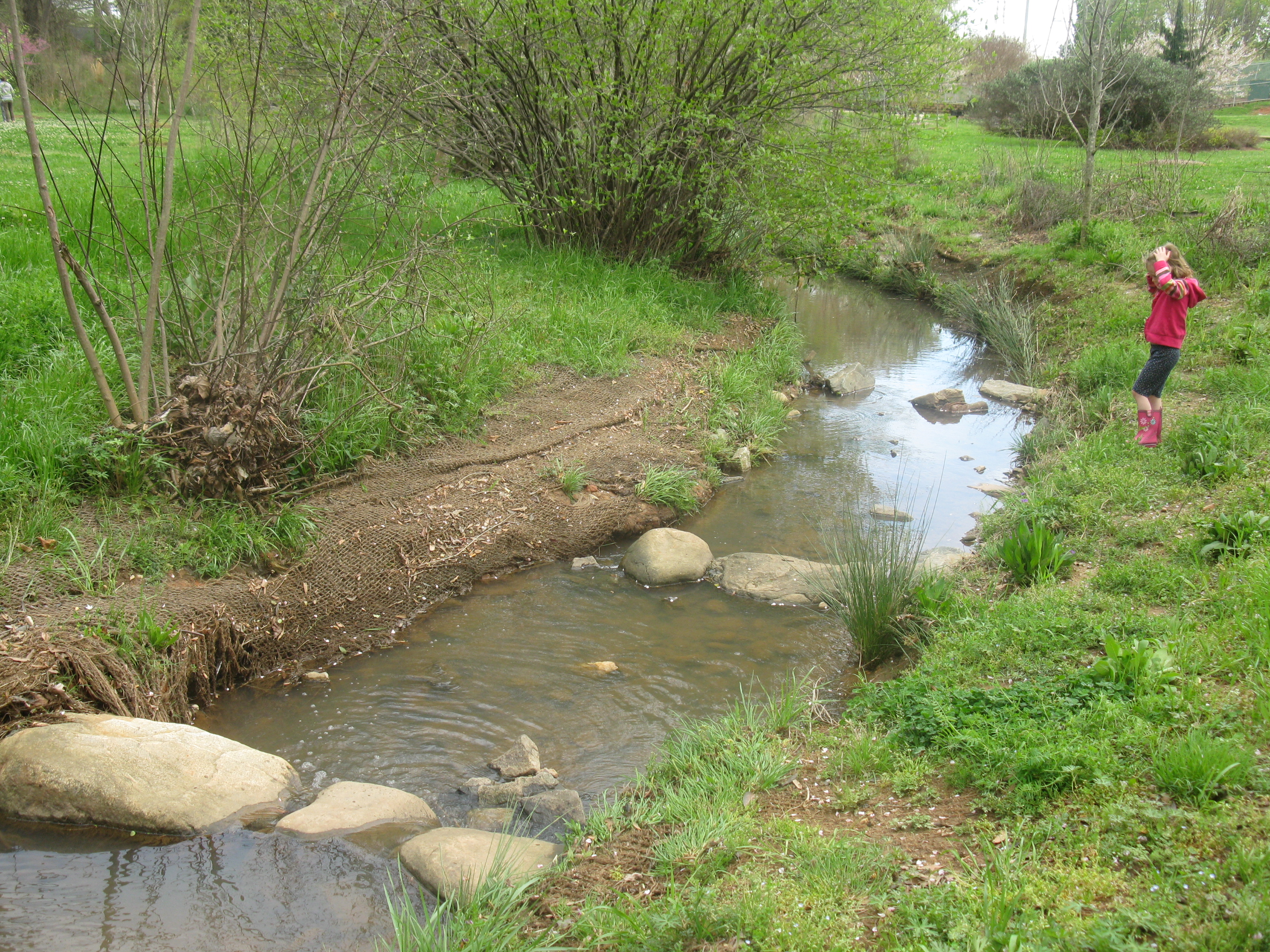
Child examines restored stream and throws her hands up in the air

My junior field assistant examines a restored stream in Charlotte, NC in March 2012. Photo by A. Jefferson

Did someone inspire and encourage you in your interest in science? Is there anyone who has inspired you to care passionately about science education for today’s students? If so, take a few minutes to send them a word of thanks, and maybe honor them with a contribution to the Geobloggers for Earth Science Education DonorsChoose challenge. Your gift can be in honor or memory of your own inspiring figures. Thank you.

Categories: by Anne, science education

Inspiring future scientists with DonorsChoose: the challenge begins!

A post by Chris RowanA post by Anne JeffersonToday marks the start of the 2012 DonorsChoose Science Bloggers For Students Challenge. From today until the 5th November, science bloggers far and wide are joining together to help teachers give their students the science education they deserve. Over the past couple of years, the combined might of the earth and ocean science bloggers has raised more than $7,000: we’re hoping that our enthusiasm, and your generosity, will help us to match or exceed that performance this year. As far as we’re concerned, anything that puts more earth science into the lives and schools of todays children is an exceedingly good thing: it connects them more strongly with the planet we live on, and will possibly inspire a life-long interest in science that will serve them well whatever they end up doing with their lives.

To that end, we at Highly Allochthonous have created our own DonorsChoose giving page, and selected some earth science-related projects that we hope to raise some funds for. Amongst them is an Ohio class asking for turbidity and light sensors to measure drinking water purity; a California class hoping to learn how to design quake-proof buildings; or – in a case that has us both fluctuating between sadness and anger at the state of education funding – you could help a Baltimore teacher buy a printer and paper to produce class worksheets, in the absence of any textbooks.

Other geobloggers are also joining in: Erik Klemetti of Eruptions is promoting some – shock – volcano-related projects, and Southern Fried Science is trawling for marine biology. More will hopefully be joining in in the next few weeks, and we’ll keep you updated on our progress – as will the widget on our sidebar.

This week is also Earth Science Week, which gives us all an even better reason to do our bit for promoting geological education. Even a few dollars can make a difference, so please consider donating and spreading the word.

Categories: science education

Stuff we linked to on Twitter last week

A post by Chris RowanA post by Anne JeffersonAutumn is upon the northern hemisphere (the Chicago and Ohio parts of it anyway) meaning that the urge to curl up with a hot drink and some good reading is stronger than ever. We can help with the latter part, at least.

Blogs in motion

Volcanoes

Earthquakes

Planets

(Paleo)climate

Water

The new water year inspired several of us to write posts.

Environmental

General Geology

Interesting Miscellaney

Categories: links

Happy New Water Year! For hydrologists, it’s already 2013.

A post by Anne Jefferson There’s nothing particularly deterministic about starting a new year on January 1st. Our wall calendars happen to do so because of the circumstances of history. For hydrologists in the northern hemisphere, January 1st is not a great time to declare one year dead and a new one born. So instead, we transition between years on the 1st day of October. October 1st, 2012 marks day 1 of the 2013 water year. But, why?

Trees with autumn colors on the banks of a river

The Upper Cuyahoga River as it might look about the time of the new water year. Photo by Ohio DNR (click image for source). A 40 km section upstream of Kent is a state scenic river and I really want to canoe it.

Many hydrologic analyses involve calculating statistics on an annual basis. We might want to calculate annual streamflow to determine how much drier 2012 was than 2011. Or we might want to look for trends in the size of floods. For the example of flood statistics, the most common way to get a time series of floods is to identify the largest flood occurring in each year. This “annual peak flow” record is then used within the framework of a probability distribution function to assign a probability of given size flood occurring in any one year. (Problematically, this has been called a “flood frequency distribution”, leading to unnecessary confusion on the part of the public, but I digress…)

We use only the largest flow each year to calculate statistics because it avoids statistical complication. Principally, we want to ensure all of our events are independent of each other. Let’s say there are two days with really high flows in a year. The highest flow is 27.8 m3/s and the second flow is 24.1 m3/s. If the first measurement was made on January 29th and the second one was from March 18th, then these two data are independent (i.e., not the same flood). But if one is from January 29th and the other is January 30th, they are clearly not independent and should not both be used to calculate statistics as if they were. So, we try to avoid this dependence issue by using only the largest flow each year.

Here’s where we come back to the idea of the water year. Let’s use an example from my local stream gage – the Cuyahoga River at Hiram Rapids. There was a big flood on December 31st, 1990 – the biggest flood of the whole year – reaching a peak flow of 71.4 m3/s. On January 1st, 1991 the water was still high – 66.8 m3/s. After that excitement, the rest of 1991 was pretty dry and flow never again gets anywhere near as high, peaking at 25.0 m3/s in early March. How do we calculate the statistics? If we used the calendar year as our basis, we’d end up double counting that late December flood and we’d throw our flood statistics off.

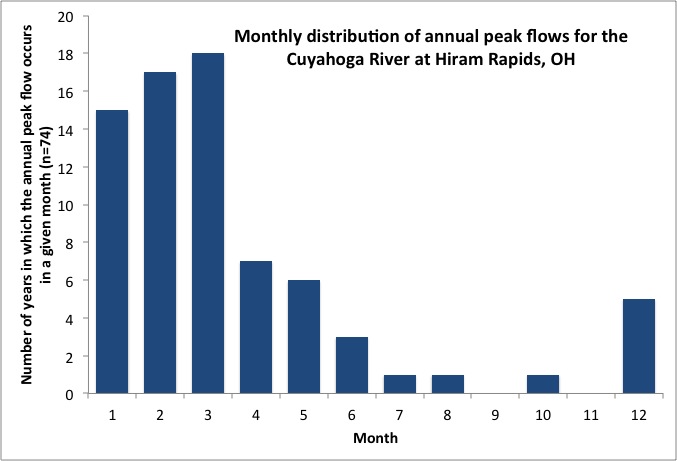
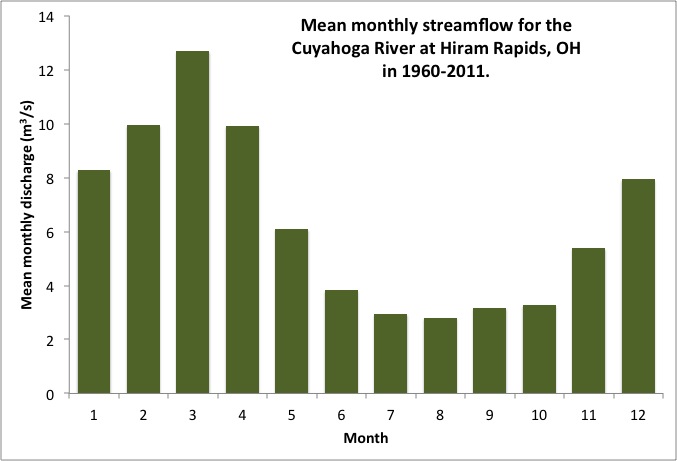
Instead, hydrologists use October 1st as our cut-off date. In many parts of the Northern Hemisphere, summer is a period of low streamflow, driven by strong evapotranspiration and atmospheric circulation patterns. (A prominent exception to the lack of summer flooding is when tropical cyclones make landfall.) In winter, rain-on-snow can produce large floods in some regions, while decreased evapotranspiration and more frontal storms increase the chances of flooding in some southern regions. In the spring, seasonal snowmelt produces flooding in northern and alpine regions. That leaves the autumn as the period least likely to have frequent flooding. Also, because evapotranspiration is subsiding with cooler temperatures, soil moisture and stream flow don’t tend to be recovering from their low points in the summer. So autumn is a time of transition and a time when extremes are unlikely. The graphs below illustrate this for my local stream gage, but similarly shaped distributions would likely exist for many other gages in the US and beyond.

Thus, it’s a perfect time of year to the clear the books and declare a new year for hydrologic statistics. And it’s got as much or more physical rationale than when we change the calendar on the wall. Happy New Water Year Everyone!

Bar graph showing months with the greatest frequency of flooding in December-April

USGS data on annual peak flows for the Cuyahoga River at Hiram Rapids (gage #04202000) illustrates that summer and fall have the least frequent big floods.

March has the highest discharge, July and August have the lowest.

Mean monthly discharge for the Cuyahoga River at Hiram Rapids shows that summer is the period of lowest flow and that by September and October average discharge is starting to increase.

Categories: by Anne, hydrology