
Moving on from Baby Rocks

I’ve spent most of the last five years studying rocks formed in the last 10-20 million years. By normal human standards, that’s quite old. If each of those 20 million years was compressed into a single second, we’re still looking at about 8 months’ worth of geological history: by contrast, the average human lifespan would be about a minute, the whole of recorded history would take up the last hour and a half, and anatomically modern humans were almost literally born yesterday (to be precise, just over two days ago).

But now that I’m in South Africa, suddenly 20 million years doesn’t seem very old at all. Johannesburg owes its existence and wealth to the gold bearing rocks of the Witwatersrand Group (some background), which are almost 3 billion – 3 thousand million – years old. That’s 150 times older; going back to our compressed 1 year=1 second timescale, the Witwatersrand is on the verge of celebrating its first centenary and receiving a congratulatory telegram from the Queen, although it still has to defer seniority to the 140 year-old planet which hosts it. From 8 months to 100 years – it seems that one of the guys here was actually being pretty accurate when he sneeringly referred to my New Zealand mudstones as ‘baby rocks’.
Continue reading
Categories: deep time, geology

Philosophia Naturalis #7

Check out the latest edition of the physical sciences blog carnival Philosophia Naturalis over at Geek Counterpoint. Lorne Ipsum has decided to go downmarket by applying tabloid-style headlines to other bloggers’ well crafted prose.

Once again, I failed to submit anything, but given all my relocation hassles I think I can be forgiven.

Categories: links

Lusi: the man-made mud volcano

(Reposted – with an update – from ye olde blog)
The latest from Lusi

In May 2006, an exploratory gas well being drilled in eastern Java hit a limestone aquifer. Because the lower part of the well had not yet been ‘cased’ – sealed off from the surrounding rock – a surge of overpressured water was released into the mudstones higher in the borehole, fracturing them and mixing them into a hot mud which eventually made its way to the surface near the drilling rig.

Since then, since then, 7,000-150,000 cubic metres of mud (up to 40 olympic swimming pools’ worth, in media units) a day has been disgorged from a vent dubbed ‘Lusi’, burying surrounding villages. I found this video on You Tube showing the encroachment of the mud – a rising tide which shows no sign of stopping.

Continue reading

Categories: geohazards, geology, Lusi

What the heck does Highly Allochthonous mean?

The first thing to get out of the way is the matter of my blog’s title, which has garnered accolades ranging from ‘more difficult to pronounce than Pharyngula’ to ‘awesome geo-nerd term’.

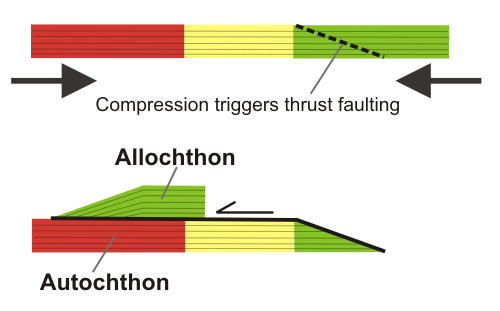
An allochthon is a sequence of rocks which has been superimposed by faulting on top of another sequence which it was originally a large distance away from; for example, a sequence of sediments which were originally deposited in the deep sea, and have then been thrust over shallow marine or continental deposits of a similar age.

allochthon.png

Continue reading

Categories: bloggery, geology

Welcome to (even more) Highly Allochthonous

Hello everyone, and welcome to the new home of ‘Highly Allochthonous’!

As regular readers already know, I’ve just completed a physical move to the southern hemisphere; but it some ways my electronic relocation, courtesy of the nice people here at Scienceblogs, seems even more unreal. I’ve occasionally commented here (and elsewhere) under the name ‘gengar’ – which has resulted in my old blog currently holding steady at #9 on the Google search for a Pokemon name – but I never imagined that I’d end up posting in such distinguished company.
Continue reading

Categories: bloggery