
Scientists discover ‘Kryptonite’

The press office of the Natural History Museum must have been beside themselves with this one: asked to analyse an unusual mineral from a mine in Serbia, one of their scientists types the composition he’s determined into Google and discovers, via Wikipedia, that it’s the same as that for Kryptonite. I’d imagine that ‘Scientist discovers new mineral – might be a good source of lithium’ would be quite a tricky media sell, whereas “Scientist discovers KRYPTONITE!!!’ kind of sells itself.
Rather disappointingly, the chemical resemblance does not lead to much physical similarity:
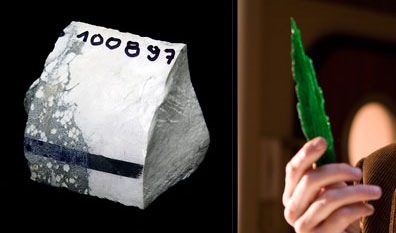
Kryptonite-comp.jpg

But the reason why is obvious – it’s not really kryptonite at all! This new mineral is described as ‘sodium lithium boron silicate hydroxide’ (shame on the NHM for describing this as the ‘chemical formula’ incidentally), whereas the Wikipedia article clearly states that the mineral in Superman Returns is ‘sodium lithium boron silicate hydroxide with fluorine‘. Just add a little fluorine, and the white and powdery ‘Jadarite’ will no doubt become green, fluorescent and capable of fending off superheroes with dubious fashion sense.
The NHM press release links to a video about the analysis of the mineral, and there’s also going be some sort of live presentation about it which you can watch online tomorrow.

Categories: geology, rocks & minerals

Tales from junior academic land

Head over to the the third edition of What’s Up, Postdoc? for more musings from us poor and downtrodden postdocs and PhDs. You could also go and read my latest column at Naturejobs while you’re at it – it will salve those of you eager for some thoughts on life in Jo’burg (of which more are forthcoming, honest).

Categories: academic life, links

The case of the THC “shutdown”: why science is a never-ending story

All this fuss about the “F-word” should not distract from the fact that the mainstream media has problems reporting a science story even if we do pitch it right. Take, for example, Bryden et al.‘s 2005 Nature paper, which reported a 30% slowdown in the strength of the thermohaline circulation (THC), also known as the meridional overturning circulation (MOC), measured across the Atlantic basin at 25ºN. In the wake of this current’s starring role in the ever-so-slightly unrealistic The Day After Tomorrow, this result got widely and breathlessly covered in the press. Even at the time, though, it was clear that this result was preliminary at best. As I commented at the time (in one of my earliest blog posts):

Because the current strengths are being estimated by an indirect method, the potential errors are quite large; in fact, the authors estimate that the error is about the same size as the apparent decrease in [THC] flow. They also argue that because the observed reduction is associated with a particular component of the flow, rather than distributed at all levels, the effect is real, which is a fair point but not a conclusive one. The other problem is that there is virtually no data on the natural variability of the thermohaline circulation, so it is also possible that the most recent survey is just detecting this rather than a sustained reduction.

Some of these caveats did make it into the better write-ups, such as the BBC one linked to above, but most of them treated the reported slowdown as a pretty solid result. End of story. Except that, of course, it wasn’t.

Continue reading

Categories: climate science, public science

Science – a victim of framing?

I can’t help thinking that there’s a certain irony that Chris Mooney and Matt Nisbet, who are talking about how to effectively advocate your point of view through framing, have managed to raise so many scientific hackles in the last two weeks. For additional irony points, Coturnix has even speculated that part of the reason for this is that the word ‘frame’ itself automatically triggers a negative response. Thinking back to my own response, I have to concede that there may be something in that – but I don’t think that’s the whole story.

Continue reading

Categories: public science

Stardust or probe dust?

A little media storm has broken out about possible contamination of the Stardust comet samples – it’s been claimed that osbornite, one of the high-temperature minerals found in Stardust’s detectors, was not from the comet at all, but from the probe’s fuel source – a possiblilty which the Stradust scientists say they have already ruled out (the Nature story linked to above contains quotes and discussion from both sides).
For those of you wondering why the presence or absence of this mineral in a comet is so important, I give you a repost from ye olde blog:

Continue reading

Categories: planets