Physical Science covers a variety of disciplinary sins: particle physicists, geologists, and astronomers all fall within its remit. So, in the course of seeking out worthy entries for this months edition of Philosophia Naturalis, I’d find myself quickly moving from discussions of quantum computing to climate modeling, from string theory, to planetary geology, from thermodynamics to extra-solar planetary systems. As you can imagine, organizing such variety is not an easy task – so instead, I’ve decided to celebrate it. Each box on the image below represents one post (accessed by clicking), and its position on the logarithmic scale roughly corresponds to the length scale of the phenomena it discusses. This months’ collection of posts spans than 50 orders of magnitude – and the keen-eyed will note that I’ve compensated for the fact that this theme is probably one edition too late.
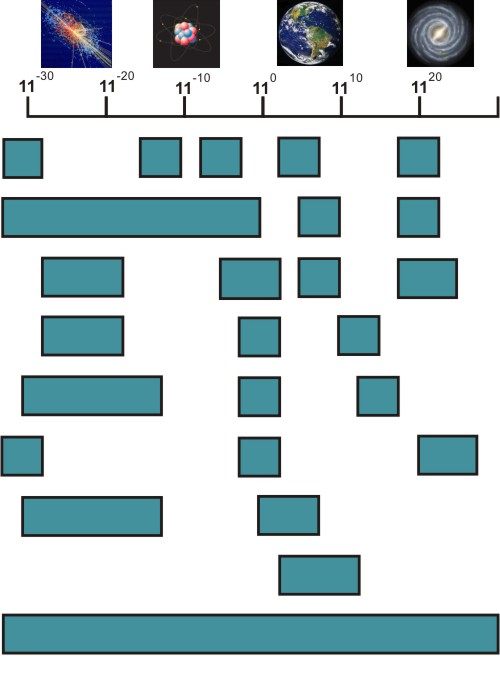
For convenience, below there’s the more traditional list of links, arranged from the very small scale to the very large.
- Sean Carrol on the media battle over string theory.
- Joe Polchinski continues his online debate with Lee Smolin aboutstrings and the sociology of science.
- Bee discusses early work on extra dimensions.
- Gordon Watts tries to cool down speculation about the detection of the Higgs boson.
- David Guarrera discusses how the LHC is not being built solely to find the Higgs boson anyway.
- Rob explains how quantum physics can be random, yet still predictable.
- The Quantum Pontiff gets depressed, amongst other things, about the practical difficulties of quantum computing.
- Bouncing neutrons and QM at Backreaction.
- Thermodynamics and self-assembly at The Old Curiosity Shop.
- Literally cool applications of sound energy at Cocktail Party Physics.
- Scott Aaranson tackles the myth of the ivory tower.
- Some sci-philosophical musings from Sean following the death of Richard Rorty.
- Clifford explains how theoretical theorists really theorize.
- Harold pines for the lost days of proper safety margins.
- As a solar energy plant opens in Nevada, Dean asks why more aren’t being built.
- Why global climate models can’t describe local climatic changes (yet).
- Steinn on why our lifestyles add up to climatic trouble. Part of a debate which started here and continued here.
- Emily points out that purported Martian ‘puddles’ are actually on a slight incline Bad New Scientist!
- Having sorted out the extended Cassini mission, Josh’s first thoughts on the extended-extended mission.
- Eris – Planet Might-Have-Been-X.
- Paul Gilster (rather approriately) discusses the possiblity of planets in the Centauri system.
- Big exoplanet discoveries abound….
- …and we’re closing in on the Earth-like ones.
- Phil asks, can black holes ever actually form? And makes everyone’s head hurt, including his own.
- And finally, Cosma Shaliz reminds us that whilst power laws may exist everywhere in nature, that doesn’t mean that everything is governed by power laws.
In closing, I’d like to remind you that pedantic comments regarding my chosen length scales will be ignored (pretty easy when you’re a few hundred miles away from the Internet), and that the next edition of Philosophia Naturalis will be hosted by Mollishka at a geocentric view. Get reading, writing, and submitting!