Nuclear ‘green’, renewables not?

I’m not sure what to make of this:

Renewable does not mean green. That is the claim of Jesse Ausubel of the Rockefeller University in New York. Writing in Inderscience’s International Journal of Nuclear Governance, Economy and Ecology, Ausubel explains that building enough wind farms, damming enough rivers, and growing enough biomass to meet global energy demands will wreck the environment.

Ausubel has analyzed the amount of energy that each so-called renewable source can produce in terms of Watts of power output per square meter of land disturbed. He also compares the destruction of nature by renewables with the demand for space of nuclear power. “Nuclear energy is green,” he claims, “Considered in Watts per square meter, nuclear has astronomical advantages over its competitors.”

Continue reading

Categories: environment

Earthquake activity in Indonesia

There have been some reports of a magnitude 6.1 earthquake shaking things up in eastern Indonesia. More info from the USGS:
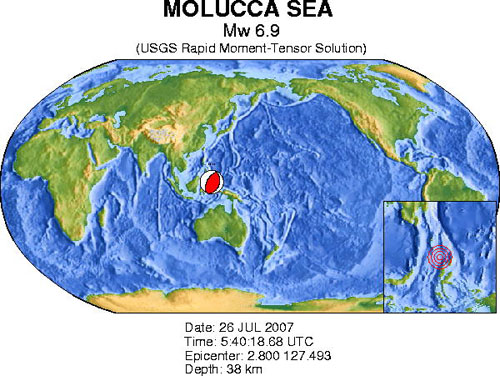
Molucca6-9.jpg

The media report that there was a tsunami warning issued, which seemed a little odd: you’re not going to get a surface rupture from a quake this deep (it must be within a subducting plate), although there’s possibly a risk of triggering an undersea landslide in this area. If you wander over to the NOAA Tsunami Warning Center, though, the text of the bulletin they issued 15 minutes after the earthquake states::

NO DESTRUCTIVE WIDESPREAD TSUNAMI THREAT EXISTS BASED ON
HISTORICAL EARTHQUAKE AND TSUNAMI DATA.

Calling this a ‘warning’ strikes me as a bit of an exaggeration.
A few hours before this, there was also a magnitude 6.6 earthquake in western Indonesia, which doesn’t seem to have got much media attention even though it should have shaken up a few people in Banda Aceh:
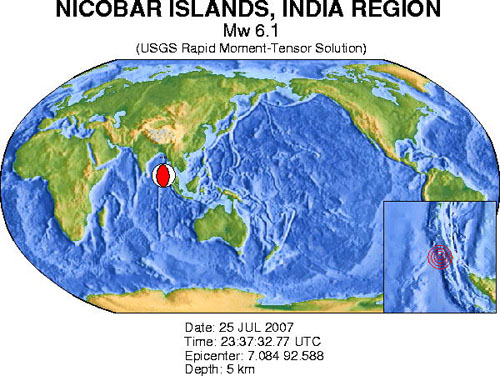
BandaAceh6-1.jpg

If that place sounds familiar, it should. This was a shallow thrust earthquake close to the Sunda Trench, the convergent plate boundary which generated the Boxing Day 2004 earthquake and tsunami (the epicentre of that quake was located on the very bottom right of the inset map). This part of the trench is part of the section that ruptured in 2004, so it seems unlikely that this earthquake occurred on the subduction thrust itself – the elastic strain built up by just two-and-a-half years of plate convergence just isn’t enough to produce an earthquake this powerful. Most likely it was a thrust in the accretionary wedge, and, from a first glance, much more likely to generate a tsunami, even though it didn’t seem to trigger any sort of bulletin at all. Curious…

Categories: earthquakes, geohazards

Volcanoes from space!

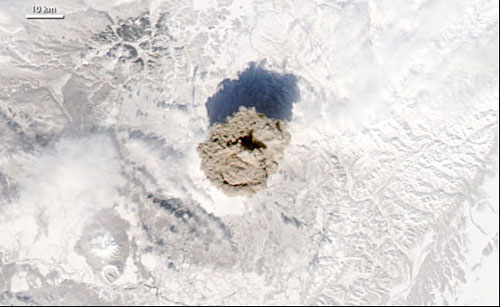
It was noted in this story about increasing seismic and thermal activity at Bezymianny volcano on the Kamchatka Peninsula that two other volcanoes had been continuously active in this region for the past 11 years or so. My interest was piqued enough to check out the Nasa Earth Observatory, where I found this fabulous image of the ash plume rising from one of these, Shiveluch, in a recent eruption (click on the image for the source page):

sheveluch_plume.jpg

Continue reading

Categories: geohazards, geology, volcanoes

Latest from the postdocosphere

Fellow scibling Alex is hosting the latest installment of What’s Up, Postdoc? over at the Daily Transcript. I’m chuffed to see that my weekend attempt at counterbalancing my moaning is included – and has also inspired Katie over at Minor Revisions to take a walk on the brighter side.

Categories: academic life, links

Monday links and an open thread

Currently what little creative energy I have is going into other writing (specifically, a really fiddly bit in the paper I’m preparing to resubmit), so here’s a couple of links for you:


Feel free to talk amongst yourselves. One suggested topic for you palaeontology freaks – would you put it under earth sciences, or biology? You could help me settle a small disagreement…

Categories: earthquakes, fossils, links