
Phases of belief

I don’t post much on the whole religion thing, but I thought (rather unwisely, perhaps – but I don’t see why Sheril should have all the fun) that the latest meany atheist appeaser agnostic blow-out (see here, here, here, here and, of course, here) was an opportunity to wheel out this analysis (slightly modified for relevance) from ye olde blog, which was inspired by the one before the one before the last one…
I’ve been puzzling over why what is a legitimate dispute between members of the pro-science camp, over emphasis and tone in the struggle against the forces of ignorance, always seems to break down into what could charitably be referred to as ‘arguing past each other’.
A common framing of different theological positions is to represent the continuum from theism through agnosticism to atheism as a change in the relative importance of empiricism and faith in a particular person’s worldview. An atheist places a high value on tangible evidence; a theist is more concerned with the greater truths that they feel exist outside of the world that we can subject to experimental verification (please note that this discussion is not addressing the existence (or not) of such truths…)

tern1.png

Continue reading

Categories: antiscience, public science

Do geologists fear the interweb?

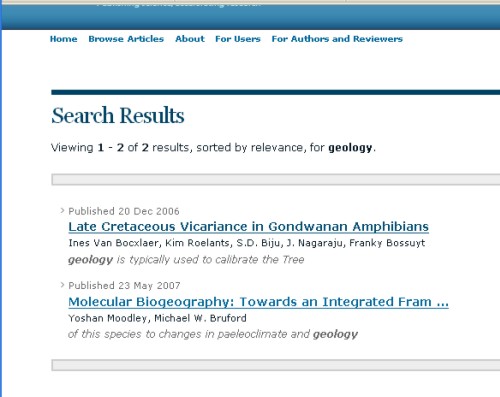
I’ve been pondering this question for a while now, and Brian’s discussion about a possible geology blog carnival gives it some topicality: why is it that so few geologists seem to have exploited the possibilities provided by the internet? Even if our numbers are growing – I’ve just added a jealousy-inducing Antarctic seismologist to my blogroll – compared to other disciplines like biology, or astronomy, the number of active geology blogs seems disproportionately small. And its not just blogging: if you search under ‘geology’ at the PLos ONE website you get this:

Plosshot.jpg

Continue reading

Categories: academic life, public science

August carnival of the postdocs

Head to the splendiferously titled Ways and Means of the Immune System for the August edition of What’s Up Postdoc, in which we junior academic muse over what we would have done differently if we could.

Categories: academic life, links

A picture is worth a thousand (drunken) words

Especially when it’s made up of lots of photos (click on the image for a larger version).

click for a large version

Most of us look like we’re having a good time, don’t we?

Categories: bloggery

Bacteria and black smokers go back a long way

I tempered the other week’s repost on some rather impressive 1.5 billion year-old black smoker chimneys, and the fossilised microbes found within them, with some words of caution about the ‘clues to the origin of life’ spin that the discovery was being given:

the first evidence of life in the geological record comes in beyond the 3.5 billion year mark, meaning that there is more distance between the first replicating organisms and these black smoker microbes as there is between the black smoker microbes and us.

In other words, the scientists who speculate on a possible connection between hydrothermal vents and the earliest life are doing just that – speculating – until they find much older equivalents of the Chinese palaeo-smokers, and fossil microbes associated with them. Unfortunately for them, such things are rather hard to come by. Hydrothermal systems are most commonly found in oceanic crust, usually associated with mid-ocean ridges, and most oceanic crust gets subducted after a few hundred million years rather than hanging around for billions like continental crust can.
It seems strange, then, that no sooner does one report of an ancient hydrothermal system appear in the literature, than another one shows up just behind it, courtesy of PhD student Lawrence Duck and his colleagues (including Suzanne Golding) at the University of Queensland. Their study of 3.24 million year-old massive hydrothermal deposits on the Pilbara craton in western Australia provides strong evidence for a flourishing bacterial ecosystem around hydrothermal vents almost 2 billion years further back in Earth’s past.

Continue reading

Categories: fossils, geology, paper reviews, Proterozoic