
AGU? Bah, humbug

Anyone who has noticed my latest Nature column will be aware that I have had to forgo the AGU Fall Meeting in San Francisco for yet another year. I suppose I can feel virtuous about not ramping up my already large carbon footprint for this year any further, but somehow I can’t help but feel a little depressed to be missing out – especially since it seems that a large proportion of the geoblogosphere will be descending on San Francisco for a little party. Just think of the Scibling shindig and add extra alcohol (if there’s any way that that is achievable, be assured that it’s geologists who will find it). This is one reason why posting has been a bit light this week – I’ve been sulking.
Continue reading

Categories: academic life, ranting

Pictures from an undersea eruption

Mid-ocean ridges are a fundamental component of the Earth’s tectonic engine: they mark places on the earth’s surface where two plates are moving apart, creating space for mantle rocks to move upwards, decompress, and melt. Every year, the resulting volcanic activity produces around 20 cubic kilometres of new ocean crust. However, our current understanding of the details of this process – exactly how the melt gets to the surface, and how and when it erupts when it gets there – is still rather hazy. The problem is that all the action is taking place beneath 2 or 3 km of seawater, making it quite difficult to monitor what’s going on. There are also tens of thousands of kilometres’ worth of ridge to choose from, so finding the section that are currently volcanically active is rather like trying to find a needle in a haystack – whilst blindfolded.
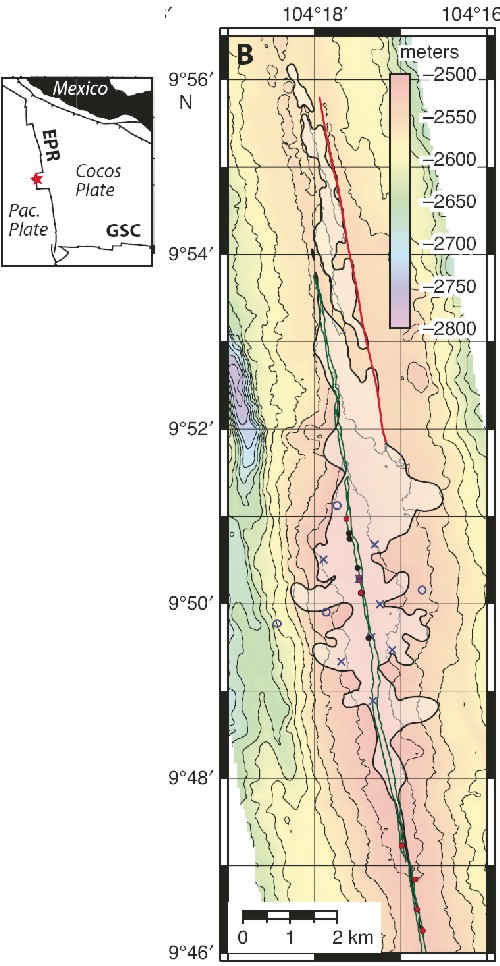
It follows that any information about the scale and characteristics of mid-ocean ridge eruptions is pretty valuable; and this is exactly what a new paper in Geology by Soule et al. provides us with – a nice snapshot of a recent volcanic eruption on the East Pacific Rise.

EPRlava.jpg

Continue reading

Categories: geology, tectonics, volcanoes

Carnivalling

Philosophia Naturalis #15 is up over at Sorting Out Science. My musings on the Black Sea flood paper made the cut; I’ve been quite amused by the attention that that particular post has generated, given that (a) I almost gave up on writing it, and (b) I almost didn’t post it. It just goes to show…
Meanwhile, the theme for the next edition of The Accretionary Wedge has been decided:

…as geologists with large rock collections, tell us about your favourite sample. Why is it interesting? Where did it come from? What’s its history? The most difficult part maybe choosing just one, so don’t feel limited. Give us the run down on as many of your favourite deskcrops as you like.

Head over to Good Schist for more details, and instructions on how to submit. I love the word ‘deskcrop’ – it’s geo-nerd terminology of the highest calibre. Even though most of my rock collection is in storage back in the UK, I think I’ve got a few interesting samples hanging around. I’d also like to invite non-geologists to participate – got an interesting hunk of stone hanging around on your desk, or being used as a bookend or doorstop? Post some photos, a description, and an account of where you found it, and perhaps your friendly neighbourhood geobloggers will be able to tell you a bit more about it. If you don’t have a blog, e-mail them to me and I’ll post them myself. The photos, not the rocks. Although if you want to send me rocks, I probably won’t complain…

Categories: links

Venusian datafest in Nature

Anyone interested in Venus will be very happy with this week’s issue of Nature, which has published a raft of papers detailing the latest findings of the European Space Agency’s Venus Express probe, which has been orbiting our inner planetary neighbour for the last 19 months. Even better, they’re freely accessible to all.
The papers are focused on the composition and dynamics of Venus’ atmosphere, which is hardly an area where I can claim expertise. Fortunately, the major findings have been nicely summarized by Svedhem et al., who come to a rather interesting conclusion:

The overall sense of the results from the first year of operation of Venus Express is that the differences, particularly in climate, between Venus and Earth are much less mysterious than previously thought after the early phase of spacecraft exploration.

Continue reading

Categories: planets

Lusi update

The latest from Lusi
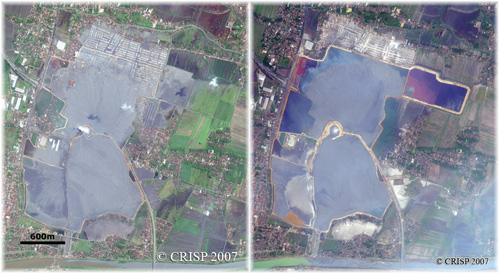
It’s been some time since I last checked in on Lusi, the mad-made mud volcano, but this account of conditions on the ground in the Christian Science Monitor prompted me to check out the latest satellite images. The picture on the left below is from early June this year (follow the link to the University of Singapore’s Centre for Remote Imaging, Sensing and Processing for access to a larger image), which I used in my last update; on the right is the most recent shot, taken on the 22nd November.

Lusi_Nov.jpg

From this elevated perspective, it appears that the earth dams thrown up by the Indonesian authorities have become much more substantial, and are now managing to contain the outflow of hot mud to a certain extent; from the colour of the river it looks like much of the tens of thousands of cubic metres being erupted every day is being diverted into it. This is hardly ideal, because as the Monitor article makes clear, this is not pleasant stuff:

The mud, which contains heavy metals and chemicals such as benzene and sulfur dioxide, has also contaminated rivers and wells in a city-sized area that was semi-industrial farmland and a shrimp production zone.

As for the 16,000 people who have been displaced, almost certainly permanently, by the eruption, they’re currently fighting for an improvement on a rather derisory compensation offer of 20% of the value of their buried homes (the rest will allegedly be paid at some later date).

Categories: geohazards, Lusi