Geopuzzle #8: Google Earth chevron challenge

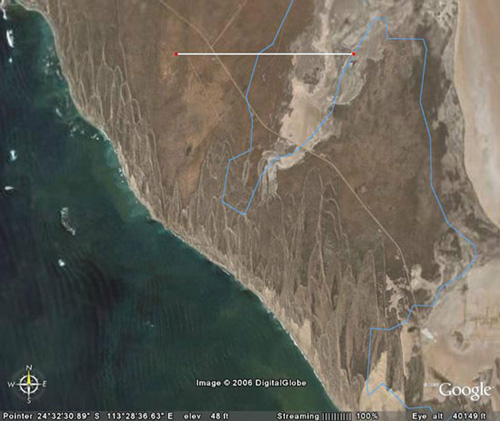
So, here was my original plan for this weekend: post a pictures of some of the proposed megatsunami chevrons as this week’s Geopuzzle, and then on Monday repost Return of the Megatsunami together with a new post which details some interesting new developments in the tale. Sadly, Ron scuppered that plan by using the Madagascar Chevrons in Where on Google Earth (even more annoyingly, even though I knew exactly where the damn things were, Lab Lemming beat me to it).
So instead, I’ve decided to try something a bit different, which may or may not work. I’m proposing that we go on a chevron hunt – how many of these things can we find? Are they just distributed around the Indian Ocean, or are they found around other ocean basins? Can we get an idea of sources from looking at their distributions? It could be an interesting exercise.
As a starting point, I’ve created a Google Map which shows the locations of the pictures from my repost (which I’ve put up early for reference), and Burckle Crater.


View Larger Map

Have a look around on the map, or in your version of Google Earth, and see if you can find any other examples. Post their locations in the comments below, and I’ll add them onto the map (with full credit to the discoverers, of course).
Go!

Categories: geopuzzling

Return of the Megatsunami

(reposted, with some modifications, from ye olde blog)
It seems like megatsunamis are back in vogue, but this time a different culprit is in the frame. Around the turn of the millennium a lot of publicity was given to the suggestion that a 200 cubic kilometre-sized chunk of the western flank of Cumbre Vieja, an active volcano on La Palma in the Canary Islands, was poised to fall into the sea in a future eruption. Modelling suggested such a collapse would send a gigantic tsunami racing westward across the Atlantic, and the eastern seaboard of the US would be assaulted by 50 m high waves that would penetrate up to 20 km inland (for comparison, the Boxing Day 2004 tsunami produced waves 20-30 m high which penetrated 2-3 km inland on the Sumatran coast, a mere 160 km away from the epicentre).
This apocalyptic scenario was put forward by Bill McGuire and his colleagues at the Benfield Hazard Research Centre. McGuire has become the go-to guy when you want a geological scare-quote for your breathless documentary about how we’re all doomed, whether by megatsunami, supervolcano, or some other hyperbolically titled geological phenomenon. In my old department in Southampton, some people who have studied past collapse events in the Canaries think that the risk is being a tad…overhyped (see also here for the Benfield team’s counterargument), because you seem to get a series of much smaller landslides rather than one big one which will Wipe Out the Whole of Western Civilisation.
At the end of 2006 Phil called our attention to an article in the New York Times (free registration required) which highlights another potential source for really big waves – oceanic asteroid impacts, which a group of scientists led by Dallas Abbott have proposed as the source of some interesting wedge-shaped deposits, referred to as ‘chevrons’, you find on some shorelines, particularly around the Indian Ocean. Firing up Google Earth, we can find them on the West Australian coast (the line on this and the following images is 5 km long:

AusChevrons.jpg

Continue reading

Categories: geohazards, geology

Where the Earth’s magnetic field comes from

The Earth’s magnetic field may approximate to a simple dipole, but explaining precisely how that dipole is generated and maintained is not simple at all. The field originates deep in the Earth, where temperatures are far too high for any material to maintain a permanent magnetisation; the dynamism that is apparent from the wandering of the magnetic poles with respect to the spin axis (secular variation), and the quasi-periodic flips in field polarity, also suggest that some process is actively generating and maintaining the geomagnetic field. Geophysicists therefore look to the most dynamic region in the planetary depths, the molten outer core, as the source of the force that directs our compass needles.

Continue reading

Categories: basics, geology, geophysics, palaeomagic, paper reviews

Uninquisitive

I think that I’ve figured out the New Mexico Department of Cultural Affairs’ problem. When the Aetogate scandal whipped up enough fuss to force them to hold an official inquiry, they pulled ‘Inquiries 101’ off the shelf, only to discover that most of the pages had been ripped out. What they had was this:

  • Convening your panel (although the meaning of a partial page headed “Conflicts of-” had been lost forever).

  • Taking evidence from accused party.

Unfortunately, their reference volume was missing these rather vital sections:
  • Taking evidence from the accusing party.

  • Identifying discrepancies in the opposing testimonies.

  • Investigating and untangling said discrepancies.

  • Reaching a balanced conclusion.

The missing pages led to the rather truncated proceedings reported on in yesterday’s Albuquerque Journal (see also Julia and Brian’s takes) . On the plus side, we now have Spencer Lucas’ response (pdf) to Parker and Martz’s accusations (see the The Reptipage for some analysis). Unfortunately, however, the “inquiry” didn’t seem particularly curious about the numerous places in the rebuttal of Parker’s allegations where the two accounts obviously conflict, leaving us outside observers with a “he said”, “she said” situation, and nothing really resolved.

Categories: academic life, general science

Geologists in peril – and liking it?

After linking to some spectacular photos taken from right in the path of an avalanche, and a jealousy-inducing photo of himself standing right next to an oozing lava flow, Geotripper asks if geologists have a death wish:

I considered what happens when events like this happen to geologists. We run for a better look! A landslide, a volcanic eruption, an earthquake, it seems like we can’t resist; while others run away in a wild panic, I imagine many or most of us will be scrabbling for a camera and running towards whatever is going on.

The closest I’ve ever got to a volcanic eruption is about 40 years (when I visited Pompeii on a school trip in the mid 90s), but I can think of several instances where my determination to plant my nose on the best exposure has put me in a somewhat precarious situation. On one such occasion during my undergraduate mapping project, I descended a few metres down a steep cliff face to examine a possible contact, and then found that I couldn’t safely climb back up again. The only way out was a descent down 25 metres’ worth of fairly sheer felsic lavas. Not fun, even if there were lots of lovely brambles at the bottom to break my fall. I was hardly alone amongst my cohort that summer, either – there was a running joke that it wasn’t a proper mapping project unless you’d had at least one near-death experience.
If this is a tendency amongst geologists, I’m don’t think it’s either the result of us all being adrenalin junkies, or of us shifting into ‘absent-minded professor’ mode and being too focussed on the rocks to notice the danger. It’s more that our appreciation of the potential risks in a particular environment are counterbalanced by our strong desire to get to grips with the geology. Our subconscious is still screaming, “Fly, you fools!”, but we also have that other little, yet very insistent, voice saying, “Hmmm, this is interesting – and you’ll see it much better from a little bit closer…” For the most part, these are risks we choose to take, because we consider the experience to be worth it. Indeed, the willingness to take risks that other people consider to be slightly mad seems to be part of human nature; it’s just that most people express the urge through bungee-jumping, or eating Fugu, or hurling their car around blind corners at 100 miles an hour, rather than running towards an active volcano. And they call us mad…
I’d be very interested to hear other people’s perspectives on this: what’s the most precarious situation you’ve got yourself embroiled in during fieldwork? And was it worth it?
Update: Ron, Kim, Silver Fox and The Lost Geologist have offered up their tales of derring-do, whilst I think Mel has found my next hiking destination

Categories: fieldwork