The limits of monomaniacal workaholism

I’ve spent most of the last three days camped in front of a scanning electron microscope, looking at lots of evil iron sulphides. And when I say ‘most’, I really do mean ‘most’. The problem when you want access to shiny bits of analytical kit is that there’s lots of other people jostling for access with you. Thus, when you finally get a precious day or two of machine time, things like food and sleep tend to slip a little down the priority queue, because who knows how vital that wasted hour could be, and how long you’ll have to wait to get another one?
The reason I wanted to try out the instrument here is that it’s tooled up with some fancy automated software which can scan entire slides on its own, picking out particular mineral phases, and recording their shape and location. This means that rather than my time being eaten up by manually moving the stage around, looking for things of interest, I could just quickly zip between different iron sulphide aggregates, looking at the different growth patterns of pyrite and greigite, and how they varied between samples with different magnetic properties. Even though I have studied these slides before, I’ve been getting pretty excited about how much more, and how much cool new stuff, you get to see with this instrument’s help compared to my previous sessions. But despite the automation, and despite the scientific potential of all this new data, the actual process of reviewing the data is still pretty monotonous: select and move to an aggregate the machine has found, note down the growth patterns, analyse some of the phases to check what is what, take a photo, then rinse and repeat. Yesterday, after spending a fair proportion of the hours between Saturday morning and Sunday evening doing this, 15 hours of this on Saturday, and an early start yesterday, my brain was starting to shut down in protest. It was fortunate that I still had a bit more time this morning to finish reviewing all of my slides.
I’ve always been quite good at focussing on an important task for stupidly long lengths of time (in between bouts of intense procrastination), so it was quite disturbing to find myself running out of mental steam so easily. When I think back my undergrad days, and even during my PhD, the sort of weekend I’ve just had was not an uncommon occurrence. In my defence, this work is filed under ‘speculative side-project’, so there wasn’t the spur of a looming deadline to keep me focused once I started to flag yesterday evening. And the extreme monotony of this sort of work makes it difficult for your mind not to wander eventually; I’ve given up SEM sessions in the past for just the same reason. Perhaps, though, I’m just getting old, and the days when I could shrug off an all-nighter are past me – and my all-time record of four nights without sleep (which included playing a rugby match on day three) will forever remain unbeaten.
Categories: academic life, in the lab

Geopuzzle #12 (finally) revisited

I hadn’t forgotten about the mystery feature that I posted more than a fortnight ago, and I certainly wasn’t intending to leave it this long. Perhaps it’s the fact that in this case, as I said at the time, I don’t have a definitive answer to give you.

gp12a.jpg

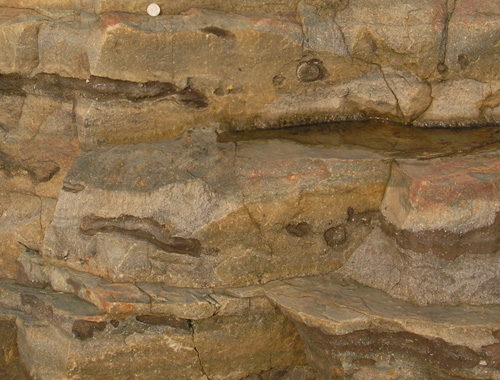
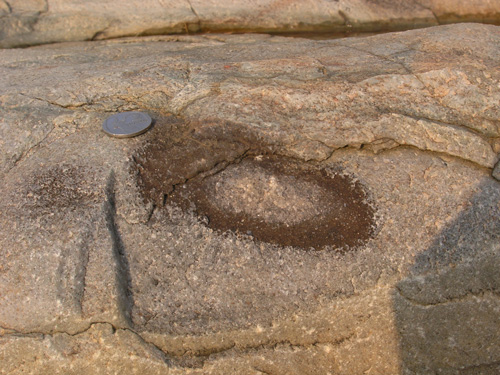
Congratulations to those who identified the 2 Rand coin acting as my scale bar. As for the thing next to it, the consensus seemed to be that it represented some sort of concretion: a geological pearl, formed by minerals accreting around a speck of organic matter or some other chemically distinct impurity during compaction and lithification of sediments. The problem with this interpretation is that the stuff inside the black rim of this concretion (quartzite) is indistinguishable from the stuff outside it (also quartzite). It’s only the rim itself which appears to be enriched in iron minerals. You can sometimes get such ring-like alteration associated with filled-in animal burrows, but given that we are again looking at the Archean sandstones that I visited a couple of months ago, we’re a couple of billion years too early for that…
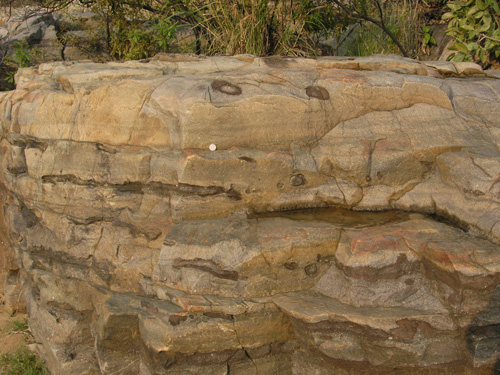
In a wider view of the outcrop, you can see that features with a similar structure are found in distinct layers, albeit somewhat intermittent and fragmented ones

gp12b.jpg

gp12c.jpg

My initial thought was that these layers might be more remnants of Archean microbial mats, similar to the ones that are found stratigraphically below this section; the difference being that here we have a higher energy environment that has disrupted them more. In this case, the first photo would represent a small mat fragment that has been torn away by strong currents and curled up on itself, trapping some sediment within it as it did so (the Lost Geologist was clearly thinking along similar lines when he suggested it was an armoured mudball). Looking more closely, though, I’m not so sure, because the layers themselves also consist of altered rims surrounding a relatively unaltered core, rather than the single layer you’d expect if it was a preserved bacterial mat. Perhaps, then, Christie is right and this represents some sort of alteration at the edge of channels followed by pore water flowing through the sediments following deposition. Quite what would cause such preferential fluid flow through the rock is unclear though, possibly because the alteration to quartzite has removed any evidence for large variations in porosity in the original sediments.
Feel free to throw in a further R2 if you’re inspired.

Categories: Archean, geology, geopuzzling, past worlds

Fire!

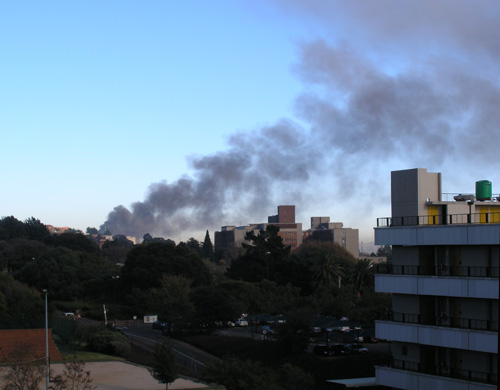
I walked into work today under a beautiful, cloudless, sky – until I looked in the direction of the UJ campus, where an ugly black cloud was accumulating in the direction of the building that houses the Geology department. It was only when I got much closer that it became clear (to my relief) that the fire was some way beyond the campus grounds, and it wasn’t the result of an overheating mass spectrometer or something. Here’s a picture from the roof of our building:

JoburgFire1.jpg

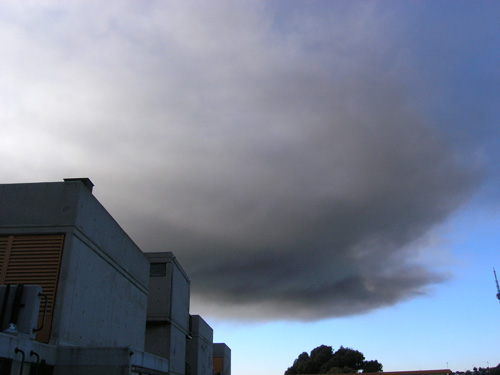
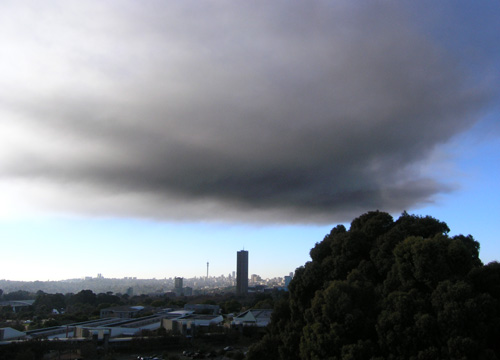
The fire seemed to have died down a bit by the time I took this photo, because the thickest cloud had already drifted over us in the direction of the city centre.

JoburgFire2.jpg

JoburgFire3.jpg

There’s nothing on the news about this yet, but one of my colleagues reckons that it might be a substation that has caught fire before (apparently Eskom’s maintentance philosophy is something along the lines of ‘leave it until something explodes’). Hopefully, no-one has been hurt.
For some reason, I’m thinking that today is a good day to back up my data.

Categories: academic life, bloggery

How long is a postdoc?

I was awarded my PhD just under two and a half years ago; I’m a little under a year and a half into my first postdoc, and potentially have funding until the end of 2009. I’m working in a laboratory that is about to go through a major upgrade, which will give me lots of shiny new toys to play with, and increase the range of measurements I can make, and the speed that I can make them at, by orders of magnitude. I’m currently at the ‘optimistic but suspicious’ stage with the data I have so far – it’s saying some potentially interesting things, but I’m still not sure I’m not being fooled by evil magnetic overprints (if my PhD taught me anything, it’s that you should never blithely assume that the primary magnetic signal dates from the time the rocks formed, and if that’s true of 10 million year-old sequences, it’s no surprise that I’m treating my 3 billion year-old samples as guilty until proven innocent). I’m also trying to spin up a side project that will try a new approach to studying the inter-relations between magnetic mineralogy and magnetic behaviour, which could yield some pretty interesting results if it works the way I hope.
On the whole, then, things seem to be going fairly well at present. But I also need to consider my progress in terms of my future career goals, which (if I stay in academia) would see me in a more teaching-orientated position such as a lectureship or teaching fellowship. I’m fully aware that a solid research record is a necessary requirement if my applications for such positions is going to be seriously considered; but what I don’t really have a good feel for yet is how long I need to work as a postdoc (or perhaps more accurately, what sort of publication record I need) before I will be considered ‘established’ enough. I was recently told that five or six years would be a reasonable waiting period before I can climb to the next rung. I’m hoping that my pre-postdoc position as a lecturing lab technician will count in this calculation, but even then it looks like I still be waiting for a while. The question then becomes, how should I spend this period? Obviously, I need to publish; I need to try and broaden my research expertise; and I need to try and build my visibility within the research community. But what is the most effective way to do this? Should I stay in one place, which might allow a more consistent output but might limit my interactions with other scientists; or should I try to move around a bit between other labs to sample a greater variety of environments and approaches to research, but with all the disruption that comes with periodically uprooting myself?
A lot depends on circumstances, of course (for example, there’s no guarantee that I could find a research post in another lab even if I though it was a good idea), but knowing what the best path might be would still be useful. Perhaps some of you smart people, whether pre-, syn-, or post-postdoc, have some thoughts or relevent experiences to share. How long was your postdoc, or how long has it been so far? What experiences or achievements were, or are, important in making you competitive in the hunt for permanent or tenure-track positions? Do you think one or two long postdocs is better than multiple short ones? Does the present academic job market doom me to eternal postdocdom?

Categories: academic life

Why you can get ‘500 year floods’ two years in a row

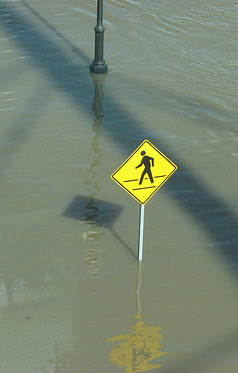
Iowaflood.jpgFor the past week, the flooding in the Upper Midwest has been all over the news, as rivers have reached record levels and thousands of people have been evacuated across several states. A couple of ScienceBloggers have been personally affected, and we hope that they, their families, and their labs continue to be safe and dry.
Floods are a personal fascination for me, as I can trace my interest in hydrology directly to the 1993 Mississippi River floods that affected my hometown in Minnesota. However, flood recurrence intervals are also one of my professional pet peeves. I make sure that students in my classes never walk away with the misconception that a 500-year flood can only happen once every 500 years. If you finish reading this post, you’ll be disabused of the notion as well.

Continue reading

Categories: by Anne, climate science, environment, geohazards