[Note: this was originally intended for the latest edition of The Accretionary Wedge, now up at Clastic Detritus, which asked the geoblogosphere to look to the geological future. Sadly, it took much longer than I thought it would, and is therefore a bit late – but what’s a few days to a geologist?]
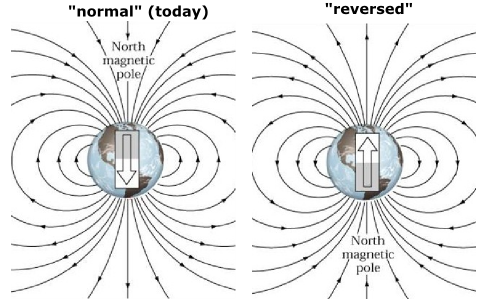
It’s fairly common knowledge that the Earth’s magnetic field periodically reverses its polarity. At the moment, magnetic field lines run from the south pole to the north pole, and point up in the southern hemisphere and down in the northern hemisphere, as in the figure on the left below. But at many points in the past, the field lines (and compasses, if they’d been invented) pointed south, and, as the figure on the right below shows, were directed upwards in the northern hemisphere and downwards in the southern hemisphere.
Rocks record the direction of the ambient magnetic field as they form, allowing us to reconstruct the history of these reversals. In the next figure, periods when the field is “normal” (the same as the present day) are in black, and periods when it is in the opposite, “reversed” polarity are in white. The field last flipped over about 780,000 years ago (0.78 million years); previous reversals occurred about 0.99, 1.07, 1.19, 1.2, 1.77 and 1.95 miilion years ago.
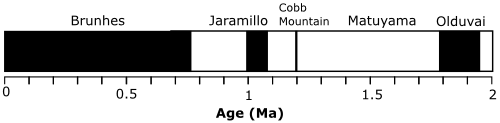
The last couple of million years worth’ of reversals. Each polarity interval, or ‘chron’, is named after either a famous palaeomagician (Brunhes, Matayama) or the location where it was first identified (Olduvai).
You can’t help but notice that the typical period between the reversals in the last couple of million years is a lot less than 780,000 years, which is why you might hear talk about us being ‘overdue’ a reversal. Is this true? When can we next expect the field to reverse? And should we care if it does?
Continue reading →