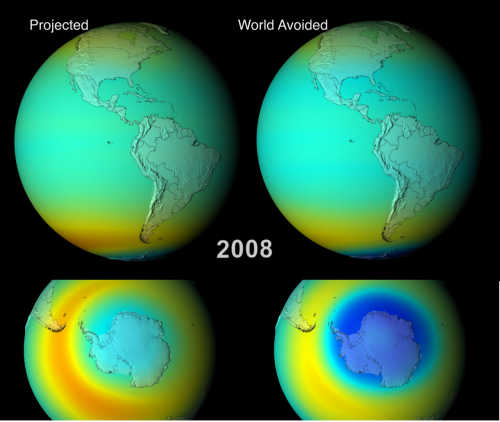
 During our little climatic digression in this week’s podclast, Chris brought up a study that I hadn’t heard about, in which Paul Newman (no, not that one) of NASA’s Goddard Centre (who have a nice write-up) and his colleagues play a game of climatic what if: what if the discovery that chlorofluorocarbons (CFCs) destroyed stratospheric ozone had been ignored, and were not phased out in the decade following the signing of the Montreal Protocol in 1987? Do our more sophisticated climate models, which can more accurately simulate atmospheric chemistry and wind patterns, confirm the hypothesis that if we had continued to emit CFCs and other ozone destroying chemicals, the ozone layer would have been severely damaged?
To answer this question, Newman et al. ran two scenarios in the same climate model, and charted the evolution of stratospheric ozone in each. The first model was based on the current (low) emissions of ozone-destroying chemicals resulting from the implementation of the Montreal Protocol; in the second, rather poetically named “world avoided” model, CFC emissions increase by 3% a year (“business as usual”) after 1974, when the ozone alarm was first sounded (and was presumably ignored in this parallel universe).
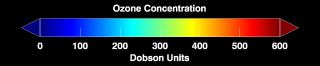
Animations fully depicting the results of both scenarios between 1974 and 2065, are available, and are well worth a watch. Below I show some edited highlights: side-by-side comparisons of the two models during September/October (southern hemisphere spring, when the Antarctic ozone hole reaches it’s maximum extent) in 2008, 2020, 2040 and 2060.