Where on (Google) Earth #183

A post by Anne JeffersonI won the Where on (Google) Earth contest #182, hosted by Dr. Jerque at Geologic Frothings, by correctly identifying the location near Aktash, Altai Republic, Russian Federation. At that spot, some intriguing geomorphic stuff happened once upon time. More specifically, starting in these mountains, spectacular Pleistocene ice-dam failure megafloods raced across the Asian continent eventually reaching the Caspian, Black, and Mediterranean seas. Discharge from these floods is estimated to rival, or even exceed, the Missoula Floods. The location Dr. Jerque put in the spotlight is close to one of the ice dams, has some absolutely spectacular ripple fields, and is just upstream of an amazing gorge created by water rushing up to 45 m/s (162 km/hr, 100 mi/hr). There’s a really nice write-up of the floods, with on-the-ground photos, that can be found here.
Having just searched out one of the most jaw-droppingly powerful geomorphic spots on Earth, I’ve opted to go for something a bit more subtle for Where on (Google) Earth #183. Nonetheless, I think there’s something geo-interesting going on in this image. The eye altitude here is ~15 km and the vertical exaggeration on my browser was set to 2.
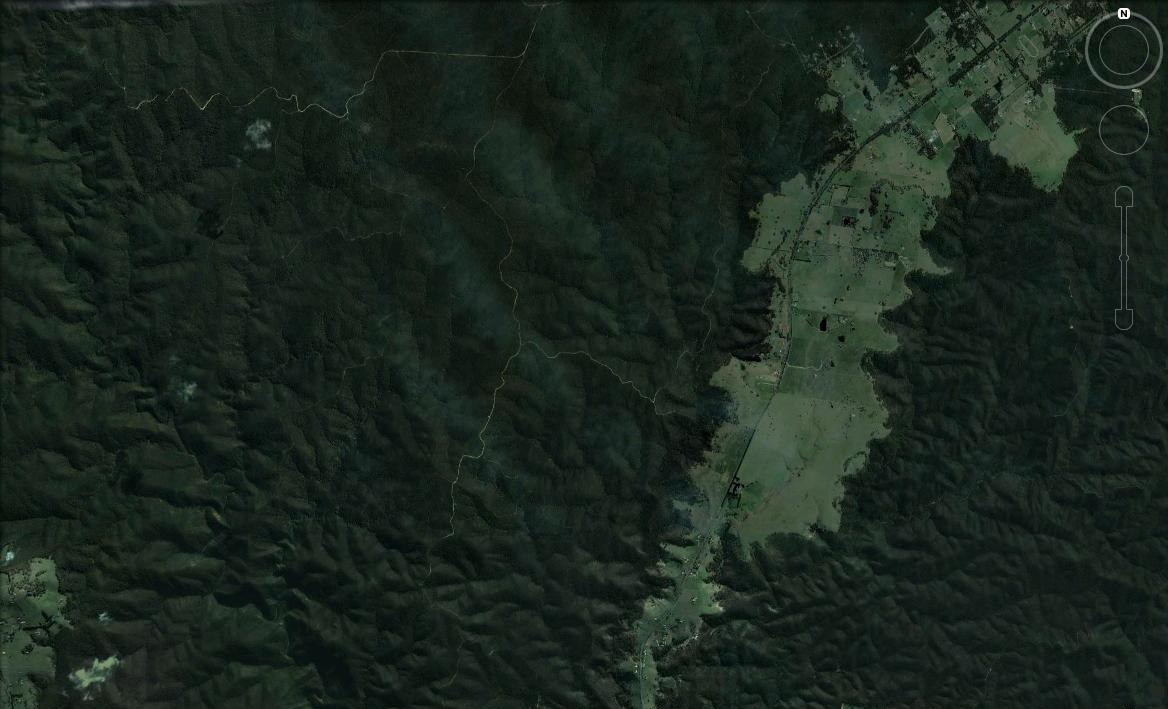
woge183-500.jpg
Click the image for a larger version.
First person to identify the latitude and longitude of the image, give a place name, and take a decent stab at why it might be interesting gets the honor of hosting the next round of the game. If you are not a blogger, you can still play, win, and then designate the blogger of your choice to host your image and the next round. I’m invoking the Schott Rule (sorry, Ron), which means that you need to wait one hour after the post time to answer for each Wo(G)E round you’ve won in the past.

Categories: by Anne, outcrops

Neoproterozoic signs of life

A post by Chris RowanResearchBlogging.orgFossils older than the base of the Cambrian – 542 million years ago – are not exactly abundant, so it was interesting to see not one, but two interesting papers in the latest issue of Geology that describe fossils from the Neoproterozoic period, from 1000 to 542 million years ago.
The first paper reports the discovery of 565 Ma trace fossils found at Mistaken Point in Newfoundland. Mistaken Point is the location of a nice section across the Cambrian boundary, and hosts the oldest known fossilised Ediacaran macrofauna (at least 10 million years older than the ones I’ve seen in Namibia).

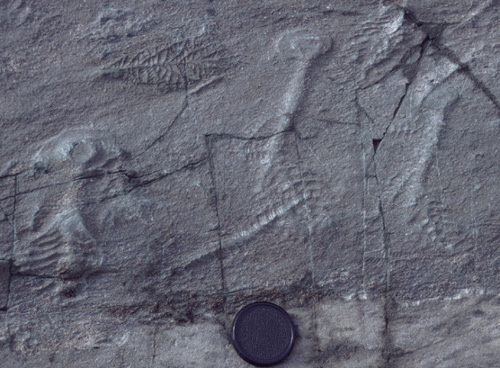
mistaken4.jpg
Ediacaran fossil, Mistaken Point. Source

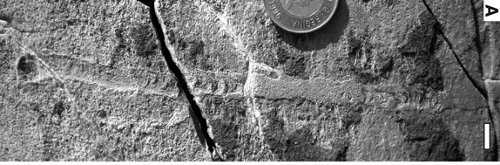
Ediacarans have generally been interpreted as immobile, bottom-dwelling filter feeders, but Liu et al. have discovered a horizon in the sequence that appears to show that something was moving around:

Mistaken_Point_Trace.jpg
Source: Liu et al., Figure 2

These trail-like features are found on the top of a fine green mudstone unit, laid down in deep water, that is capped by a volcanic tuff (which probably helped in their preservation). Liu et al. found 70 tracks about 1cm wide and up to 17 cm long. The crescent shaped ridges within the grooves, and their marginal ridges indicate that they have been formed by sediment being pushed aside and piled up by something moving through it. The lack of any consistent orientation, and the fact that a fair number are curved, indicating a change in the direction of motion, makes it unlikely that they are formed by something being passively dragged along by a current.
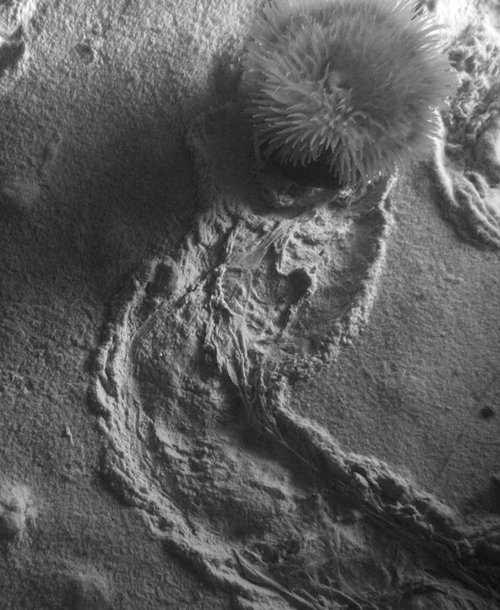
It is not known what manner of creature might have made the trails, as none are preserved at the same stratigraphic level; the only possible clue is that the tracks sometimes end in circular impressions which might mark where the creature that made the trails was resting before or after moving. Whilst the authors say that the possibility of them being made by giant single-celled protists cannot be discounted, they remark that modern sea anenomes can leave similar trails..

anenome_trail.jpg

It seems, then, that an anenome-like creature (in terms of body form and/or mode of life, at least, if not direct descent) is their favoured culprit.
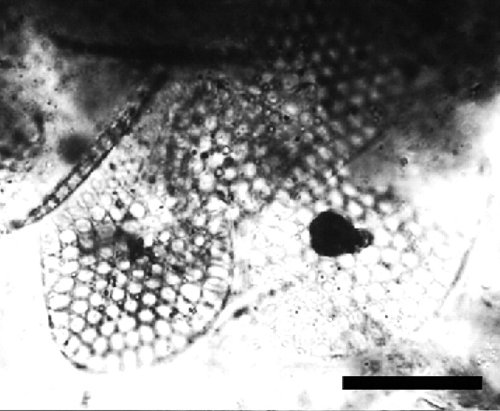
The second paper concerns these unusual microfossils from the Tindir group of northwestern Canada:

Tindir_microfossil.jpg
Scale bar is 15 μm. Source: Macdonald et al., Figure 1

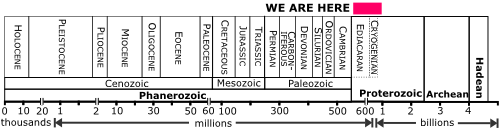
The little mineralised scales are quite interesting; the appearance of mineralised body parts is also associated with the Cambrian diversification, although the whys and wherefores are still disputed. Modern scale-forming groups of micro-organisms are also all eukaryotes, which suggests (although does not prove) that these critters were too. So from an evolutionary perspective, they’re quite interesting; unfortunately the sequence they were found in was not particularly well-dated, so based mainly on fossils like this they were placed close to the Cambrian boundary. With some more thorough mapping and geochemical correlations, however, Macdonald et al. have shown that the fossil-bearing formations were deposited prior to glacial deposits linked to the period of extreme “Snowball Earth” glaciations between about 750 and 635 million years ago. This means that the microfossils pictured above must be at least 750 million years old. Since the Snowball Earth theory proposes an extreme winnowing of most life due to the whole Earth being frozen over, this is a valuable glimpse at what might have occupied the pre-Snowball world, and tests the biological part of the hypothesis.
Taking a wider perspective, what both of these papers demonstrate is that whilst the the dawn of the Cambrian clearly marked the diversification of mobile, active animals and biomineralisers, the story of their first origins appear to have begun earlier, possibly much earlier; something to bear in mind when we are trying to link biological changes on the ancient Earth to wider geological events.
Liu, A., Mcllroy, D., & Brasier, M. (2010). First evidence for locomotion in the Ediacara biota from the 565 Ma Mistaken Point Formation, Newfoundland Geology, 38 (2), 123-126 DOI: 10.1130/G30368.1
Macdonald, F., Cohen, P., Dudas, F., & Schrag, D. (2010). Early Neoproterozoic scale microfossils in the Lower Tindir Group of Alaska and the Yukon Territory Geology, 38 (2), 143-146 DOI: 10.1130/G25637.1

Neoprotfoss_timescale.png

Categories: fossils, geology, paper reviews, past worlds, Proterozoic

Is tweeting bad for blogging?

A post by Chris RowanIt’s been pretty much a year since I first climbed aboard the Twitter bandwagon, and I’ve been musing of late of how it has gone from being something I didn’t really get at all, to becoming a fairly central part of how I interact with the Internet. It’s usually where I first get wind of big events (the Haiti earthquake, for example), it guides me to interesting news both within and without the world of science; and it keeps me up to date with the doings and thoughts of a lot of my online friends. But, I realise, not all of them, and I am starting to wonder if a problem is brewing – a disconnect between those who choose to tweet, and those who do not. Thus I’ve been thinking fairly seriously about what effect my changed online habits have had in my interactions with the world of blogs, particularly the geology-centric part of it. There have certainly been changes that may potentially have had a negative impact: whereas before I used to check my aggregated geoblogging feed over breakfast, now I’m much more likely to check my Twitter feed. Time I might have spent writing a comment on somebody’s post might now be spent writing a tweet (or retweet) about it instead – which might drive some traffic to said post, but does potentially divorce some of the conversation about a post from the post itself (and by extension, the author).

Continue reading

Categories: bloggery

Stuff I linked to on Twitter last week

A post by Chris RowanGoogle Maps alphabets
http://www.telegraph.co.uk/technology/picture-galleries/5757548/The-Google-Maps-alphabet-UK-an-A-to-Z-of-the-British-Isles.html
http://www.telegraph.co.uk/news/picturegalleries/howaboutthat/5214494/Rhett-Dashwoods-Google-Maps-alphabet.html
NOVA Geoblog reviews "Reading the Rocks" by Marcia Bjornerud [adding to Amazon wish list in 3..2..]
http://nvcc.edu/home/cbentley/geoblog/2010/02/reading-rocks-by-marcia-bjornerud.html
(via @Geoblogfeed)
More geotagging propaganda:
http://geofroth.org/?p=475
[You can do things like this
(via @drjerque)
The Other California: Be a Geotripper Geoblogger for a Day! Crowd-sourced geoblogging!
http://geotripper.blogspot.com/2010/02/other-california-be-geotripper.html
(via @Geoblogfeed)
Shell’s David Hone on iPad vs CRU pseudoscandal: We love tech, but science not so much…
http://tinyurl.com/ydssrnh
(via @mtobis, @EnergyCollectiv)
Icy volcanic breccia [as in, ice clasts WITHIN volcanic breccia…]
http://nvcc.edu/home/cbentley/geoblog/2010/02/icy-volcanic-breccia.html
(via @Geoblogfeed)
Renaissance of Technicolor dinosaurs continues. Last week’s researchers were "in the Stone Age".
http://scienceblogs.com/notrocketscience/2010/02/the_renaissance_of_technicolour_dinosaurs_continues_and_the.php
(via @edyong209)
New maps of Pluto! Best until New Horizons within 6 months of 2015 flyby
http://www.nasa.gov/mission_pages/hubble/science/pluto-20100204.html
(via @elakdawalla, @plutokiller)
How can we bridge between geologic and human timescales to help avert disaster? Read AGU’s Haiti blog:
http://www.agu.org/blog/Haiti/?p=48
(via @theAGU)
Free access to AGU papers on Caribbean plate for a limited time.
http://www.agu.org/news/archives/2010-02-02_CarribeanPlatePapers.shtml
(via @theAGU)
OK, that’s pretty darn cool : Termite Mounds from Space: Myrmecos Blog.
http://myrmecos.wordpress.com/2010/02/04/finding-termites-on-google-earth/
Must-red Eureka column on science and journalistic balance by @markgfh.
http://www.timesonline.co.uk/tol/news/science/eureka/article7011355.ece
Why the denial camp is winning (and we’re all losing) the climate wars.
http://scienceblogs.com/islandofdoubt/2010/02/why_the_denial_camp_is_winning.php?utm_source=selectfeed&utm_medium=rss
(via @ScienceBlogs)
Searching for Africa’s Last Glaciers in the Mountains of the Moon, Uganda.
http://www.e360.yale.edu/content/feature.msp?id=2237
(via @highlyanne, @YaleE360)
Cool, if small, picture: Fukutokuoka no Ba Undersea Volcano Erupts.
http://mdn.mainichi.jp/mdnnews/news/20100204p2a00m0na017000c.html
(via @GeologyDotCom)
Some nice photos of dikes that fed Deccan flood basalts, India.
http://suvratk.blogspot.com/2010/02/plumbing-beneath-deccan-volcanic.html
Excellent post at Eruptions setting recent Yellowstone eq swarm in context. All structure, no magma.
http://scienceblogs.com/eruptions/2010/02/the_structure_of_calderas.php
To end this week’s space budget discussions on a cheerier note: Cassini Mission extended until 2017. Huzzah!
http://www.nasa.gov/mission_pages/cassini/whycassini/cassini-20100203.html
Ediacaran animal trails? Evidence of ‘anemone-like’ movement in 565 Myr rocks from Newfoundland
http://www.sciencedaily.com/releases/2010/02/100203085914.htm
(via @geosociety)
Single-celled organism grows into ‘monstrous beach ball’ 20 cm diameter. A single cell!
http://www.newscientist.com/article/dn18468-zoologger-living-beach-ball-is-worlds-largest-cell.html
(via @rowanNS)
Wind abraded ventifacts on Mars and Earth: IAG Planetary Geomorph image of the month.
http://www.psi.edu/pgwg/images/feb10image.html
(via @highlyanne)
Wow. Another incredible Hubble image… of an asteroid collision in space!
http://blogs.discovermagazine.com/badastronomy/2010/02/02/hubble-captures-picture-of-asteroid-collision/
(via @DiscoverMag, @BadAstronomer)
Airborne Radar Image of Post-Quake Haiti . Some interesting background: 40km fault rupture, propogating W from epicentre.
http://www.jpl.nasa.gov/news/news.cfm?release=2010-037
If civilisation collapses, how much of our knowledge would future humans be able to retrieve? Not much…
http://www.newscientist.com/article/mg20527451.300-digital-doomsday-the-end-of-knowledge.html
(via @rowanNS)
Such an important point: Writers are Made not Born
http://serc.carleton.edu/earthandmind/posts/born.html
Simulations suggest rocky Earth-mass worlds could have formed in Alpha Centauri binary system. But in what orbits?
http://www.newscientist.com/article/dn18451-what-alien-worlds-orbit-our-nearest-star.html
Chemistry Creates Self-Stirring Liquids (w/video). Wonder if this relevant for core/mantle?
http://www.wired.com/wiredscience/2010/01/self-stirring-liquids/
(via @ScienceSoWhat)
Something rotten in the state of palaeontology. Decay removes acquired characters first. Interesting!
http://www.nature.com/news/2010/100131/full/news.2010.45.html/ [subscription only]
(via @NatureNews)
Online gallery for geology & art exhibit. Interesting, wish was more description of pieces.
http://www.twowallgallery.com/geosapiens.html
(via @clasticdetritus)

Categories: links

Man-made mud volcano starting to look like a real volcano

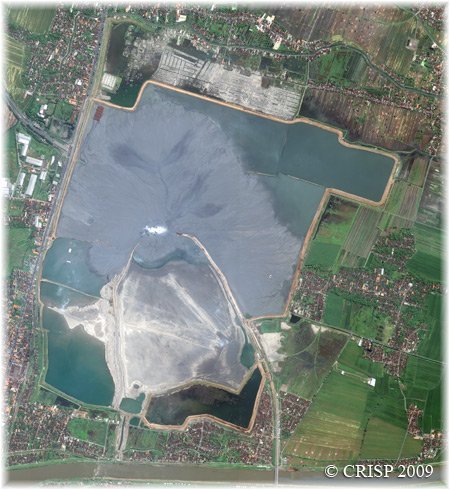
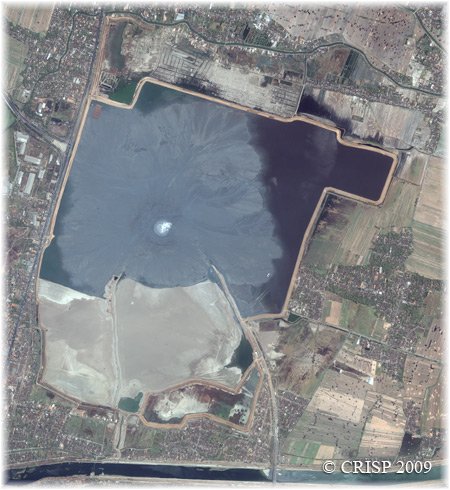
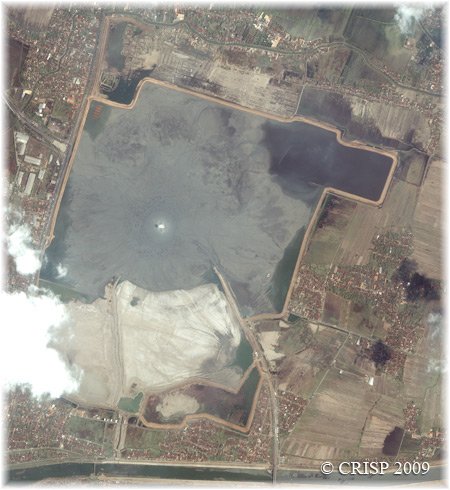
A post by Chris RowanIt’s been a while since my last update on Lusi, the allegedly/probably drilling-triggered mud volcano near Sidoarjo, Indonesia. But the NASA Earth Observatory has just released this image, taken last autumn:

Lusi_Oct08.jpg
Lusi,October 2009. Source: NASA Earth Observatory

My first thought on seeing this was, “Woah, where’d that mountain come from?” In the last images I had seen, Lusi had from above was effectively a big muddy pool, contained within man-made earthworks, with a steaming vent in the middle. This had been pretty much the case for the previous couple of years.

lusi_Oct08.jpg
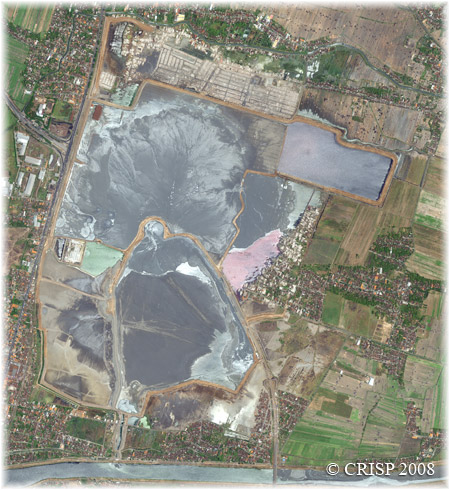
Lusi, October 2008. Source: CRISP

Now, it’s a big muddy pool with a big steaming hill in the middle. By looking through the satellite snapshots put out every couple of months by the Centre for Remote Imaging, Sensing and Processing at the University of Singapore (of which the October 2008 image above is one), you can see that over the last 12 months or so Lusi appears to have started building up instead of out, with the causeways and dams around the vent being gradually swallowed up by the grey ooze.

Lusi_May09.jpg
Lusi, May 2009. Source: CRISP

Lusi_Sep09.jpg
Lusi, September 2009. Source: CRISP

Lusi_Dec09.jpg
Lusi, December 2009. Source: CRISP

It seems, then, that Lusi has entered a new phase of its life. I wonder if this growth has anything to do with subsidence in the area?

Categories: geohazards, Lusi