Accretionary Wedge Call For Posts: Geo-Image Bonanza!

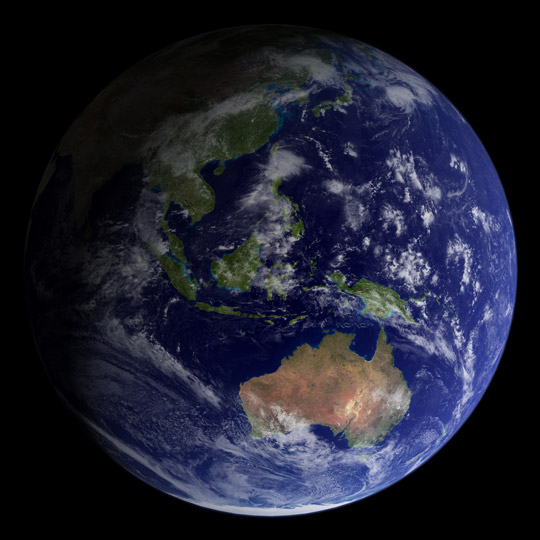
A post by Anne JeffersonA post by Chris RowanWe’re pleased to announce that the next edition of the geoblogging carnival, The Accretionary Wedge, will be held here (for the first time ever!) at Highly Allochthonous at the end of the month. The theme that we’ve chosen is simple: we want to amass a gallery of all of your favorite geologically themed pictures.
It could be a photograph you’ve taken of an outcrop or process in action; a diagram from a classic geologic paper or text book; a satellite image of an incredible landscape; an optical microscope picture of your favorite mineral; something topical, or an old and inspirational favorite. Whatever strikes your fancy. You might consider writing a little about what your chosen images shows or why you chose it, but wordless entries are OK too. We’re also OK with recycled submissions if you’ve got a post in your archives that fits the carnival theme.
The deadline for submission of posts will be Friday, May 28. To submit your entry, leave a link to in the comments section here or at the Accretionary Wedge blog. We encourage our non-blogging readers to contribute their favorite images as well: we’ll be happy to publish your image here.
NASA's Blue Marble, 2002 edition

NASA’s Blue Marble, 2002


If a picture is worth a thousand words, we should be able to amass an entire visual novel by the month’s end. We look forward to seeing what you all choose!

Categories: bloggery

Where on Google Earth #202

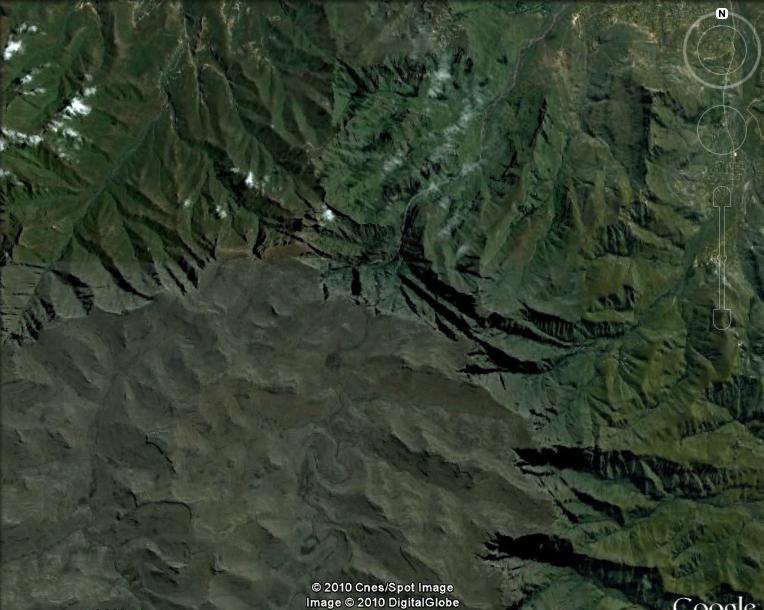
A post by Anne JeffersonA few days ago I got to learn about the Stikine terrane, its beautiful folded rocks, and its potential fossil fuel reserves during the course of searching and winning the 201st edition of Where on Google Earth. Now it’s my turn to maybe inspire someone to learn about a new piece of the Earth’s surface as I get to host the 202nd edition of this geoblogospheric scavenger hunt.
For those that haven’t played before, here’s a quick overview of the rules. First one to correctly identify the latitude and longitude of the center of the image AND say something about what makes this area geologically interesting…wins. The prize is getting to pick the next WoGE location and hosting it on your blog or picking a geoblogger to host it for you. If you’ve won WoGE in the past, you have to wait one hour before submitting your answer for each of your previous wins (the Schott Rule).
I think that this image will be fairly easy to identify, so I’ve made it a wee bit harder by cropping off the scale bar. Good luck and happy hunting.
woge202.jpg

Categories: by Anne, outcrops

Drilling for oil is more risky than it used to be

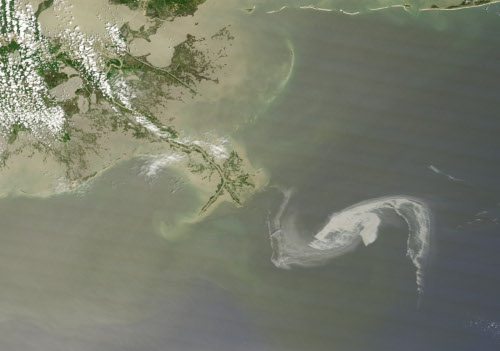
Gulf of Mexico oil slick, April 29
Satellite image of the Gulf of Mexico oil slick, April 29. Source: NASA Earth Observatory.

A post by Chris RowanThe causes of the explosion on the Deepwater Horizon rig that has led to 5000 barrels (210,000 gallons) of oil a day being leaked into the Gulf of Mexico, and an oil slick that can be seen from space, are still murky (Update: but check out a detailed account of the accident, courtesy of mandobob in the comments below). What we do know so far does not reflect particularly well on BP, who apparently understated the magnitude of the leak following the accident. Worse, just today the New York Times has reported claims that they exceeded the remit of their licence by drilling too deeply, and decided against installing a cut-off valve in the well, (in addition to choosing not to install another safety device that could also have shut off the well) although in the latter case I find the fact that BP had a choice in the matter just as disturbing as the fact that they chose incorrectly.

But there is a wider point to be considered here. The offshore drilling industry is currently undergoing a transition. Most easy targets have already been developed, and yet global demand for oil is not abating. In an attempt to quench this thirst, attention is moving into more technically challenging areas, with more complex geology and often in the deeper waters of the outer continental shelf continental slope. The increasing complexity of the equipment required to drill in such areas increases the number of things that can go wrong, and the location of the drilling makes dealing with catastrophic failures much more difficult, as we are seeing all too clearly this week.

Even if you set aside the climatic impacts of using oil to fuel our civilisation, there are environmental risks associated with drilling for it and transporting it. But I’m not sure that many people fully appreciate that for the newer oil fields that are being developed, and proposed for development, these risks are potentially much higher. The fact that current industry practices have, on the whole, not led to major spills in the past couple of decades* is no guarantee that they reduce the risks to acceptable levels at these new, more extreme drilling locations. This is especially true when, in the absence of rigorous regulatory scrutiny, oil companies are tempted to take shortcuts that may not have led to disaster in the past, but could be catastrophic where the margins of safety are lower.

In that context, I have been struck by several parallels between events in the Gulf of Mexico and Lusi , the mud volcano in Indonesia that is widely believed to have been triggered by exploratory drilling. In both cases, drilling was taking place in a difficult drilling environment with low margins of error (in the case of Lusi, the suspect hole was drilled in an area ‘primed’ for mud volcano formation). In both cases, the drilling companies did not follow absolute best practice (in the case of Lusi, they failed to case the well, which would probably have prevented the blow-out). In both cases the environmental and economic consequences for the surrounding area are severe and of long duration.

At the moment, the focus is rightly on trying to seal the Deepwater Horizon well leak and reducing as much as possible the environmental damage in the Gulf of Mexico. But one fact cannot, and should not, be ignored: the demand for oil is not going away any time soon. That demand is driving drilling in places where accidents of this sort – major, hard to stem leaks – are going to be a major risk, and our safety regulations should be evolving to adjust to this new reality. As a start, I’d propose that emergency shut-off valves cease to be an optional extra on drilling rigs.

*this ignores, of course, what has been recently pointed out by Lab Lemming, and Lisa Margonelli in the New York Times: that major spills have been regularly occurring – and largely ignored by the developed world – in places like Nigeria. The fact that oil companies have such a poor record in places unlikely to be touched by Western media and public outrage does not instil much confidence in the idea of self-regulation.

Categories: environment, geohazards

Boobquake: a slightly silly test of a ridiculous scientific hypothesis

A post by Anne JeffersonIt seems that whenever a natural disaster (or other tragedy) strikes, there is but a short delay before someone with a megaphone and an axe to grind points his finger at an entirely innocent group of people and blames them as the cause of the tectonic activity, meteorological phenomenon, or terrorist act.
What am I talking about? Pat Robertson has said that the Port-au-Prince earthquake was caused by a pact the Haitians had made with the devil. Rush Limbaugh recently suggested that the Eyjafjallaj??kull eruption was a response to the passage of the US healthcare bill (displaying a somewhat tenuous grasp of geography as well as geology). Or remember when Jerry Falwell blamed feminists, lesbians, and the ACLU for the 9-11 terrorist attacks? It’s a strange and loathsome pathology that pushes aside science in favor of demonizing those with little power.
The latest incarnation of such wackaloonery is the statement by an Iranian cleric that the immodest dress of women is the cause of earthquakes:

“Many women who do not dress modestly … lead young men astray, corrupt their chastity and spread adultery in society, which (consequently) increases earthquakes,” Hojatoleslam Kazem Sedighi was quoted as saying by Iranian media. Sedighi is Tehran’s acting Friday prayer leader. (Chicago Tribune, 19 April 2010)

A few days later, the sentiment was supported by Iran’s top spiritual leader:

“We can avoid earthquakes if the faithful and devoted people pray to God,” Jannati said during the Friday sermon. (LA Times, 23 April 2010)

Jen McCreight, a Purdue University grad student, has had enough of this nonsense and has dreamed up and organized a grassroots effort to test the correlation between immodestly dressed women and seismic activity. Today, 26 April 2010, is the day of the “boobquake,” in which thousands of women around the world will wear the least modest shirt in their closet in attempt to set the seismograph needles trembling. After the day is over, McCreight and others will show statistically that seismically…nothing happened. Because women’s bodies do not cause earthquakes.
If you want to follow the silly science, you can read McCreight’s blog, check the hashtag #boobquake on Twitter, or check in on the Facebook event page (177,829 confirmed attendees at this moment). The mainstream media has also picked up on this event, so you may hear something about it on radio or TV.
If you are concerned that this event is somehow anti-feminist or demeaning to women, here’s what McCreight has to say about it:

I’m asking women to wear their most “immodest” outfit that they already would wear, but to coordinate it all on the same day for the sake of the experiment. Heck, just showing an ankle would be considered immodest by some people. I don’t want to force people out of their comfort zones, because I believe women have the right to choose how they want to dress. Please don’t pressure women to participate if they don’t want to. If men ogle, that’s the fault of the men, not me for dressing how I like. If I want to a show a little cleavage or joke about my boobs, that’s my prerogative.

So today I’m wearing a shirt that I wouldn’t normally wear to work and I’ll probably start my 90% male hydrogeology class with a brief mention of earthquake hazards. Because even though I know that the actions of tens of thousands of women for one day aren’t going to change the minds of Iranian clerics or make a measurable difference in women’s rights or sexist attitudes, I also know that my shirt is not going to cause an earthquake. And, in the words of boobquake organizer McCreight: “I’m a firm believer that when someone says something so stupid and hateful, serious discourse isn’t going to accomplish anything – sometimes light-hearted mockery is worthwhile.”

Categories: antiscience, by Anne, ranting

Stuff I linked to on Twitter last week

A post by Chris RowanBefore you check out the interesting bits of my Twitter stream for the last week, I highly recommend clicking through to the latest edition of the geology blogging carnival The Accretionary Wedge, hosted at Callan Bentley’s Mountain Beltway. The theme this month was ‘geological heroes’, and it’s a fascinating look at some of the people who have influenced your favourite geobloggers’ careers and scientific outlooks.

Volcanos

Interesting look at optical properties of ash erupted from Eyjafjallaj\u00f6kull from
http://earthobservatory.nasa.gov/NaturalHazards/view.php
Nice summary of Eyjafjallaj\u00f6kull eruption so far from BGS
http://www.bgs.ac.uk/research/highlights/changingEruptionstyles.html
Totally. Awesome. : Spectacular footage of bombs exiting the Icelandic crater at 100s of m elevation:
http://www.youtube.com/watch?v=n6dDesUPkMo
(via @callanbentley)
Glacio-volcanic expert John Stevenson continues to provide some great background on Eyjafjallajokull eruption #ash
http://johnalexanderstevenson.blogspot.com/2010/04/eyjafjallajokull-update-more-musings.html
http://johnalexanderstevenson.blogspot.com/2010/04/eyjafjallajokull-update-more-on.html
Nice! Great plots of #ash plume last week from Man Uni LIDAR
http://data.cas.manchester.ac.uk/lidar/
(via @dr_andy_russell, @alomshaha)
What causes the volcanic lightning in the Eyjafjallaj\u00f6kull #ashcloud?
http://scienceblogs.com/startswithabang/2010/04/volcanic_lightning_eyjafjallaj.php
The scourge of jet engines everywhere: Eyjafjallajoekull ash at x20 magnification.
http://www.flickr.com/photos/interactives/4528599823/
(via @sciencebase)
Scripps scientists reveal why Iceland’s volcanoes are seething with history:
http://explorations.ucsd.edu/Features/2009/Seething_History/
(via @Explorations)
Wonderful video footage of Eyjafjallajokull’s explosive eruptions:
http://www.guardian.co.uk/world/video/2010/apr/19/iceland-eyjafjallajokull-volcano-erruption-ash
(via @kejames)
Volcanic Ash Gives Jet Engine a Turbocharge [before shredding and clogging them up, anyway…]
http://news.discovery.com/earth/volcanic-ash-gives-jet-engine-a-turbocharge.html
(via @RonsGeoPicks)
Awesome shot of lightning around Eyafallaj\u00f6kull eruption plume (h/t )
http://www.swisseduc.ch/stromboli/perm/iceland/eyafallajokull_20100416-en.html?id=14

Planets

Pretty amazing new images of solar activity: [Video] This solar loop is 30 times the size of Earth!
http://www.nasa.gov/mov/445831main_Alan%20Video%201-First%20sun%20image%20and%20footage%20H264.mov
(via @CPPGeophysics, @NASA)

General Geology

Embedded sensors to monitor landslide-prone areas
http://www.physorg.com/news191176760.html
Project site with realtime data
http://sdcoastalstorms.org/index.cfm?method=cPortal.Init
V interesting movies of analogue deformation expts: gypsum+sugar->boudins, yoghurt+cherries->shear zones!
http://www.youtube.com/user/StrucGeology
Mark Twain the geologist [Only loosely. But v interesting, all the same]
http://throughthesandglass.typepad.com/through_the_sandglass/2010/04/mark-twain-the-geologist.html
(via @RonsGeoPicks)
Ancient rock slide shifted the Continental Divide [only by 80m, but still – impressive]
http://www.montrealgazette.com/news/Massive+ancient+rockslide+shifted+geography+continent+Study/2934202/story.html
(via @geology4u)
Braided Streams of Yore
http://pascals-puppy.blogspot.com/2010/04/braided-streams-of-yore.html
(via @RonsGeoPicks)

Environmental

Arctic Sea Ice Extent, 2009-2010 Sept minimum 5.4 million sq km, bang between extreme 2007 low and 1979-2000 average.
http://earthobservatory.nasa.gov/IOTD/view.php
Nice to see some actual figures: Carbon Capture and Storage increases energy costs by up to 25%
http://europe.theoildrum.com/node/6398
(via @TheOilDrum)
Interesting discussion of climatic forcing of landslides & other geohazards (via )
http://blogs.nature.com/news/thegreatbeyond/2010/04/can_climate_change_make_the_be.html
(via @NatureNews)
Special issue of Phil. Trans Roy. Soc. on issue
http://rsta.royalsocietypublishing.org/content/368/1919.tocx
Feel free to doubt climate change: just don’t deny it [finally, a sensible analysis in MSM]
http://www.guardian.co.uk/environment/2010/apr/18/climate-change-east-anglia-report
72 1/2 bath fulls of water to make just one pair of jeans. See how our water imports worsen global water shortage.
http://news.bbc.co.uk/1/hi/sci/tech/8628832.stm
(via @suehutton)
Disturbing: Cerro de Pasco in Peru being devoured and poisoned by mine Look it up on Google Maps. Eye-opening.
http://www.physorg.com/news190816505.html

Interesting miscellaney

Sir Paul Nurse calls for reform of science funding [stable, long term funding for the ‘best’?]
http://www.timesonline.co.uk/tol/news/science/article7106626.ece
(via @TimesScience)
Nothing new under the sun: in 1954 ‘Climategate’ was ‘Tobaccogate’. Excellent piece by
http://www.thenation.com/doc/20100503/hari
It’s a microbial world – survey reveals oceans host vast diversity of (individually) rare species.
http://www.nature.com/news/2010/100418/full/news.2010.190.html
(via @NatureNews)

Categories: links