 Meandering rivers are characterized by regularly spaced bends that grow and cutoff and generally march downstream in a fairly orderly fashion. Click the image below to watch a movie of meander migration on the Allier River near Chateau de Lys, France
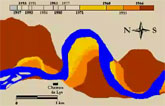
Movie 1. Meander bend migration and cut off using aerial photos and maps from: 1945,1960,1971,1980,1982, 1992, 1995, and 1997 on the Allier River, France. Created by A. Wilbers, originally found here.
Though meandering rivers are by far the most common river form on Earth, building a meandering river in a laboratory flume eluded scientists for decades. The conditions necessary to support self-maintaining meandering rivers were not known well enough to recreate in the laboratory. Flumes, or experimental channels, are a really important tool for understanding river processes, because sediment and water influxes can be tightly controlled and high precision measurements made.
Sand and gravel, the most common sediments in river banks, have low cohesion. In flumes, channels through sand and gravel, even if initially forced into a meander form, inevitably end up as wide channels with active braid bars. Solving the bank cohesion problem, by replacing sand and gravel with silt and clay, results in flume channels that have lots of curvature (sinuousity) but do not maintain their geometry through multiple meander cut-offs. Over the last 10 years, graduate students Karen Gran and Michal Tal working with Chris Paola at the University of Minnesota figured out how to make a self-sustaining single channel in coarse sediment. The key to creating a single channel was to plant alfalfa seedlings to give the banks some cohesion. You can see the results of alfalfa growth in a Quicktime video of Tal’s experiments. (Click the image below.)
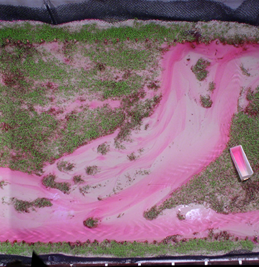
Movie 2. Tal and Paola’s experiments with alfalfa seedlings and channel form. More movies of these experiments here.
If you watched the video, you’ll notice that while the channel is indeed single thread and it does move around, the meanders don’t move downstream in the relatively orderly fashion of a natural river. So the insight of alfalfa sprouts from Gran and Paola (2001) and Tal and Paola (2007) got geomorphologists a long way towards understanding the controls on meander self-maintenance in coarse-bedded rivers, but they didn’t quite reach the finish line.
Now, a paper in the Proceedings of the National Academy of Sciences by UC Berkeley graudate student Christian Braudrick, his advisor Bill Dietrich and collaborators Glen Leverich and Leonard Sklar from San Francisco State University reports that they have succeeded where so many others have failed. In a 17-m long, 6.7 m wide flume, Braudrick and colleagues created a self-sustaining meandering channel. Their work was featured on National Public Radio’s Science Friday show, which produced the following video giving the basics of Braudrick’s process.
Movie 3. Science Friday’s video about Braudrick et al’s experiments.
One of the key things mentioned in the video, but not explained is why the lightweight sediment was plastic. In slimming down a river to fit within a laboratory, researchers have to take into account all of the possible scaling effects. That’s why alfalfa seedlings are used to simulate the grasses and trees of a normal riparian zone, for instance. The power of the water, or its shear stress, is a function of depth, slope, fluid density, and gravity. Since the depth of flume channels is so much smaller than real rivers, it means that the shear stress available to move sediment is much lower. This means flumes can’t move fist sizes pieces of gravel and the size of the sediment in the study must be scaled down accordingly. Gravel scales down reasonably well to coarse sand, but sand scales down to silt, and silt has much different cohesive properties than sand. This is where the plastic came in, because the researchers wanted to create meanders using the alfalfa to create cohesive banks not by adding cohesive sediment. The plastic beads were the size of very fine sand and they lacked cohesion. Thus, the researchers created laboratory conditions of that mimicked natural rivers – channel banks where there was a mixture of sizes of non-cohesive sediment held together by roots.
When the flume was turned on, the little plastic beads moved both along the channel bed and suspended within the water column, much as sand would do in a natural channel. With a small initial curvature at the upstream end of the flume, meanders propogated downstream and began to grow and cut off. In previous alfalfa-only experiments ( Tal and Paola, 2007), each time meanders were cut off, a trough was left on the upstream side of the abandoned meander. In natural systems, these troughs get plugged with fine sediment and create oxbow lakes that eventually fill in. In the alfalfa-only, the troughs persisted, opening the possibility of islands developing in the channel. In Braudrick’s alfalfa+plastic experiments, the little plastic beads moving in suspension filled in the troughs at the upstream end of the abandoned meander, blocking future flow through that old pathway.
From Braudrick and colleagues’ results, it appears that sand and fine sediment have an important role to play in reinforcing and maintaining the meandering pattern of river channels. Out in the real world, such fine sediment is often regarded as an undesirable pollutant of coarse-bedded rivers, so these results have the potential to change the goals of river restoration and management. Plus, now that geomorphologists have a way to simulate realistic meandering rivers in the flume, new insights into the controls and behavior of meandering rivers are likely to start pouring in.
-
Archives
- September 2025
- July 2024
- March 2024
- January 2024
- October 2023
- August 2023
- July 2023
- May 2023
- March 2023
- February 2023
- December 2022
- November 2022
- September 2022
- July 2022
- May 2022
- November 2021
- October 2021
- September 2021
- August 2021
- August 2020
- July 2020
- May 2020
- April 2020
- March 2020
- January 2020
- December 2019
- August 2019
- March 2019
- February 2019
- January 2019
- June 2018
- May 2018
- February 2018
- January 2018
- December 2017
- October 2017
- September 2017
- August 2017
- March 2017
- February 2017
- January 2017
- December 2016
- October 2016
- September 2016
- August 2016
- May 2016
- March 2016
- December 2015
- November 2015
- September 2015
- August 2015
- May 2015
- March 2015
- February 2015
- January 2015
- December 2014
- November 2014
- October 2014
- September 2014
- August 2014
- July 2014
- June 2014
- May 2014
- March 2014
- February 2014
- January 2014
- December 2013
- November 2013
- October 2013
- September 2013
- August 2013
- July 2013
- June 2013
- May 2013
- April 2013
- March 2013
- February 2013
- January 2013
- December 2012
- November 2012
- October 2012
- September 2012
- August 2012
- July 2012
- June 2012
- May 2012
- March 2012
- February 2012
- January 2012
- December 2011
- November 2011
- October 2011
- September 2011
- August 2011
- July 2011
- June 2011
- May 2011
- April 2011
- March 2011
- February 2011
- January 2011
- December 2010
- November 2010
- October 2010
- September 2010
- August 2010
- July 2010
- June 2010
- May 2010
- April 2010
- March 2010
- February 2010
- January 2010
- December 2009
- November 2009
- October 2009
- September 2009
- August 2009
- July 2009
- June 2009
- May 2009
- April 2009
- March 2009
- February 2009
- January 2009
- December 2008
- November 2008
- October 2008
- September 2008
- August 2008
- July 2008
- June 2008
- May 2008
- April 2008
- March 2008
- February 2008
- January 2008
- December 2007
- November 2007
- October 2007
- September 2007
- August 2007
- July 2007
- June 2007
- May 2007
- April 2007
- March 2007
-
Meta
Comments (15)