Later this month, Caytie, Garrett, and I will be representing the Watershed Hydrology Lab at the Geological Society of America Annual Meeting in Seattle, Washington. Garrett will be presenting the following talk on Monday at 2:55 in Conference Center Chelan 5. Abundance and Geomorphic Function of Wood in Urban Stream …
Today in my flvuial processes class, we’re going to discuss a great paper by Gran et al. on “Landscape evolution, valley excavation, and terrace development following abrupt postglacial baselevel fall.” The paper is set in a landscape I know well – southern Minnesota’s Minnesota River Basin. For my students in …
Next week, the Watershed Hydrology Lab will be well represented at the CUAHSI 2014 Biennial Colloquium. We’ll be presenting four posters, so here come the abstracts… Development of hyporheic exchange and nutrient uptake following stream restoration Stuart Baker and Anne Jefferson Stream restoration is a multi-million dollar industry in Ohio, …
Next week, the Watershed Hydrology Lab will be well represented at the CUAHSI 2014 Biennial Colloquium. We’ll be presenting four posters, so here come the abstracts… After the dam comes out: groundwater-stream interactions and water quality impacts of former reservoir sites Krista Brown and Anne Jefferson Over that past decade, …
A third abstract from our group for the 2012 Geological Society of America meeting: EVALUATING RESTORATION EFFECTS ON TRANSIENT STORAGE AND HYPORHEIC EXCHANGE IN URBAN AND FORESTED STREAMS OSYPIAN, Mackenzie L., Civil Engineering, University of North Carolina at Charlotte, Charlotte, NC 28262, mosypian@uncc.edu, JEFFERSON, Anne J., Department of Geology, Kent …
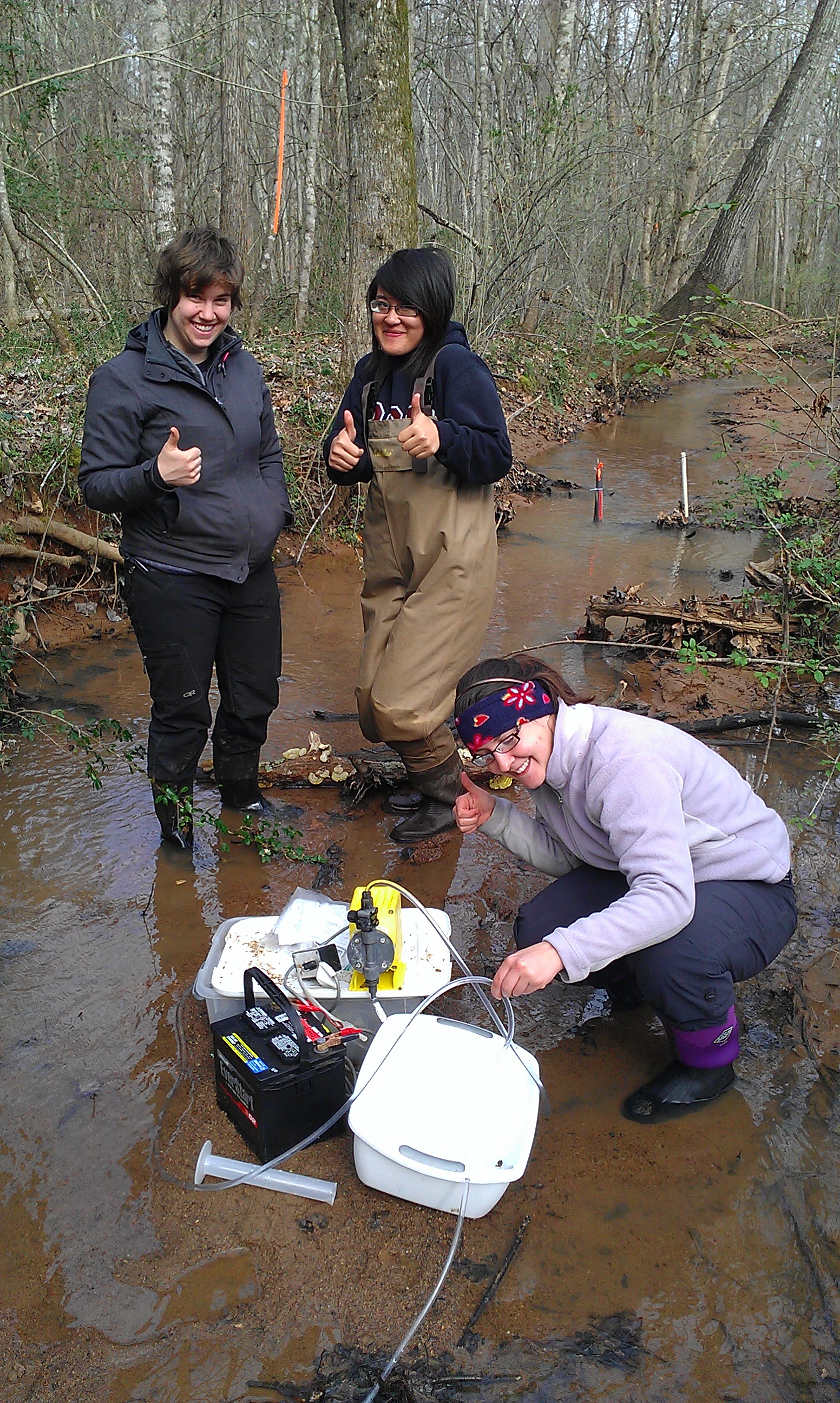
Some of our students are in the field this week, injecting Cl- and Br- into a restored reach and an unrestored reach in tributaries of Beaver Dam Creek. Our goal is to understand the role of wood jams versus restoration structures in promoting stream-hyporheic exchange.
In the photo are Alea, Xueying, and Mackenzie. Photo by Brittany. They’ve got it so capably handled they didn’t even need Sandra or I out there with them today, but I’m going tomorrow for an excuse to be in the field as much as anything.
Some of our students are in the field this week, injecting Cl- and Br- into a restored reach and an unrestored reach in tributaries of Beaver Dam Creek. Our goal is to understand the role of wood jams versus restoration structures in promoting stream-hyporheic exchange.
In the photo are Alea, Xueying, and Mackenzie. Photo by Brittany. They’ve got it so capably handled they didn’t even need Sandra or I out there with them today, but I’m going tomorrow for an excuse to be in the field as much as anything.
Some of our students are in the field this week, injecting Cl- and Br- into a restored reach and an unrestored reach in tributaries of Beaver Dam Creek. Our goal is to understand the role of wood jams versus restoration structures in promoting stream-hyporheic exchange.
In the photo are Alea, Xueying, and Mackenzie. Photo by Brittany. They’ve got it so capably handled they didn’t even need Sandra or I out there with them today, but I’m going tomorrow for an excuse to be in the field as much as anything.
At the 2011 GSA Meeting in Minneapolis next week, I’ll be presenting the following talk in the session “Monitoring and Understanding Our Landscape for the Long Term through Small Catchment Studies I: A Tribute to the Career of Owen P. Bricker.” My talk is in Minneapolis Convention Center: Room M100FG, …
Cross-posted at Highly Allochthonous I’ve got a shiny new Emriver Em2 river processes simulator (i.e., stream table), thanks to departmental equipment funds and enthusiastic colleagues. I’ve been on sabbatical this semester and away from campus, so I haven’t had a chance to play with it yet, but it is enticing …
Major congratulations to two Watershed Hydrogeology Lab graduate students who have finished writing their MS theses and will defend them next week. Ralph McGee and Cameron Moore both started in our MS in Earth Science program in August 2009, and less than two years later they have each completed impressive …
14,000 years ago there was direct connection between what is now the Red River basin and the Minnesota River basin. Today, there’s a continental divide – with the Red flowing toward Hudson Bay and the Minnesota flowing toward the Mississippi and Gulf of Mexico. But what a strange continental divide it is – for it runs through the former outlet of Lake Agassiz, in what is now known as the Traverse Gap. This divide is not so much a high point in the landscape, but a just-not-quite-as-low area.