

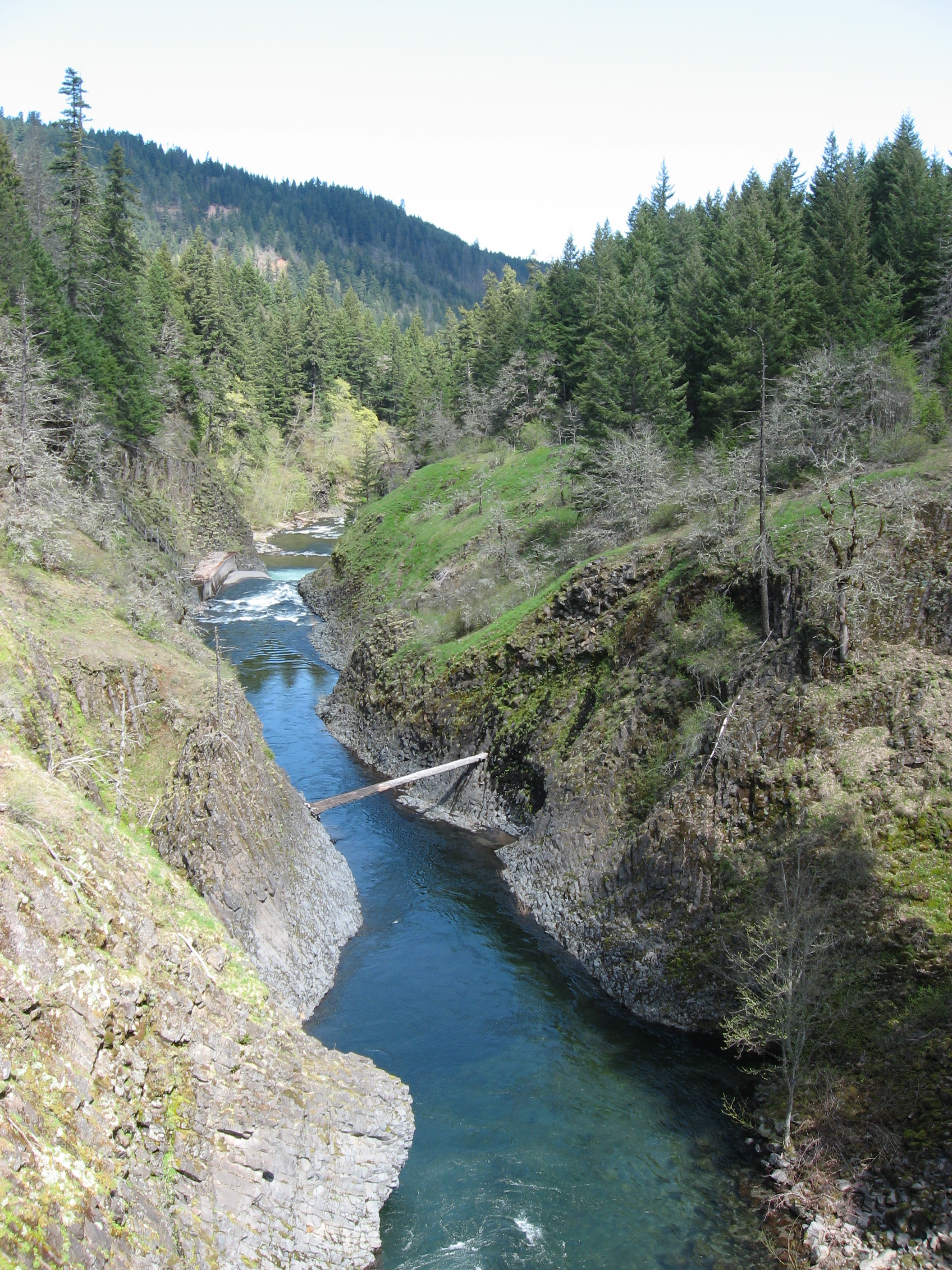
Like many North American geobloggers, I’ve recently returned from the Geological Society of America meeting in Portland, Oregon. It was a bittersweet trip for me, as it was a return to my spiritual homeland, where I spent five happy years working on the rocks and waters of the Cascade Range. Since then, I’ve felt a bit exiled on the Eastern Seaboard, so it was perhaps apropos that the trip back was a bit of a tease…in my four days in Oregon, I did not manage to see a single mountain. The picture to the right is the Hood River, draining the north side of Mt. Hood, about 45 minutes east of Portland. It was taken in April 2007, during field work for my post-doc.
Sunday
After an unexpectedly long layover in Phoenix and an entirely unexpected layover in San Francisco (thank you, US Airways), I arrived in Portland at 1 am local time Sunday morning. With any potential time-change/jet-lag problems thus mitigated, I arrived bright eyed for the first talks on Sunday morning.
The main order of business on Sunday morning was the Pardee Keynote Symposium on “The Evolution of Basaltic Landscapes: Time and River and the Lava Flowing.” I arrived in time to hear a fascinating talk on “Impacts of basaltic volcanism on incised fluvial systems: does the river give a dam?” by blogger/tweep/mapper extraordinaire Kyle House. He was talking about the lava dams, debris flows, and river incision of the Owyhee River of eastern Oregon. After a few gorgeous photos accompanied magnificent Lidar images, I was thoroughly convinced of the utility of Lidar for high-resolution geological mapping. I was also salivating at the thought of a whole day of water + lava talks full of gorgeous volcano photos.
After Steve Ingebritsen gave a lovely overview of the hydrogeology of basalts, Dennis Geist convinced me that I absolutely have to go to the Galapagos Islands, by showing pictures of volcanoes with whales for scale. His talk focused on the connections between geology and biology in the Galapagos, and got me thinking about the implications of volcanic emergence and subsidence for the evolution of the creatures of the famous archipelago. While Geist tried to convince his audience that the vegetation of the Galapagos is supported with basically no soil, neither I nor the next speaker, Oliver Chadwick, quite believed him on that point.
Indeed Chadwick talked about the patterns and processes of soil development on basaltic landscapes, where weathering rates depend not only on the usual climatic factors but also on the flow texture – with aa and pahoehoe flows exhibitting different patterns and timescales of soil development. For my own work, one key point that Chadwick made was “At some point in the history of lava flows, the surface becomes less permeable than the whole…” I think that statement has implications for the way we think about drainage development in basaltic landscapes, but I’ll wait to say more about that until my publication and/or funding record bear me out.
I spent my afternoon thinking more about basalt hydrology, in a session on “Hydrologic Characterization and Simulation of Neogene Volcanic Terranes.” I’ve got lots of notes from that session that are probably of interest only to me, but I will say that it was exciting to hear one of the grad student speakers say to me “I’ve been reading your dissertation” and to hear my work cited more than once. It is such a relief to know that people working in the field actually find my work interesting or useful. Towards the end of the session, I gave a talk on the geomorphic and hydrologic co-evolution of the central Oregon Cascades Range. My talk was based on a paper that has undergone several major revisions since my Ph.D. days, and it was a pleasure to share the latest and greatest incarnation of my thinking on the subject. The pleasure was immeasurably increased by a recent letter from the journal editor giving me only very minor revisions to do before acceptance.
On Sunday evening, the attendees of the morning talks reconvened for a wine tasting with a geological theme – the terroir of taste of Oregon wines grown on basalt versus sandstone. The wine was donated by Willamette Valley Vineyards (basalt) and King Estate (sandstone), and we got to hear from the wine makers as we sipped their wares. According to them, if you see a 2008 Willamette Valley appellation Pinot Noir or Pinot Gris, snap it up. They reckon it will be the best year ever for Oregon wines. That’s saying quite a bit, since Oregon is consistently recognized as one of the world’s best Pinot producing regions.
After a day of stimulating talks and invigorating conversation, I was ready to dive into two days focused on groundwater-surface water interactions and a day of snow, mega-floods, and debris flows to round out my conference. But my notes on those days will have to wait for now, as those paper revisions are not taking care of themselves.
-
Archives
- September 2025
- July 2024
- March 2024
- January 2024
- October 2023
- August 2023
- July 2023
- May 2023
- March 2023
- February 2023
- December 2022
- November 2022
- September 2022
- July 2022
- May 2022
- November 2021
- October 2021
- September 2021
- August 2021
- August 2020
- July 2020
- May 2020
- April 2020
- March 2020
- January 2020
- December 2019
- August 2019
- March 2019
- February 2019
- January 2019
- June 2018
- May 2018
- February 2018
- January 2018
- December 2017
- October 2017
- September 2017
- August 2017
- March 2017
- February 2017
- January 2017
- December 2016
- October 2016
- September 2016
- August 2016
- May 2016
- March 2016
- December 2015
- November 2015
- September 2015
- August 2015
- May 2015
- March 2015
- February 2015
- January 2015
- December 2014
- November 2014
- October 2014
- September 2014
- August 2014
- July 2014
- June 2014
- May 2014
- March 2014
- February 2014
- January 2014
- December 2013
- November 2013
- October 2013
- September 2013
- August 2013
- July 2013
- June 2013
- May 2013
- April 2013
- March 2013
- February 2013
- January 2013
- December 2012
- November 2012
- October 2012
- September 2012
- August 2012
- July 2012
- June 2012
- May 2012
- March 2012
- February 2012
- January 2012
- December 2011
- November 2011
- October 2011
- September 2011
- August 2011
- July 2011
- June 2011
- May 2011
- April 2011
- March 2011
- February 2011
- January 2011
- December 2010
- November 2010
- October 2010
- September 2010
- August 2010
- July 2010
- June 2010
- May 2010
- April 2010
- March 2010
- February 2010
- January 2010
- December 2009
- November 2009
- October 2009
- September 2009
- August 2009
- July 2009
- June 2009
- May 2009
- April 2009
- March 2009
- February 2009
- January 2009
- December 2008
- November 2008
- October 2008
- September 2008
- August 2008
- July 2008
- June 2008
- May 2008
- April 2008
- March 2008
- February 2008
- January 2008
- December 2007
- November 2007
- October 2007
- September 2007
- August 2007
- July 2007
- June 2007
- May 2007
- April 2007
- March 2007
-
Meta
Comments (5)